

The act requires an institution of higher education (institution) that operates a student health center to provide abortion medication to all students enrolled at the institution. The act requires an institution that has an on-site prescription drug outlet or other outlet to maintain a stock of and provide access to abortion medication to students enrolled at the institution. The act requires an institution that does not have an on-site prescription drug outlet or other outlet to either submit a prescription for abortion medication to an off-campus prescription drug outlet or other outlet or dispense abortion medication through the institution's student health center if permitted by the student health center's licensure. The act prohibits an institution from knowingly providing personally identifiable information contained in a student's patient records, billing records, or precise location data related to accessing abortion medication in response to a request from another state seeking to impose liability for accessing abortion medication. An institution is not required to provide access to or stock abortion medication if doing so would jeopardize an institution's federal grant participation, require the institution to deviate from generally accepted billing practices, modify the generally accepted standards of medical practice, or conflict with the institution's sincerely held religious beliefs or practices.(Note: This summary applies to this bill as enacted.)
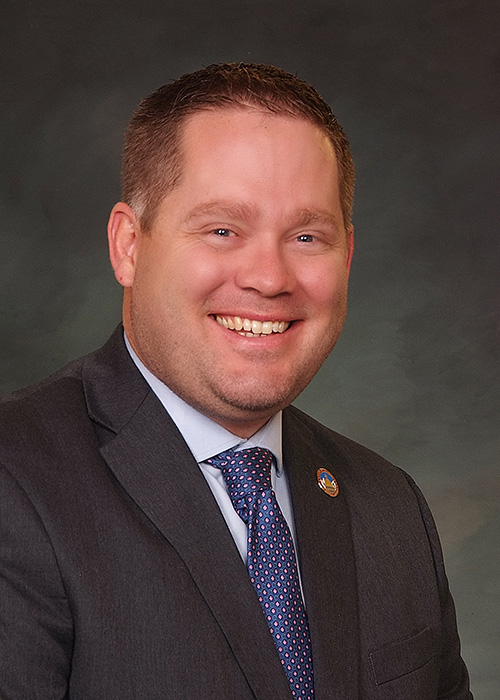
Sen. Kyle Mullica
Sponsored bills
Beginning on January 1, 2027, the act authorizes an optional collision prevention fee (fee), which is collected at the time of registration of a passenger motor vehicle, light-weight truck, motorcycle, or recreational vehicle (motor vehicle). An individual may decline to pay the fee when registering a motor vehicle, and nonpayment of the fee does not affect the individual's ability to register the motor vehicle. In connection with imposing the fee, the statewide bridge and tunnel enterprise (enterprise) within the department of transportation (department) is required to collaborate with:The department of revenue and county clerks to develop language to notify individuals about the fee, including explicit language regarding the ability to decline to pay the fee and the fact that nonpayment of the fee will not affect an individual's ability to register a motor vehicle; andThe department of revenue, the department, county clerks, the division of parks and wildlife, and other impacted stakeholders to conduct a public outreach campaign to educate the public about the fee and what benefits the fee will provide. The enterprise is required to initiate the public outreach campaign as soon as practicable and must develop and deliver customer-facing educational materials to county clerks on or before December 1, 2026.The fee amount is set at $5 and, beginning in state fiscal year 2028-29, the enterprise is allowed to adjust this fee amount upward for inflation. 75% of the revenue from the fee is credited to the newly created collision prevention fund (fund), which is continuously appropriated to the enterprise for use in the following ways:To fund wildlife safe passage projects, defined as one or more projects that reduce wildlife-vehicle collisions and improve habitat connectivity by providing wildlife road crossings;To provide matching money as required by federal grant programs relating to wildlife safe passage projects; To expend for administrative and personnel expenses related to those purposes; andTo promote the fee and fund to maximize participation in the optional fee, in collaboration with the department of revenue, impacted stakeholders, and interested organizations.In determining which wildlife safe passage projects the enterprise will undertake, the enterprise is required to:Consult with the division of parks and wildlife (division) and the Colorado wildlife and transportation alliance;Consult with the tribal government if the project is on or adjacent to tribal land;Consult with relevant local governments with jurisdiction over the area of the proposed project and any relevant local organizations engaging in work to reduce vehicle collisions;Consider studies concerning the prioritization of wildlife within the state;Consider whether the wildlife safe passage project is related to a bridge or tunnel project undertaken by the enterprise; andIn consultation with the division, consider opportunities for landowner agreements or additional conservation efforts that may be necessary to ensure the continued functionality of infrastructure associated with a proposed wildlife safe passage project. 25% of the revenue from the fee is credited to the wildlife cash fund and continuously appropriated to the division to provide services related to wildlife connectivity and wildlife crossing-related conservation efforts. The act also modifies the process for the keep Colorado wild pass fee, which is an existing optional fee paid at the time an individual registers a motor vehicle, to align with the process for the collision prevention fee by removing the presumption that an individual who declines to pay the keep Colorado wild pass fee is presumed to decline to pay that fee in subsequent years with respect to registration of the same motor vehicle. With this change, an individual must affirmatively opt out of the payment of both the keep Colorado wild pass fee and the collision prevention fee each year that the individual registers the motor vehicle. For the 2026-27 state fiscal year:$53,516 is appropriated from the DRIVES cash fund to the department of revenue for use by the division of motor vehicles; Of funds appropriated from the parks and outdoor recreation cash fund to the department of natural resources for use by the division, $778 is reappropriated to the department of revenue for use by the division of motor vehicles; and$19,940 is appropriated from the legal services cash fund, from revenue received from the department from the collision prevention fund, to the department of law to provide legal services for the department.(Note: This summary applies to this bill as enacted.)
The act directs the division of brand inspection (division) in the department of agriculture and the state board of stock inspection commissioners in the department of agriculture to receive reports of lost or stolen livestock. On or before December 31, 2026, the division shall implement procedures that:Facilitate efficient coordination with law enforcement, including procedures to ensure that reports of stolen livestock are provided to relevant law enforcement within 24 hours after the division receives a report of stolen livestock; andEnsure that the public is notified of lost or stolen livestock. The procedures implemented by the division may vary by geographic region depending on the needs of the region.(Note: This summary applies to this bill as enacted.)
Current law requires a local government or a tribal government desiring to receive funding from the statewide affordable housing fund to have filed with the division of housing of the department of local affairs (division) a commitment specifying how, within a 3-year cycle, affordable housing units within the local or tribal government's territorial boundaries will be increased by 3% each year over the baseline number of affordable housing units (baseline number). The baseline number resets every 3 years for the next cycle. To be eligible for funding from the statewide affordable housing fund, a local or tribal government is required to file a commitment with the division and achieve the 3% increase over the baseline number each year during the 3-year cycle. The act changes the requirements for the 3-year cycle beginning on January 1, 2027, and each 3-year cycle thereafter. A local government desiring to receive funding from the statewide affordable housing fund is no longer required to increase affordable housing units by 3% above the baseline each year, but is instead required to meet the target increase number of affordable housing units (target increase number). The target increase number equals the average annual number of permits for new housing units or functional equivalents of permits for new housing units that have been issued over the past 3 years within the jurisdiction of the local government, multiplied by the number of years of the upcoming 3-year cycle to which the local government is committing, multiplied by:0.10 if the average annual job growth rate in the county in which the local government is located is significantly lower than the statewide median annual job growth rate over the past 3 years, as determined by the division;0.15 if the average annual job growth rate in the county in which the local government is located is close to the statewide median annual job growth rate over the past 3 years, as determined by the division; or0.20 if the average annual job growth rate in the county in which the local government is located is significantly higher than the statewide median annual job growth rate over the past 3 years, as determined by the division. The act requires the division to establish specific numerical ranges for the job growth rate thresholds. The act permits a local government that desires to be eligible for funding from the statewide affordable housing fund but is unable to achieve the 3% annual increase in affordable housing units for the 3-year cycle beginning on January 1, 2024, to file a good faith effort waiver with the division. To be eligible, the local government must have achieved at least 65% of the targeted annual increase. The division may, in its discretion, grant a good faith effort waiver to a local government that filed for a waiver on or after June 15, 2026, but before November 1, 2026, and complied with other requirements of the act. The act permits a government that desires to be eligible for funding from the statewide affordable housing fund but is unable to meet the target increase number in affordable housing units for the 3-year cycle beginning on January 1, 2027, to file an adjustment waiver with the division. The adjustment waiver must be supported by verifiable data and propose a revised annual increase of at least one unit per year. The division may, in its discretion, grant an adjustment waiver to a government that filed for a waiver and complied with other requirements of the act. To determine whether a local government has achieved the target increase number for the 3-year cycle beginning on January 1, 2027, and for each 3-year cycle thereafter, an affordable housing unit that satisfies the following criteria counts for one affordable housing unit plus the following corresponding additional unit amount:Unless local governments have a written agreement otherwise, a unit developed with money from multiple local governments may be counted by each local government as a percentage of one unit proportional to the percentage of funding it provided;A unit that is developed on land donated by the local government qualifies for an additional 0.10 of a unit. The 0.10 of a unit qualifies for the local government that donated the land.An affordable housing unit that is developed with money provided by multiple local governments qualifies for an additional 0.10 of a unit for each local government that provided money;A unit that is developed to be for-sale housing and that meets certain affordability requirements qualifies for an additional 0.20 of a unit; andA unit that is restricted to be rented or sold to a household with an annual income of at or below 40% of the area median income, including a supportive housing unit, qualifies for an additional 0.20 of a unit. If affordable housing is developed and qualifies for a property tax exemption, thereby reducing property tax revenue to the county in which the affordable housing is located, and the county did not provide any money to develop the affordable housing, the division may, in its discretion, allow each such affordable housing unit to count as up to 1.15 affordable housing units for the county at the time of vertical construction. Beginning in 2027, to be eligible for direct funding, or for affordable housing projects within a tribal government's territorial boundaries to be eligible for funding, tribal governments are required to implement a system to expedite the development approval process for affordable housing projects and required to submit evidence of such satisfaction to the division.(Note: This summary applies to this bill as enacted.)
The act requires a person seeking certification or recertification from the peace officers standards and training board to undergo training on various missing person alerts active within the state. The department of public safety is required to create a missing person alert training program for persons seeking certification or recertification of their peace officer status. The act requires an institution of higher education (institution) to either conduct a preliminary wellness assessment for no longer than 6 hours or immediately contact a law enforcement agency if a student is reported missing. If the student is not found within the 6-hour period, or if there is evidence of a credible risk to the student's safety, the institution shall notify the institution's police department or the nearest law enforcement agency with jurisdiction over the student's current local address on file with the institution or the student's permanent address on file with the institution if the institution does not have its own police department. An institution is required to adopt and publish a preliminary wellness assessment policy. The preliminary wellness assessment must consist of at least the following steps: A digital contact attempt, a residential verification, and an academic and social inquiry. An institution that conducts a preliminary wellness assessment is immune from civil liability if the institution acted in good faith. An institution is required to maintain contemporaneous written documentation regarding the steps the institution took to complete the preliminary wellness assessment. The records are subject to certain disclosure requirements.(Note: This summary applies to this bill as enacted.)
Maddy summaryThis bill formally declares that the Colorado General Assembly's Second Regular Session will end on May 13, 2026, when it adjourns sine die. The measure directly affects the state legislature by establishing the official conclusion date for the current session of lawmakers. It does not create new laws or change policies, but rather sets the procedural timeline for when the legislative body will stop meeting for this session.
Maddy summarySJR 23 is a recognition bill that formally commends Young Americans Bank and the Young Americans Center for Financial Education for their long-term work in teaching financial literacy to students in Colorado. The measure highlights how these organizations provide real-world banking experiences and educational programs that support the state's new high school financial literacy requirements. This legislative action does not change any laws or allocate funding; instead, it simply acknowledges the contributions of these specific institutions to youth economic education.
Maddy summaryThis bill designates May 2026 as "Motorcycle Safety Awareness Month" in Colorado to promote rider safety and encourage shared road awareness. The resolution aims to highlight the importance of motorcycle rider training and education while reminding all drivers to be alert around motorcycles. It does not create new laws or change existing regulations but serves as a formal recognition to raise public awareness about motorcycle safety.
Maddy summaryThis bill memorializes former Senator MaryAnne Tebedo, honoring her life and contributions to Colorado public service. The legislation formally recognizes her decades of work in politics, including her roles as a campaign staffer, state representative, and state senator, as well as her efforts in passing funeral contract laws and her work as a mediator. It expresses the General Assembly's gratitude for her public service and extends sympathy to her surviving family members. Copies of the memorial will be sent to her children as a gesture of respect.
The act requires the secretary of state to refer a ballot issue at the November 2026 general election to seek voter approval for the state, beginning in the 2026-27 state fiscal year, to retain and spend an amount of state revenue equal to the amount of state public K-12 education funding in excess of the limitation on state fiscal year spending and to increase state public K-12 education funding by up to 2% per year for 10 years. The act directs legislative council staff to determine the amount of state public K-12 education funding and describes how legislative council staff will make that determination. The act creates a positive factor to increase state public K-12 education funding. The amount of the positive factor compounds annually for 10 years. The positive factor for the 2026-27 budget year is 2% of the program foundation calculated for the 2025-26 budget year. For the 2027-28 through 2034-35 budget years, it is the sum of 2% of the prior year's program foundation plus the prior year's positive factor. For the 2035-36 budget year and beyond, it is the sum of 2% of the 2034-35 program foundation plus the 2034-35 positive factor. A district's share of the positive factor is calculated proportionally based on the district's total program under the new school finance formula relative to the statewide total program. A district may only use its positive factor funding for increasing teacher pay, improving teacher retention, lowering class sizes, and increasing access to career and technical courses. For the 2026-27 state fiscal year, the children's account consists of an amount of money equal to the amount of state revenues that the state retains for a given fiscal year pursuant to voter approval of the act. For state fiscal years commencing on or after July 1, 2027, the account consists of that same amount minus an amount equal to the total dollar amount of warrants issued by the state treasurer to reimburse local governments for property tax exemptions. Money in the account must first be spent to pay districts their positive factor, then any remaining funds are appropriated for disability services and school services and to increase annual contact hours, and finally to programs prioritizing child care and full-day preschool. The act directs the state auditor to conduct and publish a report on excess state revenues for each state fiscal year that the state retains and spends state revenues in excess of the limitation on state fiscal year spending. That report must include descriptions of:The amount of state revenues that the state retained and spent that would otherwise have been in excess of the limitation on state fiscal year spending; andHow the state expended the state revenues that the state retained and spent that would otherwise have been in excess of the limitation on state fiscal year spending. Beginning August 1, 2027, the act requires each local education provider to post, online for free public access in a format that can be downloaded and sorted, its actual expenditures of any positive factor received. Lastly, the act updates provisions regarding the expanded earned income tax credit, the family affordability tax credit, and the affordable housing financing fund to ensure that voter approval of the act does not adversely impact those programs.(Note: This summary applies to this bill as enacted.)