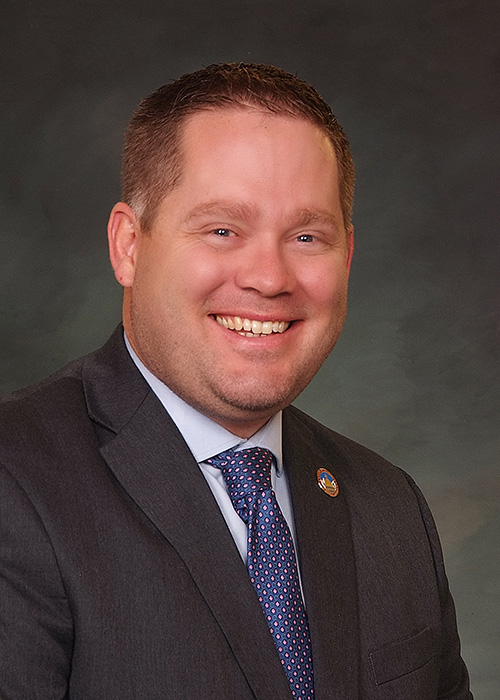
Photo of Kyle Mullica
D Colorado Senate · District 24 On the 2026 ballot

Sen. Kyle Mullica

Compare
Total votes
4,821
all sessions
Attendance
93%
316 missed
Near the chamber average
With party
96%
of cast votes
Lower than 89% of chamber peers
Bipartisan score
2%
crosses aisle rarely
Higher than 80% of chamber peers
Sponsored
475
bills & resolutions
Near the chamber average
Committees
7
assignments
475 bills and resolutions

Sponsored bills

Total
475
Primary
199
Co-sponsor
276
This page
475
matching current filters
Co-sponsor SJM 2
Passed · Colorado Senate · Co-sponsor
Memorialize Former Senator Lewis H. Entz

Maddy summarySJM 2 is a memorial resolution honoring former Colorado State Senator Lewis H. Entz, who died in December 2025 at age 94. The bill formally recognizes his decades of service in the Colorado legislature (1969-2005), including eight terms in the House and five in the Senate, with focus on agriculture, water policy, and veterans' affairs. It expresses the legislature’s tribute to his public service and extends condolences to his family. As a procedural resolution, it does not enact policy changes or affect any legislation. The resolution was introduced in the Senate on February 25, 2026.

Passed May 20, 2026 1 co-sponsor
Co-sponsor SB 143
Signed into law · Colorado Senate · Co-sponsor
Rename Colorado Youth Advisory Council Review Committee

The act renames the Representative Hugh McKean Colorado youth advisory council review committee as the Representative Hugh McKean and Senator Faith Winter Colorado youth advisory council review committee.(Note: This summary applies to this bill as enacted.)

Signed into law May 19, 2026 1 co-sponsor
Co-sponsor SB 137
Signed into law · Colorado Senate · Co-sponsor
Measures to Reduce Administrative Burdens

Current law requires each principal department of the state (department) to establish a schedule to review all of its rules. The act requires the review to occur at least every 5 years. Current law directs each department to make certain determinations when conducting the review of the rules. The act requires the following additional determinations:Whether the department has rules with the same or similar purpose, intent, or goal and, if so, how those are coordinated and whether redundant rules can be eliminated;Whether the rule is outdated or obsolete;Whether funding levels to support the program or function subject to the rule are appropriate; andWhether there are opportunities to improve the effectiveness of the rule in meeting its purpose, intent, or goal.     Current law requires each department to present a report at its 'SMART Act' hearing regarding its mandatory review of all rules. The act permits the committee of reference presiding over the 'SMART Act' hearing to make a recommendation whether a program or function subject to the rules should be subject to a sunset review or may make a recommendation to the legislative audit committee for an audit by the office of the state auditor.     The act clarifies the attorney general's responsibility regarding litigation discovery on behalf of the state of Colorado or on behalf of the people of the state of Colorado.(Note: This summary applies to this bill as enacted.)

Signed into law May 14, 2026 1 co-sponsor
Primary HB 1046
Failed · Colorado House · Lead sponsor
Regulate Earned-Wage Access Services

The bill requires a person to obtain a license to provide earned-wage access services (provider) but allows current providers to continue providing the services without a license until a license is issued or denied. The licensing, administrative, and disciplinary functions of the regulation of providers are performed by the assistant attorney general (administrator) who administers the "Uniform Consumer Credit Code". The administrator is given several powers, including adopting rules, related to this regulation.License application and issuance standards and procedures are established. A provider is issued a license if the administrator finds that the financial responsibility, character, and fitness of the applicant and of the applicant's members, managers, partners, officers, and directors are sufficient to demonstrate that the applicant will operate the business honestly and fairly and in compliance with the bill.The license fee is set by the administrator to cover the cost of regulating providers. Administrative procedures are established. A license is valid for one year, and to renew a license, a licensee must file a renewal form annually. If a licensee fails to pay the prescribed renewal fee on or before May 1 of each year, the licensee must pay a penalty of $5 per day per license until the license is renewed, but if a licensee fails to pay the appropriate renewal and penalty fees by May 15, the licensee's license automatically expires.The administrator may deny an application for a license or take disciplinary action against a licensee for failing to meet the standards set in the bill.To discipline a provider, the administrator may deny an application for licensure, revoke the license, suspend the license, issue a cease-and-desist order, impose a civil penalty of up to $1,000 per violation, bar the person from applying for or holding a license for 5 years after a revocation, issue a letter of admonition, or impose a penalty of $200 per day for records violations. A respondent aggrieved by an action or order of the administrator may obtain judicial review of the action or order in the Colorado court of appeals.A licensee is required to maintain records in conformity with the bill, rules adopted under the bill, and generally accepted accounting principles and practices in a manner that will enable the administrator to determine if the licensee is complying with the bill. A licensee shall give the administrator free access to the records in the licensee's storage location. A licensee need not preserve records pertaining to an earned-wage access services transaction for more than one year. Standards are set for this access.A licensee must file an annual report that includes all relevant information that the bill and the administrator reasonably require concerning the business and operations conducted during the preceding calendar year. Standards are set for the report. The administrator must keep the report confidential and not open it to the public for inspection pursuant to the "Colorado Open Records Act". If a licensee fails to file an annual report by April 15, the administrator may impose a penalty of $5 per day until the report is filed, but if the licensee fails to file the report and pay this penalty by May 1 of the same year, the licensee's license automatically expires.After the administrator has examined a licensee's records, the administrator shall provide a report of the examination to the licensee and may require the licensee to take corrective action. The licensee shall take the corrective action and provide proof that the corrective action was taken. The administrator is prohibited from disclosing the name or identity of a person whose acts or conduct is under investigation or examination or the facts disclosed in the investigation or examination, except for disclosures in actions or enforcement proceedings.A provider has the duty to:Develop and implement policies and procedures to respond to questions raised by consumers and address complaints from consumers;If the provider offers a consumer the option to receive proceeds for a service fee (proceeds), offer to the consumer at least one reasonable option to obtain proceeds at no cost to the consumer and clearly explain how to elect the no-cost option;Make certain disclosures about the earned-wage access services to the consumer;Inform the consumer before implementing material changes to the terms and conditions of the earned-wage access services agreement;Allow the consumer to cancel use of the earned-wage access services at any time without incurring a cancellation fee;Provide proceeds to a consumer by the means mutually agreed upon by the consumer and the provider; andTo be repaid for outstanding proceeds or payment of service fees or other amounts owed in connection with earned-wage access services from a consumer's account at a depository institution, comply with federal law and reimburse the consumer for the full amount of any overdraft or insufficient funds fees imposed on the consumer that were caused by the provider attempting to seek payment on a date before the date or in an amount different from the amount disclosed to the consumer.A provider shall not:Share with an employer a portion of a service fee that was received from or charged to a consumer for earned-wage access services;Require a consumer's credit score provided by a consumer reporting agency to determine the consumer's eligibility for earned-wage access services;Accept payment of outstanding proceeds or service fees from a consumer by means of a credit card or charge card;Charge a consumer a late fee, a deferral fee, interest, or any other penalty or charge for failure to pay outstanding proceeds or service fees;Report to a collection agency or to a debt collector information about a consumer regarding the inability of the provider to be repaid outstanding proceeds or service fees;Impose a service fee in excess of $5 for an advance of proceeds in an amount less than $75 or $7 for an advance of proceeds in an amount more than $75; except that the fee may be increased for inflation;Enter into an agreement with an employer that would require a consumer who is an employee of the employer to use earned-wage access services as a necessary condition of receiving payment of wages;Compel a consumer to pay outstanding proceeds or service fees to the provider through a lawsuit, the use of a third party to pursue collection from the consumer, or the sale of outstanding proceeds to a third-party collector or debt buyer. The collection limitations do not apply to the act of compelling payment of outstanding proceeds paid through fraudulent or other unlawful means or to pursuing an employer for breach of its contractual obligations to the provider.Solicit a tip, gratuity, or donation during the time between when a consumer requests proceeds and when the provider confirms that a transfer of proceeds has been approved and provides a listing of the fees that will be charged.The administrator may bring a civil action to recover a civil penalty of up to $5,000 for willfully violating the bill, and, if the court finds that the defendant has engaged in a course of repeated and willful violations, the court may assess a civil penalty of up to $10,000 per violation. In addition, the administrator may recover reasonable costs of the investigation and action and may request an order for reimbursement of reasonable attorney fees.(Note: This summary applies to this bill as introduced.)


Failed May 14, 2026 0 co-sponsors
Co-sponsor SJR 25
Passed · Colorado Senate · Co-sponsor
Colorado Mining Association's 150th Anniversary

Maddy summaryThis bill is a Senate Joint Resolution that formally recognizes the Colorado Mining Association for its 150th anniversary in 2026. It highlights the organization's historical significance and its role in supporting Colorado's mining industry, which contributes billions to the state's economy and supports tens of thousands of jobs. The resolution acknowledges the association's partnerships with state and federal agencies in promoting safety, environmental stewardship, and responsible mineral development. This measure does not change any laws or policies but serves as an official acknowledgment of the association's contributions to Colorado's history and economy.

Passed May 13, 2026 1 co-sponsor
Co-sponsor SB 48
Passed · Colorado Senate · Co-sponsor
Remove Exception to Marry with Judicial Approval

Current law requires an individual to be at least 18 years old in order to obtain a marriage license; except that a minor who is 16 or 17 years old may obtain a marriage license with judicial approval. The bill repeals this exception, therefore requiring that an individual be at least 18 years old to obtain a marriage license.(Note: This summary applies to the reengrossed version of this bill as introduced in the second house.)

Passed May 13, 2026 1 co-sponsor
Primary SB 183
Passed · Colorado Senate · Lead sponsor
State Funding for Colorado School of Mines Capital Construction Costs

The bill requires the state treasurer, on behalf of the state, to execute, no later than December 31, 2026, financed purchase of an asset or certificate of participation agreements (financing agreements) to finance a portion of the capital costs related to the capital renewal of a facility at the Colorado school of mines. The financing agreements are to be issued in an aggregate principal amount not to exceed $13 million plus reasonable and necessary administrative, monitoring, and closing costs and interest, including capitalized interest. The anticipated annual state-funded payments for the principal and interest components due under the financing agreements must not exceed the difference between $17.5 million and the amount of the annual state-funded payments for the agreements entered into pursuant to House Bill 24-1231, with principal amortization not occurring before July 1, 2027. The proceeds from the financing agreements will be used for the renewal of critical building systems of Guggenheim hall at the Colorado school of mines.(Note: This summary applies to the reengrossed version of this bill as introduced in the second house.)

Passed May 12, 2026 0 co-sponsors
Primary SB 45
Passed · Colorado Senate · Lead sponsor
Nuclear Workforce Development & Education Program

The bill creates the Colorado nuclear workforce development and education council (council) in the Colorado school of mines to help meet growing workforce demand in the nuclear energy sector. The bill establishes a related grant program (grant program) to provide grants to institutions of higher education for the development or expansion of nuclear engineering degree or certificate programs or course offerings. The council shall convene advisory sessions with stakeholders from the nuclear, educational, and workforce development sectors; implement the grant program; and contract with one or more third-party entities for staffing and operational assistance.     The council may seek, accept, and expend gifts, grants, and donations for council-related purposes. The state treasurer shall credit the gifts, grants, and donations to the Colorado nuclear workforce development and education cash fund (cash fund), which is created in the bill. The general assembly shall not appropriate general fund money to implement or maintain council operations or grant awards. The council shall convene and begin awarding grants only after the balance of the cash fund reaches or exceeds $500,000 (threshold) .     The bill imposes requirements to report to the Colorado commission on higher education and the general assembly about the council's funding sources, grant program implementation, and other uses of the grant program money. If the cash fund balance does not reach the threshold on or before September 1, 2027, the council is repealed and the money in the cash fund is refunded to the grantors or donors. Otherwise, the bill repeals the council, effective September 1, 2033, unless the council is extended following a sunset review.(Note: Italicized words indicate new material added to the original summary; dashes through words indicate deletions from the original summary.)(Note: This summary applies to the reengrossed version of this bill as introduced in the second house.)

Passed May 12, 2026 0 co-sponsors
Primary SB 162
Passed · Colorado Senate · Lead sponsor
Sensitive Test Results in Health Care

Beginning July 1, 2027, the bill prohibits the immediate release of a patient's sensitive test results to the patient's electronic health record or through a patient portal. Instead, the bill requires that sensitive test results, once they are finalized, not be released as part of the patient's electronic health record or through a patient portal for 3 business days.     The bill establishes 2 exceptions one exception to this requirement: Sensitive test results may be immediately released as part of the patient's electronic health record or through a patient portal immediately and without delay if the patient's health-care provider authorizes immediate release of the results or if the patient requests to receive the sensitive test results of a particular test without delay the sensitive test results to be released before the end of the three 3-business-day period .     The bill defines 'sensitive test results' as:A pathology or radiology report that is ordered for the purpose of diagnosing or monitoring a patient for cancer; orTest results that may reveal a genetic marker that relates to a cancer condition.     The bill specifies that a custodian of person that administers and controls a patient's electronic health record that contains sensitive test results is responsible for implementing the requirements of the bill. The bill states that compliance with the requirements of the bill is not information blocking under the federal '21st Century Cures Act'. A person that fails to comply with the requirements of the bill is not subject to civil, criminal, or administrative liability or professional disciplinary action.(Note: Italicized words indicate new material added to the original summary; dashes through words indicate deletions from the original summary.)(Note: This summary applies to the reengrossed version of this bill as introduced in the second house.)

Passed May 8, 2026 0 co-sponsors
Co-sponsor SR 9
Passed · Colorado Senate · Co-sponsor
Amyotrophic Lateral Sclerosis Awareness Month

Maddy summaryThis Senate Resolution designates May 2026 as ALS Awareness Month to highlight the impact of amyotrophic lateral sclerosis, a progressive and fatal neurodegenerative disease. The measure calls on Coloradans to support research, advocate for funding, and show solidarity with patients and their families who face challenges such as muscle weakness and limited life expectancy. While the resolution does not change laws or allocate funds, it formally recognizes the importance of multidisciplinary care and clinical trials in managing the disease. Copies of the resolution are sent to medical leaders, advocacy groups, and a caregiver to emphasize community support for those affected by ALS.

Passed May 7, 2026 1 co-sponsor
Showing 71 to 80 of 475 bills
Previous 1 7 8 9 48 Next