

The act creates the geologic storage stewardship enterprise (enterprise) in the department of natural resources (department) for the purpose of: Determining the amount of annual stewardship fees; Funding the long-term stewardship of geologic storage facilities in the state; Funding the plugging, abandoning, reclaiming, and, as necessary, remediating of orphaned geologic storage facilities in the state if the energy and carbon management commission (commission), after notice and a hearing, determines that available financial assurance is insufficient; and Ensuring that costs associated with long-term stewardship of geologic storage facilities are borne by geologic storage operators in the form of stewardship fees. The act creates the geologic storage stewardship enterprise board (enterprise board) to administer the enterprise. The act requires each geologic storage operator to pay an annual stewardship fee for each ton of injection carbon dioxide that the geologic storage operator injects in the state. The commission collects the stewardship fee on the enterprise's behalf. All money collected as stewardship fees is credited to the geologic storage stewardship enterprise cash fund (fund), which is created in the act. Money in the fund is continuously appropriated to the enterprise. The enterprise shall adopt rules as necessary to implement the act and the commission may adopt rules to implement its collection of stewardship fees on behalf of the enterprise. The willful violation of a commission rule, regulation, permit, or order concerning class VI injection wells used for injecting carbon dioxide for underground storage is a misdemeanor subject to a fine of $5,000 to $7,000 per day for each act of violation. To approve a geologic storage operator's request to close a site, the commission must first determine that the geologic storage operator has contributed money to the fund. Upon the commission's approval of a site closure: Ownership of the injection carbon dioxide and ownership of any remaining facilities transfer to the state without payment of additional compensation; Except in specified circumstances, the geologic storage operator is released from all regulatory liability associated with the continued storage of the injection carbon dioxide and the long-term stewardship of the associated geologic storage facility; and The enterprise undertakes long-term stewardship of the injection carbon dioxide and any associated geologic storage facility. The act makes several updates to laws concerning the administration of underground geothermal resources, including: Clarifying that "nontributary groundwater" does not include "designated groundwater", as these terms are defined in current law; Exempting certain geothermal operations from needing a well permit from the state engineer; Requiring the state engineer to notify the operator of a prior geothermal operation of an application for a proposed well, and allowing the operator the opportunity to request a hearing if the application causes concern for material injury to the prior geothermal operation; Renaming the state board of examiners of water well construction and pump installation contractors as the "state board of examiners of water well and ground heat exchanger contractors" (state board of examiners); Establishing that the authority to regulate shallow geothermal operations is shared by the state engineer and the state board of examiners; and Regulating ground heat exchanger contractors in the same manner that currently exists for water well construction contractors and pump installation contractors.(Note: This summary applies to this bill as enacted.)
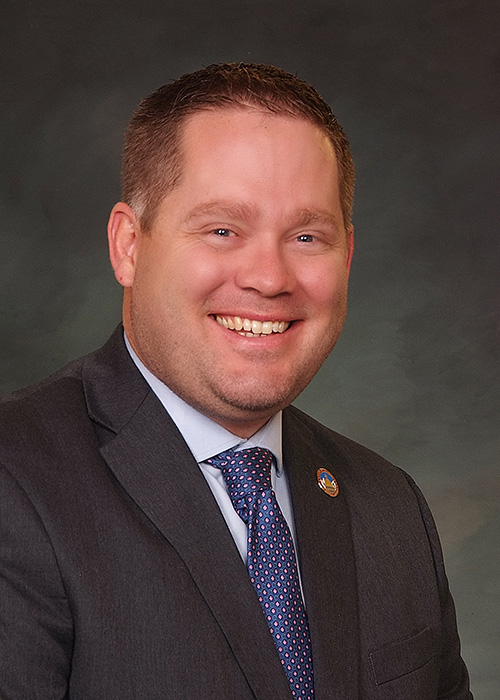
Sen. Kyle Mullica
Sponsored bills
The Tony Grampsas youth services grant program (grant program) provides grants to community-based programs to reduce incidents of youth crime and violence. The youth mentoring program, the student dropout prevention and intervention program, and the student before-and-after school project (collectively, the "programs") were created within the grant program. The act repeals the individual programs and instead lists the programs as allowable uses for grant money under the grant program. The act transfers certain responsibilities from the Tony Grampsas youth services board (board) to the department of human services (department). The act repeals local public-to-private funding match requirements. The act requires each entity that receives a grant to annually report certain information to the department; except that an entity that has an operating budget of less than $1.5 million, or that receives a grant in the amount of not more than $25,000, is not required to report on the outcomes achieved by the services provided and the methods used to track the outcomes. The act decreases the appropriation from the marijuana tax cash fund to the youth mentoring services cash fund by $500,000 and reappropriates the money to the grant program by $500,000. The act decreases the appropriation from the youth mentoring services cash fund to the grant program by $504,120. (Note: This summary applies to this bill as enacted.)
The act implements the recommendation of the department of regulatory agencies in its 2024 sunset review and report on the rural alcohol and substance abuse prevention and treatment program by continuing the program until September 1, 2030. (Note: This summary applies to this bill as enacted.)
The act permits the state, a county, a city and county, a school district, or a municipality to, with approval from a school district's board of education, install and utilize automated vehicle identification systems (system) on the school district's school buses to detect a driver of a vehicle that overtakes a stopped school bus with actuated visual signal lights in violation of current law. A school district that installs and utilizes a system for this purpose must enter into a memorandum of understanding with one or more law enforcement agencies. If a system detects a violation, the state, a county, a city and county, or a municipality may impose a civil penalty of up to $300. The act creates a rebuttable presumption that when an image produced by a system includes an electronic indicator signifying that a school bus's visual signal lights are actuated, the visual signal lights are presumed to be actuated and operational and the school bus is presumed to be stopped to receive or discharge school children. The act mandates that the fines collected through the use of the system must not be used as the basis for the compensation to the system manufacturer or vendor and that the compensation must not be based exclusively upon the number of citations issued or revenue generated by the system.(Note: This summary applies to this bill as enacted.)
For design-build transportation contracts administered by the department of transportation (department) "best value" means the overall maximum value of a proposal to the department after considering all of the evaluation factors described in the specifications for the transportation project or the request for proposals. The act requires that those evaluation factors include: Project schedule; Innovative solutions; Improved quality; Sustainability; Environmental impact; Initial cost; Long-term life-cycle cost of the transportation project; Resilience; Increased scope; and Aesthetics.(Note: This summary applies to this bill as enacted.)
The act creates a postsecondary and workforce readiness funding model that includes 3 types of funding: Start-up funding, innovation grant funding, and sustain funding. The state board of education (state board) is authorized to adopt rules concerning these funding sources. For the 2025-26 budget year through the 2027-28 budget year, the department of education (department) shall use a formula to determine each local education provider's start-up funding, which is used for eligible expenses that are associated with developing and implementing a postsecondary and workforce readiness program. Start-up funding gradually phases out and repeals after the 2027-28 budget year. Beginning in the 2028-29 budget year, innovation grant funding through the John W. Buckner postsecondary and workforce readiness innovation grant program, created in the department, is available to certain local education providers for eligible expenses that are associated with developing and implementing a postsecondary and workforce readiness program that aligns with the state's workforce demands or priorities. Local education providers that are required to adopt a priority improvement plan or a turnaround plan, or that authorize schools that are required to adopt a priority improvement plan or turnaround plan, for the current or prior budget year, or local education providers that demonstrate, or authorize a school that demonstrates, a low level of attainment on the postsecondary workforce readiness indicator for the prior school year are eligible for innovation grant funding. Beginning in the 2026-27 budget year, sustain funding is used to reimburse local education providers' expenses for students who, in the preceding budget year, successfully satisfied postsecondary credit, industry-recognized credential, or work-based learning requirements. For the 2026-27 budget year, of total sustain funding, a certain percentage is available for reimbursing postsecondary credit attainment, reimbursing industry-recognized credentials, and reimbursing work-based learning. For the 2027-28 budget year, and budget years thereafter, the state board may adjust the percentages for these categories. Beginning in January 2028, the department is required to annually report, as a part of its "SMART Act" presentation, findings regarding the effectiveness of consolidating the postsecondary and workforce readiness programs and funding streams. By November 1, 2029, the department is required to report to the joint budget committee findings regarding the effectiveness of consolidating the postsecondary and workforce readiness programs and funding streams. The act repeals the accelerating students through concurrent enrollment program and career development success program after the 2025-26 budget year. Upon passage, the act repeals the: Concurrent enrollment expansion and innovation grant program; and John W. Buckner automatic enrollment in advanced courses grant program. The act requires the department to convene a working group that includes educators to report its findings and recommendations to the joint budget committee concerning the effectiveness of the teacher retention and preparation program (TREP) and the pathways in technology (p-tech) early college high schools. For the 2025-26 state fiscal year, the act: Adjusts appropriations made in the 2025-26 long bill; Appropriates $5,018,715 from the general fund and state education fund to the department for use by student pathways to implement the act; and Appropriates $160,073 from the general fund to the department for use by school quality and support to implement the act.(Note: This summary applies to this bill as enacted.)
The act authorizes the director (director) of the division of professions and occupations in the department of regulatory agencies (division) to license dietitians and nutritionists if they meet the requirements specified by the act and the rules adopted by the director pursuant to the act. On and after September 1, 2026, an individual is prohibited from engaging in or offering to provide medical nutrition therapy unless the individual is licensed by the director. The act creates the dietetics and nutrition advisory committee in the division, which is responsible for advising the director in the regulation of medical nutrition therapy and the implementation of the act. An individual who desires to practice as a dietitian must file with the director: An application for a license; Proof of completion of educational requirements and supervised practice experience; and Proof of compliance with examination requirements or proof of holding a valid, current registration with the Commission on Dietetic Registration. An individual who desires to practice as a nutritionist must file with the director: An application for a license; Proof of completion of educational requirements and supervised practice experience; and Proof of compliance with examination requirements. Until September 1, 2028, the director may waive the examination requirement and may grant a nutritionist license to an applicant who meets specified criteria. The director may deny or refuse to renew a license, suspend or revoke a license, or impose probationary conditions on a license. The director may also issue warnings to or seek injunctive relief against a licensee or applicant for licensure who has engaged in specified grounds for discipline or unprofessional conduct. The director may issue a provisional license to practice as a dietitian or a nutritionist upon the filing of an application with the appropriate fees, submission of evidence of successful completion of the educational and supervised practice requirements, and submission of evidence that the individual has applied to take the required licensing examination. The act exempts specified individuals from the licensing requirements established by the act. An individual who practices or offers or attempts to practice as a dietitian or nutritionist without being licensed pursuant to the act and who is not exempted from licensure commits a class 2 misdemeanor. The director shall adopt rules as necessary to implement the act. The act is scheduled for repeal on September 1, 2035. Before the repeal, the functions of the director in regulating dietitians and nutritionists are scheduled for review in accordance with the sunset law. For the 2025-26 state fiscal year, the act appropriates $100,584 from the division of professions and occupations cash fund to the department of regulatory agencies to implement the act. VETOED by Governor 5/23/2025(Note: This summary applies to this bill as enacted.)
Under current law, there are 2 total program formulas to finance public schools. Absent the satisfaction of a statutorily specified condition, the first formula is scheduled to stop determining total program after the 2024-25 budget year (expiring formula), and the second formula is scheduled to determine total program beginning in the 2030-31 budget year (new formula). For the 2025-26 budget year through the 2029-30 budget year (transition period), total program is scheduled to be determined by using figures that were calculated under both the expiring formula and the new formula. The act: Extends the transition period by one year, so that it is from the 2025-26 budget year through the 2030-31 budget year; and Postpones the exclusive use of the new formula to determine total program until the 2031-32 budget year. The act changes how each school district's and institute charter school's annual total program is determined during the transition period. For the 2025-26 and 2026-27 budget years, each school district's and institute charter school's annual total program is the greater of the school district's or institute charter school's total program for the 2024-25 budget year or the amount calculated under the expiring formula plus an amount equal to 15% in 2025-26 and 30% in 2026-27 of the difference between the amounts calculated under the new formula and the expiring formula. For the 2027-28 budget year through the 2030-31 budget year, each school district's and institute charter school's annual total program is the greater of the district's or institute charter school's calculation under the expiring formula plus 1% of that calculation, or: For the 2027-28 budget year, the amount calculated under the expiring formula plus an amount equal to 45% of the difference between the amounts calculated under the new formula and the expiring formula; For the 2028-29 budget year, the amount calculated under the expiring formula plus an amount equal to 60% of the difference between the amounts calculated under the new formula and the expiring formula; For the 2029-30 budget year, the amount calculated under the expiring formula plus an amount equal to 75% of the difference between the amounts calculated under the new formula and the expiring formula; and For the 2030-31 budget year, the amount calculated under the expiring formula plus an amount equal to 90% of the difference between the amounts calculated under the new formula and the expiring formula. Under current law, there are specified conditions that apply to the transition period. If the joint budget committee determines that a specified condition occurs in a budget year during the transition period, then for the next budget year and each budget year thereafter, the transition is suspended, and each school district's total program is determined pursuant to the calculation and determination required for the budget year when the condition occurred. For one of the existing conditions, the act specifies that an income tax deposit to the state education fund that was made to correct an error does not count toward determining whether the condition has been satisfied. A school district's funded pupil count is a figure that is used as a part of determining a school district's total program. Under the expiring formula, a school district's funded pupil count is calculated by determining the greater of the school district's pupil enrollment for the applicable budget year or the average of the school district's pupil enrollment for the applicable budget year and the immediately preceding 4 budget years. Under current law, the new formula calculates a school district's funded pupil count by determining the greater of the school district's pupil enrollment for the applicable budget year or the average of the school district's pupil enrollment for the applicable budget year and the immediately preceding 3 budget years. The act changes the new formula so that: For the 2025-26 budget year, a school district's funded pupil count is calculated by determining the greater of the school district's pupil enrollment for the applicable budget year or the average of the school district's pupil enrollment for the applicable budget year and the immediately preceding 3 budget years; and For the 2026-27 budget year and each budget year thereafter, a school district's funded pupil count is calculated by determining the greater of the school district's pupil enrollment for the applicable budget year or the average of the district's pupil enrollment for the applicable budget year and the immediately preceding 2 budget years. However: If a statutorily specified condition is satisfied, and consequently for the 2026-27 budget year, a district's total program is not determined as scheduled under the transition period, then for the 2026-27 budget year, and each budget year thereafter, funded pupil count will continue to be determined by the greater of the school district's pupil enrollment for the applicable budget year or the average of the school district's pupil enrollment for the applicable budget year and the immediately preceding 3 budget years; and If, for the 2027-28 budget year, the state education fund balance is projected to be less than $200 million, then the general assembly is required to implement a smoothing factor or the funded pupil count will be determined by the greater of the school district's pupil enrollment for the applicable budget year or the average of the school district's pupil enrollment for the applicable budget year and the immediately preceding budget year for the 2027-28 budget year and each budget year thereafter. The act expiring formula is changed so that, starting in the 2027-28 budget year, the funded pupil count used in the expiring formula is the same funded pupil count that is used in the new formula to determine a district's total program during the transition period. The total program for the 2025-26 budget year is determined using the formula changes in the act. The act: Increases the statewide base per pupil funding for the 2025-26 budget year by $195.42 to account for inflation; Sets a new statewide base per pupil funding amount for the 2025-26 budget year at $8,691.80; and Sets the total program funding for the 2025-26 budget year for all school districts and institute charter schools to at least $10,036,070,748 or $10,031,606,090, depending upon whether Senate Bill 25-315 becomes law. Under current law, a new at-risk measure is required to be implemented in the 2025-26 budget year. The act repeals this requirement and requires the department of education (department) to collect data necessary to identify individual student census block groups to account for students who are at-risk of below-average academic performance and education outcomes because of socioeconomic disadvantages or poverty, but who may not qualify for free or reduced price lunch. Under current law, as a part of the charter contract, a district charter school and the school district, or the institute charter school and state charter school institute (institute), must agree on funding and services provided by the school district or institute to the charter school, subject to parameters. The act: Suspends the use of these provisions after the 2025-26 budget year; Repeals charter school at-risk supplemental aid after the 2026-27 budget year, following its gradual phase out during the 2025-26 and 2026-27 budget years; Creates incremental funding for charter schools for the 2025-26 budget year; and Requires the general assembly to consult with charter school representatives to ensure that charter schools are aligned with the implementation of the new formula. The act raises the limit from $750 million to $1 billion for the amount of money that the general assembly may appropriate to restore any or all qualified charter school debt reserve funds to their qualified charter school debt service fund requirements. Under current law, $41 million of interest and income earned on money in the public school fund is credited to certain purposes, and any remaining interest and income may be credited as specified by the general assembly or remain in the public school fund. The act requires that any remaining interest and income is credited to the public school capital construction assistance fund. The total annual amount of revenue credited to the public school capital construction fund is capped at $150 million, adjusted for inflation; except that money received from public school fund interest and income does not apply toward the cap. Any amount above the cap is credited to the state public school fund instead. The act creates the kids matter account within the state education fund. Beginning July 1, 2026, the state treasurer must deposit in the account all state revenues collected from an existing tax on 0.00065% on federal taxable income, as modified by law, of every individual, estate, trust, and corporation. The money in the account must only be used for district total program funding and total state funding for all categorical programs. Under current law, the department is required to contract with an entity to develop and implement a public information campaign to emphasize the importance of learning to read by third grade and highlight local education providers that are achieving high percentages of third-grade students who demonstrate reading competency. The act repeals the requirement that the department contract with an entity to develop and implement the information campaign. The act authorizes the department to use any unexpended money that was appropriated for the out-of-school time program grant program and is remaining at the end of the 2024-25 or 2025-26 state fiscal years in the 2025-26 or 2026-27 state fiscal years without further appropriation. The act creates and implements certain parameters for multifunction school activity buses. For the 2025-26 state fiscal year, the act: Appropriates $7,009,989 to the department from the state education fund for at-risk supplemental aid; Appropriates $7.6 million to the department from the public school capital construction assistance fund for public school capital construction assistance board cash grants; Appropriates $25 million to the department from the public school capital construction assistance fund for public school capital construction assistance board lease payments; and Adjusts the 2025-26 long bill by decreasing the cash funds appropriation from the state education fund for the state share of district's total program by $15,775,837; decreasing the cash funds appropriation from the state education fund for at-risk per pupil additional funding by $5 million; and decreasing the cash funds appropriation from the public school capital construction assistance fund for public school capital construction assistance board cash grants by $45,648,087.(Note: This summary applies to this bill as enacted.)
The act clarifies when a teacher may conclude that an early elementary school student has a significant reading deficiency requiring remediation through a specialized approach to instruction (READ plan) based on a body of evidence that includes information in addition to the student's scores on a reading assessment. Current law requires certain parental communications in connection with a student's READ plan. The act requires the addition of specific information regarding characteristics of dyslexia, if applicable, to the parental communications. Beginning no later than the 2027-28 school year, a local education provider must either develop its own screening process for identifying early elementary school students with characteristics of dyslexia or implement a universal dyslexia screener that conforms to certain new requirements. A local education provider that implements a screener may include the screener in an interim reading assessment or administer the screener separately from the interim assessment. Either way, the screener must accurately and reliably identify students at risk of reading difficulties. If an interim reading assessment includes a screener, the assessment must meet standards for validity and reliability, encourage data-driven instructional decision making, and promote efficient administration and effective follow-up. (Note: This summary applies to this bill as enacted.)
Under current law, the Colorado commission for the deaf, hard of hearing, and deafblind coordinates and advocates for the provision of, and access to, services and resources for individuals who are deaf, hard of hearing, or deafblind (services and resources). Sections 1 through 11 of the act create the communication services for people with disabilities enterprise (enterprise) and the division for the deaf, hard of hearing, and deafblind (division) within the department of human services to provide these services and resources. Section 8 creates the Colorado division for the deaf, hard of hearing, and deafblind cash fund (cash fund). Telecommunications relay services (TRS) are provided for individuals who are deaf, hard of hearing, or deafblind in the state through a monthly surcharge that voice service providers collect from their telephone customers (monthly surcharge) and through a charge that sellers of prepaid wireless telecommunications services impose at the point of sale (charge). Under current law, the public utilities commission (commission) imposes the monthly surcharge and charge, and the amounts collected are disbursed for the Colorado commission for the deaf, hard of hearing, and deafblind to provide services and resources; for the state librarian to provide reading services for the blind and print-disabled; and for the talking book library. Sections 4 and 15 transfer the authority to impose the monthly surcharge and charge to the enterprise, while maintaining the commission's responsibility for collecting the monthly surcharge from voice service providers. Money disbursed for services and resources is credited to the cash fund for use by the enterprise and the division. For the 2025-26 state fiscal year, the act appropriates $5,550,636 of monthly surcharge and charge amounts collected by voice service providers and prepaid wireless telecommunications services retailers to the departments of human services, education, regulatory agencies, revenue, personnel, and law to implement the act. (Note: This summary applies to this bill as enacted.)