

The act creates the geologic storage stewardship enterprise (enterprise) in the department of natural resources (department) for the purpose of: Determining the amount of annual stewardship fees; Funding the long-term stewardship of geologic storage facilities in the state; Funding the plugging, abandoning, reclaiming, and, as necessary, remediating of orphaned geologic storage facilities in the state if the energy and carbon management commission (commission), after notice and a hearing, determines that available financial assurance is insufficient; and Ensuring that costs associated with long-term stewardship of geologic storage facilities are borne by geologic storage operators in the form of stewardship fees. The act creates the geologic storage stewardship enterprise board (enterprise board) to administer the enterprise. The act requires each geologic storage operator to pay an annual stewardship fee for each ton of injection carbon dioxide that the geologic storage operator injects in the state. The commission collects the stewardship fee on the enterprise's behalf. All money collected as stewardship fees is credited to the geologic storage stewardship enterprise cash fund (fund), which is created in the act. Money in the fund is continuously appropriated to the enterprise. The enterprise shall adopt rules as necessary to implement the act and the commission may adopt rules to implement its collection of stewardship fees on behalf of the enterprise. The willful violation of a commission rule, regulation, permit, or order concerning class VI injection wells used for injecting carbon dioxide for underground storage is a misdemeanor subject to a fine of $5,000 to $7,000 per day for each act of violation. To approve a geologic storage operator's request to close a site, the commission must first determine that the geologic storage operator has contributed money to the fund. Upon the commission's approval of a site closure: Ownership of the injection carbon dioxide and ownership of any remaining facilities transfer to the state without payment of additional compensation; Except in specified circumstances, the geologic storage operator is released from all regulatory liability associated with the continued storage of the injection carbon dioxide and the long-term stewardship of the associated geologic storage facility; and The enterprise undertakes long-term stewardship of the injection carbon dioxide and any associated geologic storage facility. The act makes several updates to laws concerning the administration of underground geothermal resources, including: Clarifying that "nontributary groundwater" does not include "designated groundwater", as these terms are defined in current law; Exempting certain geothermal operations from needing a well permit from the state engineer; Requiring the state engineer to notify the operator of a prior geothermal operation of an application for a proposed well, and allowing the operator the opportunity to request a hearing if the application causes concern for material injury to the prior geothermal operation; Renaming the state board of examiners of water well construction and pump installation contractors as the "state board of examiners of water well and ground heat exchanger contractors" (state board of examiners); Establishing that the authority to regulate shallow geothermal operations is shared by the state engineer and the state board of examiners; and Regulating ground heat exchanger contractors in the same manner that currently exists for water well construction contractors and pump installation contractors.(Note: This summary applies to this bill as enacted.)
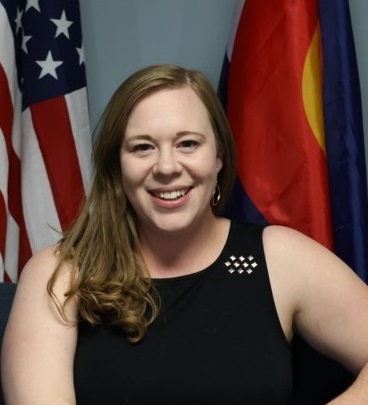
Sen. Katie Wallace
Sponsored bills
The Tony Grampsas youth services grant program (grant program) provides grants to community-based programs to reduce incidents of youth crime and violence. The youth mentoring program, the student dropout prevention and intervention program, and the student before-and-after school project (collectively, the "programs") were created within the grant program. The act repeals the individual programs and instead lists the programs as allowable uses for grant money under the grant program. The act transfers certain responsibilities from the Tony Grampsas youth services board (board) to the department of human services (department). The act repeals local public-to-private funding match requirements. The act requires each entity that receives a grant to annually report certain information to the department; except that an entity that has an operating budget of less than $1.5 million, or that receives a grant in the amount of not more than $25,000, is not required to report on the outcomes achieved by the services provided and the methods used to track the outcomes. The act decreases the appropriation from the marijuana tax cash fund to the youth mentoring services cash fund by $500,000 and reappropriates the money to the grant program by $500,000. The act decreases the appropriation from the youth mentoring services cash fund to the grant program by $504,120. (Note: This summary applies to this bill as enacted.)
The act extends the achieving a better life experience state income tax deduction (ABLE deduction) until December 31, 2030. The act specifies that the purposes of the ABLE deduction are to provide support to individuals with disabilities and their families and to provide an incentive for individuals with disabilities and their families to set aside money in an account to cover future disability-related expenses. (Note: This summary applies to this bill as enacted.)
For alternative education campuses (AECs), the act: Directs the department of education (department), when administering state education grants, to allocate priority points to AECs; Authorizes AECs to include certain high-risk students in the AEC's pupil count who are 21 years of age or younger during the budget year; Requires the department to prepare and post an annual report on enrollment trends, student demographics, and student mobility in AECs; and Exempts an AEC from losing its designation due to a fluctuation in enrollment for one school year. The act appropriates $9,613 from the general fund to the department for accountability and improvement planning. (Note: This summary applies to this bill as enacted.)
The statewide welcome, reception, and integration grant program provides grants to community-based organizations that provide culturally and linguistically appropriate navigation of services to migrants who have arrived in the United States within the past year and do not qualify for federal support services or refugee resettlement assistance benefits. The act removes the requirement that a migrant must have arrived in the United States within the past year and instead requires community-based organizations to prioritize assisting migrants who have arrived in the United States within the past 3 years. (Note: This summary applies to this bill as enacted.)
The act implements the recommendations of the department of regulatory agencies (department) in its sunset review and report on the HOA information and resource center (center). The center was scheduled to repeal on September 1, 2025. The act: Continues the center until September 1, 2030; Clarifies that the director of the division of real estate in the department is the appointing authority for the HOA information officer who is the head of the center; and Makes a technical change to refer to the HOA information officer by title, rather than by "he or she", to reflect gender-neutral language in statute.(Note: This summary applies to this bill as enacted.)
The act permits the state, a county, a city and county, a school district, or a municipality to, with approval from a school district's board of education, install and utilize automated vehicle identification systems (system) on the school district's school buses to detect a driver of a vehicle that overtakes a stopped school bus with actuated visual signal lights in violation of current law. A school district that installs and utilizes a system for this purpose must enter into a memorandum of understanding with one or more law enforcement agencies. If a system detects a violation, the state, a county, a city and county, or a municipality may impose a civil penalty of up to $300. The act creates a rebuttable presumption that when an image produced by a system includes an electronic indicator signifying that a school bus's visual signal lights are actuated, the visual signal lights are presumed to be actuated and operational and the school bus is presumed to be stopped to receive or discharge school children. The act mandates that the fines collected through the use of the system must not be used as the basis for the compensation to the system manufacturer or vendor and that the compensation must not be based exclusively upon the number of citations issued or revenue generated by the system.(Note: This summary applies to this bill as enacted.)
The act requires the director of the division of oil and public safety in the department of labor and employment (division) to adopt rules concerning retail electric vehicle charging that set forth minimum standards relating to specifications and tolerances for retail electric vehicle charging equipment and methods of retail sale at publicly accessible electric vehicle charging stations to promote consistency in the marketplace by July 1, 2026, and to enforce the rules beginning July 1, 2027. The act broadens the allowable uses of money in the electric vehicle grant fund within the Colorado energy office to include: Operational and policy work to support electric vehicle adoption, electric vehicle charging, and affordable, clean electricity for electric motor vehicles, including covering the administrative costs of this work; and Support for the development and enforcement of retail electric vehicle charging rules by the division. The act also broadens the allowable uses of money in the community impact cash fund within the department of public health and environment to include environmental equity and cumulative impact analyses. The act also requires the community access enterprise within the Colorado energy office to reduce the amount of the community access retail delivery fee that it imposes as necessary to ensure that the enterprise does not collect more than $100 million in total fee revenue prior to June 30, 2026. For the 2025-26 state fiscal year, $225,320 is appropriated to the department of labor and employment for use by the division for personal services and operating expenses. This appropriation is from reappropriated funds received from the office of the governor that are continuously appropriated to the Colorado energy office from the electric vehicle grant fund. (Note: This summary applies to this bill as enacted.)
Health benefit insurance plans (health benefit plans) include coverage for gender-affirming health care as part of individual and group health benefit plans. "Gender-affirming health care" is defined in the act as supplies, care, and services of a medical, behavioral health, mental health, psychiatric, habilitative, surgical, therapeutic, diagnostic, preventive, rehabilitative, or supportive nature relating to the treatment of gender dysphoria (gender-affirming health care). The act codifies gender-affirming health care treatments in statute and prohibits a health benefit plan from denying or limiting medically necessary gender-affirming health care, as determined and prescribed by a physical or behavioral health-care provider. The act authorizes the health insurance affordability board to seek, accept, and expend gifts, grants, or donations and to use those gifts, grants, or donations to cover abortion costs and to ensure access to legally protected health-care activity. The act exempts prescriptions for testosterone from the tracking requirements of the prescription drug use monitoring program and blocks archived records concerning testosterone use from view. (Note: This summary applies to this bill as enacted.)
Under current law, a person who does not have lawful immigration status must submit an affidavit stating that they have either applied for lawful presence or will apply for lawful presence as soon as they are eligible when the person is applying for: In-state student tuition classification; or An identification document pursuant to the "Colorado Road and Community Safety Act". The act repeals these affidavit requirements. Under current law, a jail custodian is generally required to release a defendant within 6 hours after the defendant has been granted a personal recognizance bond or is prepared to post bond. The act prohibits the jail custodian from delaying a defendant's release for the purpose of an immigration enforcement operation. Under current law, a criminal defendant may petition a court to vacate a guilty plea to a class 1 or class 2 misdemeanor or a municipal offense if the criminal defendant alleges that: They were not adequately advised by defense counsel of adverse immigration consequences of a guilty plea; They did not knowingly, intelligently, or voluntarily waive the right to counsel because they were not advised that the right to counsel includes the right to be advised regarding immigration consequences of a guilty plea; or The guilty plea was constitutionally infirm. The act extends the ability to petition a court to vacate a guilty plea to class 3 misdemeanors as classified at the time of the plea, traffic misdemeanors, and petty offenses. Under current law, state agencies and state agencies' employees are: Required to comply with provisions that limit the disclosure, collection, and access to a person's personal identifying information; Required to annually report certain information concerning requests made for a person's personal identifying information; and Subject to a civil penalty for an intentional violation of the requirements. The act extends these requirements concerning a person's personal identifying information to political subdivisions and their employees, and repeals the annual reporting requirements concerning requests made for a person's personal identifying information. The act creates minimum requirements for a public child care center, public school, local education provider, public institution of higher education, public health-care facility, or publicly supported library concerning information collection and access to its information, facilities, or property, and creates a civil penalty for an intentional violation of certain requirements. Under current law, a peace officer who is employed by the Colorado state patrol, a municipal police department, a town marshal's office, or a county sheriff's office is prohibited from arresting or detaining an individual on the basis of a civil immigration detainer request. The act extends the prohibition to a peace officer designated by the state as a peace officer. Under current law, a probation officer or probation department employee is prohibited from providing personal information about an individual to federal immigration authorities. The act extends this prohibition to a pretrial officer or pretrial services office employee. The act prohibits a military force from another state from entering the state without the governor's permission, unless the military force from another state is acting on federal orders and acting as a part of the United States armed forces. The act adds and amends definitions concerning "precise geolocation data" within the "Colorado Privacy Act". The act prohibits a controller from selling a consumer's sensitive data without obtaining consent. Under current law, a person is not subject to civil arrest while the person is present at a courthouse or on its environs, or while going to, attending, or coming from a court proceeding. The act extends this to while a person is receiving treatment in a related facility, which is a facility where programs and services are provided in relation to a court proceeding. For the 2025-26 state fiscal year, the act decreases an appropriation made in the long bill of: $54,900 from the general fund to the department of labor and employment; and $3,393 from the general fund to the department of personnel.(Note: This summary applies to this bill as enacted.)