

The act creates the work-based learning consortium pilot program (pilot program) in the department of higher education (department). The purpose of the 3-year pilot program is to: Demonstrate the value of work-based learning in postsecondary curricula by studying the impact of industry-sponsored projects on course objectives and learning outcomes; Promote the adoption of work-based learning in higher education by working with faculty at institutions of higher education (institutions) that participate in the pilot program (participating institutions) to embed project-based learning opportunities into credit-bearing programs; Provide broader access to collegiate work-based learning for students; Measure the impact of work-based learning on participating students; and Learn how institutions can increase the value of postsecondary education through career exposure and preparedness. Pending the receipt of sufficient funds, the department shall convene a consortium (consortium) of representatives from participating institutions, the commission on higher education (commission), the department of labor and employment, the department of education, and a subject matter expert with experience implementing work-based learning. The consortium shall: Work with each participating institution's faculty to embed industry-sponsored projects in course curriculum that meet the work-based learning quality standards; Work with the department to determine the impact of industry-sponsored projects; Work with a third-party platform to connect faculty from participating institutions to employers for the purpose of developing high-quality, project-based learning opportunities for classroom instruction; Advise the commission on strategies to improve student access to high-quality, work-based learning opportunities for students based on participating faculty members' experience embedding industry-sponsored projects into curriculum; Develop best practices for institutions to expand access to work-based learning in the classroom through industry-sponsored projects; and Develop findings and recommendations. Subject to available appropriations, at the end of the pilot program, the act requires the consortium to complete and submit a report to the education committees of the house of representatives and the senate, or their successor committees. The report must include: A description of the consortium's findings and recommendations; Details on the consortium's impacts on participating institutions and the effects of creating additional work-based learning activities on students, faculty, and employers; and Recommendations for statutory changes, financial resources, department policy changes, and policy changes in institutions that are necessary to improve successful work-based learning opportunities for students in institutions. The department may seek, accept, and expend gifts, grants, or donations from private or public sources for the pilot program. The department shall transmit all gifts, grants, or donations to the state treasurer, who shall credit the money to the higher education work-based learning consortium fund (fund). If, by June 30, 2028, the money in the fund has never reached or exceeded $2 million dollars, the state treasurer shall return each grantor's or donor's gift, grant, or donation. On or before November 1, 2026, the commission shall recommend a list of terms used by institutions related to work-based learning to the Colorado workforce development council for inclusion in the talent development glossary (glossary). The purpose of the list of terms is to: Augment the glossary so that collegiate work-based learning activities are accurately reflected in statewide efforts to promote work-based learning; and Demonstrate to institutions relevant opportunities to participate in statewide efforts to promote work-based learning. On or before July 1, 2026, the commission shall work with institutions, the Colorado workforce development council, the department of education, the consortium, nonprofit organizations, industry associations, and businesses to develop recommendations on how to best embed work-based learning opportunities into current degree pathways. On or before December 31, 2026, the department shall work with institutions to identify which work-based learning activities are measurable and how to best report work-based learning activities. Institutions that are eligible for the work-study program may use work-study program money to cover the costs of work-based learning credits for students who are required to complete credit-bearing work-based learning requirements to graduate from an institution. The office of economic development (office) administers the universal high school scholarship program (program). The act allows the office to spend unexpended or unencumbered money appropriated in the 2023-24 state fiscal year through the 2025-26 state fiscal year without further appropriation. The act requires that expenditures for the administrative costs of the program not exceed $1.5 million. The act extends the date for the state treasurer to transfer all unexpended and unencumbered money in the universal high school scholarship cash fund from December 30, 2026, to June 30, 2027. (Note: This summary applies to this bill as enacted.)
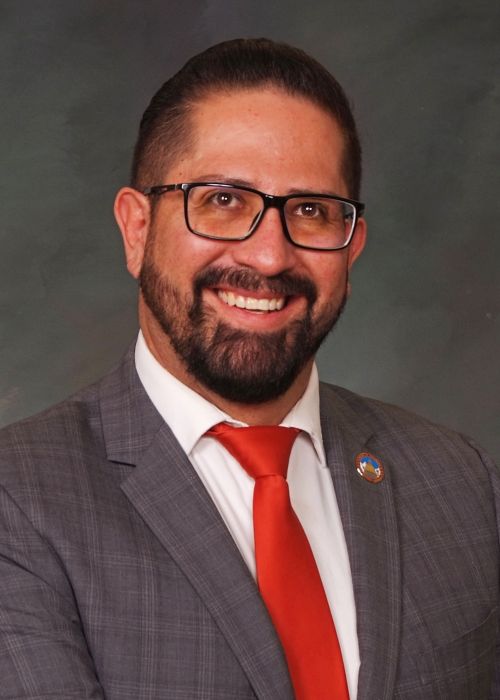
Rep. Matt Martinez
Sponsored bills
The act changes the term "epinephrine auto-injector" to "emergency-use epinephrine" in order to encompass alternatives to injecting epinephrine as a means to treat anaphylaxis in school settings. (Note: This summary applies to this bill as enacted.)
For ground ambulance services (ambulance services), the act: Allows a political subdivision or an ambulance service providing ambulance services on behalf of the political subdivision to submit to the division of insurance (division) the established rates for the ambulance services, if the rates meet specified conditions; Requires the division to publish reimbursement rates on the division's public-facing website; Establishes reimbursement rates for ambulance services that are out of network; and Prohibits an out-of-network ambulance service from billing an individual covered under a health insurance coverage plan (covered person) any outstanding balance for a covered service not paid for by an insurance carrier, except for any coinsurance, deductible, or copayment amount required to be paid by the covered person. If a covered person makes a payment for an out-of-network ambulance service, the payment must be applied to the covered person's in-network deductibles and in-network out-of-pocket maximum amounts. For the 2025-26 state fiscal year, $38,149 is appropriated from the division of insurance cash fund to the department of regulatory agencies for use by the division to implement the act. VETOED by Governor 5/29/2025(Note: This summary applies to this bill as enacted.)
Current law states that an employer shall not interfere with an agricultural worker's reasonable access to key service providers (KSP) at any location when the worker is not performing compensable work and with respect to health-care providers at any time. The act exempts an employer's property from this provision; except that the act prohibits an employer from interfering with a worker's access to KSP through remote channels on the employer's property. The act also removes language referring to health-care providers. Current law states that the division of labor standards and statistics (division) may adopt rules regarding additional times that an employer may not interfere with a worker's reasonable access to KSP. The act clarifies that such rules must apply only to locations other than the employer's property. Lastly, the act states the division shall not adopt rules that: Infringe upon an employer's private property rights; or Conflict with the common law rights of an individual to access private property in a time of emergency.(Note: This summary applies to this bill as enacted.)
The act creates the American Indian affairs interim committee (committee). The purpose of the committee is to examine issues and challenges that impact American Indian Tribal Nations. The committee consists of 6 voting members of the general assembly who serve for the duration of the committee unless they resign, are removed, or are no longer in office and 2 nonvoting members, one from the Southern Ute Indian Tribe and one from the Ute Mountain Ute Tribe. The act allows the committee to meet up to 6 times and recommend up to 5 bills during each interim, but the committee does not meet or recommend legislation during the 2025 interim. On or before January 15, 2031, the act requires the committee to submit a report to the executive committee of the legislative council summarizing the work of the committee during the preceding 5 years. The committee is repealed, effective June 30, 2031. (Note: This summary applies to this bill as enacted.)
Beginning on or before July 1, 2027, the act requires a county department of human or social services (county department) to determine whether a child or youth who is in foster care and who has a deceased parent (child or youth) may be eligible to receive survivor benefits administered by the United States railroad retirement board, social security administration, or veterans benefits administration (federal survivor benefits). The county department must make an initial eligibility determination within 90 days after assuming legal custody of or authority over the child or youth. Under current law, certain federal agencies appoint a representative payee or fiduciary (representative payee) to receive and manage federal benefits on behalf of a child or youth in foster care. If a child or youth may be eligible for federal survivor benefits and the county department is the most appropriate representative payee, the act requires the county department to apply for federal survivor benefits on behalf of the child or youth. If the county department determines that the child or youth may be eligible for federal survivor benefits but that the county department is not the most appropriate representative payee, the county department shall provide information to the prospective representative payee that the county department has identified about how to apply for federal survivor benefits on behalf of the child or youth and how to become the child's or youth's representative payee. Under current law, a county department serving as a representative payee may use federal benefits to offset the cost of providing basic care and services to a child or youth in foster care. The act prohibits this offset practice with respect to federal survivor benefits. Instead, the act directs a county department serving as a representative payee to establish an account for the federal survivor benefits (account). A county department serving as a representative payee must save money in the account for the needs of the individual child or youth. Once the child or youth leaves foster care, the county department is required to release funds in the account to the child or youth. The act sets forth various accounting and notice requirements related to federal survivor benefits and requires the department of human services (department), in consultation with interested stakeholders, to adopt rules providing guidance for county departments. The guidance extends to procedures for identifying a representative payee, county department responsibilities when federal survivor benefits are denied or when a child or youth leaves foster care, and policies governing the establishment and maintenance of an account for federal survivor benefit funds. The department must provide technical assistance to a county department about how to conserve federal survivor benefit funds in the best interests of an individual child or youth. (Note: This summary applies to this bill as enacted.)
The act prevents a pharmacy benefit manager (PBM) from prohibiting a rural independent pharmacy from using a private courier or a delivery service to deliver a prescription drug to a patient. A PBM is required to reimburse a rural independent pharmacy for a prescription drug in an amount not less than the national average drug acquisition cost for the dispensed prescription drug ingredients, plus pay a dispensing fee. When a PBM conducts an audit of a rural independent pharmacy and the audit results in a recoupment of more than $1,000 or a penalty of more than $1,000, the PBM must: Electronically notify the rural independent pharmacy of the rural independent pharmacy's rights to appeal at least 30 days before the recoupment of funds; If the rural independent pharmacy does not respond to the electronic notification within 30 days after the electronic notification, again electronically notify the rural independent pharmacy of the rural independent pharmacy's rights to appeal at least 30 days before the recoupment of funds; and If the rural independent pharmacy does not respond to the second electronic notification within 30 days after the second electronic notification, serve process on the rural independent pharmacy notifying of the rural independent pharmacy's rights to appeal at least 30 days before the recoupment of funds. The act allows a rural independent pharmacy to operate without being under the direct charge of a pharmacist if the initial interpretation and final evaluation of the prescription is done by a state-licensed pharmacist in person or remotely. (Note: This summary applies to this bill as enacted.)
The act authorizes the department of health care policy and financing (HCPF) to seek and accept gifts from private or public sources for the primary care fund. The act authorizes a federally qualified health center (FQHC) to establish a separate subsidiary company for the purpose of providing fee-for-service services outside of the FQHC's standard cost report if the subsidiary is providing fee-for-service services that have historically been provided and reimbursed on a fee-for-service basis and if HCPF determines that the subsidiary's reimbursements would be budget neutral. Upon receiving any necessary federal authorization, HCPF is required to reimburse a subsidiary of an FQHC on a fee-for-service basis for services that are eligible for fee-for-service reimbursement. A subsidiary that receives reimbursement is authorized to pass through money received from the reimbursement directly to the FQHC operating as the subsidiary's parent corporation. Services reimbursed to an FQHC's subsidiary are excluded from the FQHC's cost report. The act requires HCPF to exclude all costs associated with a subsidiary company from the calculation of a FQHC's reimbursement rates and requires a FQHC that establishes a separate subsidiary company to include the costs associated with the subsidiary in its cost report that is necessary to calculate reimbursement rates. (Note: This summary applies to this bill as enacted.)
On or after July 1, 2025, the act requires a person, before commencing a project to install or substantially repair a contiguous fence of at least a specified certain size in the Sangre de Cristo land grant lands (covered fencing project), to submit an application for the covered fencing project to the local government with jurisdiction over the covered fencing project (application) if the local government has opted into the act's requirements. No later than 14 days after the local government's receipt of an application, the local government must publish notice of the application on the local government's website. No later than 60 days after the local government's receipt of an application, the local government must either approve or reject the application based on certain criteria; except that, despite the criteria, a local government may approve an application if it determines that the benefits of the covered fencing project outweigh the harms. If the local government finds that a covered fencing project presents no significant environmental impacts, then the local government shall not require a person commencing the covered fencing project to submit an application or pay a fee. The act does not apply to a covered fencing project that is necessary for a public utility or department of transportation project, an energy sector public works project, the safety or security of a public school or prison, or fences provided by the division of parks and wildlife. (Note: This summary applies to this bill as enacted.)
For alternative education campuses (AECs), the act: Directs the department of education (department), when administering state education grants, to allocate priority points to AECs; Authorizes AECs to include certain high-risk students in the AEC's pupil count who are 21 years of age or younger during the budget year; Requires the department to prepare and post an annual report on enrollment trends, student demographics, and student mobility in AECs; and Exempts an AEC from losing its designation due to a fluctuation in enrollment for one school year. The act appropriates $9,613 from the general fund to the department for accountability and improvement planning. (Note: This summary applies to this bill as enacted.)