

Passed Apr 24, 2023
0 co-sponsors
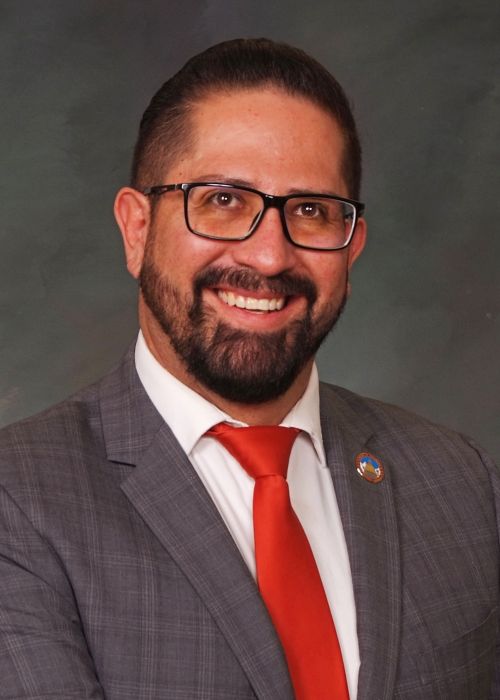
Rep. Matt Martinez
Total votes
3,565
all sessions
Attendance
99%
37 missed
Near the chamber average
With party
96%
of cast votes
Near the chamber average
Bipartisan score
2%
crosses aisle rarely
Near the chamber average
Sponsored
288
bills & resolutions
Near the chamber average
Committees
5
assignments
288 bills and resolutions
Sponsored bills
Total
288
Primary
105
Co-sponsor
183
This page
288
matching current filters
Department Of Corrections Earned Time For College Program Completion
The act requires the department of corrections (department) to, for an inmate who was sentenced for a nonviolent felony offense, deduct earned time from the inmate's sentence for each accredited degree or other credential awarded by an institution of higher education to the inmate while the inmate is incarcerated or on parole, in the following amounts: 18 months of earned time for a master's degree and 2 years of earned time for a doctoral degree; One year of earned time for receiving an associate or baccalaureate degree; and 6 months of earned time for receiving a certificate or other credential that requires completion of at least 30 credit hours. The act requires the department to designate up to six regionally accredited institutions of higher education that may award a degree or credential to an inmate for which earned time must be deducted. The act requires the general assembly to annually appropriate to the department of higher education the savings incurred during the prior state fiscal year as a result of the release of inmates from correctional facilities because of earned time granted for completion of a higher education degree or credential. The appropriation to the department of higher education is for allocation to institutions of higher education that offer accredited programs in correctional facilities. APPROVED by Governor April 12, 2023 EFFECTIVE August 7, 2023 NOTE: This act was passed without a safety clause and takes effect 90 days after sine die. (Note: This summary applies to this bill as enacted.)
Signed into law Apr 12, 2023
0 co-sponsors
Higher Education Staff Sabbaticals
Current law allows higher education faculty to take a sabbatical if the governing board of the institution where the faculty member works approves the sabbatical. The act extends sabbatical opportunities to staff of an institution of higher education who serve in a management position or similar capacity. APPROVED by Governor April 10, 2023 EFFECTIVE August 7, 2023 NOTE: This act was passed without a safety clause and takes effect 90 days after sine die. (Note: This summary applies to this bill as enacted.)
Signed into law Apr 10, 2023
0 co-sponsors
Municipal Priority Lien Surviving Treasurer's Deed
The law allows a municipality to levy a lien against real property for costs associated with removing weeds, brush, and other rubbish from the property. Such a lien has priority over other liens, except liens for general taxes and prior special assessments imposed by a municipality. A municipal clerk may certify such a lien to a county treasurer for collection. The act requires a county treasurer to accept such a municipal lien for collection if a municipality records a notice of lien within 4 months of abating the nuisance and certifies the amount of the unpaid assessment for which the lien was levied to the county treasurer within one year of recording the notice of lien. APPROVED by Governor April 3, 2023 EFFECTIVE August 7, 2023 NOTE: This act was passed without a safety clause and takes effect 90 days after sine die. (Note: This summary applies to this bill as enacted.)
Signed into law Apr 3, 2023
0 co-sponsors
Modification Of Rural Counties Officer Salary Categories
Current law categorizes each county for purposes of establishing the salaries of elected officials in the county. The statutory salary amounts are adjusted every 2 years for inflation and take effect for terms commencing after any change is made. The bill modifies the categories of 9 counties (Archuleta, Delta, Eagle, Grand, Las Animas, Ouray, Pitkin, Saguache, and Summit) with an accompanying percentage increase in salary for the counties' elected officials. APPROVED by Governor March 23, 2023 EFFECTIVE March 23, 2023 (Note: This summary applies to this bill as enacted.)
Signed into law Mar 23, 2023
0 co-sponsors
Passed Feb 23, 2023
0 co-sponsors
Passed Feb 23, 2023
0 co-sponsors
Rural County and Municipality Energy Efficient Building Codes
Counties and municipalities are currently required to adopt and enforce certain energy efficient building codes concurrently with the updating of their existing building codes or, before July 1, 2023 only, concurrently with either the adoption or updating of their building codes. Counties and municipalities must adopt and enforce these specified model energy codes within particular time frames. A rural county, which is defined as a county with a population of less than 30,000 people, is permitted to adopt a less current model code if it has applied for and not been awarded a grant that significantly assists with energy code adoption and enforcement training. Section 1 of the bill extends the compliance periods for adoption and enforcement of the model energy codes by a rural county as follows: An energy code that achieves equivalent or better energy performance than the 2021 international energy conservation code and the model electric ready and solar ready code language developed by the energy board is not required prior to July 1, 2030, instead of being required concurrently with any county code building code update occurring on or after July 1, 2023, and before July 1, 2026; An energy code that achieves equivalent or better energy and carbon emissions performance than the model low energy and carbon code developed by the energy board is not required prior to July 1, 2032, instead of being required concurrently with any county code building code update occurring on or after July 1, 2026; and An energy code that achieves equivalent or better energy performance than one of the 3 most recent editions of the international energy conservation code is not required prior to July 1, 2025, instead of being required concurrently with any county code building code adoption or update occurring before July 1, 2023. Section 2 defines a rural municipality as a municipality with a population of less than 10,000 people and extends the compliance periods for adoption and enforcement of the model energy codes in an identical manner to that outlined above for rural counties. The bill adds language allowing a rural municipality to adopt a less current model code if it has applied for and not been awarded a grant that significantly assists with energy code adoption and enforcement training.(Note: This summary applies to this bill as introduced.)
In committee Feb 23, 2023
0 co-sponsors
Ask Maddy
·
AI policy assistant
Ask Maddy about Matt Martinez
Scope: colorado
Hi! I can help you understand Matt Martinez's legislative record. What would you like to know?
Try one of these
i
Maddy answers using official bill text and legislative records. Always verify before sharing.
Sources cited inline