

The act requires the division of criminal justice in the department of public safety to convene a working group to develop a definition of "recidivism" to be used by each state entity that collects data or reports on recidivism, in any report issued by the entity. The working group consists of: Representatives of the judicial department, the department of corrections, the division of youth services in the department of human services, the state board of parole, and the department of public safety; A member from an institution of higher education; and A representative from a community-based organization that works for criminal legal reform and supports consistent data collection. The working group shall develop a definition of "recidivism" no later than January 15, 2025. The definition must include: A clearly defined measurement point to begin tracking recidivism; A clear description of the cohort to be tracked; That the recidivism event is a new deferred agreement or adjudication or conviction for a felony or misdemeanor offense, including "Victim Rights Act" crimes; and A clearly defined time period during which an event is considered a recidivism event, consistent with best practices for measuring recidivism. Each state entity that collects data or reports on recidivism in any report issued by the entity shall begin using the working group's definition on July 1, 2025. Subject to available resources, and before January 15, 2025, the working group may develop definitions of other metrics or data points related to recidivism or the desistance from crime that state entities may use. APPROVED by Governor March 6, 2024 EFFECTIVE March 6, 2024(Note: This summary applies to this bill as enacted.)
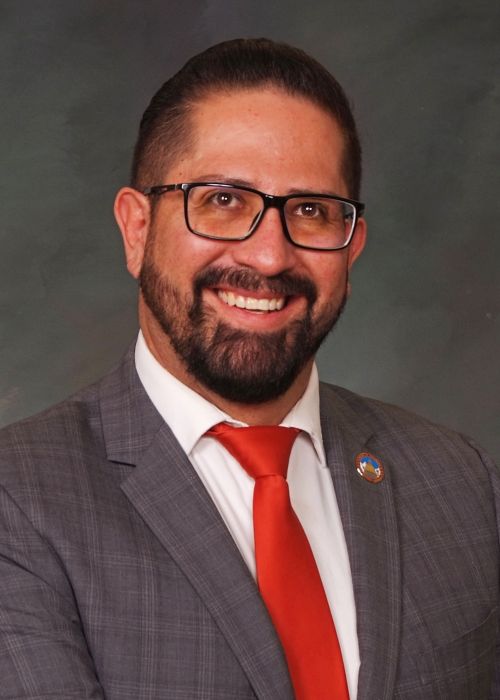
Rep. Matt Martinez
Sponsored bills
Current law specifies that after the distraint sale of a mobile home to collect delinquent property taxes, any surplus proceeds from the sale must be credited to the county general fund. The bill modifies the distraint sale statute to require a public auction of the mobile home at a fixed fair minimum price with any surplus proceeds being paid to the owner, or any other person having established a legal right thereto, in order to bring state law into compliance with the United States supreme court's recent decision affirming a property owner's constitutional right to the value of their property in excess of their tax debt. The bill also extends the redemption period for the owner of a mobile home that is located on leased land or other land not owned by the owner from one year to 2 years.(Note: This summary applies to this bill as introduced.)
Recidivism Interim Study Committee. The bill requires the division of criminal justice (division) in the department of public safety to conduct a study to examine how individuals proceed through the various stages of criminal and juvenile justice proceedings, including sentences and alternative sentencing programs. The division shall solicit proposals for an entity to assist with the study. The bill requires the division to submit a report of its findings to the joint budget committee and the judiciary committees of the house of representatives and the senate by June 30, 2025. (Note: This summary applies to this bill as introduced.)
The act requires the Colorado commission on criminal and juvenile justice (commission) to report to the general assembly about its study of sentencing reform by June 30, 2023. The report must include a summary of the commission's work and an update on the status of the commission's and any task force's efforts to address clarity and certainty in the current criminal sentencing scheme regarding the amount of time that must be served on each sentence imposed by the court prior to a defendant's parole eligibility. APPROVED by Governor June 6, 2023 EFFECTIVE June 6, 2023 (Note: This summary applies to this bill as enacted.)
The act implements the recommendations of the department of regulatory agencies to continue to the offender reentry and education programs (programs) until September 1, 2028, subject to sunset review by the department of regulatory agencies. The act also requires the department of corrections to track the long-term recidivism rates of persons who were formerly incarcerated who participated in the programs. Finally, the act requires the department of corrections to report recidivism rates and data on all individuals who participate in reentry services and programs to the judiciary committees of the house and senate. APPROVED by Governor May 17, 2023 EFFECTIVE August 7, 2023 NOTE: This act was passed without a safety clause and takes effect 90 days after sine die. (Note: This summary applies to this bill as enacted.)
Current law requires a male person who is applying for enrollment or reenrollment to a state-supported institution of higher education (institution) and who is at least 17 years and 9 months of age but younger than 26 years of age (applicant) to provide the institution with a statement of registration compliance for the United States selective service system (selective service). The act removes the requirement that an applicant register for selective service to enroll in an institution but requires institutions to provide information about selective service to eligible males prior to registration. APPROVED by Governor May 16, 2023 EFFECTIVE August 7, 2023 NOTE: This act was passed without a safety clause and takes effect 90 days after sine die. (Note: This summary applies to this bill as enacted.)
The act establishes the universal high school scholarship program (program) in the office of economic development (office) to provide scholarships for the 2024-25 academic year to students who pursue an in-demand or high-priority postsecondary pathway, including degrees, certificates, and registered apprenticeships, with a provider on the eligible training provider lists disseminated by the department of labor and employment, a provider in the Colorado state apprenticeship resource directory, a public or private institution of higher education operating in Colorado, or an organization approved by the office (service providers). The office, or a vendor contracted by the office, administers the program. The office shall develop policies and procedures necessary to administer the program. A student is eligible for the program if the student graduated from a Colorado high school or was awarded a high school equivalency credential during the 2023-24 academic year; completes the free application for federal student aid or the Colorado application for state financial aid; and did not receive a grant from the Colorado opportunity scholarship initiative. Scholarships are awarded in the following priority: First, to all eligible students who intend to enroll at a service provider to pursue an in-demand or high-priority postsecondary pathway, then to other eligible students who intend to enroll at a service provider. The office or vendor determines the amount of each scholarship award, up to a maximum $1,500. Scholarship money is distributed to the service provider for use by the student for tuition, fees, and books. The act requires the office to contract with vendors to provide postsecondary and career advising at schools identified by the office. The office shall make efforts to identify a diversity of schools in rural and urban areas of the state to receive postsecondary advising support. The act requires the state treasurer to transfer $25 million from the general fund to the universal high school scholarship cash fund (cash fund). The act appropriates $25 million from the cash fund to the office of the governor for the program. APPROVED by Governor May 16, 2023 EFFECTIVE August 7, 2023 NOTE: This act was passed without a safety clause and takes effect 90 days after sine die. (Note: This summary applies to this bill as enacted.)
The act establishes the veterans mental health services program (program) in the division of veterans affairs (division) to facilitate access to mental health services for veterans who live in a veterans community living center. The act requires a veteran to attest that the veteran has exhausted the annual number of sessions with a mental health-care provider covered by the veteran's federal veterans administration benefits before using the program. The program reimburses mental health-care providers for 26 mental health-care sessions per year with an eligible veteran. The act requires the behavioral health administration to post on its website a list of providers who participate in the program. The bill appropriates $642,645 from the general fund to the department of military and veterans affairs for use by the division for the program. APPROVED by Governor May 16, 2023 EFFECTIVE May 16, 2023 (Note: This summary applies to this bill as enacted.)
Section 1 of the act requires the public utilities commission (commission), if relying on a discount rate when calculating the net present value of future carbon-based fuel costs as part of a utility's electric resource plan, to apply a discount rate that does not exceed the long-term rate of inflation. The commission is required to determine an appropriate rate of inflation specifically for fuel costs. Section 2 requires the commission to establish rules to limit the amount of rate case expenses that an investor-owned electric or gas utility may recover from the utility's customers. In reviewing an investor-owned utility's application to modify base rates, the commission is required to certify that sufficient information is included in the application, including a comprehensive cost and revenue requirement analysis. Section 3 prohibits an investor-owned electric or gas utility from recovering various costs from its customers, including: More than 50% of annual total compensation or of expense reimbursement for a utility's board of directors; Tax penalties or fines issued against the utility; Investor-relation expenses; Certain advertising and public relations expenses; Lobbying and other expenses intended to influence the outcome of local, state, or federal legislation or ballot measures; Charitable giving expenses; Certain organizational and membership dues; Certain political contributions or expenses; Travel, lodging, food, or beverage expenses for the utility's board of directors and officers; Gift or entertainment expenses; Expenses related to aircraft for a utility's board of directors and officers; and Expenses related to unregulated products or services sold or provided by a utility. If an investor-owned utility recovers prohibited costs, the commission may assess a nonrecoverable penalty against the utility and is required to order the utility to refund the amount improperly recovered to its customers, plus interest. An investor-owned utility is required to file an annual report with the commission on the utility's compliance with the cost recovery prohibitions, which report must include the purpose, payee, and amount of any expenses associated with costs and activities not permitted to be recovered from customers. Section 4 requires that, on or before November 1, 2023, an investor-owned gas utility file with the commission for the commission's approval, amendment, or denial a gas price risk management plan that includes proposals for addressing the volatility of fuel costs recovered from the utility's customers pursuant to the utility's gas cost adjustment filings. Section 4 requires the commission to adopt rules, on or before January 1, 2025, to help protect investor-owned electric or gas utility customers from the volatility of gas prices by establishing mechanisms that align an investor-owned utility's financial incentives with the financial interests of its customers regarding incurred fuel costs. In adopting the rules, the commission is required to consider mechanisms to create a financial incentive for an investor-owned utility to improve its electricity production cost efficiency while minimizing its fuel costs. As part of its rules, the commission shall also consider, to the extent such information is relevant, each investor-owned electric or gas utility's financial health and corresponding impacts on customer affordability. Section 4 also requires the commission to open a proceeding to investigate whether and how residential and other development in certain geographic areas drive natural gas infrastructure costs for any natural gas utility that serves more than 500,000 customers in the state. After completing the investigation, the commission shall consider whether alternative infrastructure, service investments, or other actions by the utility could mitigate impacts of such development on nonparticipating or income-qualified utility customers. Section 5 requires: On or before December 31, 2023, each regulated gas utility to remove from the utility's rate tariffs incentives offered to an applicant applying for natural gas service to establish gas service to a property; The Colorado energy office to contract with an independent third party, on or before July 1, 2024, to evaluate the risk that stranded or underutilized natural gas infrastructure investments pose, including the risk posed to utility employees and contractors, and the annual projected rate impact that such stranded assets have on utility customers; The commission to determine whether any changes to rules or depreciation schedules are warranted based on its review of the evaluation contracted by the Colorado energy office; An investor-owned gas utility to provide the commission information, including a map, about the utility's gas distribution system pipes; An investor-owned gas utility to refrain from penalizing or charging a fee to a customer that voluntarily terminates gas service. The commission may adopt rules to establish standards for a customer's voluntary disconnection from an investor-owned gas utility's gas distribution system. On or before January 1, 2024, the commission to examine existing investor-owned electric utility tariffs, policies, and practices to determine if they pose a barrier to the beneficial electrification of transportation and buildings and determine whether requiring a customer that seeks to interconnect distributed energy resources or beneficial electrification resources to bear the full incremental cost of transformer or service upgrades needed for such interconnection imposes an undue burden on the customer. Section 6 requires the commission to allow a wholesale customer of an investor-owned utility to intervene in a proceeding regarding the commission's consideration of the investor-owned utility's application for cost recovery from customers if the wholesale customer has a demonstrated interest in the proceeding. Section 7 appropriates for the 2023-24 state fiscal year: $1,347,554 from the public utilities commission fixed utility fund to the department of regulatory agencies for use by the commission, with $713,745 reappropriated to the department of law; and $142,749 to the department of law from the legal services cash fund from revenue received from the Colorado energy office that originates as custodial federal funds that the office has authority to expend. APPROVED by Governor May 11, 2023 EFFECTIVE August 7, 2023 NOTE: This act was passed without a safety clause and takes effect 90 days after sine die. (Note: This summary applies to this bill as enacted.)