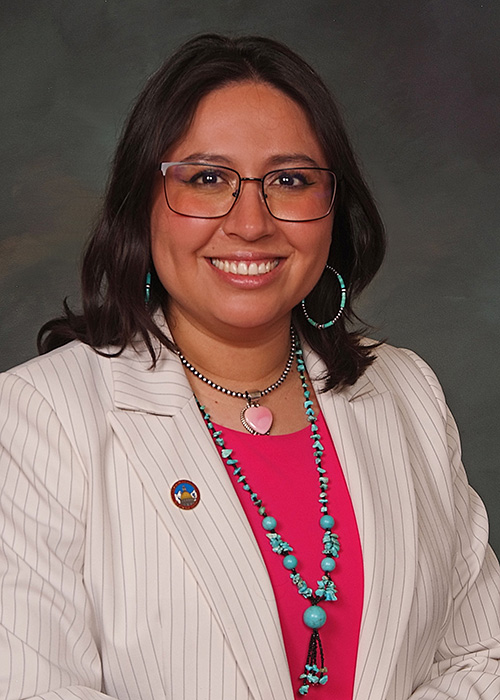
Photo of Elizabeth Velasco
D Colorado House · District 57 On the 2026 ballot

Rep. Elizabeth Velasco

Compare
Total votes
3,785
all sessions
Attendance
97%
104 missed
Near the chamber average
With party
97%
of cast votes
Higher than 75% of chamber peers
Bipartisan score
2%
crosses aisle rarely
Near the chamber average
Sponsored
318
bills & resolutions
Near the chamber average
Committees
6
assignments
318 bills and resolutions

Sponsored bills

Total
318
Primary
114
Co-sponsor
204
This page
318
matching current filters
Co-sponsor HR 25-1003
Passed · Colorado House · Co-sponsor
Women in Colorado Legal Community

Maddy summaryThis House Resolution (HR 25-1003) recognizes the importance of diversity in Colorado's legal community and honors the Colorado Women's Bar Association (CWBA) for its work supporting women in the legal profession. It highlights key milestones in Colorado's legal history, including the first women to earn law degrees, become judges, and serve in legal leadership roles. The resolution commends the CWBA's efforts to promote women's advancement in the judiciary and ensure equal representation. As a non-binding resolution, it does not create new law but formally acknowledges these contributions during Women's History Month.

Passed Apr 2, 2025 1 co-sponsor
Co-sponsor SB 25-157
In committee · Colorado Senate · Co-sponsor
Deceptive Trade Practice Significant Impact Standard

The bill establishes that certain evidence that a person has engaged in an unfair or deceptive trade practice constitutes a significant impact to the public. The bill also clarifies that a deceptive trade practice claim cannot be based solely on a claim that a person breached a contract or engaged in negligence or on a claim for damages based on the rendering of professional services, unless the claim for damages involves an allegation of a material misrepresentation of fact, a failure to disclose material information, or an action that cannot be characterized as providing advice, judgment, or opinion.(Note: This summary applies to this bill as introduced.)

In committee Apr 1, 2025 1 co-sponsor
Co-sponsor HB 25-1015
Signed into law · Colorado House · Co-sponsor
Ability to Pay Bond Online Clarifications

Current law requires that bond can be posted online. The act makes clarifying changes to the bond statutes to ensure that bond can be posted online. (Note: This summary applies to this bill as enacted.)

Signed into law Mar 31, 2025 1 co-sponsor
Co-sponsor HB 25-1016
Signed into law · Colorado House · Co-sponsor
Occupational Therapist Prescribe Medical Equipment

The act authorizes an occupational therapist to directly recommend or prescribe durable medical equipment to a patient without requesting the prescription from a licensed physician and requires that the occupational therapist consult with the patient concerning payment options. (Note: This summary applies to this bill as enacted.)

Signed into law Mar 31, 2025 1 co-sponsor
Co-sponsor HB 25-1009
Signed into law · Colorado House · Co-sponsor
Vegetative Fuel Mitigation

The act allows a fire protection district or a metropolitan district that provides fire protection services (district) to create a program to mitigate the presence of dead or dry plant material that can burn and contribute to a fire on privately owned property within a district (vegetative fuel program). A district that creates a vegetative fuel program may require an owner or occupier with an interest in private real property that contains vegetative fuel within the district to remove the vegetative fuel and assess a fine per incident of noncompliance. An incident covers all vegetative fuel on a property. A district may not require an owner or occupier of private real property to remove vegetative fuel on private real property that is classified as agricultural land by the tax assessor, owned by a nonprofit entity and leased for agricultural purposes, owned or occupied by a public utility with a vegetation management or wildfire mitigation plan to address vegetative fuel sources, or adjacent to a ditch that conveys decreed water rights or within the easement where the ditch is located. In order to assess a fine, for each incident, the district must provide written notice by certified mail of the requirement to remove vegetative fuel and allow at least 14 days for the owner or occupier to comply. An owner or occupier that does not remove the vegetative fuel as provided in the first notice may be subject to a second notice requiring the removal of vegetative fuel. An owner or occupier has at least 14 days to comply with the second notice. An owner or occupier that does not comply within at least 14 days after the second notice may receive a third notice providing for a fine approximately equal to the cost of removing the vegetative fuel. The fine may not exceed $200 per property per incident, and an owner or occupier is not subject to more than one fine for the same incident. The sum of all fines assessed against a single property may not exceed $1,200. An owner or occupier receiving a third notice may avoid a fine by removing the vegetative fuel within 14 days of the date of the third notice. A district may not access any privately owned real property without the written permission of the owner or occupier of the property. An owner or occupier is not liable to a district for damages to district personnel or equipment that occurs on the property while district personnel or equipment are present on the property to carry out a vegetative fuel program. A district may not use a drone to discover vegetative fuel on a property or to administer or enforce a vegetative fuel program created pursuant to the act. The money that a district collects from a fine must be used by the district only to remove vegetative fuel on private real property within the district's jurisdiction. A district's board may waive the fine in all or in part, in its discretion if it determines that the fine was not assessed pursuant to law, an owner or occupier is financially unable to pay the fine, the vegetative fuel has been removed, or a waiver is appropriate under the circumstances and must prioritize use of the money to assist a low-income owner or occupier, a senior owner or occupier, or an owner or occupier with a disability in removing vegetative fuel from the owner or occupier's property. A district's board may also waive a fine for delays due to weather or upon a petition for a time extension from an owner or occupier if they have undertaken good faith efforts to remove the vegetative fuel. Good faith efforts include documentation from an arborist or licensed professional landscape architect that states when the arborist or landscape architect will be able to mitigate vegetative fuel on the property and the cost of mitigation. A district's board shall grant a property owner or occupier a time extension to mitigate or pay a fine for: No longer than 3 months if the cost to mitigate exceeds $1,000 and is less than $2,500; No longer than 6 months if the cost to mitigate equals or exceeds $2,500 and is less than $5,000; No longer than 9 months if the cost to mitigate equals or exceeds $5,000 and is less than $10,000; or No longer than one year if the cost to mitigate equals or exceeds $10,000. A district's board shall adopt rules and policies after a public hearing, public notice and public comment to implement the act and shall post the adopted rules and policies to the district's website, on social media operated by the district, and in a local newspaper of general circulation. A vegetative fuel program may only be effective 30 days or more after posting of the adopted rules and policies on the district's website. As part of the rules and policies, a district shall designate an individual to oversee and manage the district's vegetative fuel program. A district may certify to the county treasurer a delinquent charge made or levied against a property, and the treasurer may collect and pay over the charge in the same manner that property taxes are collected and paid. (Note: This summary applies to this bill as enacted.)


Signed into law Mar 31, 2025 1 co-sponsor
Co-sponsor HB 25-1077
Signed into law · Colorado House · Co-sponsor
Backflow Prevention Devices Requirements

Backflow is the reverse flow of water, fluid, or gas caused by back pressure or back siphonage. Under current law, individuals who are engaged in the business of installing, removing, inspecting, testing, or repairing backflow prevention devices are subject to the licensure requirements for plumbers, except when the individuals are installing or testing a stand-alone fire suppression sprinkler system. The act exempts individuals engaged in the business of inspecting, testing, or repairing backflow prevention devices from licensure requirements but retains the licensure requirements for individuals engaged in the installation or removal of the devices; except that individuals who install or replace a backflow prevention device on a stand-alone fire suppression system remain exempted from the licensure requirements. The act requires that, on and after July 1, 2025, a licensed plumber who installs, tests, inspects, repairs, or reinstalls a backflow prevention device and a certified cross-connection control technician or a licensed plumber with a cross-connection control technician certification who tests or repairs a backflow prevention device must affix a tag on the backflow prevention device that contains certain information about the licensed plumber, the certified cross-connection control technician, or the licensed plumber with a cross-connection control technician certification, as applicable, and the service that was provided. (Note: This summary applies to this bill as enacted.)
Signed into law Mar 28, 2025 1 co-sponsor
Primary HB 25-1286
In committee · Colorado House · Lead sponsor
Protecting Workers from Extreme Temperatures

The bill requires employers to implement protections for workers who are exposed to extreme hot and cold temperatures at the worksite, including temperature mitigation measures, rest breaks, and temperature-related injury and illness prevention plans. (Note: This summary applies to this bill as introduced.)

In committee Mar 27, 2025 0 co-sponsors
Co-sponsor SB 25-170
Signed into law · Colorado Senate · Co-sponsor
Deoxyribonucleic Acid & Sexual Assault Kit Backlog Testing & Data

The act requires the Colorado bureau of investigation (CBI) to spend $3,000,000 in specifically appropriated money from House Bill 24-1430, concerning the provision for payment of the expenses of the executive, legislative, and judicial departments of the state of Colorado, and of its agencies and institutions, for and during the fiscal year beginning July 1, 2024, except as otherwise noted, on backlogged DNA evidence and sexual assault kit tests, as well as DNA retesting related to CBI's laboratory misconduct that was discovered in 2023. Additionally, the act allows CBI to contract with external labs to perform the testing. The act requires CBI to create a dashboard on the department of public safety's website to update the public on the backlog at least every 30 days. CBI shall provide the general assembly with updates on the sexual assault kit backlog, including the number of cases pending, the number of tests CBI's lab conducted, the number of tests CBI contracted out, an update on CBI's laboratory staffing levels, the average turnaround time for a sexual assault kit test, and other relevant data points every 30 days from March 10, 2025, through June 30, 2026. (Note: This summary applies to this bill as enacted.)

Signed into law Mar 26, 2025 1 co-sponsor
Co-sponsor SJR 25-013
Passed · Colorado Senate · Co-sponsor
Nowruz Day

Maddy summarySJR 25-013 is a symbolic resolution recognizing Thursday, March 20, 2025, as Nowruz Day in Colorado. It honors the ancient Persian New Year celebration observed by Iranian, Kurdish, Afghan, and Central Asian communities, acknowledging its cultural significance and the contributions of Colorado's Iranian-American residents. The resolution has no legal effect but formally extends recognition to the traditions of Nowruz, including its themes of renewal and community. It directly affects Colorado's Iranian-American community by affirming their cultural heritage through state acknowledgment.

Passed Mar 24, 2025 1 co-sponsor
Co-sponsor SB 25-024
Signed into law · Colorado Senate · Co-sponsor
Judicial Officers

Beginning July 1, 2025, the act increases by one the number of district court judges in the fourth, seventeenth, eighteenth, and twenty-third judicial districts and increases by one the number of county court judges in La Plata county. Beginning July 1, 2026, the act increases by one the number of district court judges in the fourth, seventh, thirteenth, seventeenth, eighteenth, and nineteenth judicial districts and increases by one the number of county court judges in Larimer county, Douglas county, Mesa county, and Eagle county. Current law requires district court judges regularly assigned to Arapahoe county to maintain offices within Arapahoe county. The act allows the district court judges assigned to Arapahoe county to maintain offices outside of the county seat. For the 2025-26 state fiscal year, the act appropriates $2,638,326 from the general fund to the judicial department to implement the increased number of judges and appropriates $621,337 from the general fund to the judicial department for use by the office of state public defender. (Note: This summary applies to this bill as enacted.)

Signed into law Mar 24, 2025 1 co-sponsor
Showing 231 to 240 of 318 bills
Previous 1 … 23 24 25 … 32 Next