Maddy summaryHouse Joint Resolution 25-1025 is a commemorative resolution by the Colorado General Assembly. It officially recognizes the week of April 6-12, 2025, as National Crime Victims' Rights Week in Colorado. The resolution aims to honor crime victims and those who serve them, and encourages Colorado citizens to seek justice and show compassion for victims.
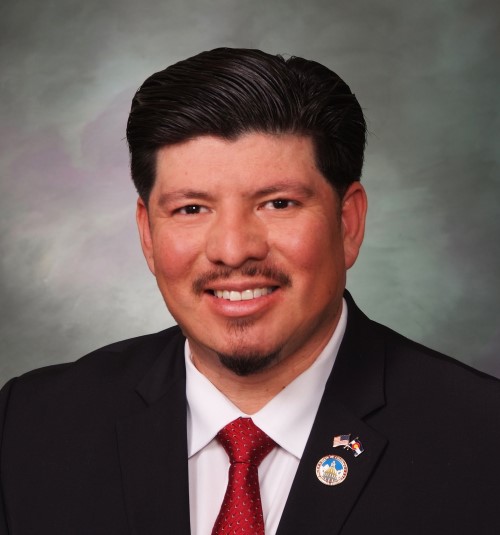
Rep. Carlos Barron
Sponsored bills
Maddy summaryHouse Joint Resolution 25-1024 authorizes the installation of a memorial on the State Capitol Grounds to honor the victims of the Sand Creek Massacre of November 29, 1864. The bill designates the former location of the "Union Soldier" statue on the west grounds of the capitol as the appropriate site for this memorial. Its purpose is to respect and memorialize the Cheyenne and Arapaho people and their ancestors, promote cross-cultural understanding, and educate the public about the massacre.
Maddy summaryHouse Joint Memorial 25-1001 serves to memorialize former Representative Rodney Bockenfeld, who passed away on February 13, 2025, at the age of 69. The resolution pays tribute to his years of dedicated public service as both an Arapahoe County Commissioner and a State Representative and extends sympathy to his family.
Maddy summaryHouse Joint Resolution 25-1022 designates May 2025 as "Motorcycle Safety Awareness Month" in Colorado. This resolution, affecting motorcycle riders and all motorists, aims to promote safety through education and training and encourages motorists to "share the road."
Maddy summarySenate Joint Resolution 25-017 designates the North Academy Bridge spanning Interstate 25 in Colorado Springs as the "Naval Aviation Pilot and Aviation Machinist Mate Petty Officer First Class Daniel T. Griffin Bridge." This resolution honors Daniel T. Griffin, recognized as the first Coloradan killed during the attack on Pearl Harbor. It also allows the Colorado Department of Transportation to explore a cooperative agreement with the Colorado Springs City Council for the maintenance of the bridge's signs.
The bill requires the public utilities commission (commission) to evaluate electrical generation and grid resilience against geomagnetic storms (evaluation) and report the findings of the evaluation to the general assembly. The bill requires each electrical utility that is subject to the jurisdiction of the North American Electric Reliability Corporation to annually submit a critical energy infrastructure information request to the federal energy regulatory commission. If the utility receives the permission, each of these electrical utilities must annually brief the general assembly on the utility's contingency action plan and any information necessary to: Evaluate the ability of and identify shortfalls to restoring electrical power operation, fuel delivery, and equipment function within specified time frames following certain types of geomagnetic storms; and Evaluate the certification of hardware and software monitoring and controlling systems for energy generation and distribution. The bill sets standards for the evaluation. Based on the evaluation, the commission shall adopt rules requiring an electrical utility to meet resiliency standards for geomagnetic storms. The rules include: Requiring the monitoring of the space weather prediction center of the national oceanic and atmospheric administration in order to isolate large power transformers and power generation from the grid; Mechanically isolating critical components if or when a coronal mass ejection is likely to cause geomagnetically induced currents; Restricting or closing fuel pipeline valves to mitigate damage in a sectional failure; Installing automatic neutral ground blocking devices in large power transformers; Ensuring that computer equipment can be mechanically isolated from the grid and sheltered from geomagnetically induced surges; Requiring all networked systems that operate electrical generation and distribution to be electronically and physically separable from the outside networks; and Requiring the cyber-certification of hardware and software that operate electrical generation and distribution. (Note: Italicized words indicate new material added to the original summary; dashes through words indicate deletions from the original summary.) (Note: This summary applies to the reengrossed version of this bill as introduced in the second house.)
The concurrent resolution submits a constitutional amendment to the voters of the state at the 2026 general election that will, if approved, add to the nonexclusive list of inalienable rights of all persons the right to direct the upbringing, education, and care of their children.(Note: This summary applies to this concurrent resolution as introduced.)
The act encourages each local education provider to adopt a policy to reduce food waste in school cafeterias and food preparation facilities (policy). The policy may address food waste diversion and aversion initiatives, including composting, donation of excess food to local nonprofits, or share table programs that permit students to return whole food or beverage items for redistribution to other students. A local education provider that implements a policy shall comply with all applicable sanitation and health requirements, including protocols to prevent student exposure to allergens, and shall require school personnel to complete related safety training. Current law establishes the Colorado circular communities enterprise (enterprise) to award grants and other funding and to provide technical assistance to certain entities throughout the state that pursue a circular economy for waste management, including waste diversion and aversion. The act requires the enterprise to consider reducing food waste by incentivizing public schools to develop and implement effective composting, excess food donation, or share table programs. The act extends limited immunity from civil and criminal liability to school personnel and local education providers that supervise food and beverage redistribution in accordance with policies that include share tables. (Note: This summary applies to this bill as enacted.)

The act clarifies that the child of an inbound active duty military member (member) who has an existing individualized education program (IEP) or existing section 504 plan is eligible for open enrollment, remote enrollment, and guaranteed matriculation. The act requires the school district, district charter school, or an institute charter school (local education provider) where the child enrolls to ensure the student receives the appropriate services and accommodations, consistent with the child's existing IEP or section 504 plan, without unreasonable delay upon enrollment. The act requires each local education provider to take reasonable steps to notify members and their families of their rights, including providing information on special education services to prevent inadvertent exclusion and to ensure members and their families are fully informed of available supports. (Note: This summary applies to this bill as enacted.)

The act requires the division of fire prevention and control, which hosts the wildfire information and resource center website and provides information regarding active wildfires on the website, to include hyperlinks to websites that display emergency information and wildfire updates for each county in Colorado and to coordinate with county governments in order to provide the hyperlinks. (Note: This summary applies to this bill as enacted.)