

If approved by a vote of at least 55% of the voters of the state voting on the issue at the 2026 general election, the concurrent resolution prohibits a person from being a state representative or senator for a term of office that immediately follows a term for which the person was appointed to fill a vacancy in the general assembly for that office.(Note: This summary applies to this concurrent resolution as introduced.)
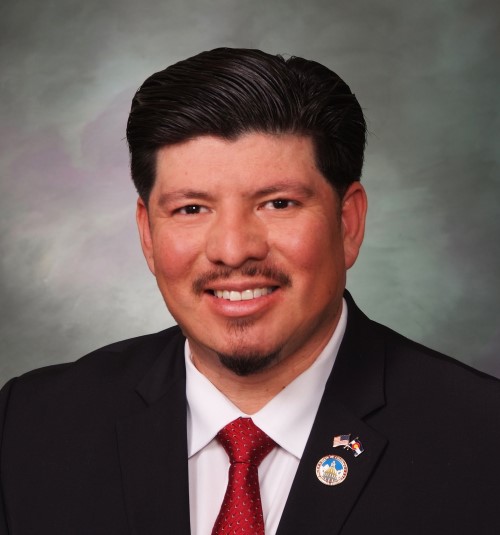
Rep. Carlos Barron
Sponsored bills
In 1975, the general assembly enacted the original "Interstate Compact on Placement of Children" (compact). In 2024, the general assembly enacted an updated version of the compact. The act clarifies that the original compact remains in effect until the updated compact is enacted into law by 35 states. (Note: This summary applies to this bill as enacted.)
Maddy summarySJR 25-008 designates March 3, 2025, as "Buy Colorado Day" (also called "303 Day") and March 3-10, 2025, as "Buy Colorado Week" to encourage Coloradans to support local businesses. The resolution urges residents to spend money at homegrown Colorado brands and enterprises, highlighting the state's diverse business community including restaurants, breweries, agricultural producers, and retailers. This symbolic measure has no legal force and serves as a recognition of Colorado's economic contributions, not a new policy or requirement. It directly affects all Coloradans by promoting a voluntary shift in consumer behavior toward local spending.
Maddy summarySJR 25-018 recognizes April 2025 as Sexual Assault Awareness Month and designates April 30, 2025, as Colorado Denim Day. The resolution symbolically supports the annual Denim Day observance, which began in Colorado in 2013, to raise awareness about sexual violence and honor the work of organizations like the Colorado Coalition Against Sexual Assault (CCASA). It highlights ongoing challenges such as evidence kit backlogs and the need for survivor support services, without creating new laws or funding. This is a ceremonial resolution, not a policy change, aligning Colorado with the global Denim Day movement that uses wearing jeans to protest attitudes condoning sexual assault.
Maddy summaryThis House Resolution (HR 25-1004) designates March 31, 2025, as "Cesar Chavez Day" in Colorado to honor Cesar Chavez and Dolores Huerta. It recognizes their shared legacy in advocating for farm workers' rights, including organizing the United Farm Workers, securing union contracts, and improving workplace safety and fair treatment. The resolution has no legal effect or policy changes - it is purely commemorative, expressing the House's acknowledgment of their historical contributions. It does not directly affect any individuals or create new obligations. The resolution was passed by the Colorado House of Representatives and signed by the Speaker.
The act merges 2 existing medicaid waiver programs for children into one children's home- and community-based services waiver program, known as the children with complex health needs waiver program. The act relocates provisions to the new program due to the repeal of the 2 existing waiver programs. (Note: This summary applies to this bill as enacted.)
The act expands the definition of an anti-growth law, which local governmental entities are generally prohibited from enacting or enforcing, to include a generally applicable land use law that, in census urban areas as defined by the United States census bureau, explicitly decreases the permitted residential density or residential uses of land to a lower residential density or fewer residential uses than were allowed by the land's usage and zoning as of July 1, 2025, without ensuring a corresponding increase of residential density or residential uses elsewhere in the jurisdiction. The act provides that certain limitations on anti-growth laws do not apply to land that contains or is directly adjacent to a wildlife crossing structure. The act also permits a municipality to seek a judicial determination as to the legality of a proposed municipal initiative for a land use ordinance that restricts or limits the development or use of land that is submitted to the legislative body of the municipality, allows the owners of a property that is specifically subject to the proposed ordinance and persons designated as representing the petition proponents to intervene in the proceeding, and tolls the period within which the municipality is required to adopt the proposed initiated ordinance or call an election during the pendency of the judicial determination. (Note: This summary applies to this bill as enacted.)
The act eliminates the statutory cap on the number of veterinary students permitted to attend Colorado state university at one time. The act eliminates additional financial limitations related to the professional veterinary medicine program at Colorado state university, including eliminating the university's bonding authority with respect to the veterinary medicine program. (Note: This summary applies to this bill as enacted.)
The statutory definition of "clean energy" determines which energy projects are eligible for clean energy project financing at the county and city and county level. The statutory definition of "clean energy resource" determines which energy resources may be used by a qualifying retail utility to meet the 2050 clean energy target. The act updates the 2 statutory definitions to include nuclear energy; except that, for property valuations made for tax purposes, the act exempts from the definition of "clean energy resource" nuclear energy. (Note: This summary applies to this bill as enacted.)
The act requires the Colorado bureau of investigation (CBI) to spend $3,000,000 in specifically appropriated money from House Bill 24-1430, concerning the provision for payment of the expenses of the executive, legislative, and judicial departments of the state of Colorado, and of its agencies and institutions, for and during the fiscal year beginning July 1, 2024, except as otherwise noted, on backlogged DNA evidence and sexual assault kit tests, as well as DNA retesting related to CBI's laboratory misconduct that was discovered in 2023. Additionally, the act allows CBI to contract with external labs to perform the testing. The act requires CBI to create a dashboard on the department of public safety's website to update the public on the backlog at least every 30 days. CBI shall provide the general assembly with updates on the sexual assault kit backlog, including the number of cases pending, the number of tests CBI's lab conducted, the number of tests CBI contracted out, an update on CBI's laboratory staffing levels, the average turnaround time for a sexual assault kit test, and other relevant data points every 30 days from March 10, 2025, through June 30, 2026. (Note: This summary applies to this bill as enacted.)