The act requires that an applicant for a building permit or a construction permit for a project with a total construction cost of more than $1 million (permit) file with the permitting agency, prior to commencing work under the permit, a signed declaration under penalty of perjury verifying that any person working under the permit maintains valid workers' compensation insurance coverage for the duration of the permit. A person may file a complaint with the division of workers' compensation in the department of labor and employment alleging a person's workers' compensation insurance coverage is not in compliance with the state's workers' compensation laws.(Note: This summary applies to this bill as enacted.)
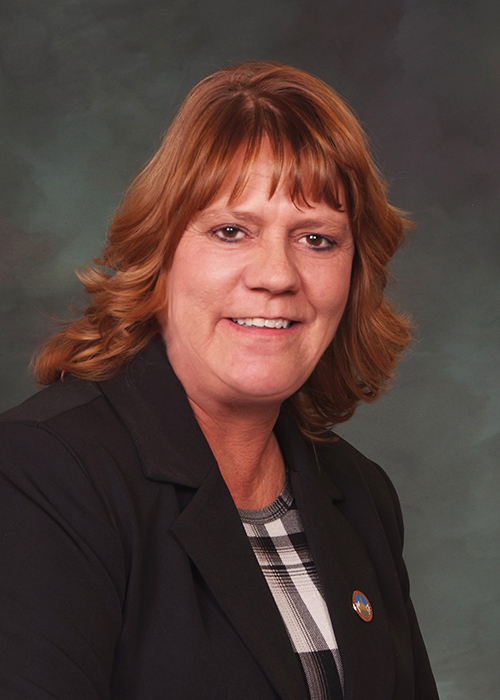
Rep. Tisha Mauro
Sponsored bills
The act authorizes the secretary of state (secretary) to:Mark as void or remove from the system an entity filing and adjust the entity's status if an electronic payment for the entity filing fee is reversed or is not completed; andMark a business record with a notice that an entity has received a complaint or is under investigation without referring a complaint about the entity to the attorney general if the secretary receives a notice from the attorney general that the entity being listed as the registered agent was created or registered without authorization or for fraudulent purposes. The act prohibits using a fraudulent entity as a registered agent in a business entity filing. Colorado law provides an administrative process for determining if an entity filing is made fraudulently or otherwise violates the law when a complaint is made (violation). When a complaint is filed, the secretary may note on the entity's records a notice of the complaint and investigation. If such a determination is made, the entity filings may be canceled and the filers penalized. The procedures require the attorney general to notify the entity's registered agent. If the entity does not reply, the complaint is deemed to be conceded. The act:Authorizes the attorney general to provide written notice to any other point of contact that the attorney general determines through investigation to be a means to reach the entity, if the address of the registered agent is the same as the address of the complainant;Repeals a requirement that a second 21-day notice be mailed before the complaint is deemed to be conceded;Authorizes a person that is injured by a violation to bring an action to dissolve the entity; andAuthorizes the secretary to take certain actions against another entity that also uses the same fraudulent or unauthorized entity as its registered agent. Under current law, actions to dissolve an entity must be brought in the district court for the county where the entity's principal office is located; if the entity has no principal office in this state, where the registered agent is located; or, if the entity has no registered agent, in Denver. The act authorizes the action to be brought in Denver when the dissolution is based on a fraudulent filing. The act also sets up a procedure through which, if the secretary has a reasonable basis to believe that a record is fraudulent or unauthorized based on the response or failure to respond to an interrogatory, the secretary may:Mark the record with a notice that the record is unauthorized or fraudulent and declare the entity delinquent;Redact the unauthorized address or name from the record and from any other relevant records;Disable filing functionality on the entity's records; andProceed with administrative procedures. A person aggrieved by any of these actions may request the secretary to reverse the actions taken. If the secretary denies the request, the aggrieved person may seek judicial review in Denver. To implement the act, $193,954 is appropriated from the department of state cash fund to the department of state.(Note: This summary applies to this bill as enacted.)
The act implements the recommendation of the department of regulatory agencies' sunset review and report in continuing the registration program for vessels until September 1, 2036. The act also makes changes to definitions of 'vessel' and adds a definition of 'vessel livery'. Current law requires that the records of a vessel livery related to hired vessels be preserved for at least 30 days after the vessel is to be returned to the vessel livery. The act extends this period to 3 years after the vessel is to be returned to the vessel livery. Current law provides that an individual who violates provisions related to the minimum age of motorboat operators is subject to a fine of $100. The act changes 'individual' to 'person'.(Note: This summary applies to this bill as enacted.)
The act changes the purpose of the small business recovery and resiliency loan program (program) from supporting small businesses recovering from the economic crisis caused by COVID-19 to supporting Colorado's small businesses regardless of COVID-19 impacts. The act provides that money in the small business recovery and resiliency fund (fund) may be matched by participants in the program at a ratio of $1 of fund money for every $1 of money from other sources. Once the money from the fund is matched by other sources and comprises a tranche, the act specifies that the money from the tranche may be used for loans or to purchase participation interest in loans for businesses as determined by the program oversight board (board), including working capital and the purchase of equipment. The act allows a deferral of principal and interest payments on a loan made through the program for circumstances of hardship and repeals the requirement that the hardship must be caused by the COVID-19 pandemic or ongoing economic conditions. The act repeals a requirement that money from the fund must be proportionally reserved for applications from eligible borrowers located in a county based on the county's metrics related to small businesses, as determined by the board, for an initial period of time and that the money must be allocated to a county. Instead, the act requires each tranche of loan funding to be used to fund businesses across the state over the duration of the program and to maintain targets and support businesses located in rural counties and businesses owned by women, minorities, or veterans. The program will track the distribution of capital to counties. The act requires the state treasurer to transfer $5 million from the fund to the Colorado startup loan program fund on June 30, 2026.(Note: This summary applies to this bill as enacted.)
The act prohibits using an automated driving system to drive a commercial motor vehicle unless an individual who holds a commercial driver's license is in the vehicle, monitors the vehicle's driving, and intervenes, if necessary, to avoid illegal or unsafe driving. The individual must be in the driver's seat if hazardous materials are being transported. The penalty is $1,000 for a first offense, is $2,000 for a second offense, and doubles for each subsequent offense. The act does not apply to a light-duty vehicle or a truck-mounted attenuator. The prohibition is repealed September 1, 2031. The chief of the Colorado state patrol will analyze the act's effects on commercial vehicle safety on highways. By November 1, 2030, the chief of the Colorado state patrol will issue a report to the relevant committees of the house of representatives and senate. The report must make recommendations as whether to continue the prohibition and, if continued, any recommended legislation to improve the prohibition. For the 2026-27 state fiscal year, $14,357 is appropriated to the department of revenue from the Colorado DRIVES vehicle services account in the highway users tax fund to implement the act.(Note: This summary applies to this bill as enacted.)
The act extends for an additional 10 years the availability of the state income tax credit allowed to a taxpayer who makes a qualifying monetary contribution to promote child care in the state equal to 50% of the total value of the contribution, not to exceed $100,000, through income tax years commencing prior to January 1, 2038.(Note: This summary applies to this bill as enacted.)
The act makes the following changes to the 'Labor Peace Act':Specifies that employees' right to bargain collectively includes the right to bargain collectively concerning any mandatory subject of bargaining;Eliminates the requirement for a second election to negotiate a union security agreement clause in the collective bargaining process;Declares that it is not an unfair labor practice for an employer to refuse to agree to a lawful proposal made by the exclusive representative of the employees, or for the exclusive representative of the employees to refuse to agree to a lawful proposal made by the employer, concerning a mandatory subject of bargaining if the refusing party has bargained in good faith with the other party; andRequires employers and employees, through their exclusive representative, to bargain in good faith.(Note: This summary applies to this bill as enacted.)
The act:Increases the statewide base per pupil funding for the 2026-27 budget year by $208.60 to account for inflation;Sets a new statewide base per pupil funding amount for the 2026-27 budget year at $8,900.40; andSets the total program funding for the 2026-27 budget year at $10,178,856,871. Under current law, there are 2 total program formulas that are used to determine a school district's total program, commonly referred to as the old formula and the new formula. A school district's funded pupil count is a figure that is used as a part of determining a school district's total program. Under the new formula, for the 2026-27 budget year and each budget year thereafter, a school district's funded pupil count is calculated by determining the greater of the school district's pupil enrollment for the applicable budget year or the average of the district's pupil enrollment for the applicable budget year and the immediately preceding 2 budget years. However, the act requires that when specified conditions are met, a school district's funded pupil count is the school district's online pupil enrollment for the budget year, plus the school district's supplemental kindergarten enrollment for the budget year, plus the school district's extended high school pupil enrollment for the budget year, plus the greater of:The school district's pupil enrollment for the budget year;An amount equal to 50% of the school district's pupil enrollment for the budget year, plus an amount equal to 30% of the school district's pupil enrollment for the preceding budget year, plus an amount equal to 20% of the school district's pupil enrollment for the budget year that is 2 years preceding the budget year; orAn amount equal to 97% of the school district's pupil enrollment for the preceding budget year. A school district's cost of living factor is a figure that is used as a part of determining a school district's total program. Under the old formula and the new formula, the act requires the cost of living factor that was used for the 2025-26 budget year to apply in the 2026-27 budget year. Under current law, for the 2026-27 budget year, a district's total program is the greater of:The district's total program amount for the 2024-25 budget year; orThe amount calculated for the 2025-26 budget year under the old formula plus an amount equal to 30% of the difference between the amounts calculated between the old formula and the new formula. The act clarifies that for the 2026-27 budget year, if the calculation under the new formula is less than the calculation under the old formula, then that district's total program for the 2025-26 budget year is the greater of:The district's total program amount for the 2024-25 budget year under the old formula; orThe amount calculated for the 2026-27 budget year under the old formula. The act permits a school transformation grant recipient that is implementing a priority improvement or turnaround plan to use the grant award to plan for and implement rigorous redesign strategies. The act changes the provisions that determine the amounts of total program that school districts and the state charter school institute distribute to their charter schools. Related to the changes of these provisions, the act repeals at-risk supplemental aid for charter schools. The act exempts from a future repeal the general assembly's legislative declaration that using state education fund money for maintaining a website that explains major categories in the chart of accounts for local education providers is a permissible use of state education fund money. The act repeals the scheduled repeal of, resulting in a continuation of, a statute that authorizes contingency reserve fund payments to be used for rural or small rural school districts if an unusual financial burden would be caused by the withholding of local property taxes due to a delay in filing the audit report due to extraordinary problems that could not have been reasonably foreseen or prevented by the rural or small rural school district. The act adds an assistant superintendent, a vice principal, and an assistant principal to the list of eligible school employees who may receive a salary without a reduction in public employees' retirement association (PERA) benefits if the service retiree meets specified conditions. The act permits a local education provider to request that the department of education approve the local education provider's use of pencil and paper to complete any or every portion of a state assessment for grades 3 or 4 and requires that the local education provider be responsible for costs owed to the vendor that are associated with the administration of the assessment using pencil and paper. The act authorizes the state board of education to adopt rules that are necessary to determine the district of residence of a child with a disability for a circumstance that is not described under law. The act repeals the requirement that $500,000 be distributed to administrative units that enroll children with disabilities and instead requires that $1 million be distributed to fund reimbursements for administrative units that pay tuition or education expenses that ensure a free appropriate public education for a student in out-of-home placement who has an individualized education program. The act requires the department of education to engage stakeholders concerning public placements in facility schools and on the issue of whether to make recommendations concerning such placements to the state board of education regarding rules or to the general assembly regarding statutes. Under current law, each participating school food authority that satisfies certain requirements is eligible to receive a local food purchasing grant and an amount to increase wages or stipends for individuals employed to prepare and serve school meals. The act clarifies that a charter school that operates under a participating school food authority is eligible for the awards. The act:Prohibits a board of cooperative services (BOCES) from acting as a statewide authorizer of programs or schools; andLimits a BOCES to operating a school or program outside the geographic boundaries of its school district members, unless specified conditions are satisfied. The act permits a local education provider to offer one or more part-time programs for homeschool students if specified conditions are satisfied. The act requires an authorizer contracting with an education management provider to maintain appropriate independence from, and oversight of, the education management provider. The act prohibits a school district from creating a contract school that is a full-time complete educational program offered exclusively by a private entity pursuant to a contract with the public entity. The act appropriates:$3,755,558 to the department of education from the state education fund for the state share of districts' total program;$313,395 to the department of education from the state education fund for management and administration for information technology services and for use by school district operations for administration related to public school finance; and$3,385,203 to the department of education from the state education fund for school district operations for costs associated with holding charter schools harmless for changes in the distribution of total program funding. The act adjusts the 2026-27 long bill by decreasing:$8,502,195 from the appropriation from the state education fund to the department of education for the state share of districts' total program funding; and$3,504,995 from the appropriation from the state education fund to the department of education for use by school district operations for at-risk supplemental aid.(Note: This summary applies to this bill as enacted.)

The act requires an institution of higher education (institution) that operates a student health center to provide abortion medication to all students enrolled at the institution. The act requires an institution that has an on-site prescription drug outlet or other outlet to maintain a stock of and provide access to abortion medication to students enrolled at the institution. The act requires an institution that does not have an on-site prescription drug outlet or other outlet to either submit a prescription for abortion medication to an off-campus prescription drug outlet or other outlet or dispense abortion medication through the institution's student health center if permitted by the student health center's licensure. The act prohibits an institution from knowingly providing personally identifiable information contained in a student's patient records, billing records, or precise location data related to accessing abortion medication in response to a request from another state seeking to impose liability for accessing abortion medication. An institution is not required to provide access to or stock abortion medication if doing so would jeopardize an institution's federal grant participation, require the institution to deviate from generally accepted billing practices, modify the generally accepted standards of medical practice, or conflict with the institution's sincerely held religious beliefs or practices.(Note: This summary applies to this bill as enacted.)

Beginning on January 1, 2027, the act authorizes an optional collision prevention fee (fee), which is collected at the time of registration of a passenger motor vehicle, light-weight truck, motorcycle, or recreational vehicle (motor vehicle). An individual may decline to pay the fee when registering a motor vehicle, and nonpayment of the fee does not affect the individual's ability to register the motor vehicle. In connection with imposing the fee, the statewide bridge and tunnel enterprise (enterprise) within the department of transportation (department) is required to collaborate with:The department of revenue and county clerks to develop language to notify individuals about the fee, including explicit language regarding the ability to decline to pay the fee and the fact that nonpayment of the fee will not affect an individual's ability to register a motor vehicle; andThe department of revenue, the department, county clerks, the division of parks and wildlife, and other impacted stakeholders to conduct a public outreach campaign to educate the public about the fee and what benefits the fee will provide. The enterprise is required to initiate the public outreach campaign as soon as practicable and must develop and deliver customer-facing educational materials to county clerks on or before December 1, 2026.The fee amount is set at $5 and, beginning in state fiscal year 2028-29, the enterprise is allowed to adjust this fee amount upward for inflation. 75% of the revenue from the fee is credited to the newly created collision prevention fund (fund), which is continuously appropriated to the enterprise for use in the following ways:To fund wildlife safe passage projects, defined as one or more projects that reduce wildlife-vehicle collisions and improve habitat connectivity by providing wildlife road crossings;To provide matching money as required by federal grant programs relating to wildlife safe passage projects; To expend for administrative and personnel expenses related to those purposes; andTo promote the fee and fund to maximize participation in the optional fee, in collaboration with the department of revenue, impacted stakeholders, and interested organizations.In determining which wildlife safe passage projects the enterprise will undertake, the enterprise is required to:Consult with the division of parks and wildlife (division) and the Colorado wildlife and transportation alliance;Consult with the tribal government if the project is on or adjacent to tribal land;Consult with relevant local governments with jurisdiction over the area of the proposed project and any relevant local organizations engaging in work to reduce vehicle collisions;Consider studies concerning the prioritization of wildlife within the state;Consider whether the wildlife safe passage project is related to a bridge or tunnel project undertaken by the enterprise; andIn consultation with the division, consider opportunities for landowner agreements or additional conservation efforts that may be necessary to ensure the continued functionality of infrastructure associated with a proposed wildlife safe passage project. 25% of the revenue from the fee is credited to the wildlife cash fund and continuously appropriated to the division to provide services related to wildlife connectivity and wildlife crossing-related conservation efforts. The act also modifies the process for the keep Colorado wild pass fee, which is an existing optional fee paid at the time an individual registers a motor vehicle, to align with the process for the collision prevention fee by removing the presumption that an individual who declines to pay the keep Colorado wild pass fee is presumed to decline to pay that fee in subsequent years with respect to registration of the same motor vehicle. With this change, an individual must affirmatively opt out of the payment of both the keep Colorado wild pass fee and the collision prevention fee each year that the individual registers the motor vehicle. For the 2026-27 state fiscal year:$53,516 is appropriated from the DRIVES cash fund to the department of revenue for use by the division of motor vehicles; Of funds appropriated from the parks and outdoor recreation cash fund to the department of natural resources for use by the division, $778 is reappropriated to the department of revenue for use by the division of motor vehicles; and$19,940 is appropriated from the legal services cash fund, from revenue received from the department from the collision prevention fund, to the department of law to provide legal services for the department.(Note: This summary applies to this bill as enacted.)