Under current law, the Colorado job growth incentive tax credit (credit) may only be allowed by the economic development commission (commission) through state income tax year 2026. The act amends the Colorado job growth incentive tax credit to authorize the commission to allow new credit awards through state income tax year 2034. The act also extends the commission's annual reporting requirement through September 1, 2042.(Note: This summary applies to this bill as enacted.)
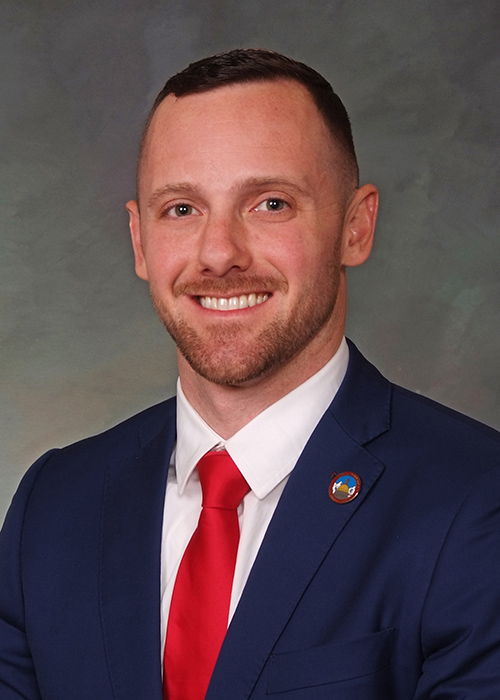
Rep. Jarvis Caldwell
Sponsored bills
The act requires a school district that is considering submitting to its voters a ballot question concerning capital construction to solicit proposals from its charter schools about their capital construction needs. The act specifies the solicitation process requirements and requires the school district to notify a charter school that submitted a proposal whether the school district will include the charter school's capital construction needs in the school district's ballot question or questions. If the school district decides not to include the charter school's capital construction needs in the ballot question, the notification must include the school district's reasons for the exclusion and must include an opportunity for the charter school to address issues raised by the school district. If the school district and charter school mutually agree to the content of the charter school's proposal, a school district that voluntarily submits to its voters a ballot question for the charter school's capital construction needs is not required to comply with the required solicitation process.(Note: This summary applies to this bill as enacted.)
The act extends for an additional 10 years the availability of the state income tax credit allowed to a taxpayer who makes a qualifying monetary contribution to promote child care in the state equal to 50% of the total value of the contribution, not to exceed $100,000, through income tax years commencing prior to January 1, 2038.(Note: This summary applies to this bill as enacted.)
Beginning on January 1, 2027, the act authorizes an optional collision prevention fee (fee), which is collected at the time of registration of a passenger motor vehicle, light-weight truck, motorcycle, or recreational vehicle (motor vehicle). An individual may decline to pay the fee when registering a motor vehicle, and nonpayment of the fee does not affect the individual's ability to register the motor vehicle. In connection with imposing the fee, the statewide bridge and tunnel enterprise (enterprise) within the department of transportation (department) is required to collaborate with:The department of revenue and county clerks to develop language to notify individuals about the fee, including explicit language regarding the ability to decline to pay the fee and the fact that nonpayment of the fee will not affect an individual's ability to register a motor vehicle; andThe department of revenue, the department, county clerks, the division of parks and wildlife, and other impacted stakeholders to conduct a public outreach campaign to educate the public about the fee and what benefits the fee will provide. The enterprise is required to initiate the public outreach campaign as soon as practicable and must develop and deliver customer-facing educational materials to county clerks on or before December 1, 2026.The fee amount is set at $5 and, beginning in state fiscal year 2028-29, the enterprise is allowed to adjust this fee amount upward for inflation. 75% of the revenue from the fee is credited to the newly created collision prevention fund (fund), which is continuously appropriated to the enterprise for use in the following ways:To fund wildlife safe passage projects, defined as one or more projects that reduce wildlife-vehicle collisions and improve habitat connectivity by providing wildlife road crossings;To provide matching money as required by federal grant programs relating to wildlife safe passage projects; To expend for administrative and personnel expenses related to those purposes; andTo promote the fee and fund to maximize participation in the optional fee, in collaboration with the department of revenue, impacted stakeholders, and interested organizations.In determining which wildlife safe passage projects the enterprise will undertake, the enterprise is required to:Consult with the division of parks and wildlife (division) and the Colorado wildlife and transportation alliance;Consult with the tribal government if the project is on or adjacent to tribal land;Consult with relevant local governments with jurisdiction over the area of the proposed project and any relevant local organizations engaging in work to reduce vehicle collisions;Consider studies concerning the prioritization of wildlife within the state;Consider whether the wildlife safe passage project is related to a bridge or tunnel project undertaken by the enterprise; andIn consultation with the division, consider opportunities for landowner agreements or additional conservation efforts that may be necessary to ensure the continued functionality of infrastructure associated with a proposed wildlife safe passage project. 25% of the revenue from the fee is credited to the wildlife cash fund and continuously appropriated to the division to provide services related to wildlife connectivity and wildlife crossing-related conservation efforts. The act also modifies the process for the keep Colorado wild pass fee, which is an existing optional fee paid at the time an individual registers a motor vehicle, to align with the process for the collision prevention fee by removing the presumption that an individual who declines to pay the keep Colorado wild pass fee is presumed to decline to pay that fee in subsequent years with respect to registration of the same motor vehicle. With this change, an individual must affirmatively opt out of the payment of both the keep Colorado wild pass fee and the collision prevention fee each year that the individual registers the motor vehicle. For the 2026-27 state fiscal year:$53,516 is appropriated from the DRIVES cash fund to the department of revenue for use by the division of motor vehicles; Of funds appropriated from the parks and outdoor recreation cash fund to the department of natural resources for use by the division, $778 is reappropriated to the department of revenue for use by the division of motor vehicles; and$19,940 is appropriated from the legal services cash fund, from revenue received from the department from the collision prevention fund, to the department of law to provide legal services for the department.(Note: This summary applies to this bill as enacted.)

The act requires a court to sentence a defendant convicted of second degree assault by strangulation in an enhanced range as a crime of violence subject to mandatory incarceration if the defendant has previously been convicted of second degree assault by strangulation. A previous conviction must be set forth in the complaint, indictment, or information for the present act.(Note: This summary applies to this bill as enacted.)

The act allows for a county, a landowner in the town, or a registered elector in the town to apply to the secretary of state (secretary) to determine a town is abandoned when a town:Has no board of trustees or town clerk;Is unable to hold an election; andOwns or operates infrastructure critical for the treatment or delivery of water to residents. The act authorizes the department of public health and environment to transfer up to $100,000 from the small communities water and wastewater grant fund to the department of public safety to cover the cost of operation and maintenance of a town's water system if an application for abandonment of the town has been filed with the secretary and the town has a water system that is failing or is likely to fail.(Note: This summary applies to this bill as enacted.)
The act requires a minor who is under 18 years old to have written permission of the minor's parent or legal guardian to obtain an instruction permit to drive a motorcycle. The act does not apply to emancipated minors.(Note: This summary applies to this bill as enacted.)
The act creates the 'Adults' Security and Safeguards from Exploitation in Transactions Act' or the 'ASSET Act'. The act requires or authorizes a qualified individual at a bank or credit union (financial institution) to do the following when the individual reasonably and in good faith suspects that a vulnerable adult is the victim of financial exploitation:The qualified individual must notify appropriate local law enforcement or the county agency handling adult protective services; andThe qualified individual may notify a third party previously designated by or reasonably associated with the vulnerable adult. A financial institution or qualified individual may delay a disbursement from an account if the financial institution or qualified individual:Reasonably believes that the vulnerable adult is subject to financial exploitation;Provides written notification of the delay and the reason for the delay to all parties authorized to transact business on the account within 2 business days after the requested disbursement; except that a party who is reasonably believed to have engaged in financial exploitation of the vulnerable adult need not be notified; andContinues its internal review of the suspected or attempted financial exploitation. The delay may continue until:The financial institution or qualified individual reasonably believes that the vulnerable adult is not subject to financial exploitation;Local law enforcement or the county agency handling adult protective services concludes its investigation; orA court orders that the delay be removed. A financial institution or qualified individual must make a determination within 90 days after beginning the delay of a disbursement or, if waiting on the investigation of local law enforcement or a county agency handling adult protective services, within 180 days. The disbursement must be made or refused based on the conclusions of the investigation or the expiration of the time. A financial institution and qualified individual are immune from liability arising from the actions or from failing to take the actions authorized in the act if the act or failure to act was made in good faith and exercising reasonable care. A financial institution must provide access to or copies of records that are relevant to the suspected or attempted financial exploitation of an vulnerable adult to agencies charged with administering state adult protective services laws and to law enforcement. The records made available to agencies are not public records, as defined in the 'Colorado Open Records Act'.(Note: This summary applies to this bill as enacted.)
Maddy summaryThis bill establishes a joint committee of five legislators to inform the Governor that the current legislative session is about to end. The committee, composed of three House members and two Senate members, will also ask the Governor if he has any final messages for the assembly. Although the bill was introduced in 2026, it was ultimately not passed as the Senate laid it on the table. Its primary function is a procedural step to ensure proper communication between the legislature and the executive branch at the conclusion of a session.
Current law requires certain entities to file, or allows certain entities to voluntarily file, a clean energy plan to achieve an 80% reduction in greenhouse gas emissions caused by the entity's electricity sales in Colorado by 2030, relative to 2005 levels (2030 emission reductions). The act repeals current law stating that clean energy plans submitted by a cooperative electric association or a municipally owned utility under certain circumstances are deemed approved by the public utilities commission (commission) and requiring the division of administration in the department of public health and environment (division) to consult with the commission in verifying a clean energy plan submitted by a cooperative electric association or a municipally owned utility. The act also repeals current law stating that voluntary submission of a clean energy plan by a cooperative electric association or a municipally owned utility does not alter the entity's regulatory status with respect to the commission. A municipally owned utility that has encountered challenges in achieving the 2030 emission reductions may submit to the division, no later than December 31, 2026, an updated clean energy plan that demonstrates achievement of the 2030 emission reductions by the earliest date possible on or after December 31, 2029, but no later than December 31, 2032. A municipally owned utility that submits an updated clean energy plan to the division must:Provide a detailed generation and transmission plan to the division with the updated clean energy plan;Provide an annual report to the division beginning January 1, 2028, and continuing each year until December 31, 2033, that contains certain information related to the updated clean energy plan;Cease burning coal by December 31, 2032; andSeek to achieve certain additional reductions in greenhouse gas emissions without impairing the municipally owned utility's ability to maintain certain electric reliability standards. The updated clean energy plan must be verified by the division.(Note: This summary applies to this bill as enacted.)