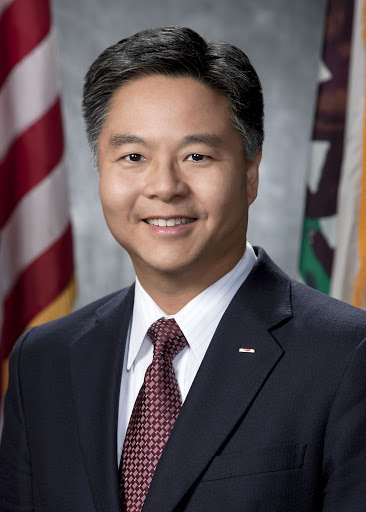
Photo of Ted Lieu
D California Senate · District 28

Sen. Ted Lieu

Compare
Total votes
20,360
all sessions
Attendance
93%
1,078 missed
Near the chamber average
With party
99%
of cast votes
Near the chamber average
Bipartisan score
1%
crosses aisle rarely
Near the chamber average
Sponsored
757
bills & resolutions
Near the chamber average
Committees
0
assignments
757 bills and resolutions

Sponsored bills

Total
757
Primary
208
Co-sponsor
549
This page
757
matching current filters
Co-sponsor ACR 11
Signed into law · California House · Co-sponsor
Relative to a Day of Remembrance.

This measure would declare February 19, 2013, as a Day of Remembrance in order to increase public awareness of the events surrounding the internment of Americans of Japanese ancestry during World War II.

Signed into law Mar 13, 2013 1 co-sponsor
Primary SB 1172
Signed into law · California Senate · Lead sponsor
Sexual orientation change efforts.

Existing law provides for licensing and regulation of various professions in the healing arts, including physicians and surgeons, psychologists, marriage and family therapists, educational psychologists, clinical social workers, and licensed professional clinical counselors. This bill would prohibit a mental health provider, as defined, from engaging in sexual orientation change efforts, as defined, with a patient under 18 years of age. The bill would provide that any sexual orientation change efforts attempted on a patient under 18 years of age by a mental health provider shall be considered unprofessional conduct and shall subject the provider to discipline by the provider's licensing entity. The bill would also declare the intent of the Legislature in this regard.

Signed into law Sep 30, 2012 0 co-sponsors
Co-sponsor SB 411
Vetoed · California Senate · Co-sponsor
Home Care Services Act of 2012.

Existing law provides for the In-Home Supportive Services (IHSS) program, a county-administered program under which qualified aged, blind, and disabled persons receive services enabling them to remain in their own homes. The IHSS program includes various eligibility requirements for individuals who provide services to recipients under the program. Under existing law, a private provider of in-home care services is not subject to the requirements of the IHSS program. Existing law provides for the licensing and regulation of various community care facilities by the State Department of Social Services. This bill would enact the Home Care Services Act of 2012, which would provide, on and after July 1, 2013, for the licensure and regulation of home care organizations, as defined, by the State Department of Social Services, and the certification of home care aides. The bill would exclude specified entities from the definition of a home care organization. The bill would impose various licensure requirements on a home care organization. The bill would also impose a civil penalty on an individual or entity that operates a home care organization without a license, except as specified. The bill would require a home care organization to provide a client with specified information before arranging for the provision of home care services, as defined, to that client, including, but not limited to, the types and hours of available home care services, and the extent to which payment may be expected from specified sources. In addition, this bill would require a home care organization, among other things, to distribute to the client its advance directive policy and provide a written notice to the client of certain rights. The bill would also prohibit a home care organization from hiring an individual as a home care aide unless that individual meets certain requirements, including, but not limited to, demonstrating that he or she has specified language skills and providing proof of certification as a home care aide as specified. The bill would require certain employment agencies to maintain liability insurance, as specified, and ensure that any person it refers to provide home care services has been certified prior to the referral. This bill would require background clearances for home care aides, as prescribed, and would set forth specific duties of the home care organization, the department, and the Department of Justice in this regard. The bill would require home care aides to demonstrate they are free of active tuberculosis. The bill would also require a home care organization to conduct regular evaluations of its home care aides, as specified. The bill would require the department to impose various fees to be deposited in the Home Care Organization and Home Care Aide Fund to be created by this bill. This bill, in addition, would prescribe enforcement procedures, fines, and penalties for violations of the act by a home care organization or a home care aide and violations of specified requirements by an employment agency, as defined.

Vetoed Sep 30, 2012 1 co-sponsor
Primary SB 691
Signed into law · California Senate · Lead sponsor
Unemployment insurance: use of information.

Under existing law, the information obtained in the administration of the Unemployment Insurance Code is for the exclusive use and information of the Director of Employment Development in the discharge of his or her duties and is not open to the public. However, existing law permits the use of the information for specified purposes. Existing law lists as a specified purpose to provide an authorized governmental agency with relevant information that relates to any specific workers' compensation insurance fraud investigation, as provided. Existing law provides that a person who knowingly accesses, uses, or discloses this confidential information without authorization is guilty of a misdemeanor. This bill would expand the definition of "authorized governmental agency" to include the Contractors' State License Board. This bill would require the director to provide the Agricultural Labor Relations Board with specified information for use in the investigation or enforcement of the Alatorre-Zenovich-Dunlap-Berman Agricultural Labor Relations Act of 1975. By requiring this information to be provided to the Contractors' State License Board and the Agricultural Labor Relations Board, this bill would expand the crime of unauthorized access, use, or disclosure of this information, and would impose a state-mandated local program. The California Constitution requires the state to reimburse local agencies and school districts for certain costs mandated by the state. Statutory provisions establish procedures for making that reimbursement. This bill would provide that no reimbursement is required by this act for a specified reason. This bill would incorporate additional changes in Section 1095 of the Unemployment Insurance Code, proposed by AB 174 and SB 1258 that would become operative only if this bill and either or both of those bills are chaptered and become effective January 1, 2013, and this bill is chaptered last.

Signed into law Sep 30, 2012 0 co-sponsors
Co-sponsor AB 2026
Signed into law · California House · Co-sponsor
Income taxes: credits: film: extension.

The Personal Income Tax Law and the Corporation Tax Law allow various credits against the taxes imposed by those laws, including a credit against those taxes for taxable years beginning on or after January 1, 2011, in an amount equal to a specified percentage of the qualified expenditures, as defined, attributable to the production of a qualified motion picture in California, or, where the qualified motion picture has relocated to California or is an independent film, as provided. Existing law allows specified qualified taxpayers to elect to assign the credit, requires specified information from qualified taxpayers that apply for a tax credit allocation, and imposes specified duties on the California Film Commission related to the administration of the credits, including a requirement to allocate the tax credits until July 1, 2015, and limits the aggregate amount of credits that may be allocated to qualified motion pictures in any fiscal year to $100,000,000, through the 2014–15 fiscal year. Existing law additionally allows, in lieu of the credits under the Personal Income Tax Law and the Corporation Tax Law for qualified motion pictures, a credit against qualified state sales and use taxes, as provided. This bill, under the Personal Income Tax Law and the Corporation Tax Law, would impose additional duties on the California Film Commission related to the administration of the credits and would extend the requirement to allocate the tax credits 2 additional years, until July 1, 2017. This bill would also extend the limit on the aggregate amount of credits that may be allocated through the 2016–17 fiscal year. This bill would also require assigning qualified taxpayers to provide the Franchise Tax Board with specified information, would revise the information included in an application for a tax credit allocation, and require the Legislative Analyst's Office to prepare reports related to the effectiveness and administration of the qualified motion picture credit under the Sales and Use Tax Law, the Personal Income Tax Law, and the Corporation Tax Law. This bill would require the California Film Commission to annually post on its Internet Web site and make available for public release specified information, including a list of qualified taxpayers and the tax credit amounts allocated to each qualified taxpayer by the commission. The bill would authorize various state agencies to disclose specified taxpayer information for purposes of the Legislative Analyst's Office report, and would impose specified criminal penalties on the disclosure of that information. By expanding the crime of knowingly and wrongfully accessing, using, or disclosing specified information, this bill would impose a state-mandated local program. The California Constitution requires the state to reimburse local agencies and school districts for certain costs mandated by the state. Statutory provisions establish procedures for making that reimbursement. This bill would provide that no reimbursement is required by this act for a specified reason. This bill would declare that it is to take effect immediately as an urgency statute.

Signed into law Sep 30, 2012 1 co-sponsor
Primary SB 956
Vetoed · California Senate · Lead sponsor
Buy-here-pay-here automobile sellers and lenders.

(1) Existing law prohibits a person from acting as a dealer in vehicles, as specified, without a license issued by the Department of Motor Vehicles. Existing law governs conditional sale contracts, as defined, for the purchase of motor vehicles, including the enforceability of those contracts. Existing law also governs lease contracts, as defined, for the lease of motor vehicles, including the enforceability of those contracts. Existing law, the California Finance Lenders Law, the violation of which is a crime, provides for the licensure and regulation of finance lenders by the Commissioner of Corporations, but exempts from its provisions a bona fide conditional contract of sale involving the disposition of personal property when that form of agreement is not used for the purpose of evading provisions of that law. This bill would enact the Buy-Here-Pay-Here Automobile Dealers Act. The bill would define a "buy-here-pay-here" dealer as a dealer, as defined, who enters into conditional sale contracts, as defined, or lease contracts, as defined, and assigns less than 90% of all unrescinded contracts to an unaffiliated 3rd-party finance or leasing source, within 45 days of the consummation of those contracts. The bill would exclude from this definition automobile sellers who meet specified requirements. This bill would require those dealers to obtain a finance lender license and subject them to specified other provisions of the California Finance Lenders Law. The bill would also define a "buyer-borrower" as a person who enters into a conditional sale contract or lease contract with a buy-here-pay-here automobile dealer. The bill would provide that the Department of Corporations would have regulatory jurisdiction over the lending and repossessing activities of buy-here-pay-here automobile dealers, as specified. This bill would govern the terms and conditions of contracts entered into by a buy-here-pay-here automobile dealer and the rights of the parties, including, but not limited to, requiring a notice to a buyer-borrower of specified rights under the contract. (2) Existing law, the Collateral Recovery Act, provides for the licensure and regulation of repossession agencies, as defined, and their employees by the Bureau of Security and Investigative Services within the Department of Consumer Affairs. This bill would impose additional requirements on a buy-here-pay-here automobile dealer seeking to repossess a vehicle, including, but not limited to, prohibiting a dealer from commencing repossession proceedings due to failure to make a scheduled loan payment prior to the 16th day following the day on which that payment was due, requiring a dealer to hire a licensed repossession agency to repossess the vehicle on the dealer's behalf, and prohibiting the dealer from charging the buyer-borrower a fee exceeding $500 for the dealer's costs in connection with the repossession. The bill would also establish a cap on interest rates that could be charged under a conditional sale or lease contract and require a buy-here-pay-here automobile dealer to allow a buyer-borrower 45 days to repay any penalties, fees, and other charges imposed by the dealer on the buyer-borrower in connection with past due payments that have been brought current. (3) The bill would state findings and declarations of the Legislature with regard to buy-here-pay-here automobile dealers. (4) Because this bill would expand the scope of a crime, the bill would create a state-mandated local program. The California Constitution requires the state to reimburse local agencies and school districts for certain costs mandated by the state. Statutory provisions establish procedures for making that reimbursement. This bill would provide that no reimbursement is required by this act for a specified reason.


Vetoed Sep 29, 2012 0 co-sponsors
Co-sponsor AB 1447
Signed into law · California House · Co-sponsor
Automobile sales finance: sellers.

The Rees-Levering Motor Vehicle Sales and Finance Act regulates conditional sales contracts for motor vehicles, and, among other things, requires a person selling or leasing a motor vehicle under a conditional sale contract to disclose certain information to the buyer of the vehicle. A willful violation of those provisions is a misdemeanor and may render the contract unenforceable. A seller who violates the provisions of the act may also be liable to the buyer for monetary damages. This bill would require a buy-here-pay-here dealer, as defined, to issue a 30-day or 1,000-mile warranty to the buyer or lessee of a used vehicle bought or leased at retail price, and would require the warranty to cover the engine, transmission, drive axle, front and rear wheel drive components, engine cooling system, brakes, front and rear suspension systems, steering, seatbelts, inflatable restraint systems, catalytic converter or other emissions components, heater, seals and gaskets, electrical, electronic, and computer components, alternator, generator, starter, and ignition system. The bill would require the buy-here-pay-here dealer to either repair those covered parts that fail or, at the buy-here-pay-here dealer's election, to cancel the sale or lease and reimburse the buyer or lessee, as specified. The bill would require the buy-here-pay-here dealer to pay 100% of the cost of labor and parts for any repairs under the warranty. The bill would void an agreement for the purchase or lease of a vehicle that waives, limits, or disclaims these requirements. The bill would provide that a warranty is deemed to have been issued if a buy-here-pay-here dealer fails to issue a warranty pursuant to these provisions. The bill would prohibit a buy-here-pay-here dealer from requiring the buyer to make payments in person, with the exception of the downpayment for the vehicle, would prohibit the buy-here-pay-here dealer from repossessing the vehicle or charging a penalty following timely payment of a deferred downpayment, as specified, would prohibit the buy-here-pay-here dealer from, after the sale of the vehicle, tracking the vehicle using electronic tracking technology and from disabling the vehicle with starter interrupt technology, except as specified, and would make a violation of these prohibitions a misdemeanor punishable by a fine of up to $1,000. By creating a new crime, this bill would impose a state-mandated local program. The bill would also make findings and declarations related to buy-here-pay-here dealers, and would authorize the Department of Motor Vehicles to promulgate any necessary regulations. The California Constitution requires the state to reimburse local agencies and school districts for certain costs mandated by the state. Statutory provisions establish procedures for making that reimbursement. This bill would provide that no reimbursement is required by this act for a specified reason.
Signed into law Sep 29, 2012 1 co-sponsor
Primary SB 1210
Signed into law · California Senate · Lead sponsor
Collection of criminal fines and penalties.

(1) Under existing law, in every case where a person is convicted of a crime and whose sentence includes parole, the court is required to assess a parole revocation fine, as specified, for deposit into the Restitution Fund in the State Treasury. This bill would require the court to assess an additional postrelease community supervision revocation restitution fine or mandatory supervision revocation restitution fine in every case where a person is convicted of a crime and is subject to postrelease community supervision or mandatory supervision, for deposit into the Restitution Fund in the State Treasury, a continuously appropriated fund. Because the bill creates a new source of revenue for deposit into the Restitution Fund, the bill would make an appropriation. (2) Existing law generally provides that in any case in which a defendant is ordered to pay restitution, the order to pay restitution shall be deemed a money judgment that is fully enforceable by the victim as if the restitution order were a civil judgment, and any portion of the restitution order that remains unsatisfied after a defendant is no longer on probation or parole is enforceable by the victim, as specified. This bill would also specify that any portion of a restitution order that remains unsatisfied after a defendant is no longer on postrelease community supervision or mandatory supervision is enforceable by the victim pursuant to those provisions. (3) Existing law requires the Department of Corrections and Rehabilitation to deduct and retain certain funds from the wages, trust account deposits, or settlement or trial awards of a prisoner for the payment of certain fees and fines, including restitution orders, restitution fines, and specified administrative fees, and also authorizes the department to collect funds from a parolee for the payment of restitution orders and fines, unless prohibited by federal law. Under existing law, these funds are required to be deposited in the Restitution Fund in the State Treasury. This bill would specify that, when a prisoner is punished by imprisonment in a county jail for a felony, an agency designated by the county board of supervisors is authorized to deduct and retain those funds, and would also authorize that agency to collect funds from a parolee. The bill would require these agencies to transfer these funds for deposit in the Restitution Fund, or would permit direct payment to the victim. If the board of supervisors designates the county sheriff as the collecting agency, the bill would require the board of supervisors to first obtain the concurrence of the county sheriff. (4) Existing law authorizes delinquent fines, state or local penalties, forfeitures, restitution fines and orders, and any other amounts imposed by a superior court upon a person or entity for criminal offenses, that total at least $100 in the aggregate, to be referred by the superior court, the county, or the state to the Franchise Tax Board for collection. This bill would also authorize the referral of delinquent fines, state and local penalties, forfeitures, restitution fines and orders, and other amounts imposed by a juvenile court to the board for collection.

Signed into law Sep 29, 2012 0 co-sponsors
Co-sponsor SB 1161
Signed into law · California Senate · Co-sponsor
Communications: Voice over Internet Protocol and Internet Protocol enabled communications service.

Under existing law, the Public Utilities Commission has regulatory authority over public utilities, including telephone corporations, as defined. This bill would, until January 1, 2020, prohibit the commission from regulating Voice over Internet Protocol (VoIP) and Internet Protocol enabled service (IP enabled service) , as defined, except as required or delegated by federal law or expressly provided otherwise in statute. The bill would prohibit any department, agency, commission, or political subdivision of the state from enacting, adopting, or enforcing any law, rule, regulation, ordinance, standard, order, or other provision having the force or effect of law, that regulates VoIP or other IP enabled service, unless required or delegated by federal law or expressly authorized by statute. The bill would specify certain areas of law that are expressly applicable to VoIP and IP enabled service providers. The bill would provide that its limitations upon the commission's regulation of VoIP and IP enabled services do not affect the commission's existing authority over non-VoIP and other non-IP enabled wireline or wireless service and do not affect the enforcement of any state or federal criminal law or local ordinances of general applicability that apply to the conduct of business, the California Environmental Quality Act, or a local utility user tax, among other things.

Signed into law Sep 28, 2012 1 co-sponsor
Primary SB 1275
Signed into law · California Senate · Lead sponsor
Vacancies in office: special elections.

Existing law requires the Governor to issue a proclamation calling a special election to fill a vacancy in the office of Representative in Congress or either house of the Legislature within 14 days of when the vacancy occurs. Existing law requires that a special general election be conducted to fill the vacancy on a Tuesday at least 112 days, but not more than 126 days, following the issuance of the election proclamation. Existing law requires that a special primary election be conducted on a Tuesday either 8 or 9 weeks prior to the date of the special general election, as specified. Existing law imposes deadlines relating to the filing of nomination papers for a candidate in a special primary election, as specified. Existing law also imposes deadlines for submitting an application for a vote by mail ballot in a special election. This bill would, instead, require that the special general election occur at least 126 days, but not more than 140 days, after the issuance of the election proclamation. In addition, this bill would require that the special primary election be conducted on a Tuesday either 9 or 10 weeks prior to the date of the special general election, as specified. This bill would also revise the deadlines relating to the filing of nomination papers for a candidate in a special primary election. The bill would require that an application for a vote by mail ballot in a special election be made in the same manner as for a regular election. By imposing new duties or higher levels of service on local elections officials, this bill would impose a state-mandated local program. The California Constitution requires the state to reimburse local agencies and school districts for certain costs mandated by the state. Statutory provisions establish procedures for making that reimbursement. This bill would provide that, if the Commission on State Mandates determines that the bill contains costs mandated by the state, reimbursement for those costs shall be made pursuant to these statutory provisions.

Signed into law Sep 28, 2012 0 co-sponsors
Showing 151 to 160 of 757 bills
Previous 1 15 16 17 76 Next