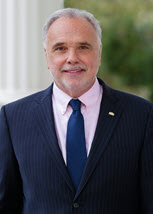
Photo of Mike Morrell
R California Senate · District 23

Sen. Mike Morrell

Compare
Total votes
18,326
all sessions
Attendance
95%
843 missed
Lower than 77% of chamber peers
With party
96%
of cast votes
Lower than 96% of chamber peers
Bipartisan score
3%
crosses aisle rarely
Higher than 93% of chamber peers
Sponsored
581
bills & resolutions
Lower than 87% of chamber peers
Committees
0
assignments
581 bills and resolutions

Sponsored bills

Total
581
Primary
183
Co-sponsor
398
This page
581
matching current filters
Co-sponsor SCA 1
In committee · California Senate · Co-sponsor
A resolution to propose to the people of the State of California an amendment to the Constitution of the State, by amending Sections 1, 5, 6, and 8 of, and adding Sections 11 and 12 to, Article XIX thereof, relating to transportation.

(1) Article XIX of the California Constitution restricts the expenditure of revenues from taxes imposed by the state on fuels used in motor vehicles upon public streets and highways to street and highway and certain mass transit purposes, and restricts the expenditure of revenues from fees and taxes imposed by the state upon vehicles or their use or operation to state administration and enforcement of laws regulating the use, operation, or registration of vehicles used upon the public streets and highways, as well as to street and highway and certain mass transit purposes. These restrictions do not apply to revenues from taxes or fees imposed under the Sales and Use Tax Law or the Vehicle License Fee Law. Article XIX prohibits the Legislature from borrowing revenues from taxes imposed by the state on fuels used in motor vehicles, and from using those revenues other than as specifically permitted by Article XIX. Article XIX provides that up to 25% of fuel tax revenues allocated to the state may be pledged or used for the payment of principal and interest on voter-approved transportation bonds issued for street and highway purposes on and after November 2, 2010, upon voter approval and appropriation by the Legislature. Article XIX provides that up to 25% of fuel tax revenues allocated to cities and counties may be pledged or used for the payment of principal and interest on voter-approved transportation bonds issued for street and highway purposes. However, in counties where voters have approved the use of fuel tax revenues for certain mass transit purposes, Article XIX provides that the Legislature may authorize any fuel tax revenues allocated to mass transit purposes to be pledged or used for payment of principal and interest on voter-approved bonds issued for those mass transit purposes. This measure would prohibit the Legislature from borrowing revenues from fees and taxes imposed by the state on vehicles or their use or operation, and from using those revenues other than as specifically permitted by Article XIX. The measure would also prohibit those revenues from being pledged or used for the payment of principal and interest on bonds or other indebtedness. The measure would delete the provision that provides for use of any fuel tax revenues allocated to mass transit purposes to be pledged or used for payment of principal and interest on voter-approved bonds issued for those mass transit purposes, and would instead subject those expenditures to the existing 25% limitation applicable to the use of fuel tax revenues for street and highway bond purposes. This measure would also restrict the expenditure of revenues from taxes imposed by the state on motor vehicle fuels used other than in motor vehicles upon public streets and highways, by requiring the use of those revenues for street and highway purposes, but only with respect to the portion of the affected revenues attributable to increases in tax rates that are effective on or after July 1, 2010. This restriction on expenditures would not apply if federal law requires another use of any portion of those revenues. The measure would also prohibit the Legislature from borrowing those revenues or pledging those revenues for debt service. (2) Article XI of the California Constitution requires the revenues derived under the Vehicle License Fee Law from a rate that does not exceed 0.65% of the market value of a vehicle to be allocated to cities and counties, and does not restrict expenditure of those revenues for a particular purpose. This measure would require revenues derived from that portion of the vehicle license fee rate that exceeds 0.65% of the market value of a vehicle to be used solely for street and highway purposes and would prohibit the Legislature from borrowing those revenues. The measure would also prohibit those revenues from being pledged or used for the payment of principal and interest on bonds or other indebtedness. (3) This measure would make other conforming changes.

In committee Sep 9, 2015 1 co-sponsor
Primary SB 408
Signed into law · California Senate · Lead sponsor
Midwife assistants.

The Licensed Midwifery Practice Act of 1993 provides for the licensing and regulation of midwives by the Medical Board of California. The license to practice midwifery authorizes the holder to attend cases of normal childbirth and to provide prenatal, intrapartum, and postpartum care, including family planning care, for the mother, and immediate care for the newborn. The Licensed Midwifery Practice Act of 1993 requires a midwife to refer to a physician and surgeon under prescribed circumstances. A violation of the Licensed Midwifery Practice Act of 1993 is a crime. The Nursing Practice Act provides for the licensure and regulation of the practice of nursing by the Board of Registered Nursing and authorizes the board to issue a certificate to practice nurse-midwifery to a person who meets educational standards established by the board or the equivalent of those educational standards. The Nursing Practice Act authorizes a certified nurse-midwife, under the supervision of a licensed physician and surgeon, to attend cases of normal childbirth and to provide prenatal, intrapartum, and postpartum care, including family-planning care, for the mother, and immediate care for the newborn, and provides that the practice of nurse-midwifery constitutes the furthering or undertaking by a certified person, under the supervision of a licensed physician and surgeon who has current practice or training in obstetrics, to assist a woman in childbirth so long as progress meets criteria accepted as normal. This bill would authorize a midwife assistant to perform certain assistive activities under the supervision of a licensed midwife or certified nurse-midwife, including the administration of medicine, the withdrawing of blood, and midwife technical support services. The bill would define terms for these purposes. The bill would prohibit a midwife assistant from being employed for inpatient care in a licensed general acute care hospital. By adding new requirements and prohibitions to the Licensed Midwifery Practice Act of 1993, the violation of which would be a crime, the bill would impose a state-mandated local program. The California Constitution requires the state to reimburse local agencies and school districts for certain costs mandated by the state. Statutory provisions establish procedures for making that reimbursement. This bill would provide that no reimbursement is required by this act for a specified reason.

Signed into law Sep 8, 2015 0 co-sponsors
Co-sponsor SB 11
In committee · California Senate · Co-sponsor
Environmental quality: transportation infrastructure.

The California Environmental Quality Act (CEQA) requires a lead agency, as defined, to prepare, or cause to be prepared, and certify the completion of, an environmental impact report (EIR) on a project that it proposes to carry out or approve that may have a significant effect on the environment or to adopt a negative declaration if it finds that the project will not have that effect. CEQA establishes a procedure by which a person may seek judicial review of the decision of the lead agency made pursuant to CEQA. This bill would exempt from these CEQA provisions a project that consists of the inspection, maintenance, repair, restoration, reconditioning, relocation, replacement, or removal of existing transportation infrastructure if certain conditions are met, and would require the person undertaking these projects to take certain actions, including providing notice to an affected public agency of the project's exemption. Because a lead agency would be required to determine if a project qualifies for this exemption, this bill would impose a state-mandated local program. This bill would also, in an action or proceeding seeking judicial review under CEQA, prohibit a court from staying or enjoining a transportation infrastructure project that is included in a sustainable communities strategy or an alternate planning strategy and for which a programmatic EIR has been certified unless it makes specified findings. For purpose of these provisions, the bill would specify that a transportation infrastructure project includes a project that consists of new construction of transportation infrastructure or a project that consists of the inspection, maintenance, repair, restoration, reconditioning, relocation, replacement, or removal of existing transportation infrastructure. The California Constitution requires the state to reimburse local agencies and school districts for certain costs mandated by the state. Statutory provisions establish procedures for making that reimbursement. This bill would provide that no reimbursement is required by this act for a specified reason.

In committee Sep 4, 2015 1 co-sponsor
Primary SB 647
Signed into law · California Senate · Lead sponsor
Real estate investments: securities: qualification exemption.

(1) Existing law, the Real Estate Law, requires any transaction that involves the sale of, or an offer to sell, a note secured directly by an interest in one or more parcels of real property, or the sale of an undivided interest in a note secured directly by one or more parcels of real property, to comply with specified requirements. Existing law limits, to the allowable percentage of the current market value of a property, as specified, the aggregate principal amount of the note or interest sold. Existing law requires a broker to make reasonable efforts to ensure the offer or sale of notes or interest in notes to be secured by a lien on real property or a business opportunity, meets certain criteria, including, among others, that the investment in the notes is suitable and appropriate for the purchaser. To meet this requirement, a broker may obtain a completed investor questionnaire from each person to whom the broker offers or sells the notes and deeds of trust. This bill would modify the allowable percentage of the current market value that can be sold, as specified. The bill would require the investor questionnaire to be completed within a specific time before the sale, modify the requirement for subsequent questionnaires, and remove the necessity of a broker obtaining an annually updated completed investor questionnaire from each person to whom the broker offered or sold notes and deeds of trust. The bill would update the address of the Real Estate Commissioner on a required notice. (2) Existing law, the Corporate Securities Law of 1968, provides that it is unlawful to offer or sell any security in this state unless the offer and sale of the security has been qualified with the Commissioner of Business Oversight, or the security or transaction is exempt from qualification. That law also provides that all offers and sales of a security are subject to antifraud provisions, which require information provided to offerees and purchasers to be true and to not omit any material facts necessary to prevent the statements made from being misleading. That law requires an issuer engaged in the business of purchasing, selling, financing, or brokering real estate, that relies on specified transactions exemptions or a securities exemption from qualification for an offering that involves the offer or sale of securities to a person who is not an accredited investor to provide additional information to the Commissioner of Business Oversight regarding the nature of the proposed offering on a form prescribed by the commissioner. This bill would remove from these requirements to provide additional information to the commissioner, an offering of securities that relies on an exemption for a security that is a promissory note secured by a lien on real property, which is neither one of a series of notes of equal priority secured by interests in the same real property nor a note in which beneficial interests are sold to more than one person or entity.


Signed into law Sep 3, 2015 0 co-sponsors
Co-sponsor SB 2
died · California Senate · Co-sponsor
Greenhouse Gas Reduction Fund.

Existing law requires all moneys, except for fines and penalties, collected by the State Air Resources Board from the auction or sale of allowances as part of a market-based compliance mechanism relative to reduction of greenhouse gas emissions to be deposited in the Greenhouse Gas Reduction Fund. Existing law continuously appropriates 60% of the annual proceeds of the fund to various purposes, including high-speed rail, transit and intercity rail capital, low-carbon transit operations, and affordable housing and sustainable communities. This bill would exclude from allocation under these provisions the annual proceeds of the fund generated from the transportation fuels sector. The bill would instead provide that those annual proceeds shall be appropriated by the Legislature for transportation infrastructure, including public streets and highways, but excluding high-speed rail.

died Sep 1, 2015 1 co-sponsor
Co-sponsor SB 736
Passed · California Senate · Co-sponsor
Escrow agents.

The Escrow Law requires the licensing of escrow agents by the Commissioner of Business Oversight, and further requires licensees to participate as members of the Escrow Agents' Fidelity Corporation, a nonprofit corporation established to pay members for loss of trust fund obligations, as specified. The law requires a licensed escrow agent to maintain a bond based on the previous year's average annual trust fund obligations, as specified. This bill would make findings and declarations regarding the role of Fidelity Corporation to support and enhance trust in licensed escrow agents, and specify that Fidelity Corporation is required to indemnify a member escrow agent against loss in accordance with the Escrow Law. The bill would state the intent of the Legislature for the commissioner to utilize the services of private 3rd parties, with prior escrow or escrow conservation, liquidation, or receivership experience, who are independent of the department to perform conservation, liquidation, and receiver functions, and would require the full amount of any penalty revenue, up to $125,000 at any one time, as specified, to be available for use by the commissioner to compensate an appointed conservator, liquidator, or receiver. The bill would also authorize the commissioner to utilize all or a portion of the bond or other required obligations, and all or a portion of a licensee's assets remaining following conservation, liquidation, or receivership to compensate an appointed conservator, liquidator, or receiver. By making this penalty revenue and other revenue available to the commissioner in this regard, this bill would make an appropriation.

Passed Aug 27, 2015 1 co-sponsor
Co-sponsor SB 417
Passed · California Senate · Co-sponsor
Law enforcement: United States Immigration and Customs Enforcement holds.

Existing law prohibits a law enforcement official, as defined, from detaining an individual on the basis of a United States Immigration and Customs Enforcement hold after that individual becomes eligible for release from custody, unless, at the time that the individual becomes eligible for release from custody, certain conditions are met, including, among other things, that the continued detention of the individual on the basis of the immigration hold would not violate any federal, state, or local law, or local policy, and that the individual has been convicted of, or arrested for, specified crimes. This bill would instead require a law enforcement official to detain an individual on the basis of a United States Immigration and Customs Enforcement hold for up to 48 hours, excluding Saturdays, Sundays, and holidays, after that individual becomes eligible for release from custody if that individual has been convicted of, or arrested for, specified crimes and if the continued detention of the individual on the basis of the immigration hold would not violate any federal law. By imposing additional duties on local law enforcement officers, this bill would impose a state-mandated local program. The bill would require a local agency that violates these provisions to pay a fine of $100,000, to be collected by the Attorney General, and would allow the Attorney General to commence a civil action to enforce the fine. The bill would require proceeds of the fine to be deposited in the Restitution Fund, a continuously appropriated fund. By increasing deposits to be made to a continuously appropriated fund, this bill would make an appropriation. The California Constitution requires the state to reimburse local agencies and school districts for certain costs mandated by the state. Statutory provisions establish procedures for making that reimbursement. This bill would provide that, if the Commission on State Mandates determines that the bill contains costs mandated by the state, reimbursement for those costs shall be made pursuant to these statutory provisions.

Passed Aug 27, 2015 1 co-sponsor
Co-sponsor SCR 70
Signed into law · California Senate · Co-sponsor
Relative to Student Safety Month.

This bill would designate the month of June 2015 as Student Safety Month, and would recognize the importance of providing young people with a learning environment and foundation that will promote successful careers and that will be the force to help California grow and prosper.

Signed into law Aug 26, 2015 1 co-sponsor
Showing 211 to 220 of 581 bills
Previous 1 21 22 23 59 Next