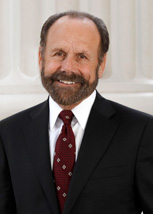
Photo of Jerry Hill
D California Senate · District 13 · Former member

Sen. Jerry Hill

Compare
Total votes
34,484
all sessions
Attendance
99%
121 missed
Higher than 94% of chamber peers
With party
99%
of cast votes
Near the chamber average
Bipartisan score
0%
crosses aisle rarely
Near the chamber average
Sponsored
1,209
bills & resolutions
Near the chamber average
Committees
0
assignments
1,209 bills and resolutions

Sponsored bills

Total
1,209
Primary
295
Co-sponsor
914
This page
1,209
matching current filters
Co-sponsor ACR 2
Passed · California Assembly · Co-sponsor
Relative to Spay Day USA 2011.

This measure would declare February 22, 2011, to be Spay Day USA 2011 in California, and would request that Californians observe that day by having their dogs and cats spayed or neutered and by contributing to organizations that provide spay and neuter services.

Passed Feb 23, 2011 1 co-sponsor
Co-sponsor ACR 19
Passed · California Assembly · Co-sponsor
Relative to Black History Month.

This measure would recognize February 2011 as Black History Month, urge all citizens to join in celebrating the accomplishments of African Americans during Black History Month, and encourage the people of California to recognize the many talents, achievements, and contributions that African Americans make to their communities.

Passed Feb 23, 2011 1 co-sponsor
Co-sponsor ACR 5
Passed · California Assembly · Co-sponsor
Relative to Martin Luther King, Jr. Day.

This measure would designate that January 17, 2011, be observed as the official memorial of the late Rev. Dr. Martin Luther King, Jr.'s birth, commemorate Martin Luther King, Jr. Day, the work of Dr. Martin Luther King, Jr., and the Civil Rights Movement in changing public policy in California and in the United States of America.

Passed Jan 24, 2011 1 co-sponsor
Co-sponsor SB 220
Vetoed · California Senate · Co-sponsor
Health care coverage: preventive health services: tobacco cessation.

Existing law, the federal Patient Protection and Affordable Care Act (PPACA) , enacts various health care coverage market reforms. With respect to plan years beginning on and after September 23, 2010, the act requires health insurance issuers to provide coverage, and not impose cost-sharing requirements, for certain preventive health services. PPACA also requires each state to, by January 1, 2014, establish an American Health Benefit Exchange that facilitates the purchase of qualified health plans by qualified individuals and qualified small employers, as specified. Existing law, the Knox-Keene Health Care Service Plan Act of 1975, provides for the regulation of health care service plans by the Department of Managed Health Care and makes a violation of the act a crime. Existing law provides for the regulation of health insurers by the Department of Insurance. Existing law requests the University of California to establish the California Health Benefits Review Program to assess legislation proposing to mandate a benefit or service and legislation proposing to repeal a mandated benefit or service, as specified. This bill would require certain health care service plan contracts and health insurance policies issued, amended, renewed, or delivered on or after September 23, 2010, to provide coverage, and not impose cost-sharing requirements, for certain preventive health services consistent with federal law. The bill would also require certain health care service plan contracts and health insurance policies issued, amended, renewed, or delivered on or after January 1, 2011, to provide coverage for tobacco cessation treatment that includes specified courses of treatment and medication. The bill would request the University of California, as part of the California Health Benefits Review Program, to prepare a report regarding any state savings as a result of this coverage requirement. The bill would make the coverage requirement inoperative upon a determination that it will result in the state assuming additional costs, as specified. Because a willful violation of the bill's provisions relative to health care service plans would be a crime, the bill would impose a state-mandated local program. The California Constitution requires the state to reimburse local agencies and school districts for certain costs mandated by the state. Statutory provisions establish procedures for making that reimbursement. This bill would provide that no reimbursement is required by this act for a specified reason.


Vetoed Nov 30, 2010 1 co-sponsor
Co-sponsor AB 2204
Failed · California Assembly · Co-sponsor
Developmental services: stakeholder groups.

Under existing law, the Lanterman Developmental Disabilities Services Act, the State Department of Developmental Services contracts with local, nonprofit regional centers to provide various services and supports to individuals with developmental disabilities. The department is required to consult with stakeholders for various reasons, including, but not limited to, coordinating client advocacy, planning programs, and creating alternative service delivery models to obtain services and supports. This bill would require the department, in convening stakeholder groups pursuant to the act, to take into account the state's ethnic, sexual orientation, gender identity, geographic, and socioeconomic diversity and to use best efforts to include stakeholder groups that, collectively, reflect the interests of the state's diverse population. The bill would also require the department to include in appropriate reports to the Legislature a description of how it has complied with the requirement of stakeholder group diversity.

Failed Nov 30, 2010 1 co-sponsor
Primary AB 1981
Failed · California Assembly · Lead sponsor
Recycling: waste tires: fees.

(1) The California Tire Recycling Act requires a person who purchases a new tire to pay a California tire fee and the revenue generated from the fee is deposited in the California Tire Recycling Management Fund, for expenditure by the Department of Resources Recycling and Recovery, upon appropriation by the Legislature, for programs related to the disposal of waste tires, except that a specified amount of the fee is designated for programs and projects that mitigate or remediate air pollution caused by waste tires. The tire fee is imposed upon, among other things, a new tire sold with a new or used motor vehicle, including the spare tire. Existing law authorizes the department to enter into a contract with the State Board of Equalization to collect the fee pursuant to the Fee Collection Procedures Law, which provides for criminal penalties for certain violations of that law. This bill would exclude, from the tire fee, a tire on a vehicle that is sold or leased by a new motor vehicle dealer. The bill would instead require a person who purchases or leases those vehicles to pay a California vehicle tire fee and would require the retail vehicle seller, as defined, to collect the California vehicle tire fee. The retail vehicle seller would be required to remit the fee, except as specified, to the state for deposit in the California Tire Recycling Management Fund. The bill would also make conforming changes with regard to the vehicle tire fee, including conforming changes to the Automobile Sales Finance Act. The bill would impose a state-mandated local program by creating new crimes with regard to the collection of the California new vehicle tire fee. The bill would require the State Board of Equalization, in consultation with the State Air Resources Board and the Department of Resources Recycling and Recovery, to submit a report to the Legislature, by January 1, 2012, regarding the fiscal effect of the imposition of the California vehicle tire fee. (2) The California Constitution requires the state to reimburse local agencies and school districts for certain costs mandated by the state. Statutory provisions establish procedures for making that reimbursement. This bill would provide that no reimbursement is required by this act for a specified reason.
Failed Nov 30, 2010 0 co-sponsors
Co-sponsor SB 1426
Failed · California Senate · Co-sponsor
State budget.

Existing law requires the Governor to submit to the Legislature, within the first 10 days of each calendar year, a budget for the ensuing fiscal year. Under existing law, the budget is required to contain a complete plan and itemized statements of all proposed expenditures and all estimated revenues of the state for the ensuing fiscal year, together with a comparison with the actual revenues and expenditures for the last completed fiscal year, the estimated revenues and expenditures for the existing fiscal year, and the budgeted revenues and expenditures for the next fiscal year. Existing law further requires the Director of Finance to provide to the Legislature, on or before May 14 of each year, an estimate of General Fund revenues for the current fiscal year and the ensuing fiscal year, any proposals to reduce expenditures to reflect updated revenue estimates, and specified proposed adjustments to the Governor's Budget. This bill would instead require the budget submitted by the Governor to contain itemized statements, provisional language, performance measurement standards for state agencies and programs, recommended state expenditures, and a projection of anticipated state revenues, including revenues anticipated to be one-time revenues. In addition, the bill would require the budget to contain an estimate of the total resources available for the state expenditures recommended for the budget year and the succeeding fiscal year, and would further require the budget to contain a projection of anticipated state expenditures and anticipated state revenues for the 3 fiscal years following the fiscal year succeeding the budget year, along with budget-related plans and proposals for those 3 fiscal years. In the event recommended expenditures exceed estimated revenues, the Governor would be required to recommend reductions in expenditures or the sources from which the additional revenues should be provided and to include an estimate of the long-term impact that the expenditure reductions or additional revenues will have on the state economy. The Governor would also be required to submit with the budget any legislation necessary to implement appropriations contained in the budget, together with a 5-year capital infrastructure and strategic growth plan. If the Governor's budget proposes to create a new state program or agency, or to expand the scope of an existing state program or agency, resulting in a net increase in state costs during the budget year or the succeeding fiscal year, or proposes to reduce a state tax resulting in a net decrease in state revenue in the budget year or the succeeding fiscal year, the proposal would be required to be accompanied by a statement identifying state program reductions or sources of additional state revenue in an amount that is equal to or greater than the net increase in state costs or net decrease in state revenue. The bill would also require the Director of Finance to provide to the Legislature, on or before October 15 of each year, updated projections of state revenues and state expenditures for the current fiscal year and for the ensuing fiscal year. The bill would also state the intent of the Legislature to establish an oversight process for evaluating and improving the performance of all state programs and to establish a schedule of review for all state programs, whether managed by a state or local agency.

Failed Nov 30, 2010 1 co-sponsor
Co-sponsor ACR 67
Failed · California Assembly · Co-sponsor
Relative to Public Service Recognition Week.

This measure would designate the week of May 2 to May 8, 2010, as Public Service Recognition Week, and encourage all Californians to recognize the crucial role of public employees in this state.

Failed Nov 30, 2010 1 co-sponsor
Primary AB 2206
Failed · California Assembly · Lead sponsor
Foster care: insurance.

Existing law establishes the Foster Family Home and Small Family Home Insurance Fund to be used, upon appropriation of the Legislature, by the State Department of Social Services to pay, on behalf of foster family homes and small family homes, as defined, claims of foster children, their parents, guardians, or guardians ad litem resulting from occurrences peculiar to the foster-care relationship and the provision of foster-care services. Existing law specifies costs for which the fund is not liable, including any loss arising out of a dishonest, fraudulent, criminal, or intentional act. This bill would, instead, specify that the fund is not liable for any loss arising out of a dishonest, fraudulent, criminal, or intentional act of a foster parent.

Failed Nov 30, 2010 0 co-sponsors
Primary AB 1733
Failed · California Assembly · Lead sponsor
Director of California Biotechnology Retention and Recruitment: duties.

Existing law authorizes the Governor to appoint and fix the salaries of assistants and other personnel as the Governor deems necessary for his or her office. This bill would require the Governor to create, within the Office of the Governor, the position of Director of California Biotechnology Retention and Recruitment, as specified. The bill would make the director responsible for serving as an informational resource for biotechnology, life science, and medical companies, as specified.

Failed Nov 30, 2010 0 co-sponsors
Showing 771 to 780 of 1,209 bills
Previous 1 … 77 78 79 … 121 Next