Existing law requires a defendant who appears and demurs to the plaintiff's complaint in a summary proceeding for obtaining possession of real property to serve and file all moving and supporting papers at least 16 court days before the hearing, except as specified. This bill would provide that in a summary proceeding for obtaining possession of real property, if a tenant in a commercial real property, as defined, demurs to the complaint, the notice of hearing on the demurrer must designate a hearing date not more than 20 court days following the filing of the demurrer. The bill would also make a technical, nonsubstantive change.
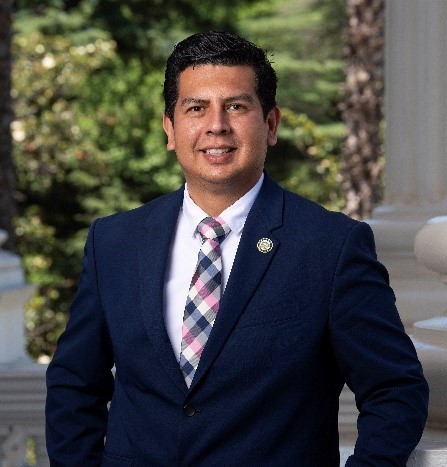
Asm. David Alvarez
Sponsored bills
The Donahoe Higher Education Act sets forth the missions and functions of California's public segments of higher education and their respective institutions of higher education. The California State University, under the administration of the Trustees of the California State University, and the University of California, under the administration of the Regents of the University of California, are 2 of the segments. Provisions of the act apply to the University of California only to the extent that the Regents of the University of California act, by appropriate resolution, to make them applicable. This bill would require the California State University, and would request the University of California, to develop and implement a 4-year accountability plan for outreach to, and admission of, first-generation college students to the segment, as specified. The bill would require the California State University, and would request the University of California, to submit an annual report to the Assembly Committee on Education, the Assembly Committee on Higher Education, and the Senate Committee on Education on the implementation and ongoing administration of the accountability plan, as provided.
The California Environmental Quality Act (CEQA) requires a lead agency, as defined, to prepare, or cause to be prepared, and certify the completion of an environmental impact report on a project that it proposes to carry out or approve that may have a significant effect on the environment or to adopt a negative declaration if it finds that the project will not have that effect. The CEQA also requires a lead agency to prepare a mitigated negative declaration for a project that may have a significant effect on the environment if revisions in the project would avoid or mitigate that effect and there is no substantial evidence that the project, as revised, would have a significant effect on the environment. The CEQA exempts certain projects from its requirements, including actions necessary to prevent or mitigate an emergency. Existing law prohibits an electrical corporation from beginning the construction of a line, plant, or system, or extensions of those facilities without first having to obtain from the Public Utilities Commission a certificate that the present or future convenience and necessity require or will require the construction. Existing law specifies that the certificate is not required for the extension, expansion, upgrade, or other modification of existing electrical transmission facilities. This bill would, for electrical infrastructure projects, as defined, designate the commission as the lead agency for purposes of the CEQA, would require the commission to prescribe procedures for the preparation of the appropriate environmental review document for those projects, and would specify the manner in which the environmental review for those projects is to be conducted. The bill would repeal these provisions on January 1, 2035.
Existing law, including the California Residential Care Facilities for the Elderly Act and the California Community Care Facilities Act, requires the licensure and regulation of certain residential health and care facilities and establishes specified rights for the residents of these licensees. Existing law makes a violation of certain of these provisions or a willful or repeated violation of any rule or regulation promulgated under these provisions a crime. This bill would enact the Resident Access Protection Act. The act would provide a resident of a long-term care facility with the right to in-person, onsite access to a visitor or a health care and social services provider during a public health emergency in which visitation rights of residents are curtailed by a state or local order, as specified. The act would prescribe how a resident may leave their long-term care facility on outings during a public health emergency. The act would require a long-term care facility, among other things, to provide safety protocols required of care staff, visitors, and health and social services providers during a public health emergency to the residents, resident representatives, and visitors in writing. A violation of the act would be a crime and subject to civil penalties. By creating a new crime, this bill would impose a state-mandated local program. The bill would authorize a state or local government order to deny resident access to visitors and health care and social services providers for up to 7 days during a public health emergency and would authorize an extension of that order, as specified. The bill would authorize a state or local government order to supersede its provisions during a declared state of emergency, local emergency, health emergency, or local health emergency to limit the number of visitors or health care and social services providers who may simultaneously visit a resident, except as specified. The bill would authorize a state or local government order to specify the terms by which visitors or health care and social services providers can demonstrate their proficiency to follow the same safety protocols required by staff. The act would provide that its provisions may not otherwise be suspended, superseded, or modified, except by the Governor pursuant to their authority under the California Emergency Services Act, as specified. The bill would require certain facilities licensed pursuant to the California Residential Care Facilities for the Elderly Act and the California Community Care Facilities Act to comply with these requirements. By expanding the duties of these health care facilities, this bill would expand an existing crime, thereby imposing a state-mandated local program. The California Constitution requires the state to reimburse local agencies and school districts for certain costs mandated by the state. Statutory provisions establish procedures for making that reimbursement. This bill would provide that no reimbursement is required by this act for a specified reason.

This measure would recognize the importance of California Native American Day, celebrated this year on September 27, 2024, and the annual California Indian Cultural Awareness Conference, to the enhancement of awareness of California Indian culture.
Maddy summaryThis bill establishes Filipino American History Month to recognize the long-standing contributions of Filipinos to California and the United States. It directly affects state officials and the public by designating a specific month for commemoration and education. The resolution highlights historical milestones, including early Spanish-era interactions, the development of Filipino communities in cities like Stockton and San Francisco, and the significant roles Filipinos played in agriculture, shipbuilding, and military service during World War II. By formally acknowledging these events, the bill aims to promote awareness of Filipino American heritage within the state.
Maddy summaryThis bill designates November 22, 2024, as Kimchee Day in California to honor the traditional Korean dish and its cultural significance. It acknowledges the long history of kimchee, the contributions of Korean Americans, and the dish's recognized health benefits and growing popularity in the United States. The resolution directs the Assembly's Chief Clerk to send copies of the document to the author for distribution.
Maddy summaryThis bill establishes Transgender History Month in California to recognize the state's significant contributions to transgender history and activism. The resolution highlights key historical figures and events, such as early Indigenous gender variance, the Cooper Do-nuts and Compton's Cafeteria riots, and the founding of major support organizations. By formally acknowledging these milestones, the measure aims to educate the public about the long-standing presence and struggles of transgender people in California.
Maddy summaryThis bill is a House Resolution that formally recognizes Diwali as a significant cultural and religious holiday for Indian Americans and South Asian Americans in California. It acknowledges the festival's importance to Hindus, Sikhs, Buddhists, and Jains by highlighting its historical roots and the specific meanings it holds for each group. The resolution expresses the Assembly's respect for these communities and encourages Californians to participate in the celebration of lights on November 1, 2024. As a commemorative measure, the bill does not alter laws or funding but serves to officially honor the occasion within the state legislature.
Maddy summaryThis bill designates the week of June 3, 2024, as Sacramento Valley Ecosystem Awareness Week to highlight the region's unique natural and agricultural resources. The measure acknowledges the area's importance for migratory birds, endangered fish species, and rice farming while promoting efforts to restore local ecosystems. It expresses legislative support for the Floodplain Forward Coalition, a group working to improve water management and environmental health in the valley. The resolution serves as a formal recognition of these ecological values rather than creating new laws or funding.