This measure would request that the federal Centers for Disease Control and Prevention conduct further investigation into the concerns raised regarding potential health impacts attributed to pollution in the Tijuana River.
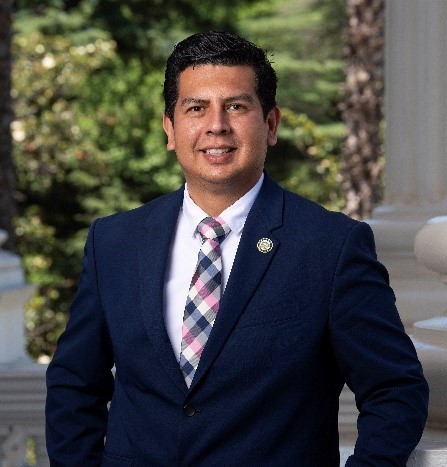
Asm. David Alvarez
Sponsored bills
Maddy summaryThis bill designates specific periods in 2024 as Boat People Awareness Week and Month to honor Vietnamese refugees who fled their country by sea after the Vietnam War. The resolution highlights the historical hardships these individuals faced, including dangerous voyages and high mortality rates, while acknowledging their significant contributions to communities across California. It does not create new laws or funding but serves as a commemorative measure to recognize the resilience and spirit of the Vietnamese refugee community. The text is intended to be shared with the bill's author for public distribution to raise awareness about this historical event.
Maddy summaryThis bill recognizes August 15, 2024, as India's Independence Day and encourages all Californians to participate in celebrations honoring the occasion. It directly affects the residents of California, particularly the state's large Indian American community, by formally acknowledging the historical significance of the date when India gained independence from British rule. The measure does not create new laws or change government operations; instead, it serves as a symbolic gesture to highlight the cultural contributions of Indian Americans and the shared values of democracy and nonviolence between the two nations.
This measure would declare the month of June 2024 to be Portuguese Heritage Month and would recognize June 10 as the Day of Portugal and May 20 as the Day of the Azores.
Maddy summaryThis bill officially recognizes June 21, 2024, as the 2024 International Day of Yoga within the state of California. It does not create new laws or change existing regulations but serves as a formal acknowledgment of the global event. The measure is intended to highlight the history and benefits of yoga as a wellness practice.
This measure would designate the week of June 23, 2024, to June 29, 2024, inclusive, and every third week of June thereafter, as Roadside Assistance Worker Appreciation Week.
Existing law establishes the California Border Environmental and Public Health Protection Fund in the State Treasury to receive funds appropriated in the annual Budget Act, including, but not limited to, proceeds of bonds sold as specified, and other sources, such as from the North American Development Bank (NADBank) , and makes money in the fund available, upon appropriation, to the California-Mexico Border Relations Council, a state entity. Money in the fund is used to assist local governments in implementation of projects to identify and resolve environmental and public health problems that directly threaten the health or environmental quality of California residents or sensitive natural resources of the California border region, among other purposes. This bill would authorize, upon appropriation by the Legislature in the annual Budget Act or another statute, funds to be made available to the California Environmental Protection Agency (CalEPA) for NADBank for loans, grants, and direct expenditures to address water quality problems arising in the California-Mexico cross-border watersheds. The bill would require the funding to be available for specified purposes, as provided, including water quality projects for the Tijuana River, and would make 10% of the funding available for the administrative costs of implementing these provisions. The bill would authorize funding provided for activities or projects in the State of Baja California to be provided through direct expenditures and for grants to an eligible funding recipient authorized to work in Mexico under a specified circumstance. The bill would require grant funding to be conditioned upon the enforceability and accountability requirements mutually agreed upon by CalEPA and NADBank, and would authorize CalEPA to withhold funding if the requirements of the applicable funding agreement are not met. The bill would also authorize grant funding to be conditioned on enforceability and accountability mechanisms agreed upon by CalEPA, NADBank, and the recipient. The bill would require CalEPA to notify the leadership office in each house of the Legislature on cross-border collaboration and the expenditure of the funding, as provided. This bill would make legislative findings and declarations as to the necessity of a special statute for the North American Development Bank.
Under existing law, the State Water Resources Control Board and the 9 California regional water quality control boards regulate water quality and prescribe waste discharge requirements in accordance with the federal national pollutant discharge elimination system permit program established by the federal Clean Water Act and the Porter-Cologne Water Quality Control Act. This bill would require the board to, on or before August 1, 2025, establish regulations governing annual reporting by compliance entities, as defined, regarding waste discharges, as provided. The bill would require compliance entities to submit a report to the board by June 1, 2026, and annually thereafter on waste discharges and their locations, as provided. The bill would require, within 3 months of reporting to the board waste discharges that affect the quality of the water of the state within any region, any nonexempt compliance entity to prominently label any product sold in California whose production resulted in waste discharge contaminating California's water quality with a warning label, as specified. The bill would authorize the board to adopt regulations to seek administrative penalties for nonfiling, late filing, or other failures to meet the requirements of these provisions, and would require these penalties to be deposited into the California Water Quality and Public Health Impact Fund, which the bill would create. The bill would require the moneys in the fund to be used exclusively to mitigate the impacts of the contamination on waters of the state caused by the reported waste discharges. The bill would authorize the board to charge compliance entities a reasonable fee necessary to cover the board's reasonable costs of administering and implementing these provisions and to impose noncompliance penalties, not to exceed $1,000,000. The bill would exempt from these provisions certain discharge requirements prescribed by the state board or a regional board and permits issued by a state in accordance with a program approved by the United States Environmental Protection Agency pursuant to the federal Clean Water Act.
Existing law, referred to as the Density Bonus Law, requires a city or county to provide a developer that proposes a housing development within the city or county with a density bonus and other incentives or concessions, as specified, if the developer agrees to construct specified percentages of units for lower income households or very low income households, and meets other requirements. Existing law, the California Coastal Act of 1976 (act) , regulates development, as defined, in the coastal zone, as defined, and requires a new development to comply with specified requirements. The Density Bonus Law provides that its provisions do not supersede or in any way alter or lessen the effect or application of the act, and requires that any density bonus, concessions, incentives, waivers or reductions of development standards, and parking ratios to which an applicant is entitled under the Density Bonus Law be permitted in a manner consistent with the act. This bill would instead provide that, in the coastal zone, the Density Bonus Law does not relieve a project from the requirement to obtain a coastal development permit, as specified. The bill would require any density bonus, concessions, incentives, waivers or reductions of development standards, and parking ratios to which an applicant is entitled to be permitted in a manner that is consistent with the Density Bonus Law and does not result in significant adverse impacts to coastal resources and public coastal access, as specified. Existing law, the California Coastal Act, requires each local government lying, in whole or in part, within the coastal zone to prepare a local coastal program, as specified. Existing law specifies that a local coastal program is not required to include housing policies and programs. This bill would repeal that provision and instead require, on or by July 1, 2026, any local government in the coastal zone to submit an amendment to the local government's local coastal program that harmonizes the Density Bonus Law and the California Coastal Act, as specified. The bill would require this amendment to be processed as de minimis, as specified, if certain conditions are met. By requiring local governments to submit an amendment to its local coastal program, this bill would impose a state-mandated local program. The California Constitution requires the state to reimburse local agencies and school districts for certain costs mandated by the state. Statutory provisions establish procedures for making that reimbursement. This bill would provide that, if the Commission on State Mandates determines that the bill contains costs mandated by the state, reimbursement for those costs shall be made pursuant to the statutory provisions noted above.

The Personal Income Tax Law imposes a tax on individual taxpayers measured by the taxpayer's taxable income for the taxable year, but excludes certain items of income from the computation of tax, including an exclusion for combat-related special compensation. This bill, for taxable years beginning on or after January 1, 2024, and before January 1, 2034, would exclude from gross income retirement pay received by a taxpayer from the federal government for service performed in the uniformed services, as defined, during the taxable year. The bill, for taxable years beginning on or after January 1, 2024, and before January 1, 2034, would also exclude from gross income annuity payments received by a qualified taxpayer, as defined, pursuant to a United States Department of Defense Survivor Benefit Plan during the taxable year. The bill would make related findings and declarations. Existing law requires any bill authorizing a new tax expenditure to contain, among other things, specific goals, purposes, and objectives that the tax expenditure will achieve, detailed performance indicators, and data collection requirements. This bill also would include additional information required for any bill authorizing a new tax expenditure. The bill would require the Franchise Tax Board and the Department of Veterans Affairs to provide any data requested by the Legislative Analyst to write the report, as provided, and would make taxpayer information received by the Legislative Analyst subject to limitation on the collection and use of that information. By expanding the scope of a crime, this bill would impose a state-mandated local program. The California Constitution requires the state to reimburse local agencies and school districts for certain costs mandated by the state. Statutory provisions establish procedures for making that reimbursement. This bill would provide that no reimbursement is required by this act for a specified reason. This bill would take effect immediately as a tax levy.