

Existing law requires each participating community college to provide a Student Success Completion Grant award to a student attending a community college if the student receives a Cal Grant B or C award, makes satisfactory academic progress, and is a California resident or is exempt from paying nonresident tuition. Existing law awards $1,298 per semester, or the quarterly equivalent, for eligible students who enroll in 12, 13, or 14 units per semester, or the quarterly equivalent number of units, awards $4,000 per semester, or the quarterly equivalent, for eligible students who enroll in 15 units per semester, or the quarterly equivalent number of units, and, commencing with the 2023–24 academic year, awards $5,250 per semester, or the quarterly equivalent, to eligible students who are current or former foster youth who enroll in 12 or more units per semester, or the quarterly equivalent number of units. This bill would require each participating community college to also award $1,298 per semester, or the quarterly equivalent, to eligible students who enroll in 9 or more units per semester, or the quarterly equivalent number of units, who are considered full-time as part of a disabled student programs and services Academic Accommodation Plan, as described.
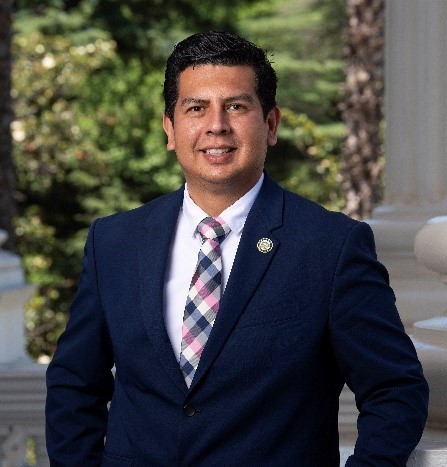
Asm. David Alvarez
Sponsored bills
The California Environmental Quality Act (CEQA) requires a lead agency, as defined, to prepare, or cause to be prepared, and certify the completion of an environmental impact report (EIR) on a project that it proposes to carry out or approve that may have a significant effect on the environment or to adopt a negative declaration if it finds that the project will not have that effect. CEQA also requires a lead agency to prepare a mitigated negative declaration for a project that may have a significant effect on the environment if revisions in the project would avoid or mitigate that effect and there is no substantial evidence that the project, as revised, would have a significant effect on the environment. Existing law authorizes the Governor to certify projects meeting certain requirements as infrastructure projects and provides those certified projects with certain streamlining benefits, including requiring the lead agency to prepare the record of proceedings concurrently with the environmental review process and requiring the resolution of an action or proceeding challenging the certification of an EIR for certified projects or the granting of any project approvals, to the extent feasible, within 270 days of the filing of the record of proceedings with the court, as specified. Existing law requires the lead agency, within 10 days of the certification of an infrastructure project, to provide a public notice of the certification, as provided. If a lead agency fails to approve a project certified as an infrastructure project before January 1, 2033, existing law specifies that the certification is no longer valid. This bill would include the San Vicente Energy Storage Facility project proposed by the San Diego County Water Authority and a project for the repair, rehabilitation, or replacement of the South Bay Sewage Treatment Plant in the County of San Diego, operated by the International Boundary and Water Commission, as infrastructure projects, thereby providing the above-described streamlining benefits to those 2 projects. To the extent the bill would increase the duties of a lead agency regarding projects proposed by a third party, this bill would impose a state-mandated local program. The California Constitution requires the state to reimburse local agencies and school districts for certain costs mandated by the state. Statutory provisions establish procedures for making that reimbursement. This bill would provide that no reimbursement is required by this act for a specified reason. This bill would make legislative findings and declarations as to the necessity of a special statute for the County of San Diego.
Existing law sets forth the missions and functions of California's public and independent segments of higher education, and details the ways in which their respective institutions are to be differentiated. Existing law specifies that the California State University shall offer undergraduate and graduate instruction through the master's degree in the liberal arts and sciences and professional education. Existing law states that the University of California has the sole authority in public higher education to award doctoral degrees in all fields of learning, except that it may agree with the California State University to award joint doctoral degrees in selected fields and the California State University may award professional or applied doctoral degrees statewide that do not duplicate University of California doctoral degrees and satisfy certain requirements. This bill, notwithstanding any other law, would authorize the California State University to award undergraduate and graduate degrees jointly with international institutions of higher education. The bill would also authorize the California State University to award professional or applied doctoral degrees jointly with international institutions of higher education only if the doctoral degrees do not duplicate University of California doctoral degrees and satisfy the requirements of existing law.
Existing law establishes the California Interagency Council on Homelessness to identify mainstream resources, benefits, and services that can be accessed to prevent and end homelessness in California by creating partnerships between federal, state, local, and nonprofit entities. Existing law requires a state agency or department that administers one or more state homelessness programs, upon request of the council, to participate in council activities, as specified, and to provide to the council any relevant information regarding those state homelessness programs. This bill would require, commencing September 1, 2025, a state agency or department that administers one or more state homelessness programs to report annually to the council cost and outcome data for each program the agency or department administers, and would require the council, in coordination with each agency or department required to report to the council, as specified, to develop data collection and reporting procedures for this purpose. The bill would require the council to compile the data reported by agencies and departments and, commencing April 1, 2026, annually make that data available to the public.
Existing law authorizes the governing body of a school district, a county office of education, or a charter school to adopt a policy to limit or prohibit the use by its pupils of smartphones while the pupils are at a schoolsite or while the pupils are under the supervision and control of an employee or employees of that school district, county office of education, or charter school. Existing law, however, specifies circumstances in which a pupil may not be prohibited from possessing or using a smartphone. This bill would instead require the governing body of a school district, a county office of education, or a charter school to, by July 1, 2026, develop and adopt, and to update every 5 years, a policy to limit or prohibit the use by its pupils of smartphones while the pupils are at a schoolsite or while the pupils are under the supervision and control of an employee or employees of that school district, county office of education, or charter school, as provided. By imposing additional duties on local educational agencies, the bill would constitute a state-mandated local program. The California Constitution requires the state to reimburse local agencies and school districts for certain costs mandated by the state. Statutory provisions establish procedures for making that reimbursement. This bill would provide that, if the Commission on State Mandates determines that the bill contains costs mandated by the state, reimbursement for those costs shall be made pursuant to the statutory provisions noted above.
Existing law, the Recreational Vehicle Park Occupancy Law, prescribes various terms and conditions applicable to recreational vehicle park tenancies. The bill would prohibit a person from requiring an occupant, tenant, or resident, as defined, in a qualified recreational vehicle park to reregister if the purpose of the reregistration requirement is to prevent the occupant, tenant, or resident from gaining or maintaining status as a resident, and would make a person who violates these provisions liable for a civil penalty of $500, as specified. The bill would define "qualified recreational vehicle park" as a recreational vehicle park located within the City of Imperial Beach. This bill would make legislative findings and declarations as to the necessity of a special statute for the City of Imperial Beach.
Existing law establishes the In-Home Supportive Services (IHSS) program, administered by the State Department of Social Services and counties, under which qualified aged, blind, or disabled persons are provided with supportive services in order to permit them to remain in their own homes. As a condition of receiving services under the IHSS program, existing law requires an applicant or recipient to obtain a certification from a licensed health care professional declaring that the applicant or recipient is unable to perform some activities of daily living independently, and that without services to assist the applicant or recipient with activities of daily living, the applicant or recipient is at risk of placement in out-of-home care. Existing law requires that the certification be received prior to service authorization, except under certain circumstances. Existing law requires the department to develop a standard certification form, as specified, and to identify alternative documentation, including, but not limited to, hospital or nursing facility discharge plans, containing the required information. Existing law sets forth various provisions relating to end-of-life care. When a health care provider makes a diagnosis that a patient has a terminal illness, existing law generally requires the health care provider, upon request, to provide the patient or another person authorized to make health care decisions with comprehensive information and counseling regarding legal end-of-life care options. This bill would, before the discharge from an acute care hospital of a Medi-Cal beneficiary diagnosed with a terminal illness, require the hospital's designated case manager or discharge planner to evaluate the patient's likely need for posthospital services and ability to access those services. The bill would require the hospital case manager or discharge planner to ask the patient or authorized person if they are interested in receiving information about the IHSS program if that patient is anticipated to need in-home personal care. If interest is expressed, the bill would require the hospital case manager or discharge planner to provide to the patient or authorized person the information, including how to initiate the application process and the option for a family member to provide care as an IHSS provider subject to the IHSS provider enrollment conditions. If the patient seeks to apply for services under the IHSS program, the bill would require the hospital case manager or discharge planner to communicate to the patient's primary care physician the patient's interest in applying for IHSS to support the timely completion of the health care certification form.
Existing law establishes the State Department of Public Health and sets forth its powers and duties to license and administer health facilities, as defined, including skilled nursing facilities and intermediate care facilities. Existing law requires skilled nursing facilities and intermediate care facilities to adopt certified nurse assistant training programs approved by the department. A violation of the provisions relating to those training requirements is a misdemeanor. Existing law requires the department to prepare and maintain a list of approved training programs for nurse assistant certification, including training programs conducted by skilled nursing facilities or intermediate care facilities, as well as local agencies and education programs. This bill additionally would require the department, no later than December 31, 2025, to solicit applications from vendors to provide the written and oral competency examination of a nurse assistant certification examination in Spanish. The bill also would require the department, by July 1, 2029, to publish on its internet website, and to update at least twice annually, a list of information including, but not limited to, approved training programs, as specified, competency test pass rates for the previous 2 years, aggregated by the language in which the test was taken, and the number of nurse assistants trained in the previous 2 years.
The Donahoe Higher Education Act sets forth the missions and functions of the public institutions of higher education, including the University of California, administered by the Regents of the University of California, the California State University, administered by the Trustees of the California State University, and the California Community Colleges, administered by the Board of Governors of the California Community Colleges. The provisions of the Donahoe Higher Education Act apply to the University of California only to the extent that the Regents of the University of California, by appropriate resolution, make them applicable. This bill would prohibit the University of California, California State University, or California Community Colleges from disqualifying a student from being hired for an employment position due to the student's failure to provide proof of federal work authorization, except where that proof is required by federal law or where that proof is required as a condition of a grant that funds the particular employment position for which the student has applied. This bill would require the University of California, the California State University, and the California Community Colleges to treat a specified prohibition in federal law on hiring undocumented noncitizens as inapplicable because that provision does not apply to any branch of state government. The bill would further provide that, to the extent student employment is considered a "benefit" for purposes of federal law, the bill constitutes authorization to provide that benefit for purposes of specified federal law. This bill would require the University of California, the California State University, and the California Community Colleges to implement the bill by January 6, 2025. The bill's provisions would apply to the University of California, unless it is found inapplicable to the University of California and then only to the extent that the Regents of the University of California, by appropriate resolution, make them applicable. By imposing new duties on community college districts, the bill would impose a state-mandated local program. The California Constitution requires the state to reimburse local agencies and school districts for certain costs mandated by the state. Statutory provisions establish procedures for making that reimbursement. This bill would provide that, if the Commission on State Mandates determines that the bill contains costs mandated by the state, reimbursement for those costs shall be made pursuant to the statutory provisions noted above.
(1) Existing law, the Medical Practice Act, provides for the licensure and regulation of physicians and surgeons by the Medical Board of California and requires the board to adopt and administer standards for the continuing education of those licensees. Existing law requires general internists and family physicians who have a patient population of which over 25% are 65 years of age or older to complete at least 20% of all mandatory continuing education hours in a course related to geriatric medicine or the care of older patients. This bill would revise the above-described course requirements to include the special care needs of patients with dementia. (2) Existing law, the Nursing Practice Act, establishes the Board of Registered Nursing to license and regulate the practice of nursing. Existing law requires the board to establish standards for continuing education consisting of specified approved coursework. Existing law requires a licensee under the act to submit a statement to the board, under penalty of perjury, indicating compliance with those continuing education requirements. This bill would require a nurse practitioner who provides primary care to a patient population of which over 25% are 65 years of age or older to certify that they have completed at least 20% of all existing mandatory continuing education hours in a course in the field of gerontology, the special care needs of patients with dementia, or the care of older patients at the time of renewal. By expanding the scope of a crime, the bill would impose a state-mandated local program. (3) Existing law, the Physician Assistant Practice Act, establishes the Physician Assistant Board for the licensure and regulation of physician assistants. Existing law authorizes the board to require a licensee to complete specified continuing education coursework as a condition of license renewal. This bill would require a physician assistant who provides primary care to a patient population of which over 25% are 65 years of age or older to complete at least 20% of all mandatory continuing education hours in a course in the field of geriatric medicine, the special care needs of patients with dementia, or the care of older patients. (4) This bill would incorporate additional changes to Section 2811.5 of the Business and Professions Code proposed by AB 2270 and AB 2581 to be operative only if this bill and either or both of those bills are enacted and this bill is enacted last. The California Constitution requires the state to reimburse local agencies and school districts for certain costs mandated by the state. Statutory provisions establish procedures for making that reimbursement. This bill would provide that no reimbursement is required by this act for a specified reason.