Maddy summaryACR 10 designates January 13, 2025, as Korean American Day in California. The resolution commemorates the arrival of the first Korean immigrants to the U.S. on January 13, 1903, and recognizes Korean Americans' historical contributions to California and the nation. It does not create new laws or policies, but serves as a ceremonial acknowledgment of this community's heritage and impact.
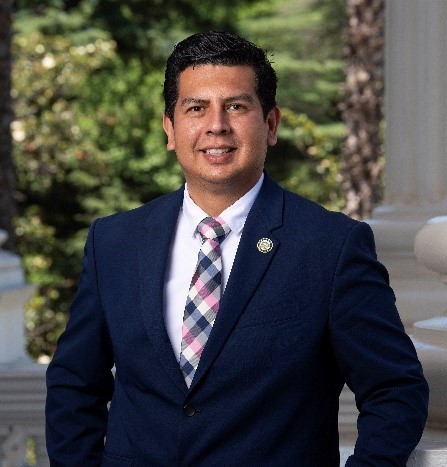
Asm. David Alvarez
Sponsored bills
The California Constitution prohibits the total annual appropriations subject to limitation of the State and of each local government from exceeding the appropriations limit of the entity of government for the prior year adjusted for the change in the cost of living and the change in population. The California Constitution defines "appropriations subject to limitation" of the State for these purposes. The California Constitution establishes the Budget Stabilization Account and requires, for every fiscal year and based on the Budget Act for that fiscal year, the Controller to transfer from the General Fund to the Budget Stabilization Account, no later than October 1, a sum equal to 1.5% of the estimated amount of General Fund revenues for that fiscal year. The California Constitution requires other transfers between the General Fund and the Budget Stabilization Account, as specified. The California Constitution prohibits the amount transferred pursuant to these provisions for any fiscal year from exceeding an amount that would result in a balance in the account that, when the transfer is made, exceeds 10% of the amount of the General Fund proceeds of taxes for the fiscal year estimate, as specified. This measure would change the 1.5% required transfer to an undetermined percentage of the estimated amount of General Fund revenues for that fiscal year. The measure would change the 10% limit on the balance in the Budget Stabilization Account to 20% of the amount of the General Fund proceeds of taxes for the fiscal year estimate, as specified. The measure would specify that funds transferred under these provisions to the Budget Stabilization Account do not constitute appropriations subject to the above-described annual appropriations limit.
Existing law establishes the State Board of Education, and requires the state board to adopt rules and regulations, not inconsistent with the laws of the state, to govern the public elementary and secondary schools of the state. Existing law requires the state board to determine all questions of policy within its powers. Pursuant to these powers, the state board has adopted a policy known as the California English Learner Roadmap State Board of Education Policy: Educational Programs and Services for English Learners, also known as the EL Roadmap Policy, for the stated purpose of assisting the State Department of Education in providing guidance to local educational agencies with respect to educating English learners attending California public schools. This bill would require the department to develop a statewide implementation plan for the EL Roadmap Policy. In developing the plan, the bill would require the department to convene an advisory committee with representation from specified entities. The bill would require the department to include in the plan, among other things, clear and measurable statewide goals of implementation and a system of monitoring and accountability of the implementation of the department's plan. The bill would require the department to, on or before November 1, 2026, submit a report with the statewide implementation plan for the EL Roadmap Policy to the appropriate policy and fiscal committees of the Legislature. The bill would require the department to annually report, commencing January 1, 2027, to the appropriate policy and fiscal committees of the Legislature on local educational agencies that are engaged in the implementation of the plan, as provided.
Existing law requires the Governor to appoint every officer whose mode of appointment is not prescribed by law. Existing law also prescribes the manner of the Governor's appointment of those officers. This bill would require the office of the Governor, commencing January 1, 2026, to maintain on its internet website a list of every state board and commission that includes, for each state board or commission, the membership list, stated purpose, duties, meeting frequency, internet website, and vacancies in the membership. The bill would require the office of the Governor, on or before January 1, 2027, and annually thereafter, to create and publish on its internet website a report containing aggregate demographic information of appointments made by the office during the prior calendar year, as specified.
Under existing law, the State Water Resources Control Board and the 9 California regional water quality control boards regulate water quality. Existing law requires each regional board to formulate and adopt water quality control plans for all areas within the region, as provided. Existing law establishes in the continuously appropriated State Water Quality Control Fund the continuously appropriated State Water Pollution Cleanup and Abatement Account, which is administered by the state board. Existing law authorizes the State Water Resources Control Board on behalf of itself or a regional board, to accept donations of moneys from a permittee for the purpose of updating a water quality control plan. This bill would authorize the state board, on behalf of itself or a regional board, to accept moneys from donations, grants, or contributions, or through contractual agreements, from public agencies for the purpose of planning, permitting, or providing technical support for projects of public benefit, as defined, within the state board's or regional board's jurisdiction. The bill would require all funds received to be deposited, and separately accounted for, in the State Water Pollution Cleanup and Abatement Account, for expenditure in accordance with the terms of the donation, grant, contribution, or contractual agreement. The bill would require the state board to provide notice, as specified, before accepting those moneys. Because the funds deposited would be a new source of funds in the continuously appropriated State Water Pollution Cleanup and Abatement Account within the continuously appropriated State Water Quality Control Fund, the bill would make an appropriation.
(1) Existing law establishes the California Community Colleges, under the administration of the Board of Governors of the California Community Colleges, the California State University, under the administration of the Trustees of the California State University, and the University of California, under the administration of the Regents of the University of California, as the 3 segments of public postsecondary education in the state. A portion of the Donahoe Higher Education Act known as the Equity in Higher Education Act declares, among other things, that it is the policy of the State of California that all persons, regardless of their sex, should enjoy freedom from discrimination of any kind in the postsecondary educational institutions of the state. Existing law requires the President of the University of California and the chancellor of each University of California campus to have primary responsibility for ensuring that campus programs and activities are free from discrimination based on age and specified characteristics. This bill would revise and recast the above-described provision to require the chancellor of each University of California campus to have the primary responsibility for ensuring that campus programs and activities are free from discrimination based on specified characteristics, including, but not limited to, the prevention of sexual harassment, as provided. The bill would require, among other requirements related to nondiscrimination, the office of the President of the University of California to annually present a report to the Board of Regents on the state of the University of California system in ensuring that programs and activities are free from discrimination based on specified characteristics, as provided. The bill would also require the President of the University of California to annually present during a public hearing of the Senate Budget Subcommittee on Education and the Assembly Budget Subcommittee on Education Finance the annual report described above. (2) Existing law requires the Chancellor of the California State University and the president of each California State University campus to have the primary responsibility for ensuring that campus programs and activities are free from discrimination based on age and specified characteristics. This bill would revise and recast the above-described provision to instead require the president of each California State University campus to have the primary responsibility for ensuring that campus programs and activities are free from discrimination based on specified characteristics, including, but not limited to, the prevention of sexual harassment, as provided. The bill would require, among other requirements related to nondiscrimination, the office of the Chancellor of the California State University to annually present a report to the Board of Trustees on the state of the California State University system in ensuring that programs and activities are free from discrimination based on specified characteristics, as provided. The bill would also require the Chancellor of the California State University to annually present during a public hearing of the Senate Budget Subcommittee on Education and the Assembly Budget Subcommittee on Education Finance the annual report described above. (3) Existing law requires the governing board of a community college district to have the primary responsibility for ensuring that community college district programs and activities are free from discrimination based on age and specified characteristics and requires the office of the Chancellor of the California Community Colleges to have responsibility for monitoring the compliance of each district with specified regulations. This bill would revise and recast the above-described provision to instead require the governing board of each community college district and the chief executive officer of the community college district to have joint responsibility for ensuring that programs and activities offered by the community college district are free from discrimination based on specified characteristics, including, but not limited to, the prevention of sexual harassment, as provided. The bill would require, among other requirements related to nondiscrimination, the chancellor's office to annually make a presentation during a public meeting of the Board of Governors on the state of the California Community Colleges system in ensuring that community college district programs and activities are free from discrimination based on specified characteristics, as provided. The bill would also require the Chancellor of the California Community Colleges to annually present during a public hearing of the Senate Budget Subcommittee on Education and the Assembly Budget Subcommittee on Education Finance the presentation described above. To the extent the bill would impose new duties on community college districts, the bill would impose a state-mandated local program. The California Constitution requires the state to reimburse local agencies and school districts for certain costs mandated by the state. Statutory provisions establish procedures for making that reimbursement. This bill would provide that, if the Commission on State Mandates determines that the bill contains costs mandated by the state, reimbursement for those costs shall be made pursuant to the statutory provisions noted above.

Existing law establishes the California Community Colleges, under the administration of the Board of Governors of the California Community Colleges, the California State University, under the administration of the Trustees of the California State University, and the University of California, under the administration of the Regents of the University of California, as the 3 segments of public postsecondary education in the state. Existing law requires the California State University, on or before December 1 of each year, to submit a report to the Legislature on the investigations and outcomes of sexual harassment reports and formal sexual harassment complaints, and to post the annual reports on its internet website, as provided. This bill would instead require the California State University, on or before December 1 of each year, to submit a report to the Legislature that provides a summation of the activities undertaken by each campus and by the systemwide Title IX office to ensure campus programs and activities are free from sex discrimination, and would revise the content of the report, as provided. The bill would additionally require the California Community Colleges, on or before December 1, 2026, and on or before December 1 every 3 years thereafter, and request the University of California, on or before December 1, 2026, and on or before each December 1 thereafter, to submit an analogous report to the Legislature that provides a summation of the activities undertaken by each district or campus, as applicable, and by each systemwide Title IX office, to ensure campus programs and activities are free from sex discrimination, as provided. The bill would require the office of the Chancellor of the California Community Colleges, and request the University of California, to post certain annual reports on their respective internet websites. The bill would require the California State University, and request the University of California, to present each report during a public meeting of the trustees or the regents, as applicable. This bill would require, on or before September 1, 2026, and on or before each September 1 thereafter, the governing board of each community college district to prepare and submit to the chancellor's office a report on the activities undertaken by each community college district to ensure campus programs and activities are free from sex discrimination, as provided. The bill would require each community college district to post the annual reports on its internet website and to present each report during a public meeting of the governing board of the community college district. By imposing new requirements on community college districts, the bill would impose a state-mandated local program. The California Constitution requires the state to reimburse local agencies and school districts for certain costs mandated by the state. Statutory provisions establish procedures for making that reimbursement. This bill would provide that, if the Commission on State Mandates determines that the bill contains costs mandated by the state, reimbursement for those costs shall be made pursuant to the statutory provisions noted above.

Existing law provides for various memorials and monuments on the grounds of the State Capitol. Existing law requires the Department of General Services to maintain state buildings and grounds. Existing law, the Apology Act for the 1930s Mexican Repatriation Program, makes findings and declarations regarding the unconstitutional removal and coerced emigration of United States citizens and legal residents of Mexican descent, between the years 1929 and 1944, to Mexico from the United States during the 1930s "Mexican Repatriation" Program. Existing law expresses the apology of the State of California to those individuals who were illegally deported and coerced into emigrating to Mexico and requires that a plaque to commemorate those individuals be installed and maintained by the Department of Parks and Recreation in an appropriate public place in the City or County of Los Angeles. This bill would authorize a nonprofit organization representing Mexican Americans or Mexican immigrants to enter into negotiations to plan, construct, and maintain a memorial to Mexican Americans and Mexican immigrants who were forcibly deported from the United States during the Great Depression, as provided. The bill would require the memorial to be located at an appropriate public place in the City or County of Los Angeles. The bill would require the nonprofit organization to enter into negotiations with the Department of General Services and the state agency with jurisdiction over the state property where the memorial is proposed, where applicable, if the nonprofit organization proposes to locate the memorial on state property. The bill would require the nonprofit organization to submit a plan for the memorial to the department and the applicable state agency for review and approval. The bill would require these provisions to be funded exclusively through private sources. This bill would, if the nonprofit organization proposes a site owned by the City of Los Angeles or the County of Los Angeles for location of the memorial, require the nonprofit organization to follow any procedures that the City of Los Angeles or the County of Los Angeles require to consider approving the proposed memorial. This bill would make legislative findings and declarations as to the necessity of a special statute for the City of Los Angeles and the County of Los Angeles.
The California Environmental Quality Act (CEQA) requires a lead agency, as defined, to prepare, or cause to be prepared, and certify the completion of an environmental impact report on a project that it proposes to carry out or approve that may have a significant effect on the environment or to adopt a negative declaration if it finds that the project will not have that effect. CEQA also requires a lead agency to prepare a mitigated negative declaration for a project that may have a significant effect on the environment if revisions in the project would avoid or mitigate that effect and there is no substantial evidence that the project, as revised, would have a significant effect on the environment. This bill would, if certain conditions are met, exempt from the provisions of CEQA the routine maintenance of public stormwater facilities that are fully concrete or that have a conveyance capacity of less than a 100-year storm event. The bill would, if the lead agency determines that a project is not subject to CEQA pursuant to these provisions and determines to approve or carry out the project, require the lead agency to file a notice with the State Clearinghouse in the Office of Planning and Research and with the county clerk in the county in which the project will be located, as provided, thereby imposing a state-mandated local program. Because a lead agency would be required to determine whether a project qualifies for this exemption, the bill would impose a state-mandated local program. This bill would repeal these provisions on January 1, 2030. CEQA provides that, if a nonelected decisionmaking body of a local lead agency certifies an environmental impact report, approves a negative declaration or mitigated negative declaration, or determines that a project is not subject to CEQA, the certification, approval, or determination may be appealed to the agency's elected decisionmaking body. This bill would prohibit the appeal of determinations by nonelected decisionmaking bodies of cities with a population of at least 1,000,000 that those routine maintenance projects of certain public stormwater facilities are exempt from CEQA to the agency's elected decisionmaking body. This bill would repeal these provisions on January 1, 2030. The California Constitution requires the state to reimburse local agencies and school districts for certain costs mandated by the state. Statutory provisions establish procedures for making that reimbursement. This bill would provide that no reimbursement is required by this act for a specified reason. This bill would declare that it is to take effect immediately as an urgency statute.
Existing law establishes the California Racial Mascots Act, which prohibits public schools from using the term Redskins as a school or athletic team name, mascot, or nickname. Existing law requires the Superintendent of Public Instruction to establish and implement a system of complaint processing, known as the Uniform Complaint Procedures, for specified educational programs. This bill would exempt public schools operated by an Indian tribe or a tribal organization from this prohibition. The bill would prohibit, beginning July 1, 2026, public schools, except for public schools operated by an Indian tribe or tribal organization, from using any derogatory Native American term, as defined, as a school or athletic team name, mascot, or nickname, except as provided. The bill would require the Uniform Complaint Procedures to apply to school or athletic team names, mascots, or nicknames pursuant to the bill. To the extent that the bill would impose new duties on public schools, the bill would impose a state-mandated local program. The California Constitution requires the state to reimburse local agencies and school districts for certain costs mandated by the state. Statutory provisions establish procedures for making that reimbursement. This bill would provide that, if the Commission on State Mandates determines that the bill contains costs mandated by the state, reimbursement for those costs shall be made pursuant to the statutory provisions noted above.