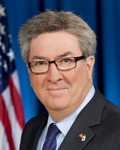
Photo of Ken Cooley
D California Assembly · District 8

Asm. Ken Cooley

Compare
Total votes
20,914
all sessions
Attendance
92%
1,471 missed
Near the chamber average
With party
97%
of cast votes
Lower than 95% of chamber peers
Bipartisan score
1%
crosses aisle rarely
Higher than 89% of chamber peers
Sponsored
1,581
bills & resolutions
Near the chamber average
Committees
0
assignments
1,581 bills and resolutions

Sponsored bills

Total
1,581
Primary
190
Co-sponsor
1,391
This page
1,581
matching current filters
Primary AB 1393
Failed · California Assembly · Lead sponsor
Personal liability insurance.

Existing law regulates each insurer admitted to do business in this state, and authorizes a surplus line broker to solicit and place insurance for an insured with a nonadmitted insurer if certain requirements are met. Existing law generally requires an insurance policy providing comprehensive personal liability insurance that is issued or renewed in California to contain a provision for coverage against liability for the payment of workers' compensation to household employees. This bill would exempt a policy of comprehensive personal liability insurance written by a nonadmitted insurer from that requirement.

Failed Feb 1, 2022 0 co-sponsors
Primary AB 767
Failed · California Assembly · Lead sponsor
Capitol Park.

Existing law establishes the Historic State Capitol Commission for the purpose of, among others, reviewing and advising the Legislature on any development, improvement, or other physical change in any aspect of the historic State Capitol, as defined to include Capitol Park upon the adoption of a master plan regarding Capitol Park by the Joint Rules Committee. This bill would require any development, improvement, or other physical change in any aspect of Capitol Park to be approved by the Joint Rules Committee regardless if a master plan regarding Capitol Park has been adopted by the Joint Rules Committee, as specified.

Failed Feb 1, 2022 0 co-sponsors
Primary AB 860
Failed · California Assembly · Lead sponsor
Native American tribes: ethnohistory: report.

Existing law establishes the Native American Heritage Commission, consisting of 9 members appointed by the Governor subject to Senate confirmation. Existing law, among other things, authorizes the commission to bring an action to prevent severe and irreparable damage to, or assure appropriate access for Native Americans to, a Native American sanctified cemetery, place of worship, religious or ceremonial site, or sacred shrine located on public property. This bill, no later than January 1, 2024, would require the commission to prepare, or cause to be prepared, a report on the ethnohistory of Native American tribes in the Sacramento region covering the period from January 1, 1950, through the present, as provided. The bill would require that this report include recommendations for how to expand the ethnography and ethnohistory to include other Native American tribes in California. The bill would require the commission to submit copies of the report to specified entities and to maintain a copy in its records. The bill would appropriate the sum of $135,000 from the General Fund for this purpose.

Failed Feb 1, 2022 0 co-sponsors
Co-sponsor AB 637
Failed · California Assembly · Co-sponsor
Enabling Youth to Access Workforce Training Grant Program.

Existing law, the California Workforce Innovation and Opportunity Act, establishes the California Workforce Development Board. Existing law requires the board to assist the Governor in developing and continuously improving California's workforce investment system, as specified. This bill would create the Enabling Youth to Access Workforce Training Grant Program. Upon appropriation by the Legislature, the bill would require the California Workforce Development Board to create the program, which would fund supportive services, as specified, that are necessary for homeless youth and current or former foster youth to enable their participation in the workforce development program, as defined. Under the bill, grants would be awarded on a competitive basis. The bill would require the board to conduct outreach activities and to provide technical assistance to eligible applicants to ensure that grants are awarded to qualified applicants providing a broad spectrum of supportive services. The bill would prescribe definitions, duties for the board, and requirements for applications and applicants, including the requirement that applicants agree to provide the board any information that it deems necessary to meet reporting requirements and other grant requirements. The bill would require the board to evaluate how grants awarded under the program address the needs of eligible targeted populations and, beginning one year after the initial award of grant funds, to post an annual report on its internet website regarding the progress and success of the program.

Failed Feb 1, 2022 1 co-sponsor
Primary AB 1245
Failed · California Assembly · Lead sponsor
Resentencing.

Existing law authorizes, when a defendant has been committed to the state prison or to a county jail for the commission of a felony, the court to recall the sentence and commitment previously ordered and resentence the defendant in the same manner as if the defendant had not previously been sentenced if doing so is in the interest of justice. Existing law authorizes a defendant to be resentenced pursuant to these provisions upon the court's own motion within 120 days of the date of commitment, or upon the recommendation of specified individuals, including, among others, the district attorney of the county in which the defendant was sentenced. This bill would additionally authorize a petition for recall and resentencing by a defendant who has served at least 15 years of their sentence and has at least 24 months of their sentence remaining. The bill would also establish procedural requirements for resentencing a defendant pursuant to these provisions including by, among other things, requiring a petition for resentencing to be filed with the presiding judge of the superior court in which the defendant was originally sentenced, requiring the presiding judge, or a judge appointed by the presiding judge, to act on the petition within 90 days of the petition having been filed, and requiring the court to specify the reason for its judgment on the petition. The bill would, if a petition for recall and resentencing is filed by the Secretary of the Department of Corrections and Rehabilitation, the Board of Parole Hearings, a county correctional administrator, or the district attorney of the county in which the defendant was sentenced, and the petition is based on a defendant's exceptional rehabilitation while imprisoned, require the court to appoint counsel for the defendant and hold a hearing on the petition and would prohibit the court from denying the petition to recall and resentence the defendant unless there is evidence beyond a reasonable doubt that the defendant is likely to commit a future violent crime. To the extent this bill would require local public defenders to provide a higher level of service, this bill would impose a state-mandated local program. The bill would, upon appropriation by the Legislature, allocate savings accrued as a result of resentencing a defendant pursuant to these provisions who was sentenced to imprisonment in the state prison to the district attorney of the county in which the resentencing occurred, to the superior court in the county in which the resentencing occurred, and, in certain instances, to the public defender of the county in which the resentencing occurred. The California Constitution requires the state to reimburse local agencies and school districts for certain costs mandated by the state. Statutory provisions establish procedures for making that reimbursement. This bill would provide that, if the Commission on State Mandates determines that the bill contains costs mandated by the state, reimbursement for those costs shall be made pursuant to the statutory provisions noted above.

Failed Feb 1, 2022 0 co-sponsors
Primary AB 820
Failed · California Assembly · Lead sponsor
Corporation Tax Law: banks and financial corporations: exclusions: interest income.

The Corporation Tax Law imposes on every bank and specified financial corporations doing business in the state a tax according to or measured by net income, as provided. That law defines net income as gross income, computed as provided, less allowable deductions. That law also provides various exclusions from gross income. Under that law, when the income of a taxpayer subject to a tax under the Corporation Tax Law is derived from or attributable to sources both within and without the state, the tax is required to be measured by the net income derived from or attributable to sources within the state in accordance with specified procedures. Under that law, in the case of an apportioning trade or business that derives more than 50% of its gross business receipts from conducting one or more qualified business activities, which includes savings and loan activities and banking or financial business activities, business income is apportioned in accordance with a 3-factor formula. Under the 3-factor formula, the specified apportioning trade or business is required to multiply business income by a fraction, the numerator of which is the property factor plus the payroll factor plus the sales factor, and the denominator of which is 3. Existing law requires any bill authorizing a new tax expenditure to contain, among other things, specific goals, purposes, and objectives the tax expenditure will achieve, detailed performance indicators, and data collection requirements. This bill would require, for taxable years beginning on or after January 1, 2022, and before January 1, 2027, a qualified taxpayer that apportions its business income under the 3-factor formula described above to exclude the amount of qualified interest income from its calculation of the sales factor under the 3-factor formula. The bill would define a qualified taxpayer as a bank or financial corporation, as defined, that generates business income that is derived from or attributable to sources within and without this state and that is determined pursuant to the 3-factor formula. The bill would define qualified interest income as interest income that a qualified taxpayer generates on a qualified loan, as defined, during the taxable year and that would be subject to apportionment under the 3-factor formula but for the application of the bill's provisions. This bill would also provide that, for taxable years beginning on or after January 1, 2022, gross income does not include the amount of qualified interest income, which is defined as interest income that a qualified taxpayer generates on a qualified loan during the taxable year, generated by the qualified taxpayer. The bill would define a qualified taxpayer for this purpose as a bank or financial corporation that generates business income that is solely derived from or attributable to sources within this state. This bill would provide findings to comply with the additional information requirement for any bill authorizing a new tax expenditure. This bill would take effect immediately as a tax levy.

Failed Feb 1, 2022 0 co-sponsors
Co-sponsor AB 1135
Failed · California Assembly · Co-sponsor
State of California Housing Allocation Act.

Existing law establishes the Business, Consumer Services, and Housing Agency in state government, consisting of, among other entities, the Department of Housing and Community Development (HCD) . Existing law requires HCD to administer various programs intended to promote the development of housing, including the Multifamily Housing Program, pursuant to which HCD provides financial assistance in the form of deferred payment loans to pay for the eligible costs of development for specified activities. Existing law also establishes the California Housing Finance Agency (CalHFA) within HCD with the primary purpose of meeting the housing needs of persons and families of low or moderate income. Existing law also establishes the California Tax Credit Allocation Committee (CTCAC) , composed of specified members, and requires that CTCAC, among other things, allocate specified federal low-income housing tax credits, as provided. This bill would enact the State of California Housing Allocation Act, which would require the Business, Consumer Services, and Housing Agency, HCD, CalHFA, and CTCAC, no later than January 1, 2023, to jointly establish and operate a single, centralized housing funding allocation committee, which would be within the Business, Consumer Services, and Housing Agency and comprised of representatives of those entities. The bill would require the committee to be responsible for allocating state controlled financing to housing developments and to serve as the point of contact for developers seeking to build affordable housing in California. The bill, no later than December 31, 2023, would require the committee to create a unified application and award process for the allocation of state-controlled affordable housing funds and, to the extent permitted by any applicable law governing the allocation and use of those state-controlled affordable housing funds, make applications and awards at least twice per calendar year. The bill would authorize the committee to exclude state-controlled affordable housing funds from this unified application and award process for specified reasons. The bill would require the Secretary of Business, Consumer Services, and Housing to develop a new organizational plan for the housing departments in the agency to streamline processes and eliminate redundant tasks between departments, as provided, and to submit a report on that plan to the Legislature no later than December 31, 2022.


Failed Feb 1, 2022 1 co-sponsor
Co-sponsor AB 926
Failed · California Assembly · Co-sponsor
Fire prevention: local assistance grant program: projects: report.

Existing law requires the Department of Forestry and Fire Protection to establish a local assistance grant program for fire prevention activities, as defined, in the state. Existing law requires the department to prioritize, to the extent feasible, projects that are multiyear efforts. Existing law authorizes the department to consider the fire risk of an area, among other things, when awarding local assistance grants. This bill would expand the definition of "fire prevention activities" to include the removal of hazardous dead trees, creation of fuel breaks and community defensible spaces, and creation of ingress and egress corridors. The bill would also require the department to prioritize projects that have a completed, or nearly completed, environmental review document, as provided. The bill would authorize the department to consider and evaluate the wildfire risk within the proposed project area, as well as the socioeconomic characteristics of communities that the various education and mitigation projects are intended to protect, when awarding local assistance grants. Existing law requires the department to provide a report to the appropriate policy committees of the Legislature on or before July 1, 2022, that includes a summary of specified findings relating to fire prevention activities and the local assistance grant program. This bill would also require the report to include, but not be limited to, the total amount of acreage treated by an awarded grant recipient, whether the project was awarded funding for vegetation management activities, the number of communities protected by an awarded project, and the total number of population receiving a benefit of the project.

Failed Feb 1, 2022 1 co-sponsor
Co-sponsor AB 269
Failed · California Assembly · Co-sponsor
Nursing: licensure: renewal fees: reduced fee.

Existing law, the Nursing Practice Act, provides for the licensure and regulation of nurses by the Board of Registered Nursing in the Department of Consumer Affairs. Existing law requires a licensee under the act to apply for renewal of their license every 2 years and allows an inactive license to be reactivated, as specified. This bill would authorize the board to reduce as prescribed the renewal fee for a licensee who meets certain age and practice qualifications.

Failed Feb 1, 2022 1 co-sponsor
Co-sponsor AB 1622
In committee · California Assembly · Co-sponsor
Smog check program: catalytic converter theft.

Existing law establishes a motor vehicle inspection and maintenance program, commonly known as the smog check program, that is administered and enforced by the Department of Consumer Affairs. The smog check program requires inspection of motor vehicles upon initial registration, biennially upon renewal of registration, upon transfer of ownership, and in certain other circumstances. Among other things, the smog check program requires the department to provide a licensed smog check station with a sign informing customers about options when their vehicle fails a biennial smog check inspection. Existing law requires the sign to be posted conspicuously, as provided, and requires the sign in all licensed smog check stations. Existing regulations implement this requirement. A person who violates these laws, including any order, rule, or regulation of the department adopted pursuant to these laws, is guilty of a misdemeanor. This bill would require the department to provide a licensed smog check station with a sign informing customers about strategies for deterring catalytic converter theft, including the etching of identifying information on the catalytic converter. The bill would require the sign to be posted conspicuously in an area frequented by customers and would require it in all licensed smog check stations. The bill would also authorize stations where licensed smog check technician repairs are performed to offer and recommend to customers the etching as an optional service provided in conjunction with the smog check. Because the department would adopt regulations implementing the new requirements and a violation of these regulations would be a crime, the bill would impose a state-mandated local program. The California Constitution requires the state to reimburse local agencies and school districts for certain costs mandated by the state. Statutory provisions establish procedures for making that reimbursement. This bill would provide that no reimbursement is required by this act for a specified reason.

In committee Jan 24, 2022 1 co-sponsor
Showing 221 to 230 of 1,581 bills
Previous 1 … 22 23 24 … 159 Next