

(1) The United States Constitution generally requires a state to give full faith and credit to the public acts, records, and judicial proceedings of every other state. Existing law authorizes, upon the demand made by another state, the extradition of a person charged with committing an act in this state that results in a crime in the demanding state, as specified. Existing law sets forth procedures by which a person may enforce a judgment for the payment of money and child custody orders issued by the court of a state other than California. Existing law authorizes a California court or attorney to issue a subpoena if a foreign subpoena has been sought in this state. Existing law generally prohibits a provider of health care, a health care service plan, or a contractor from disclosing medical information regarding a patient, enrollee, or subscriber without first obtaining an authorization, unless a specified exception applies, including that the disclosure is in response to a subpoena. This bill would prohibit a provider of health care, a health care service plan, or a contractor from releasing medical information related to a person or entity allowing a child to receive gender-affirming health care or gender-affirming mental health care in response to a criminal or civil action, including a foreign subpoena, based on another state's law that authorizes a person to bring a civil or criminal action against a person or entity that allows a child to receive gender-affirming health care or gender-affirming mental health care. The bill additionally would prohibit law enforcement agencies from knowingly making or participating in the arrest or extradition of an individual pursuant to an out-of-state arrest warrant based on another state's law against providing, receiving, or allowing a child to receive gender-affirming health care or gender-affirming mental health care in this state, as specified. (2) Existing law, known as the Uniform Child Custody Jurisdiction and Enforcement Act, provides the state exclusive jurisdictional basis for making an initial child custody determination, and permits a California court to assume temporary emergency jurisdiction in specified circumstances. Existing law permits a court to decline to exercise its jurisdiction if it determines that it is an inconvenient forum and a court in another state is a more appropriate forum. Existing law permits a California court to decline to exercise its jurisdiction if the petitioner has wrongfully taken the child from another state or engaged in similar reprehensible conduct, except as specified. Existing law prohibits a court from considering the taking or retention of a child from a person who has legal custody of the child if there is evidence that the taking or retention was a result of domestic violence. The bill would prohibit the enforcement of an order based on another state's law authorizing a child to be removed from their parent or guardian based on that parent or guardian allowing their child to receive gender-affirming health care or gender-affirming mental health care. The bill would prohibit a court from finding that it is an inconvenient forum where the law or policy of another state that may take jurisdiction limits the ability of a parent to obtain gender-affirming health care or gender-affirming mental health care, as defined, and the provision of such care is at issue in the case before the court. The bill would authorize a court to take temporary jurisdiction because a child has been unable to obtain gender-affirming health care. The bill would additionally prohibit a court from considering the taking or retention of a child from a person who has legal custody of the child, if the taking or retention was for obtaining gender-affirming health care or mental health care. The bill would declare its provisions to be severable. (3) This bill would incorporate additional changes to Sections 2029.300 and 2029.350 of the Code of Civil Procedure proposed by AB 2091 to be operative only if this bill and AB 2091 are enacted and this bill is enacted last.
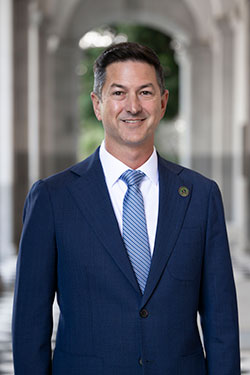
Asm. Chris Ward
Sponsored bills
Existing law, the Teacher Housing Act of 2016, authorizes a school district to establish and implement programs that address the housing needs of teachers and school district employees who face challenges in securing affordable housing, as provided. Under existing law, a program established under the act is restricted to "teacher or school district employees," except as specified. Existing law defines the term "teacher or school district employees" for these purposes to mean any person employed by a unified school district maintaining prekindergarten, transitional kindergarten, and grades 1 to 12, inclusive, an elementary school district maintaining prekindergarten, transitional kindergarten, and grades 1 to 8, inclusive, or a high school district maintaining grades 9 to 12, inclusive, including, but not limited to, certificated and classified staff. This bill would establish a substantially similar program for community college faculty and employees. The bill would define the term "faculty or community college district employees" for these purposes to mean any person employed by a community college district, including, but not limited to, certified and classified staff.
Existing law, the Alatorre-Zenovich-Dunlap-Berman Agricultural Labor Relations Act of 1975, grants agricultural employees the right to form and join labor organizations and engage in collective bargaining with respect to wages, terms of employment, and other employment conditions, and authorizes employees to elect exclusive bargaining representatives for these purposes. Existing law creates the Agricultural Labor Relations Board and prescribes its composition, duties, and powers. Existing law authorizes the board to hold hearings and conduct investigations and requires that certain procedures be the exclusive method of redressing unfair labor practices. Under existing law, any person who willfully resists, prevents, or interferes with a member of the board or its agents or agencies in the performance of their duties is guilty of a misdemeanor. Existing law requires the board to certify the results of an election conducted by secret ballot of employees in a collective bargaining unit to designate a collective bargaining representative, unless the board determines there are sufficient grounds to refuse to do so. Existing law further provides that if the board refuses to certify an election because of employer misconduct that would render slight the chances of a new election reflecting the free and fair choice of employees, the labor organization shall be certified as the bargaining representative for the bargaining unit. This bill would refer to the election by secret ballot process as a polling place election. The bill would establish alternative procedures to the polling place election and authorize a labor organization to be certified as the exclusive bargaining representative of a bargaining unit through either a labor peace election or a non-labor peace election, as prescribed, dependent on whether an employer enrolls and agrees to a labor peace election for labor organization representation campaigns. The bill would provide that a labor peace election or a non-labor peace election permits a bargaining unit to summarily select a labor organization as its representative for collective bargaining purposes without using the existing polling place process. Under the bill, a labor peace election would be a mail ballot election and a non-labor peace election would establish a process for the submission of a petition with proof of majority support, subject to certification by the board. Among other provisions, the bill would require for both alternative procedures that an employer respond to the board with regard to a petition, including providing a specified list of employees to the board. By expanding the definition of a crime, this bill would impose a state-mandated local program. This bill would establish a schedule for agricultural employers to indicate to the board whether they agree to a labor peace compact, defined to mean an agreement by the employer to, among other things, make no statements for or against union representation to its employees or publicly, in any written or oral form, at any time during employee hire, rehire, or orientation, or after certain documents regarding organization are filed with the board. The bill would prohibit a labor peace compact from prohibiting an employer from communicating truthful statements to employees regarding workplace policies or benefits, as specified. The bill would require the board to develop an online web-based labor peace election process that will allow employers to indicate their labor peace choice online, and that will allow labor organizations to see whether a specific agricultural employer has agreed to a labor peace election campaign. This bill would repeal the above provisions on January 1, 2028. This bill would prescribe civil penalties to be imposed upon an agricultural employer who commits an unfair labor practice in an amount not to exceed $10,000 for each violation, and would increase that sum to an amount not to exceed $25,000 for specified violations. The bill would require the board to consider specified factors in determining the amount of a civil penalty pursuant to these provisions. The bill would also authorize the board to impose personal liability for these penalties upon a director or officer of an employer in certain circumstances. Existing law authorizes a person aggrieved by the final order of the board granting or denying in whole or in part the relief sought for an unfair labor practice, to obtain a review of the order in a specified court of appeal by filing in the court a written petition requesting that the order of the board be modified or set aside. This bill would require an employer who appeals or petitions for a writ of review of any order of the board involving make-whole, backpay, or other monetary awards to employees, to post an appeal bond in the amount of the entire economic value of the order, as specified, and would provide for the bond to be forfeited under specified conditions. This bill would state that its provisions are severable. The California Constitution requires the state to reimburse local agencies and school districts for certain costs mandated by the state. Statutory provisions establish procedures for making that reimbursement. This bill would provide that no reimbursement is required by this act for a specified reason.
Existing law establishes the Department of Housing and Community Development and requires it to, among other things, administer various programs intended to fund the acquisition of property to develop or preserve affordable housing. Existing law grants the department various powers and duties, including, among other things, the power to provide advice, technical information, and consultative and technical services. This bill would authorize the department, in administering federally funded grant programs administered by the department, to (1) publish a notice of funding availability and application deadlines ahead of, and contingent upon, availability of funding, (2) issue funding to an award recipient up-front rather than as a reimbursement, and (3) provide technical assistance to applicants that meet program submission deadlines to correct technical errors or provide missing information. The bill would require the department to establish and publish on its internet website a tracking system for the programs it administers that provides the deadlines for each step of a program application.
Existing law requires every motor vehicle subject to registration to be equipped with an adequate muffler in constant operation and properly maintained to prevent any excessive or unusual noise and prohibits a muffler or exhaust system from being equipped with a cutout, bypass, or similar device. Existing law further prohibits the modification of an exhaust system of a motor vehicle in a manner that will amplify or increase the noise emitted by the motor of the vehicle so that the vehicle exceeds existing noise limits when tested in accordance with specified standards. Existing law establishes the motor vehicle inspection program, which provides for privately operated stations that are referred to as smog check stations and are authorized to issue certificates of compliance or noncompliance to vehicles that meet certain requirements. Existing law requires a certain number of stations providing referee functions available to consumers, which ensures uniform and consistent tests and repairs by all qualified smog check technicians and licensed smog check stations throughout the state. Existing law requires stations providing referee functions to provide for the testing of vehicular exhaust systems and the issuance of certificates of compliance for those vehicles that have received a citation for the noise limit violations described above. Under existing law, it is unlawful for an owner to request, cause, or permit the operation of any vehicle that is, among other things, not equipped as required by law. Under existing law, if there is a violation, an owner or any other person who was not driving the vehicle involved in the violation may be mailed a written notice to appear by the court. Existing law authorizes a court to dismiss any action in which a person is prosecuted for operating a vehicle in violation of the noise limit requirements mentioned above if a certificate of compliance has been issued or if the defendant had reasonable grounds to believe that the exhaust system was in good working order and had reasonable grounds to believe that the vehicle was not operated in violation of those requirements. Existing law also prohibits a person from modifying the exhaust system of a vehicle with a whistle-tip, operating a vehicle that has been so modified, or engaging in the business of installing a whistle-tip onto the vehicle's exhaust system. This bill would require a court to require a certificate of compliance for a violation of the noise limit requirements mentioned above for specified vehicles. The bill would require the court to utilize the notification procedures mentioned above and if a certificate of compliance is not provided to the court within 3 months of the violation date, the bill would require the court to treat this failure as noncompliance and inform the Department of Motor Vehicles by following specified procedures. The bill would require the department, before renewing the registration of any vehicle, to check whether the court has issued a hold on the vehicle registration for a violation of the requirements mentioned above and to refuse to renew the registration until it has received a notification from the court that a certificate of compliance has been issued. This bill would also require stations providing referee functions to provide for the testing of exhaust systems of motor vehicles and the issuance of certificates of compliance for vehicles that have received a citation for installing, operating, or engaging in the business of installing a whistle-tip onto a vehicle's exhaust system and for motorcycles that have received a citation for the violations mentioned above. Existing law requires an officer, if, after an arrest, accident investigation, or other law enforcement action, it appears that a violation, including, among other things, a mechanical requirement by law, has occurred, to prepare, and the violator to sign, a written notice containing the violator's promise to correct the alleged violation, and to deliver proof of correction of the violation to the issuing agency except if the officer finds that the violation cited was for a motorcycle that has a modification of the exhaust system in a manner that amplifies or increases the noise emitted by the motor so that the motorcycle is not in compliance with the law. This bill would eliminate that exemption. These requirements would become operative on January 1, 2027.
Existing law grants the State Department of Health Care Services the sole authority in state government to determine the qualifications of personnel working within alcoholism or drug abuse recovery and treatment programs licensed, certified, or funded under state law. Existing law requires the department to require that a person providing counseling services within those programs be registered with or certified by a certifying organization approved by the department, except as specified. This bill would exempt graduate students participating in supervised internships affiliated with university programs in psychology, social work, marriage and family therapy, or counseling, who are completing supervised practicum hours to meet postgraduate requirements, and associates registered with the Board of Behavioral Sciences from the registration and certification requirement. This bill would require exempted programs providing practicum for graduate students to report to all department-approved certifying organizations a graduate student who has been removed from practicum as a result of an ethical or professional conduct violation. Existing law prohibits the department from approving a certifying organization that does not, prior to registering or certifying a counselor, contact other department-approved certifying organizations to determine whether an individual has had their registration or certification revoked. Existing law requires certifying organizations to deny an individual's request for registration if the individual's certification has been previously revoked. This bill would prohibit the department from approving a certifying organization that does not, prior to registering or certifying a counselor, contact other department-approved certifying organizations to determine whether an individual has been removed from a postgraduate practicum for an ethical or professional violation. This bill would also require a certifying organization to deny an individual's request for registration if the individual has been removed from a postgraduate practicum for an ethical or professional violation. The bill would require the department to adopt regulations to implement these provisions on or before December 31, 2025. This bill would incorporate additional changes to Section 11833 of the Health and Safety Code proposed by AB 2473 to be operative only if this bill and AB 2473 are enacted and this bill is enacted last.
Existing law, the Municipal Water District Law of 1911, provides for the formation of municipal water districts and grants to those districts specified powers. Existing law permits a district to acquire, control, distribute, store, spread, sink, treat, purify, recycle, recapture, and salvage any water for the beneficial use of the district, its inhabitants, or the owners of rights to water in the district. Existing law, upon the request of certain Indian tribes and the satisfaction of certain conditions, requires a district to provide service of water at substantially the same terms applicable to the customers of the district to the Indian tribe's lands that are not within a district, as prescribed. Existing law also authorizes a district, until January 1, 2023, under specified circumstances, to apply to the applicable local agency formation commission to provide this service of water to Indian lands, as defined, that are not within the district and requires the local agency formation commission to approve such an application. This bill, among other things, would extend the above provisions regarding the application to the applicable local agency formation commission to January 1, 2027. By imposing new duties on local officials, the bill would create a state-mandated local program. The California Constitution requires the state to reimburse local agencies and school districts for certain costs mandated by the state. Statutory provisions establish procedures for making that reimbursement. This bill would provide that no reimbursement is required by this act for a specified reason.
The Planning and Zoning Law requires each county and city to adopt a comprehensive, long-term general plan for its physical development, and the development of certain lands outside its boundaries, that includes, among other mandatory elements, a land use element, and a conservation element. Existing law also authorizes the legislative body of a city or a county to adopt ordinances establishing requirements for parking, and permits variances to be granted from the parking requirements of a zoning ordinance for nonresidential development if the variance will be an incentive to the development and the variance will facilitate access to the development by patrons of public transit facilities. This bill would prohibit a public agency from imposing any minimum automobile parking requirement on any residential, commercial, or other development project, as defined, that is located within 12 mile of public transit, as defined. The bill, notwithstanding the above-described prohibition, would authorize a city, county, or city and county to impose or enforce minimum automobile parking requirements on a housing development project if the public agency makes written findings, within 30 days of the receipt of a completed application, that not imposing or enforcing minimum automobile parking requirements on the development would have a substantially negative impact, supported by a preponderance of the evidence in the record, on the public agency's ability to meet its share of specified housing needs or existing residential or commercial parking within 12 mile of the housing development. The bill would create an exception from the above-described provision if the housing development project (1) dedicates a minimum of 20% of the total number of housing units to very low, low-, or moderate-income households, students, the elderly, or persons with disabilities, (2) contains fewer than 20 housing units, or (3) is subject to parking reductions based on any other applicable law. The bill would prohibit these provisions from reducing, eliminating, or precluding the enforcement of any requirement imposed on a housing development project that is located within 12 mile of public transit to provide electric vehicle supply equipment installed parking spaces or parking spaces that are accessible to persons with disabilities. By changing the duties of local planning officials, this bill would impose a state-mandated local program. Existing law also requires the Department of Housing and Community Development to notify a city, county, or city and county, and authorizes the department to notify the office of the Attorney General, that the city, county, or city and county is in violation of state law if the department finds that the housing element or an amendment to the housing element does not substantially comply with specified provisions of the Planning and Zoning Law, or that the local government has taken action or failed to act in violation of specified provisions of law. Existing law authorizes the Attorney General to bring suit for a violation of those provisions. This bill would add a violation of the minimum automobile parking requirements of residential, commercial, or other development projects, as described above, to the list of laws that, when violated, require the department to notify the jurisdiction and authorize the Attorney General to bring an action to enforce state law. The bill would include findings that changes proposed by this bill address a matter of statewide concern rather than a municipal affair and, therefore, apply to all cities, including charter cities. This bill would incorporate additional changes to Section 65585 of the Government Code proposed by AB 2011 and AB 2653 to be operative only if this bill and AB 2011 or AB 2653, or all 3 bills, are enacted and this bill is enacted last. The California Constitution requires the state to reimburse local agencies and school districts for certain costs mandated by the state. Statutory provisions establish procedures for making that reimbursement. This bill would provide that no reimbursement is required by this act for a specified reason.
Existing law establishes the California-Mexico Border Relations Council in state government, chaired by the Secretary for Environmental Protection, and prescribes the functions and duties of the council with respect to coordinating the activities of state agencies that are related to cross-border programs, initiatives, projects, and partnerships that exist within state government, and state and local efforts that are of concern between California and Mexico. Existing law requires the council to develop a strategic plan to guide a project to study, monitor, remediate, and enhance water quality in the New River in the County of Imperial. Existing law requires the council to establish the New River Water Quality, Public Health, and River Parkway Development Program to coordinate funding for, and the implementation of, recommendations from the strategic plan and related projects. This bill would make $100,000,000 available from the General Fund, upon appropriation by the Legislature in the annual Budget Act or another statute, to the State Water Resources Control Board for grants and direct expenditures to address water quality problems arising in the California-Mexico cross-border rivers. The bill would require the funding to be available for purposes consistent with the New River Water Quality, Public Health, and River Parkway Development Program and water quality projects for the Tijuana River and would make 5% of the funding available for the administrative costs of the state board in implementing these provisions and 5% available for the costs of the Office of the Attorney General in enforcing these provisions. The bill would require the state board, in consultation with the California Environmental Protection Agency, the San Diego Regional Water Quality Control Board, and the Colorado River Basin Regional Water Quality Control Board, to administer the funding, as specified. The bill would require expenditures of the funding to be consistent with the work of the California Environmental Protection Agency Border Affairs Program and would require priority for the funding to be given to projects that have funding committed by the United States, the Republic of Mexico, the State of Baja California, or the City of Tijuana or Mexicali. The bill would authorize grant funding to be conditioned on enforceability and accountability mechanisms agreed upon by the state board and the recipient, as prescribed, and would authorize funding to be provided for activities or projects in the State of Baja California under certain circumstances. The bill would require the state board and the California Environmental Protection Agency to notify the leadership office in each house of the Legislature on cross-border collaboration and the expenditure of the funding.
Existing law, until January 1, 2025, establishes the California State Nonprofit Security Grant Program under the administration of the Director of the Office of Emergency Services to improve the physical security of nonprofit organizations that are at high risk of violent attacks or hate crimes due to ideology, beliefs, or mission, and repeals these provisions on that date. Existing law authorizes award recipients to use grant funds for various security enhancements, as specified. Under existing law, the California State Nonprofit Security Grant Program limits the amount of any award to $200,000. This bill would additionally include as eligible security training. The bill would increase the amount an award recipient may be awarded from $200,000 to $500,000 and would authorize an award recipient to use up to 5% of grant funds towards management and administration, as described. The bill would limit the amount an award recipient may use on construction and renovation to $100,000 of the funds awarded. The bill would require the Office of Emergency Services to provide ongoing assistance to applicants that require a vulnerability or threat assessment, as specified. This bill would delete the above-described January 1, 2025, repeal date, thereby extending the operation of the California State Nonprofit Security Grant Program indefinitely.