

Existing law establishes various offenses for a person who places or displays certain symbols, marks, signs, emblems, and other physical impressions, including, but not limited to, a Nazi swastika, hangs nooses, or burns or desecrates crosses or other religious symbols on private and nonprivate property, as specified, with the intent to terrorize a person, as specified. Existing law, for the first conviction, punishes a person who hangs a noose or places or displays a sign, mark, symbol, emblem, or other physical impression with the intent to terrorize a person, as specified, with imprisonment in county jail not to exceed one year, a fine not more than $5,000, or both the fine and imprisonment, and with imprisonment in county jail not to exceed one year, a fine not to exceed $15,000, or both the fine and imprisonment for a subsequent conviction. Existing law, for a person who engages in a pattern of conduct by placing or displaying certain symbols, as specified, allows a person's punishment to be increased to imprisonment of 16 months or 2 or 3 years, a fine not more than $10,000, or both. Existing law punishes a person convicted of burning or desecrating a religious symbol with imprisonment for 16 months or 2 or 3 years, by a fine of not more than $10,000, or by both the fine and imprisonment, or imprisonment in a county jail not to exceed one year, by a fine not to exceed $5,000, or both the fine and imprisonment for the first conviction, and the same punishment for a subsequent conviction except the misdemeanor fine increases to $15,000. This bill would expand these offenses to include hanging a noose, placing or displaying a sign, mark, symbol, emblem, or other physical impression, including, but not limited to, a Nazi swastika, and burning, desecrating, or destroying a religious symbol, such as a cross, at schools and public places, generally, as specified, for the purpose of terrorizing a person, as specified. The bill would, for the first conviction, punish a person who hangs a noose, places or displays certain symbols, or burns or desecrates a religious symbol, as specified, with imprisonment for 16 months or 2 or 3 years, by a fine of not more than $10,000, or both the fine and imprisonment, or by imprisonment in a county jail not to exceed one year, by a fine not to exceed $5,000, or by both the fine and imprisonment. For a 2nd or subsequent conviction under these provisions, the bill would punish a person with imprisonment for 16 months or 2 or 3 years, by a fine of not more than $15,000, or by both the fine and imprisonment, or by imprisonment in a county jail not to exceed one year, by a fine not to exceed $10,000, or by both the fine and imprisonment. This bill would state the intent of the Legislature is to criminalize, for the purpose of terrorizing a person, the display or placement of the Nazi swastika and not swastikas associated with Hinduism, Buddhism, and Jainism. By creating a new crime, this bill would impose a state-mandated local program. The California Constitution requires the state to reimburse local agencies and school districts for certain costs mandated by the state. Statutory provisions establish procedures for making that reimbursement. This bill would provide that no reimbursement is required by this act for a specified reason.
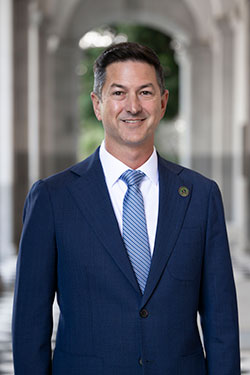
Asm. Chris Ward
Sponsored bills
Existing law vests the Public Utilities Commission with regulatory authority over public utilities, including electrical corporations. Under existing law, the Green Tariff Shared Renewables Program requires an electrical corporation with 100,000 or more customers in California to file with the commission an application requesting approval of a tariff to implement a program enabling ratepayers to participate directly in offsite electrical generation facilities that use eligible renewable energy resources. Existing law requires the commission to develop programs to increase the adoption of renewable generation among residential customers in disadvantaged communities, and, acting pursuant to that requirement, the commission has adopted, among others, the Disadvantaged Communities Green Tariff program and the Community Solar Green Tariff program. Existing law imposes various requirements on public works projects, as defined, including a requirement that, at minimum, all workers employed on a public works project be paid the general prevailing rate of per diem wages for work of a similar character in the locality in which a public work is performed, as specified. Existing law requires that contractor and subcontractor payroll records subject to prevailing wage requirements be verified by written declaration under the penalty of perjury, as specified. This bill would require the commission, on or before March 31, 2024, to evaluate each customer renewable energy subscription program, as described, to determine if the program meets specified goals, to authorize the termination or modification of a program that does not meet those goals, and to determine whether it would be beneficial to ratepayers to establish a community renewable energy program. The bill would require the commission, on or before July 1, 2024, to establish that program if doing so would be beneficial to ratepayers and to require each electrical corporation to participate in that program. The bill would require each community choice aggregator and electric service provider, within 180 days of the establishment of that program, to notify the commission whether it will participate in the program and would authorize a community choice aggregator or electric service provider to begin participating in, or end its participation in, that program at any time by notifying the commission. The bill would require the community renewable energy program, if established, to be complementary to, and consistent with, specified requirements of the California Building Standards Code, ensure at least 51% of its capacity serves low-income customers, prohibit its costs from being paid by nonparticipating customers, require that the construction of its community renewable energy facilities comply with specified prevailing wage requirements, provide bill credits to subscribers, and prioritize the maximum use of state and federal incentives and accelerate its implementation to ensure that time- or quantity-limited federal incentives can be obtained for the benefit of subscribers, as specified. Because the bill would expand the crime of the penalty of perjury, it would impose a state-mandated local program. The bill would require the commission, on or before March 31, 2024, to report to the Legislature on its actions taken as a result of its evaluation of each customer renewable energy subscription program, its justification for terminating, modifying, or retaining each program, and whether it would be beneficial to ratepayers to establish the community renewable energy program. The bill would also require the commission, within 24 months of establishing the community renewable energy program and annually thereafter, to submit a report to the Legislature on the facilities deployed, and customers subscribed, pursuant to that program. Under existing law, a violation of the Public Utilities Act or an order, decision, rule, direction, demand, or requirement of the commission is a crime. Because the above provisions would be part of the act and a violation of a commission action implementing this bill's requirements would be a crime, the bill would impose a state-mandated local program. The California Constitution requires the state to reimburse local agencies and school districts for certain costs mandated by the state. Statutory provisions establish procedures for making that reimbursement. This bill would provide that no reimbursement is required by this act for a specified reason.
Existing law requires an operator of a commercial website or online service that collects personally identifiable information through the internet about individual consumers residing in California who use or visit its commercial website or online service to make its privacy policy available to consumers, as specified. This bill would require a social media company, as defined, to post their terms of service for each social media platform, as defined, owned or operated by the company in a specified manner and with additional specified information, subject to certain exceptions. The bill would define "terms of service" to mean a policy or set of policies adopted by a social media company that specifies, at least, the user behavior and activities that are permitted on the internet-based service owned or operated by the social media company, and the user behavior and activities that may subject the user or an item of content to being actioned, as defined. This bill would also require the social media company to submit reports, as specified, starting no later than January 1, 2024, to the Attorney General. The bill would specify the information required by the reports, including, but not limited to, the current version of the terms of service for each social media platform owned or operated by the company, specified categories of content and what policies the social media company has for that platform to address that content, and data related to violations of the terms of service for each platform. The bill would require the Attorney General to make all terms of service reports submitted pursuant to those provisions available to the public in a searchable repository on its official internet website. The bill would state the intent of the Legislature that a social media company that violates the above provisions shall be subject to meaningful remedies sufficient to induce compliance with these provisions, and would specify civil penalties that a company shall be liable for if the bill's provisions are violated, and how the Attorney General or a city attorney may bring an action against violators. The bill would specify that the duties, obligations, remedies, and penalties imposed by the bill are cumulative to existing law.
Existing law authorizes a landlord, or the landlord's agent, who receives a request to rent a residential property from an applicant to charge that applicant an application screening fee to cover the costs of obtaining information about the applicant. This bill would define the term "reusable tenant screening report" to mean a consumer report, as defined, that was prepared within the previous 30 days by a consumer reporting agency at the request and expense of an applicant, is made directly available to the landlord for use in the rental application process or is provided through a third-party website that regularly engages in the business of providing reusable tenant screening reports that are available to landlords and complies with all state and federal laws pertaining to use and disclosure of information contained in a consumer report by a consumer reporting agency, and is available to the landlord at no cost to access or use. The bill would require a reusable tenant screening report to include specified information, including the results of an eviction history check, as prescribed. The bill would prohibit a landlord from charging the applicant a fee for the landlord to access the report or an application screening fee.
This measure would proclaim the month of September 2022 as Prostate Cancer Awareness Month.
This measure would designate a specified portion of State Highway Route 44, near Oak Run in the County of Shasta, as the Stan Statham Memorial Highway. This measure would request the Department of Transportation to determine the cost of appropriate signs showing this special designation and, upon receiving donations from nonstate sources covering that cost, to erect those signs.
This measure would designate the East End Complex-Block 171 in Sacramento as the Mario Obledo Building, and would request the Department of General Services to determine the cost of erecting appropriate plaques and markers showing the designation and, upon receiving donations from nonstate sources, to cover that cost to erect signage.
This measure would urge the United States Congress to amend the United States Social Security Administration's index of earnings to ensure that a decline in aggregate wages due to COVID-19 does not result in decreased benefits.
This measure would request that the Department of Transportation remove the "The Christopher Columbus Transcontinental Highway" designation from the portion of Interstate 10 in the state, as well as any signage and markers memorializing that designation, and advise the Federal Highway Administration of the state's action.
This measure would, among other things, on the first anniversary of the attack on the United States Capitol on January 6, 2021, urge the Select Committee to Investigate the January 6th Attack on the United States Capitol to uncover the facts, circumstances, and causes relating to the attack, and honor the individuals who died or were injured as a result of the attack.