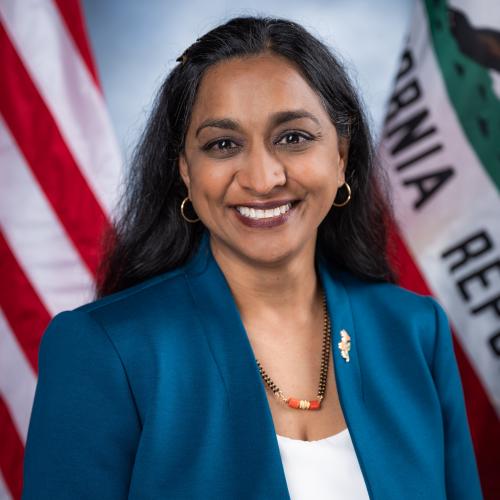
Photo of Darsh Patel
D California Assembly · District 76 On the 2026 ballot

Asm. Darsh Patel

Compare
Total votes
4,853
all sessions
Attendance
96%
159 missed
Lower than 95% of chamber peers
With party
99%
of cast votes
Near the chamber average
Bipartisan score
0%
crosses aisle rarely
Near the chamber average
Sponsored
405
bills & resolutions
Near the chamber average
Committees
11
assignments
405 bills and resolutions

Sponsored bills

Total
405
Primary
39
Co-sponsor
366
This page
405
matching current filters
Co-sponsor HR 77
Passed · California Assembly · Co-sponsor
Relative to school governance.

Maddy summaryThis House Resolution declares January 2026 as School Board Recognition Month to honor the nearly 5,000 school board members across California's 1,000 school districts and county offices of education. The resolution recognizes these locally elected officials for their work in guiding public education and serving diverse communities, emphasizing their role in ensuring students' academic, social-emotional, and health needs are met. It calls on community members to join in acknowledging the dedication of school board members and collaborate to improve the education system. The bill has no operational effect beyond this symbolic recognition and does not change any laws or policies.

Passed Feb 5, 2026 1 co-sponsor
Co-sponsor HR 76
Passed · California Assembly · Co-sponsor
Relative to affordable homeownership.

Maddy summaryThis House Resolution formally recognizes the importance of affordable homeownership for California families, particularly those with lower incomes, and highlights how nonprofit-led programs help build generational wealth and reduce economic disparities. The document emphasizes that existing state programs like CalHome support the construction and preservation of affordable homes through competitive funding to cities, counties, indigenous communities, and nonprofit builders such as Habitat for Humanity. While the resolution does not create new laws or funding, it serves as an official acknowledgment of homeownership's role in improving educational outcomes, health, civic participation, and neighborhood stability. The text also notes California's significant housing deficit and racial wealth gaps as context for why expanding affordable ownership opportunities is a priority for state policy.

Passed Feb 5, 2026 1 co-sponsor
Primary AB 1015
Failed · California Assembly · Lead sponsor
Discrimination and harassment prevention training.

Existing law requires a specified employer with 5 or more employees to, by January 1, 2021, provide at least 2 hours of classroom or other effective interactive training and education regarding sexual harassment to all supervisory employees and at least one hour of classroom or other effective interactive training and education regarding sexual harassment to all nonsupervisory employees in California and, after that date, once every 2 years. Existing law requires that a method be provided for employees who have completed the training to save electronically and print a certificate of completion. Existing law requires that an employee who has received training in compliance with these provisions within the prior 2 years either from a current or a prior employer be given, and be required to read and acknowledge receipt of, the employer's antiharassment policy within 6 months of assuming the employee's new position and requires that the employee then be put on a 2-year tracking schedule based on the employee's last training. Existing law places the burden of establishing that the prior training was legally compliant with these provisions upon the employer. This bill would authorize an employer to satisfy the training requirements by demonstrating that the employee possesses a certificate of completion within the past 2 years.

Failed Feb 2, 2026 0 co-sponsors
Primary AB 1212
Failed · California Assembly · Lead sponsor
University of California: faculty and employee housing.

Existing law authorizes a school district and the California State University (CSU) to establish and implement programs that address the housing needs of teachers or faculty, as applicable, and school district or CSU employees who face challenges in securing affordable housing, as specified. The act provides that it specifically creates a state policy supporting housing for teachers and school district employees, and for faculty and CSU employees, as described by specified federal law and permits school districts, CSU campuses, and developers in receipt of local or state funds or tax credits designated for affordable rental housing to restrict occupancy to teachers and school district employees, or faculty and CSU employees, as applicable, on land owned by school districts or the CSU, so long as that housing does not violate any other applicable laws. Existing law defines various terms for these purposes. This bill would authorize the University of California to establish and implement a similar program to the school district and CSU programs described above to address the housing needs of University of California faculty or employees who face challenges in securing affordable housing, as specified. The bill would provide that it specifically creates a state policy supporting housing for University of California faculty or campus or medical center employees as described by specified federal law and permits the University of California campuses or medical centers, or developers, in receipt of local or state funds or tax credits designated for affordable rental housing to restrict occupancy to University of California faculty or employees on land owned by the University of California or an auxiliary enterprise, as defined, so long as that housing does not violate any other applicable laws. The bill would define various terms for these purposes.

Failed Feb 2, 2026 0 co-sponsors
Primary AB 448
Failed · California Assembly · Lead sponsor
California Health Facilities Financing Authority Act: nondesignated hospitals: loan repayment.

Under existing law, the California Health Facilities Financing Authority Act (act) authorizes the California Health Facilities Financing Authority to, among other things, make loans from the continuously appropriated California Health Facilities Financing Authority Fund to participating health institutions, as defined, for financing or refinancing the acquisition, construction, or remodeling of health facilities. Under the act, the authority is authorized to issue revenue bonds to provide the funds for achieving these purposes. Existing law appropriates $40,000,000 to provide cashflow loans to nondesignated public hospitals, as needed, due to the financial impacts of the COVID-19 public health emergency. Existing law requires the nondesignated public hospitals participating in this loan program to repay and discharge the loan within 24 months of the date of the loan. This bill would extend the repayment requirements for nondesignated public hospitals participating in the loan program that had received a loan approval from, and entered into a loan and security agreement with, the authority by requiring those hospitals to begin monthly repayments on the loan 32 months after the date of the loan, and discharge the loan within 60 months of the date of the loan, as prescribed. The bill would require the monthly payments to be amortized over the term of the loan, at 0% interest. By removing restrictions limiting the expenditure of moneys appropriated for purposes of these loans, the bill would make an appropriation.

Failed Feb 2, 2026 0 co-sponsors
Primary AB 684
Failed · California Assembly · Lead sponsor
University of California: meetings of the Regents.

Existing law establishes the University of California, under the administration of the Regents of the University of California, as one of the segments of public postsecondary education in the state. Existing law requires all meetings of the regents, defined to include the Board of Regents, the standing and special committees or subcommittees of the board, and an advisory board, advisory commission, advisory committee, advisory subcommittee, study group, task force, or similar multimember advisory body of the board that has continuing subject matter jurisdiction in the area of compensation, to be subject to the Bagley-Keene Open Meeting Act, except as provided. This bill would define, for purposes of being subject to the Bagley-Keene Open Meeting Act, the "Regents of the University of California" to also include the Academic Senate of the University of California, Board of Admissions and Relations with Schools.

Failed Feb 2, 2026 0 co-sponsors
Primary AB 1186
Failed · California Assembly · Lead sponsor
Data collection: race and ethnicity: minimum categories.

Existing law requires state agencies, boards, or commissions that directly or by contract collect demographic data on the ethnic origin, ethnicity, or race of Californians to use specified collection categories for Asian, Native Hawaiian, Pacific Islander, Black, and African American groups. Existing law establishes the Demographic Research Unit within the Department of Finance, which, among other things, acts as the primary state government liaison with the United States Census Bureau in the acquisition and distribution of census data and related documentation to state agencies. This bill, subject to a specified exception, would require any state agency, board, or commission that directly or by contract collects demographic data on the ethnic origin, ethnicity, or race of Californians to collect data on at least the minimum categories on race and ethnicity, as defined, as well as at least the top 9 largest detailed categories, and prescribed write-in options, as provided. The bill would require compliance with these provisions by January 1, 2029. The bill would establish, within the Demographic Research Unit, the position of the Chief Statistician of California, who would be required to, among other things, standardize collection of demographic data across state agencies, as provided. The bill would require the Chief Statistician of California and the Demographic Research Unit to oversee implementation of these provisions and provide technical assistance. The bill would also require, on or before January 1, 2027, and annually thereafter, each state agency, board, or commission required to comply with the bill's provisions to submit a report to the Legislature and the Assembly Committee on Governmental Organization on compliance with these provisions, as provided. The bill would require data collected pursuant to this section to be made available to the public in accordance with state and federal law, except for personal identifying information, as specified. The bill would prohibit an agency from disclosing personal identifying information to any federal agency unless the disclosure is expressly required by federal law.

Failed Feb 2, 2026 0 co-sponsors
Primary AB 588
Failed · California Assembly · Lead sponsor
State Fire Marshal: lithium battery working group: membership: funding.

Existing law requires the State Fire Marshal, commencing January 1, 2026, to adopt regulations that promote the fire and electrical safety of electric bicycles, powered mobility devices, and storage batteries, as specified. Existing law defines storage batteries for these purposes to include lithium batteries, as provided. This bill would require the Office of the State Fire Marshal to convene a lithium battery working group, composed of specified members selected by the State Fire Marshal, to identify those safety issues associated with lithium batteries and associated charging infrastructure installed or used near or within residential or commercial occupancies that have not already been addressed in the 2025 Edition of the California Building Standards Code, and to recommend potential solutions that will enhance building safety for the State Fire Marshal and other impacted agencies to consider, as provided. The bill would require the working group to deliver the initial research, findings, and recommendations on or before January 1, 2027. Existing law establishes the Building Standards Administration Special Revolving Fund in the State Treasury. Existing law provides that moneys in the fund, which include building permit applicant fees, shall be available, upon appropriation, to the Office of the State Fire Marshal, among other state entities, for expenditure in carrying out various provisions relating to building and housing standards, as provided. This bill would make moneys in the Building Standards Administration Special Revolving Fund available, upon appropriation, to support the working group. The bill would also appropriate an unspecified amount from the fund for specified purposes related to addressing building safety concerns associated with lithium batteries and associated charging infrastructure being installed or used near or within residential or commercial occupancies.

Failed Feb 2, 2026 0 co-sponsors
Co-sponsor AB 1468
Failed · California Assembly · Co-sponsor
Ethnic studies: content standards, curriculum frameworks, instructional materials, and compliance monitoring.

Existing law requires the State Board of Education to adopt statewide academically rigorous content standards in the core curriculum areas of reading, writing, mathematics, history/social science, and science, as specified. Existing law requires the Instructional Quality Commission to, among other things, recommend curriculum frameworks to the state board and develop criteria for evaluating instructional materials. This bill would require the state board to, on or before January 1, 2028, develop and adopt academically rigorous content standards for ethnic studies instruction in high school. The bill would require the commission, on or before January 1, 2028, to review and recommend to the state board curriculum frameworks and instructional materials for ethnic studies instruction in high school, as specified. The bill would require the state board to provide the commission with evaluation criteria to use in providing its review and recommendations. The bill would state the intent of the Legislature to enact subsequent legislation to establish an advisory committee with a majority of the advisory committee's members being experts in African American studies, Asian American and Pacific Islander studies, Native American studies, and Latino and Chicanx studies, to provide input to the state board on proposed content standards and to the commission on proposed curriculum frameworks and instructional materials for ethnic studies instruction in high school. Existing law requires a pupil to complete designated coursework while in grades 9 to 12, inclusive, in order to receive a diploma of graduation from high school. These graduation requirements include, commencing for pupils graduating in the 2029–30 school year, the completion of a one-semester course in ethnic studies meeting specified requirements. Under existing law, the requirement to complete an ethnic studies course may be fulfilled by the completion of, among others, a course based on the model curriculum developed by the Instructional Quality Commission, an ethnic studies course taught as part of a course that has been approved as meeting the A–G requirements of the University of California and the California State University, or a locally developed ethnic studies course approved by the governing board of a school district or the governing body of a charter school. Existing law requires the curriculum, instruction, and instructional materials for these ethnic studies courses to meet specified requirements, including that they not reflect or promote any bias, bigotry, or discrimination against any person or group of persons on the basis of certain characteristics. Existing law makes these provisions relating to ethnic studies courses operative only upon an appropriation of funds by the Legislature for purposes of these provisions. This bill would require the curriculum, instruction, and instructional materials for any high school ethnic studies course, including ethnic studies courses meeting high school graduation requirements, to meet the above-described requirements, and would require the curriculum, instruction, and instructional materials for all high school ethnic studies courses to additionally, among other things, foster multicultural respect and understanding and focus on the domestic experience and stories of historically marginalized peoples in American society. To the extent that the bill would impose new duties on local educational agencies, the bill would impose a state-mandated local program. The bill would require a school district, county office of education, or charter school to provide, on or before June 30, 2026, the State Department of Education with a copy of all curricula, instruction, and instructional materials in ethnic studies that schools offer or plan to offer to pupils in any of grades 9 to 12, inclusive, and the adoption calendar for curricula, instruction, and instructional materials in ethnic studies proposed for adoption by the governing board or body of the local educational agency for instruction to these pupils. The bill would require a local educational agency that does not have an ethnic studies course in place for its pupils in any of grades 9 to 12, inclusive, on or before June 30, 2026, to provide the department with a copy of all curricula, instruction, and instructional materials in ethnic studies that its schools seek to adopt at least 60 days before being first presented at a public meeting of the governing board or body of the local educational agency for instruction to these pupils. The bill would require the department to post the information received pursuant to these requirements on its internet website. To the extent that the bill would impose new duties on local educational agencies, it would impose a state-mandated local program. The bill would require the department to monitor compliance with the requirements of this bill as part of its annual compliance monitoring of state and federal programs and to provide a report to the relevant policy and fiscal committees of the Legislature summarizing the data collected through compliance monitoring, as specified. The California Constitution requires the state to reimburse local agencies and school districts for certain costs mandated by the state. Statutory provisions establish procedures for making that reimbursement. This bill would provide that, if the Commission on State Mandates determines that the bill contains costs mandated by the state, reimbursement for those costs shall be made pursuant to the statutory provisions noted above.


Failed Feb 2, 2026 1 co-sponsor
Co-sponsor AB 397
Failed · California Assembly · Co-sponsor
Personal Income Tax Law: young child tax credit.

The Personal Income Tax Law allows various credits against the taxes imposed by that law, including a young child tax credit to a qualified taxpayer in a specified amount multiplied by the earned income tax credit adjustment factor, as provided. That law also allows a payment from the continuously appropriated Tax Relief and Refund Account for an amount in excess of tax liability. Existing law defines "qualified taxpayer" for this purpose to include an eligible individual, as defined, who has a qualifying child, defined to be a child younger than 6 years of age as of the last day of the taxable year, and who meets other specified criteria. This bill, for taxable years beginning on or after January 1, 2025, would instead define a "qualifying child" to mean a child younger than a specified age as of the last day of the taxable year, as described. By increasing the payments from the Tax Relief and Refund Account, a continuously appropriated fund, the bill would make an appropriation. Existing law requires any bill authorizing a new tax expenditure to contain, among other things, specific goals that the tax expenditure will achieve, detailed performance indicators, and data collection requirements. This bill would include additional information required for any bill authorizing a new tax expenditure.

Failed Feb 2, 2026 1 co-sponsor
Showing 231 to 240 of 405 bills
Previous 1 23 24 25 41 Next