

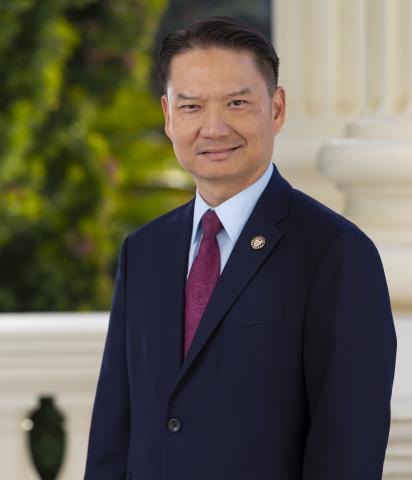
Photo of Tri Ta
R California Assembly · District 70 On the 2026 ballot

Asm. Tri Ta

Compare
Total votes
12,842
all sessions
Attendance
86%
1,179 missed
Lower than 85% of chamber peers
With party
99%
of cast votes
Near the chamber average
Bipartisan score
1%
crosses aisle rarely
Near the chamber average
Sponsored
806
bills & resolutions
Higher than 82% of chamber peers
Committees
6
assignments
806 bills and resolutions

Sponsored bills

Total
806
Primary
103
Co-sponsor
703
This page
806
matching current filters
Primary AB 329
Failed · California Assembly · Lead sponsor
Theft: jurisdiction.

Existing law establishes the jurisdiction of a criminal action brought by the Attorney General for theft, organized retail theft, or receipt of stolen property as including the county where an offense involving the theft or receipt of the stolen merchandise occurred, the county in which the merchandise was recovered, or the county where any act was done by the defendant in instigating, procuring, promoting, or aiding in the commission of the offense. Existing law defines the crime of grand theft to include stealing, taking, or carrying away the cargo of another with a value of over $950. This bill would include the crime of cargo theft in the above-mentioned jurisdictional provisions.

Failed Jan 10, 2024 0 co-sponsors
Co-sponsor AB 15
Failed · California Assembly · Co-sponsor
Public records: parole calculations and inmate release credits.

Existing law, the California Public Records Act, requires state and local agencies to make their records available for inspection by the public, subject to specified criteria and with specified exceptions. Existing law exempts from disclosure any investigatory or security file compiled by any other state or local police agency, or any investigatory or security files compiled by any other state or local agency for correctional, law enforcement, or licensing purposes. Under existing law, criminal offenders sentenced to imprisonment in the state prison are sentenced for either a determinate term or an indeterminate life sentence, and a person sentenced to an indeterminate life sentence is held until release by the Board of Parole Hearings. Under existing law, a person sentenced to a determinate sentence is released after serving the term of their sentence, minus any credits earned, and is required to serve a period of time after release under parole supervision. Existing constitutional provisions, enacted by Proposition 57 at the November 8, 2016, statewide general election, make an inmate sentenced to state prison for a conviction of a nonviolent felony offense eligible for early parole consideration after completing the full term for their primary offense, as defined. This bill would provide that Department of Corrections and Rehabilitation records pertaining to an inmate's release date and their early release credits are public records and are subject to disclosure under the California Public Records Act, with specified exceptions. The bill would state that the provisions relative to the California Public Records Act are declaratory of existing law.

Failed Jan 10, 2024 1 co-sponsor
Co-sponsor ACR 119
Introduced · California Assembly · Co-sponsor
Relative to the October 7, 2023, attack on Israel.

This measure would condemn and decry the Hamas terrorist organization in the harshest terms for its premeditated, coordinated, and barbaric attacks on Israel, acts of sexual violence, hostage taking, and theft of relief supplies intended for the civilian population of Gaza, and demand the release of all hostages held by Palestinian terrorists. The measure would condemn and denounce in the strongest possible terms all instances of anti-Semitism occurring in California, the United States, and globally.

Introduced Jan 4, 2024 1 co-sponsor
Co-sponsor AB 1265
Failed · California Assembly · Co-sponsor
Transportation fuels: gasoline specifications.

The California Global Warming Solutions Act of 2006 establishes the State Air Resources Board as the state agency responsible for monitoring and regulating sources emitting greenhouse gases. The act requires the state board to approve a statewide greenhouse gas emissions limit equivalent to the statewide greenhouse gas emissions level in 1990 and to ensure the statewide greenhouse gas emissions are reduced to at least 40% below the statewide greenhouse gas emissions limit by 2030. The act authorizes the state board to include the use of market-based compliance mechanisms in its regulation of greenhouse gas emissions. This bill would specify that transportation fuels are not subject to regulations implementing a market-based compliance mechanism for greenhouse gas emissions. Existing law authorizes the state board to adopt and implement motor vehicle fuel specifications for the control of air contaminants and sources of air pollution. Existing law authorizes the state board to grant variances from the gasoline specifications, as provided. This bill would require the state board to grant variances from gasoline specifications, including for gasoline imported from outside the state, whenever a refinery outage or other supply interruption would result in substantial short-term price increases, as specified. Existing law requires the state board to establish, by regulation, maximum standards for volatility of gasoline, as provided. Pursuant to these authorities, the state board has adopted the California Reformulated Gasoline regulations, which include regulations establishing the maximum Reid vapor pressure of gasoline for various regions of the state at specified time periods. This bill would require the state board to waive the Reid vapor pressure requirement on summer-blend gasoline under the California Reformulated Gasoline regulations and to allow for the early transition to winter-blend gasoline if the state board determines that the gasoline market is experiencing a sudden and unusual increase in gasoline prices.

Failed Jan 3, 2024 1 co-sponsor
Co-sponsor SB 342
died · California Senate · Co-sponsor
Pupil instruction: history-social science curriculum framework: financial literacy.

Existing law requires the adopted course of study for grades 1 to 6, inclusive, and for grades 7 to 12, inclusive, to offer courses in specified areas of study, including social sciences. Existing law establishes the Instructional Quality Commission and requires the commission to, among other things, recommend curriculum frameworks to the State Board of Education. Existing law requires the state board, concurrently with, but not before, the next revision of textbooks or curriculum frameworks in the social sciences, health, and mathematics curricula, to ensure that these academic areas integrate components of, among other things, financial literacy. Notwithstanding that requirement on the state board, existing law requires the commission, when the history-social science curriculum framework is revised after January 1, 2017, to consider including age-appropriate information for kindergarten and grades 1 to 12, inclusive, regarding certain topics on financial literacy. This bill instead would require the commission, when the history-social science curriculum framework is revised after January 1, 2024, to include age-appropriate information and content for kindergarten and grades 1 to 12, inclusive, regarding those financial literacy topics.

died Nov 29, 2023 1 co-sponsor
Co-sponsor SB 44
died · California Senate · Co-sponsor
Controlled substances.

Existing law makes it a crime to possess for sale or purchase for purpose of sale, transport, import, sell, furnish, administer, give away, manufacture, compound, convert, produce, derive, process, or prepare various controlled substances, including, among others, fentanyl, peyote, and various other opiates and narcotics. This bill, Alexandra's Law, would require the court to advise a person who is convicted of, or who pleads guilty or no contest to, the above crimes, as specified, of the danger of selling or administering illicit drugs and counterfeit pills and that, if a person dies as a result of that action, the defendant can be charged with homicide. The bill would require the court to read the advisory statement in a case in which the defendant exchanged a controlled substance containing fentanyl or its analogs for anything else of value, as specified. The bill would require the advisory statement to be included in a plea form, if used, and specified on the record. The bill would require that the fact the advisory was given be recorded in the abstract of conviction and would prohibit the advisement from being used as evidence in the prosecution of a minor in juvenile court.

died Nov 29, 2023 1 co-sponsor
Co-sponsor AB 243
Signed into law · California Assembly · Co-sponsor
Child abduction survivors: address confidentiality program.

Existing law authorizes victims of domestic violence, sexual assault, stalking, human trafficking, and elder or dependent adult abuse, and members of their households, to complete an application to be approved by the Secretary of State for the purpose of enabling state and local agencies to respond to requests for public records without disclosing a program participant's changed name or location, subject to specified conditions. Existing law makes it a misdemeanor for any person to make a false statement in an application. This bill, beginning on July 1, 2024, would make victims of child abduction, as defined, and members of their households eligible for the protections of this address confidentiality program. By expanding the scope of the program to include victims of child abduction and their household members, this bill would impose new duties on local public officials and expand the scope of an existing crime, thereby imposing a state-mandated local program. The California Constitution requires the state to reimburse local agencies and school districts for certain costs mandated by the state. Statutory provisions establish procedures for making that reimbursement. This bill would provide that with regard to certain mandates no reimbursement is required by this act for a specified reason. With regard to any other mandates, this bill would provide that, if the Commission on State Mandates determines that the bill contains costs so mandated by the state, reimbursement for those costs shall be made pursuant to the statutory provisions noted above.

Signed into law Oct 10, 2023 1 co-sponsor
Co-sponsor AB 226
Signed into law · California Assembly · Co-sponsor
University of California: California Native American Graves Protection and Repatriation Act of 2001.

The California Constitution provides that the University of California constitutes a public trust, and requires the university to be administered by the Regents of the University of California, a corporation in the form of a board, with full powers of organization and government, subject to legislative control only for specified purposes. The California Native American Graves Protection and Repatriation Act of 2001 requires all agencies and museums, which is defined to include higher education institutions, that receive state funding and have possession or control over collections of California Native American human remains and associated funerary objects to inventory those remains and objects for repatriation to the appropriate California Indian tribes, as specified. This bill would urge the University of California to, on or before June 30, 2024, and annually thereafter, report each University of California campus's progress towards completing repatriation pursuant to the California Native American Graves Protection and Repatriation Act of 2001. The bill would urge the office of the President of the University of California to provide available funding to sufficiently support those efforts. The bill would urge the University of California to prohibit use of any Native American human remains or cultural items for purposes of teaching or research at the University of California. Existing law requires the California State Auditor to conduct an audit commencing in the year 2019 and again in 2021 regarding the University of California's compliance with the federal and California acts and to report its findings to the Legislature and all other appropriate entities. This bill would require the California State Auditor to additionally conduct an audit again in 2024 and 2026, and to also report its findings to the Native American Heritage Commission.

Signed into law Oct 10, 2023 1 co-sponsor
Co-sponsor AB 656
Signed into law · California Assembly · Co-sponsor
California State University: doctoral programs.

Existing law establishes the California State University, under the administration of the Trustees of the California State University, and the University of California, under the administration of the Regents of the University of California, as 2 of the segments of public postsecondary education in this state. Existing law provides for the missions and functions of these segments, and states that the University of California has the sole authority in public higher education to award doctoral degrees in all fields of learning, except that it may agree with the California State University to award joint doctoral degrees in selected fields. However, existing law authorizes the California State University to offer doctoral programs in education, audiology, physical therapy, occupational therapy, and public health without that agreement. This bill would authorize the California State University to award professional or applied doctoral degrees statewide that do not duplicate University of California doctoral degrees and satisfy certain requirements. The bill would require a California State University campus seeking authorization to offer a professional or applied doctoral degree program pursuant to the bill to submit specified information on the proposed doctoral degree for review by the office of the Chancellor of the California State University, and approval by the trustees, as provided. The bill would authorize professional or applied doctoral degree programs that are approved for implementation by the trustees pursuant to the bill to be implemented at any California State University campus, but would limit the number of doctoral degree programs that may be offered at a California State University campus. The bill would prohibit the trustees from approving more than 10 new doctoral degree disciplines pursuant to the bill per academic year. The bill would require the Legislative Analyst's Office to conduct a systemwide evaluation of doctoral degree programs established pursuant to the bill and report the results of the evaluation to the Legislature and the Governor on or before December 31, 2028.

Signed into law Oct 10, 2023 1 co-sponsor
Co-sponsor AB 988
Signed into law · California Assembly · Co-sponsor
Miles Hall Lifeline and Suicide Prevention Act: veteran and military data reporting.

Existing federal law, the National Suicide Hotline Designation Act of 2020, designates the 3-digit telephone number "988" as the universal number within the United States for the purpose of the national suicide prevention and mental health crisis hotline system operating through the 988 Suicide and Crisis Lifeline, maintained by the Assistant Secretary for Mental Health and Substance Use, and the Veterans Crisis Line, which is maintained by the Secretary of Veterans Affairs. Existing law creates a separate surcharge, beginning January 1, 2023, on each access line for each month, or part thereof, for which a service user subscribes with a service supplier. Existing law sets the 988 surcharge for the 2023 and 2024 calendar years at $0.08 per access line per month and beginning January 1, 2025, at an amount based on a specified formula not to exceed $0.30 per access line per month. Existing law authorizes the 911 and 988 surcharges to be combined into a single-line item, as described. Existing law provides for specified costs to be paid by the fees prior to distribution to the Office of Emergency Services. Existing law, the Miles Hall Lifeline and Suicide Prevention Act, creates the 988 State Suicide and Behavioral Health Crisis Services Fund and requires the fees to be deposited along with other specified moneys into the fund. Existing law provides that, upon appropriation by the Legislature, the funds be used for specified purposes and in accordance with specified priorities. Existing law requires the Office of Emergency Services to require an entity seeking moneys available through the fund to annually file an expenditure and outcomes report containing specified information, including, among other things, the number of individuals served and the outcomes for individuals served, if known. This bill would require an entity seeking moneys from the fund to also include the number of individuals who used the service and self-identified as veterans or active military personnel in its annual expenditure and outcomes report.

Signed into law Oct 8, 2023 1 co-sponsor
Showing 581 to 590 of 806 bills
Previous 1 … 58 59 60 … 81 Next