

Existing law requires the Department of Motor Vehicles, upon proper application, to issue driver's licenses and identification cards. The federal Implementing Recommendations of the 9/11 Commission Act of 2007 and the federal Intelligence Reform and Terrorism Prevention Act of 2004 facilitate travel within the western hemisphere by authorizing the use of enhanced driver's licenses and identification cards meeting specified requirements as travel documents. This bill would authorize the Department of Motor Vehicles to enter into a memorandum of understanding with a federal agency for the purpose of facilitating travel within the western hemisphere pursuant to the federal Implementing Recommendations of the 9/11 Commission Act of 2007 and the federal Intelligence Reform and Terrorism Prevention Act of 2004 through the issuance of enhanced driver's licenses, provisional licenses, or identification cards. The bill would authorize the department to issue or renew, upon request, an enhanced driver's license, provisional license, or identification card for specified persons. The bill would require a person applying for the initial issuance or renewal of an enhanced driver's license, provisional license, or identification card to submit, under the penalty of perjury, additional proof of identity, residency, and citizenship that satisfies the requirements of the federal Implementing Recommendations of the 9/11 Commission Act of 2007 and the federal Intelligence Reform and Terrorism Prevention Act of 2004. By expanding the scope of the crime of perjury, this bill would impose a state-mandated local program. The bill would require the department to provide a protective shield and to take other specified security measures for the enhanced driver's license, provisional license, or identification card. The bill would prohibit specified information submitted by an applicant for an enhanced driver's license, provisional license, or identification card from being disclosed by the department, as specified. The bill would make all laws related to the privacy or security of a driver's license, provisional license, or identification document, or a similar document, or regulating the use, access, or sharing of information applicable to enhanced driver's licenses, provisional licenses, and identification cards. The bill also would require a person applying for an enhanced driver's license, provisional license, or identification card to submit an additional application fee. The bill would require the department to set the application fee, by regulation, in an amount not to exceed the reasonable regulatory cost of issuing or renewing the license or identification card or $55, whichever is less, and to provide specified information to the applicant. The bill would require the fees to be deposited into the Motor Vehicle Account. The bill would, upon appropriation by the Legislature, require those fees to be expended by the department in implementing the above provisions. The bill would require the department to submit an annual report to specified committees of the Legislature on the implementation of the enhanced driver's license, provisional license, and identification card. Existing constitutional provisions require that a statute that limits the right of access to the meetings of public bodies or the writings of public officials and agencies be adopted with findings demonstrating the interest protected by the limitation and the need for protecting that interest. This bill would make legislative findings to that effect. The California Constitution requires the state to reimburse local agencies and school districts for certain costs mandated by the state. Statutory provisions establish procedures for making that reimbursement. This bill would provide that no reimbursement is required by this act for a specified reason.
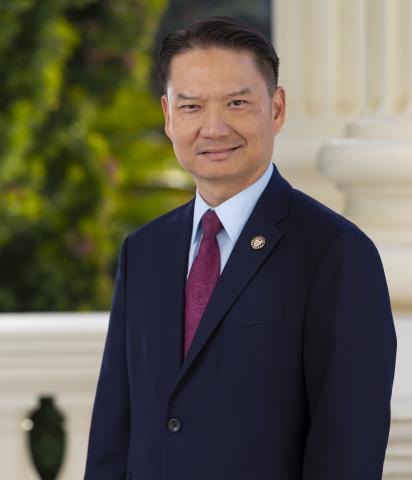
Asm. Tri Ta
Sponsored bills
The Personal Income Tax Law, in modified conformity with federal income tax law, excludes from the gross income of a beneficiary of, or contributor to, a qualified tuition program, which includes a Golden State Scholarshare College Savings Trust, distributions or earnings under that program, as specified. This bill, for taxable years beginning on or after January 1, 2024, and before January 1, 2028, would allow under that law a deduction against gross income in the amount equal to the monetary contribution made by a qualified taxpayer, as defined, to the California qualified tuition program established pursuant to the Golden State Scholarshare Trust Act not to exceed either $1,000 or $2,000, per beneficiary, as provided. The bill would require, with exceptions, in the case of any distribution in excess of qualified higher education expenses, as defined, that the aggregate amount of the deduction allowed that reduced the qualified taxpayer's gross income in any taxable year be added to the gross income of the qualified taxpayer in the taxable year of the distribution, as provided. The bill would provide that the deduction is only operative for taxable years for which an appropriation is made for its purposes in the annual Budget Act or other statute. Existing law requires any bill authorizing a new tax expenditure to contain, among other things, specific goals, purposes, and objectives the tax expenditure will achieve, detailed performance indicators, and data collection requirements. This bill would also include additional information required for any bill authorizing a new tax expenditure. This bill would take effect immediately as a tax levy.
Existing law classifies controlled substances into 5 schedules and places the greatest restrictions and penalties on the use of those substances placed in Schedule I. Opiates, including fentanyl, are classified in Schedule II. Existing law prohibits a person from possessing for sale or purchasing for purposes of sale specified controlled substances, including fentanyl, and punishes a violation of that prohibition by imprisonment in a county jail for 2, 3, or 4 years. Existing law also prohibits transporting, importing into this state, selling, furnishing, administering, or giving away specified controlled substances, including fentanyl, and punishes a violation of that prohibition by imprisonment in a county jail for 3, 4, or 5 years. Existing law also prohibits the trafficking of specified controlled substances, including fentanyl, and punishes a violation of that prohibition by imprisonment in a county jail for 3, 6, or 9 years. This bill would impose an additional punishment of 3, 4, or 5 years to a person who is convicted of the crimes mentioned above involving fentanyl or a fentanyl analog that was designed, shaped, colored, advertised, or packaged in such a way as to resemble food or candy. By imposing a new enhancement to the penalty of a crime, this bill would impose a state-mandated local program. The California Constitution requires the state to reimburse local agencies and school districts for certain costs mandated by the state. Statutory provisions establish procedures for making that reimbursement. This bill would provide that no reimbursement is required by this act for a specified reason.
(1) The Motor Vehicle Fuel Tax Law, administered by the California Department of Tax and Fee Administration, imposes a tax upon each gallon of motor vehicle fuel removed from a refinery or terminal rack in this state, entered into this state, or sold in this state, at a specified rate per gallon. Existing law requires the department to adjust the tax on July 1 each year by a percentage amount equal to the increase in the California Consumer Price Index, as calculated by the Department of Finance. Article XIX of the California Constitution restricts the expenditure of revenues from the Motor Vehicle Fuel Tax, Diesel Fuel Tax Law, and other taxes imposed by the state on fuels used in motor vehicles upon public streets and highways to street and highway and certain mass transit purposes. This bill would authorize the Governor to suspend an adjustment to the motor vehicle fuel tax, as described above, scheduled on or after July 1, 2025, upon making a determination that increasing the rate would impose an undue burden on low-income and middle-class families. The bill would require the Governor to notify the Legislature of an intent to suspend the rate adjustment on or before January 10 of that year, and would require the Department of Finance to submit to the Legislature a proposal by January 10 that would maintain the same level of funding for transportation purposes as would have been generated had the scheduled adjustment not been suspended. (2) The California Constitution provides for the establishment of the State Board of Equalization, which, before July 1, 2017, had primary responsibility for most of the state's duties, powers, and responsibilities regarding the administration of taxes and fees. Existing law, on July 1, 2017, transferred to the California Department of Tax and Fee Administration various duties, powers, and responsibilities of the State Board of Equalization, including administration of the Motor Vehicle Fuel Tax Law and the Diesel Fuel Tax Law, as specified. This bill would also change references in these provisions of law from the "State Board of Equalization" to the "California Department of Tax and Fee Administration" or "department", as applicable, to reflect the transfer of the board's duties, powers, and responsibilities to the department. (3) This bill would take effect immediately as a tax levy.
Existing law declares that the protection of the public interest in the development of the water resources of the state is of vital concern to the people of the state and that the state shall determine in what way the water of the state, both surface and underground, should be developed for the greatest public benefit. Existing law establishes within the Natural Resources Agency the State Water Resources Control Board and the California regional water quality control boards. Existing law requires the work of the state board to be divided into at least 2 divisions, known as the Division of Water Rights and the Division of Water Quality. This bill would establish a statewide goal to increase above- and below-ground water storage capacity by a total of 3,700,000 acre-feet by the year 2030 and a total of 4,000,000 acre-feet by the year 2040. The bill would require the Department of Water Resources, in consultation with the state board, to take reasonable actions to promote or assist efforts to achieve the statewide goal, as provided. The bill would require the department, beginning July 1, 2027, and on or before July 1 every 2 years thereafter until January 1, 2043, in consultation with the state board, to prepare and submit a report to the Legislature on the progress made to achieve the statewide goal.
Existing law requires the State Board of Education to adopt basic instructional materials for use in kindergarten and grades 1 to 8, inclusive, for governing boards of school districts in specified subjects and any other subject, discipline, or interdisciplinary area for which the state board determines the adoption of instructional materials to be necessary or desirable, and requires the governing board of each school district maintaining one or more high schools to adopt instructional materials for use in the high schools under its control, consistent with specified conditions. Existing law requires the adopted course of study for grades 1 to 6, inclusive, and for grades 7 to 12, inclusive, to offer instruction in specified areas of study, including social sciences. Existing law establishes the Instructional Quality Commission and requires the commission to, among other things, recommend curriculum frameworks to the state board. Existing law requires the state board, concurrently with, but not before, the next revision of textbooks or curriculum frameworks in the social sciences, health, and mathematics curricula, to ensure that these academic areas integrate components of, among other things, financial literacy. Notwithstanding that requirement on the state board, existing law requires the commission, when the history-social science curriculum framework is revised after January 1, 2017, to consider including age-appropriate information for kindergarten and grades 1 to 12, inclusive, regarding certain topics on financial literacy. This bill would require the Superintendent of Public Instruction, subject to an appropriation of one-time funds for this purpose in the annual Budget Act or another statute, to allocate funding for the purchase of standards-aligned instructional materials in financial literacy for kindergarten and grades 1 to 12, inclusive, and for professional development in that content, as provided. The bill would require the Superintendent to allocate these funds to school districts, county offices of education, charter schools, and the state special schools on the basis of an equal amount per unit of average daily attendance, as those numbers were reported at the time of the first principal apportionment for the 2021–22 fiscal year. The bill would require a school district, county office of education, charter school, or state special school to expend allocated funds for professional development or instructional materials in financial literacy that is aligned to the history-social science curriculum framework adopted by the state board and the financial literacy subject matter recommended considered by the commission, as provided.
Existing law requires the Department of Parks and Recreation to issue a park pass for free use of all park facilities in the state park system to a veteran of war in which the United States has been, or may be, engaged, who is a resident of this state, who presents to the department proof of a disability, proof of being held captive as a prisoner of war, or proof of being a recipient of a Congressional Medal of Honor, and proof of an honorable discharge from service. This bill would require a pass for free day use of any unit of the state park system that is operated by the state to be issued to Gold Star Family members, as provided.