

Existing law requires the Department of Motor Vehicles to issue a driver's license to an applicant when the department determines that the applicant is lawfully entitled to a license. Existing law allows an in-person applicant for a driver's license or identification card to request the word "VETERAN" be printed on the face of the driver's license or identification card, subject to certain requirements, including, among others, verification of veteran status, as specified, and payment of a $5 fee, which the department is authorized to increase by regulation, in an amount not to exceed $15, as specified. This bill, commencing July 1, 2019, would prohibit a fee from being charged for the above-described request if made by (1) a person who has been determined to have a current income level that meets the eligibility requirements for specified assistance programs, or (2) a person who can verify his or her status as a homeless person, in accordance with specified provisions.
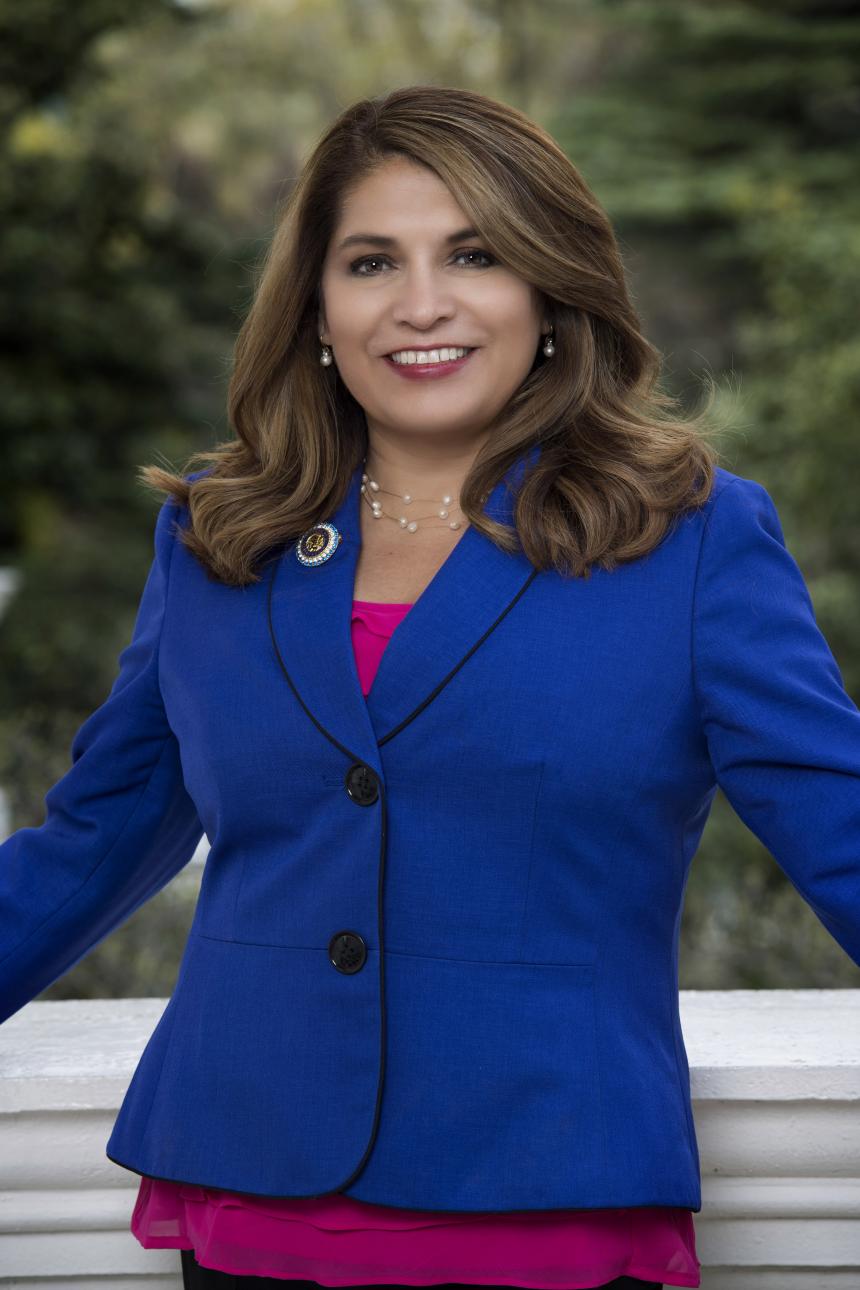
Asm. Sharon Quirk-Silva
Sponsored bills
(1) Existing law, the Political Reform Act of 1974, provides for the comprehensive regulation of campaign financing and activities. The act requires a committee that supports or opposes ballot measures to name and identify itself using a name or phrase that clearly identifies the economic or other special interests of its major donors of $50,000 or more. The act also requires that the identity of a common employer shared by major donors be disclosed. This bill would repeal these provisions. (2) The act defines "expenditure" as a payment, a forgiveness of a loan, a payment of a loan by a 3rd party, or an enforceable promise to make a payment, unless it is clear from the surrounding circumstances that it is not made for political purposes. This bill, which would be known as the California Disclose Act, would describe circumstances in which a payment would be made for political purposes within the meaning of the definition of "expenditure." (3) The act prohibits a candidate or committee from sending a mass mailing unless the name, street address, and city of the candidate or committee are shown on the outside of each piece of mail in the mass mailing, as specified. This bill would additionally require the name of such an entity to be disclosed in a mass electronic mailing, as defined, that the entity sends. The bill would provide that these disclosure requirements do not apply if the mass mailing or mass electronic mailing is paid for by an independent expenditure. (4) The act prohibits a candidate, committee, or slate mailer organization from expending campaign funds to pay for specified telephone calls that advocate support of, or opposition to, a candidate, ballot measure, or both, unless the name of the organization that authorized or paid for the call is disclosed to the recipient of the call during the course of each call. This bill would instead apply these requirements to a candidate, a candidate controlled committee established for an elective office for the controlling candidate, a political party committee, and a slate mailer organization that expends campaign funds to pay for such telephone calls. The bill would provide that these disclosure requirements do not apply if the telephone call is paid for by an independent expenditure. (5) The act also requires advertisements, as defined, to include prescribed disclosure statements, including, among others, a requirement that the disclosure statements include the names of the persons who made the 2 highest cumulative contributions, as defined, to the committee paying for the advertisement. This bill would repeal and recast provisions of the act relating to advertisement disclosure statements. The bill would revise the definition of "advertisement" to exclude a number of communications, including communications that involve wearing apparel, sky writing, and certain electronic media communications, as specified. The bill would also replace existing advertisement disclosure statements with newly prescribed disclosure statements that identify the name of the committee paying for the advertisement and the top contributors to that committee. The bill would define "top contributors" for purposes of these provisions as the persons from whom the committee paying for the advertisement received its 3 highest cumulative contributions, as specified. The bill would exempt certain committees, including committees that make independent expenditures totaling $1,000 or more in a calendar year, from the requirement to disclose the top contributors in advertisement disclosure statements. The bill would also prescribe location and format criteria for the disclosure statements that are specific to radio and telephone, television and video, print, and electronic media advertisements. (6) The act imposes, in addition to other penalties, a fine of up to triple the amount of the cost of an advertisement on a person who violates the disclosure requirements for advertisements. This bill would revise the scope of violations subject to that fine by specifying that it applies to certain disclosure requirements and intentional violations. (7) The act prohibits a person from making a contribution as an intermediary on behalf of another person without disclosing to the recipient of the contribution specified information about both the intermediary and the source of the contribution. The act also prohibits a person from making a contribution to a committee on the condition or with the agreement that it will be contributed to a particular candidate unless the contribution is disclosed in compliance with those requirements for contributions made by an intermediary. This bill would prohibit a person from making a contribution to a committee or candidate that is earmarked unless the contribution is disclosed in compliance with the requirements for contributions made by an intermediary. The bill would also describe circumstances in which a contribution is deemed to be earmarked. The bill would impose additional disclosure requirements in connection with earmarked contributions from one committee to another. (8) Because a violation of the act is punishable as a misdemeanor, this bill would impose a state-mandated local program. The California Constitution requires the state to reimburse local agencies and school districts for certain costs mandated by the state. Statutory provisions establish procedures for making that reimbursement. This bill would provide that no reimbursement is required by this act for a specified reason. (9) The Political Reform Act of 1974, an initiative measure, provides that the Legislature may amend the act to further the act's purposes upon a 23 vote of each house of the Legislature and compliance with specified procedural requirements. This bill would declare that it furthers the purposes of the act. This bill would declare that it is to take effect immediately as an urgency statute.
The law governing the taxation of insurers, the Personal Income Tax Law, and the Corporation Tax Law allow various credits against the taxes imposed by those laws, including a credit, for taxable years beginning on or after January 1, 2017, and before January 1, 2018, equal to 50% of a contribution to the College Access Tax Credit Fund, as provided. Those laws specify that the moneys in the College Access Tax Credit Fund shall be allocated first to the General Fund, then, upon appropriation, to specified agencies for administrative costs related to this credit, and lastly continuously appropriated to the Student Aid Commission for awarding Cal Grants, as provided. This bill would extend the operation of the credit to taxable years beginning before January 1, 2023. By extending the operation of the credit and thus the appropriation in those provisions, the bill would make an appropriation.
Existing law establishes the Student Opportunity and Access Program, administered by the Student Aid Commission, to distribute funds on a progress payment schedule for projects designed to increase the accessibility of postsecondary educational opportunities for certain groups of elementary and secondary school pupils and, to the extent of available resources, for community college students. Existing law requires these projects to be proposed and operated through consortia that involve at least one secondary school district office, at least one 4-year college or university, at least one community college, and at least one nonprofit educational, counseling, or community agency or private vocational or technical school that is accredited as specified. This bill would, contingent upon sufficient funding provided in the annual Budget Act or other statute, require the Student Aid Commission to ensure that at least one consortium is established, in accordance with the requirements of existing law, to serve the pupils of Orange County. This bill would make legislative findings and declarations as to the necessity of a special statute for Orange County.
Existing law, the Mental Health Services Act (MHSA) , an initiative measure enacted by the voters as Proposition 63 at the November 2, 2004, statewide general election, establishes the Mental Health Services Oversight and Accountability Commission. Existing law requires the State Department of Health Care Services, in consultation with the Mental Health Services Oversight and Accountability Commission and the County Behavioral Health Directors Association of California, to develop and administer instructions for the Annual Mental Health Services Act Revenue and Expenditure Report, which gathers specified information on mental health spending as a result of the MHSA, including the expenditures of funds distributed to each county. Existing law requires the counties to submit the required data and to certify the accuracy of the report. This bill would require counties to report spending on mental health services for veterans from MHSA funds. By requiring a county to report additional information regarding the use of MHSA funds, this bill would impose a state-mandated local program. The California Constitution requires the state to reimburse local agencies and school districts for certain costs mandated by the state. Statutory provisions establish procedures for making that reimbursement. This bill would provide that, if the Commission on State Mandates determines that the bill contains costs mandated by the state, reimbursement for those costs shall be made pursuant to the statutory provisions noted above.
Existing law authorizes counties to participate in the CalFresh Employment and Training program (CalFresh E&T) , established by federal law, and requires a participating county to demonstrate in its CalFresh E&T plan how it is effectively using CalFresh E&T funds for each of the specified components that the county offers, including work experience or training and job search. Existing law, for a county that elects to participate in the CalFresh E&T, requires an individual to be deferred from a mandatory placement in CalFresh E&T if he or she satisfies any of various criteria, including, among others, residing in a federally determined work surplus area. Existing federal law limits a participant who is an able-bodied adult without dependents (ABAWD) to 3 months of CalFresh benefits in a 3-year period unless that participant has met specified work participation requirements or is otherwise exempt. Existing law directs the State Department of Social Services to annually seek a federal waiver of this limitation, and provides that an eligible county is included in this waiver. This bill, for a county that elects to participate in CalFresh E&T, would prohibit a person who is subject to the able-bodied adult without dependents (ABAWD) time limit described above from mandatory placement in CalFresh E&T. The bill would include job search training and job retention, among others, as CalFresh E&T components that a county may offer. The bill would require the department to adopt regulations by January 1, 2019. This bill would incorporate additional changes to Section 18926.5 of the Welfare and Institutions Code proposed by SB 282 to be operative only if this bill and SB 282 are enacted and this bill is enacted last.
This measure would recognize the importance of civic engagement across the State of California.
This measure would proclaim the month of September 2017 as Childhood Cancer Awareness Month, and state the commitment of the Legislature to support efforts to find cures for, and achieve prevention of, childhood cancer.
This measure would recognize the month of September 2017 as Student Hunger Action Month.
This measure would recognize October 20, 2017, as Arirang Day and would celebrate the culture and contributions of Korean Americans to California.