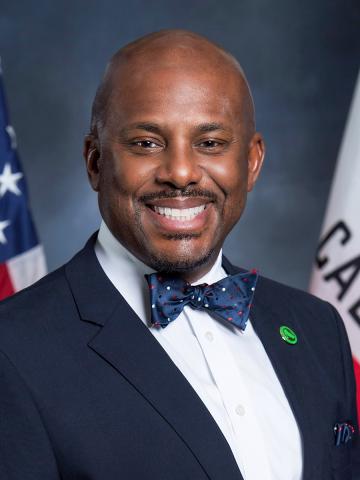
Photo of Mike Gipson
D California Assembly · District 65

Asm. Mike Gipson

Compare
Total votes
25,976
all sessions
Attendance
97%
714 missed
Higher than 81% of chamber peers
With party
99%
of cast votes
Higher than 87% of chamber peers
Bipartisan score
0%
crosses aisle rarely
Lower than 89% of chamber peers
Sponsored
2,631
bills & resolutions
Higher than 81% of chamber peers
Committees
7
assignments
2,631 bills and resolutions

Sponsored bills

Total
2,631
Primary
293
Co-sponsor
2,338
This page
2,631
matching current filters
Primary ACR 28
Passed · California Assembly · Lead sponsor
Sickle Cell Disease Awareness Month.

This measure would recognize September 2020 as Sickle Cell Disease Awareness Month and encourage the Legislature to appropriate funds for research, treatment, and monitoring of sickle cell disease, and for related education and outreach.

Passed Jan 15, 2020 0 co-sponsors
Co-sponsor SB 284
Vetoed · California Senate · Co-sponsor
Juvenile justice: county support of wards.

Existing law generally requires a county from which a person is committed to the Department of Corrections and Rehabilitation, Division of Juvenile Justice, to pay to the state an annual rate of $24,000 while the person remains under the direct supervision of the division or remains cared for and supported at the expense of the division. This bill would increase that annual rate to $125,000 if the offense on which the commitment is based, had it been filed in a court of criminal jurisdiction at the time of adjudication, had a maximum aggregate sentence of fewer than 7 years or if the offense on which the commitment is based occurred when the person was 15 years of age or younger.

Vetoed Jan 13, 2020 1 co-sponsor
Co-sponsor ACR 98
Passed · California Assembly · Co-sponsor
Relative to mental health and substance use treatment.

This measure would urge specified state departments and the Attorney General to use their authority to ensure that health care service plans and health insurers subject to their authority comply with the federal Paul Wellstone and Pete Domenici Mental Health Parity and Addiction Equity Act of 2008.

Passed Jan 9, 2020 1 co-sponsor
Primary AB 1061
Signed into law · California Assembly · Lead sponsor
Foster care.

Existing law establishes the Aid to Families with Dependent Children-Foster Care (AFDC-FC) program, under which counties provide payments to foster care providers on behalf of qualified children in foster care. In order to be eligible for AFDC-FC, existing law requires, in pertinent part, a child to be placed in one of several specified placements. Existing law sets forth the rights of a minor in foster care, including, among other rights, the right to be involved in the development of, and to review, their own case plan and plan for permanent placement. Prior to making a change in the placement of a dependent child, existing law requires a social worker or placing agency to develop and implement a placement preservation strategy to preserve the dependent child's placement. If a placement change is necessary, existing law requires the social worker or placing agency to serve written notice of that change on specified parties at least 14 days prior to the change. Existing law requires complaints under these provisions to be investigated by the Office of the State Foster Care Ombudsperson, and requires the office to provide the findings of an investigation to the county child welfare director or their designee. This bill would delete references to placing agencies, would extend the application of these provisions to probation-supervised youth in foster care placement, and make related changes. The bill would also require a social worker or probation officer to, among other things, develop with the caregiver a placement preservation strategy. The bill would also require a social worker or probation officer to notify specified parties at least 14 calendar days prior to a placement change if the social worker or probation officer reserves a placement change request from the caregiver or provider or otherwise finds that a foster care placement change is necessary. If a complaint is investigated by the office under these provisions, the bill would also require the office to provide the findings of the investigation to the chief probation officer or the chief probation officer's designee, as applicable. The bill would also exempt placement changes made under certain circumstances, including hospitalizations, from these provisions. By adding to the duties of probation officers, this bill would impose a state-mandated local program. The California Constitution requires the state to reimburse local agencies and school districts for certain costs mandated by the state. Statutory provisions establish procedures for making that reimbursement. This bill would provide that no reimbursement is required by this act for a specified reason.


Signed into law Oct 12, 2019 0 co-sponsors
Primary AB 1354
Signed into law · California Assembly · Lead sponsor
Juvenile court school pupils: joint transition planning policy: individualized transition plan.

(1) Existing law requires a county office of education and county probation department to have a joint transition planning policy that includes collaboration with relevant local educational agencies to coordinate education and services for youth in the juvenile justice system. This bill would require, as part of the joint transition planning policy, the county office of education to assign transition oversight responsibilities to existing county office of education personnel who will work in collaboration with the county probation department, as needed, and relevant local educational agencies to ensure that specified transition activities are completed for the pupil, and to facilitate the transfer of, among other things, complete and accurate education records and the pupil's individualized education plan, when a pupil enters the juvenile court school, as specified. The bill would require a pupil detained for more than 20 consecutive schooldays to have an individualized transition plan, as specified, to be developed by the county office of education in collaboration with the county probation department, as needed, and to have specified items accessible to the holder of the educational rights of the pupil upon the pupil's release. The bill would require, for pupils detained for 20 consecutive schooldays or fewer, the pupil's individualized learning plan, if one exists, to be made available by the county office of education to the pupil upon the pupil's release. The bill would require the county office of education, in collaboration, as needed, with the county probation department, to establish procedures for the timely, accurate, complete, and confidential transfer of educational records, as specified. The bill would specify that these provisions also apply to juvenile court schools that are operated by, or as, charter schools. By imposing additional requirements on county offices of education and certain charter schools, the bill would impose a state-mandated local program. (2) The California Constitution requires the state to reimburse local agencies and school districts for certain costs mandated by the state. Statutory provisions establish procedures for making that reimbursement. This bill would provide that, if the Commission on State Mandates determines that the bill contains costs mandated by the state, reimbursement for those costs shall be made pursuant to the statutory provisions noted above.

Signed into law Oct 11, 2019 0 co-sponsors
Co-sponsor AB 32
Signed into law · California Assembly · Co-sponsor
Detention facilities: private, for-profit administration services.

Existing law establishes the Department of Corrections and Rehabilitation and sets forth its powers and duties regarding the administration of correctional facilities and the care and custody of inmates. Existing law, until January 1, 2020, authorizes the Secretary of the Department of Corrections and Rehabilitation to enter into one or more agreements with private entities to obtain secure housing capacity in the state or in another state, upon terms and conditions deemed necessary and appropriate to the secretary. Existing law, until January 1, 2020, authorizes the secretary to enter into agreements for the transfer of prisoners to, or placement of prisoners in, community correctional centers, and to enter into contracts to provide housing, sustenance, and supervision for inmates placed in community correctional centers. This bill, on or after January 1, 2020, would prohibit the department from entering into or renewing a contract with a private, for-profit prison to incarcerate state prison inmates, but would not prohibit the department from renewing or extending a contract to house state prison inmates in order to comply with any court-ordered population cap. The bill would also prohibit, after January 1, 2028, a state prison inmate or other person under the jurisdiction of the department from being incarcerated in a private, for-profit prison facility. This bill would also prohibit, with exceptions, the operation of a private detention facility, as defined, within the state.

Signed into law Oct 11, 2019 1 co-sponsor
Primary AB 879
Signed into law · California Assembly · Lead sponsor
Firearms.

Existing law generally requires ammunition to be sold only to a person whose information matches an entry in the Automated Firearms System and who is eligible to possess ammunition, to a person who has a current certificate of eligibility issued by the Department of Justice, or to a person who purchases or transfers the ammunition in a single ammunition transaction, as specified. Existing law imposes a per transaction fee not to exceed $1 on ammunition purchasers and transferees and requires that this money be deposited in the continuously appropriated Ammunition Safety and Enforcement Special Fund. Existing law requires a person or business to have a valid ammunition vendor license to sell more than 500 rounds of ammunition in any 30-day period. Existing law generally requires the sale or transfer of firearms to be conducted through a licensed firearms dealer. This bill would, commencing July 1, 2024, require the sale of firearm precursor parts, as defined, to be conducted by or processed through a licensed firearm precursor part vendor. Commencing July 1, 2024, the bill would require a person or business to have a valid firearm precursor part vendor license to sell more than one firearm precursor part in any 30-day period, except as exempted. This bill would make a violation of this prohibition a misdemeanor. The bill would require that a licensed firearm dealer or licensed ammunition vendor automatically be deemed a licensed firearm precursor part vendor. The bill would create an application process for firearm precursor part vendors, as specified. The bill would establish the Firearm Precursor Parts Special Account, into which vendor license fees would be deposited. The bill would continuously appropriate money in the fund to the department for purposes of implementing, administering, and enforcing the firearm precursor part authorization program, thereby making an appropriation. The bill would require the firearm precursor part vendor to conduct business at the location specified in the license, except in the case of gun shows or events, as specified. Commencing July 1, 2025, the bill would require the Department of Justice to electronically approve the purchase or transfer of firearm precursor parts through a vendor. The bill would generally limit the sale of firearm precursor parts to a person whose information matches an entry in the Automated Firearms System and who is eligible to possess a firearm precursor part, to a person who has a valid certificate of eligibility issued by the Department of Justice, or to a person who purchases or transfers the firearm precursor part in a single transaction, as specified. Commencing July 1, 2025, the bill would require a vendor to submit records of sales and transfers of firearm precursor parts to the department, and require the department to retain those records, as specified. The bill would create the Firearm Precursor Parts Enforcement Special Fund and would allow the department to charge firearm precursor part purchasers and transferees a per transaction fee not to exceed $1 to be deposited into the fund. The bill would continuously appropriate moneys in the fund to the department for the purposes of implementing, operating, and enforcing the firearm precursor part authorization program, thereby making an appropriation. The bill would make it a misdemeanor to sell or give possession of a firearm precursor part to a person under 21 years of age. The bill would make it a misdemeanor for a person who is prohibited from possessing a firearm to possess a firearm precursor part. The bill would make it a misdemeanor to provide a firearm precursor part to a person who is prohibited from possessing firearm precursor parts. The bill would make it a misdemeanor to transfer a firearm precursor part without processing the transaction through a firearm precursor parts vendor. The bill would make it a misdemeanor to bring a firearm precursor part into the state without first having the part delivered to a licensed firearm precursor part vendor. By creating new crimes, this bill would impose a state-mandated local program. The California Constitution requires the state to reimburse local agencies and school districts for certain costs mandated by the state. Statutory provisions establish procedures for making that reimbursement. This bill would provide that no reimbursement is required by this act for a specified reason.
Signed into law Oct 11, 2019 0 co-sponsors
Co-sponsor AB 1400
Signed into law · California Assembly · Co-sponsor
Employment safety: firefighting equipment: mechanics.

Existing law establishes a workers' compensation system, administered by the Administrative Director of the Division of Workers' Compensation, to compensate an employee for injuries sustained in the course of employment. Existing law requires the Commission on Health and Safety and Workers' Compensation to conduct a continuing examination of the workers' compensation system and of the state's activities to prevent industrial injuries and occupational diseases. This bill would require the commission, in partnership with the County of Los Angeles and relevant labor organizations, on or before January 1, 2021, to submit a study to the Legislature, the Occupational Safety and Health Standards Board, and the Los Angeles County Board of Supervisors on the risk of exposure to carcinogenic materials and incidence of occupational cancer in mechanics who repair and clean firefighting vehicles.

Signed into law Oct 10, 2019 1 co-sponsor
Primary AB 748
Signed into law · California Assembly · Lead sponsor
Nonminor dependents.

Existing law authorizes the juvenile court to retain jurisdiction over any person who is found to be a ward or a dependent child of the juvenile court until the ward or dependent child attains 21 years of age. Existing law also authorizes a nonminor who has not yet attained 21 years of age and who exited foster care at or after the age of majority, to petition the court to resume dependency jurisdiction or to assume transition jurisdiction, as described. Existing law prescribes the circumstances upon which the court appoints counsel for a child, a nonminor dependent, or their parent or guardian in dependency proceedings. Under existing law, in the case of a nonminor dependent, representation by counsel is not provided for a parent, unless the parent is receiving court-ordered family reunification services. This bill would require the court to hold a dispositional proceeding for a youth 18 years of age if the youth was found to be a minor within the jurisdiction of the juvenile court at a specified hearing prior to the youth attaining 18 years of age, and was continuously detained, as specified, and the youth has provided informed consent to the dispositional proceeding. For purposes of these provisions, the fact that a youth has attained 18 years of age would not be cause to relieve counsel appointed in dependency proceedings. The bill would require the court, at the dispositional proceeding, to determine by clear and convincing evidence if at least one of certain conditions existed immediately prior to the youth attaining 18 years of age, including the existence of substantial danger to the safety or well-being of the person if they were returned home, as specified. The bill would set forth other procedural steps relating to the dispositional proceeding. The bill would condition the implementation of these provisions on federal approval, as specified, and would require the Judicial Council, on or before July 1, 2020, to amend or adopt rules of court, and to develop or amend appropriate forms, as necessary to implement these provisions. By imposing additional duties on county employees relating to the above-described dispositional proceeding, the bill would impose a state-mandated local program. The California Constitution requires the state to reimburse local agencies and school districts for certain costs mandated by the state. Statutory provisions establish procedures for making that reimbursement. This bill would provide that no reimbursement is required by this act for a specified reason.

Signed into law Oct 9, 2019 0 co-sponsors
Co-sponsor AB 49
Signed into law · California Assembly · Co-sponsor
California Voter Protection Act of 2019.

(1) Existing law authorizes certain counties, on or after specified dates, to conduct any election as an all-mailed ballot election if, among other conditions, the county elections official permits a voter to vote a ballot at a vote center. Existing law also requires, as another condition for conducting an all-mailed ballot election, that beginning 29 days before the day of the election, the county elections official mail to each registered voter a vote by mail ballot packet that includes a return envelope with instructions for the use and return of the vote by mail ballot. This bill, the California Voter Protection Act of 2019, would require the elections official to begin mailing vote by mail ballots no later than 29 days before an election and would require that the mailing be complete within 5 days. The bill would prohibit the county elections official from discriminating against any region or precinct in the county in choosing which ballots to mail first within the prescribed 5-day mailing period. This bill would incorporate additional changes to Section 4005 of the Elections Code proposed by AB 59 to be operative only if this bill and AB 59 are enacted and this bill is enacted last. (2) Existing law requires that application for a vote by mail voter's ballot be made in writing to the elections official having jurisdiction over the election during a specified period prior to the election, subject to specified exceptions. This bill would impose the requirements described in (1) above to the mailing of vote by mail ballots in elections that are not all-mailed ballot elections, thereby requiring the elections official to begin mailing vote by mail ballots no later than 29 days before an election. By imposing new duties on local elections officials, the bill would impose a state-mandated local program. (3) The California Constitution requires the state to reimburse local agencies and school districts for certain costs mandated by the state. Statutory provisions establish procedures for making that reimbursement. This bill would provide that, if the Commission on State Mandates determines that the bill contains costs mandated by the state, reimbursement for those costs shall be made pursuant to the statutory provisions noted above.

Signed into law Oct 8, 2019 1 co-sponsor
Showing 1,661 to 1,670 of 2,631 bills