

Existing law requires the driver of any vehicle, upon meeting or overtaking any schoolbus that is stopped for the purpose of loading or unloading any schoolchildren and displaying a flashing red light signal and stop signal arm, to bring the vehicle to a stop immediately before passing the schoolbus and prohibits the driver from proceeding past the schoolbus until the flashing red light signal and stop signal arm cease operation. Existing law makes a violation of these provisions a crime. Existing law requires all schoolbuses to be equipped with certain safety features, as specified. This bill would require each schoolbus, school pupil activity bus, youth bus, and child care motor vehicle to be equipped with an internal video system, and would require each schoolbus equipped with a stop signal arm to be equipped with an external video system. The bill would require school officials to monitor these video systems and would require a school official who believes, based on a review of an external video system, a violation of the above-described crime has occurred to notify the local law enforcement agency. By placing additional duties on local educational agencies and local educational agency officials, the bill would impose a state-mandated local program. The California Constitution requires the state to reimburse local agencies and school districts for certain costs mandated by the state. Statutory provisions establish procedures for making that reimbursement. This bill would provide that, if the Commission on State Mandates determines that the bill contains costs mandated by the state, reimbursement for those costs shall be made pursuant to the statutory provisions noted above.
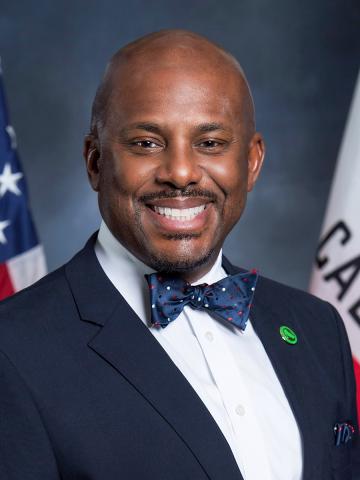
Sponsored bills
(1) Existing law establishes the Department of Technology within the Government Operations Agency. Existing law requires each state agency and certain designated state entities, on or before February 1 of each year, to submit to the Department of Technology a summary of their actual and projected information technology and telecommunications costs and a summary of their actual and projected information security costs, as specified. This bill would, instead, require each state agency to comply with those provisions and would define state agency for these purposes to mean every state office, officer, department, division, bureau, board, and commission, except for the California State University. (2) Existing law establishes the Office of Information Security within the Department of Technology, headed by the Chief of the Office of Information Security. Existing law requires the chief to establish an information security program and requires that program to include specified responsibilities, including coordinating the activities of state agency information security officers for purposes of integrating statewide security initiatives and ensuring compliance with information security and privacy policies and standards. Existing law requires specified state entities to implement and comply with the policies and procedures issued by the office. This bill would require each state agency to comply with the policies and procedures issued by the Office of Information Security, and would define state agency for these purposes to mean every state office, officer, department, division, bureau, board, and commission, except for the California State University.
Existing law makes an act punishable as a hate crime if it is a criminal act committed, in whole or in part, because of an actual or perceived characteristic of the victim relating to the victim's disability, gender, nationality, race or ethnicity, religion, sexual orientation, or association with a person or group with one or more of those actual or perceived characteristics. Under existing law, a person who commits a crime that is a hate crime is required to receive an enhanced sentence. This bill would make it a hate crime to commit a criminal act, in whole or in part, because of the victim's actual or perceived homeless status, as defined. By expanding the scope of an enhancement, this bill would impose a state-mandated local program. This bill would also make technical, conforming changes. The California Constitution requires the state to reimburse local agencies and school districts for certain costs mandated by the state. Statutory provisions establish procedures for making that reimbursement. This bill would provide that no reimbursement is required by this act for a specified reason.
Existing law, the Uniform Anatomical Gift Act, authorizes the making of a donation of all or part of a human body or a pacemaker to take effect upon or after death, as specified. Existing law also requires each general acute care hospital to develop a protocol for identifying potential organ and tissue donors. Existing law requires an application for an original or renewal driver's license or identification card to contain a space for the applicant to enroll in the Donate Life California Organ and Tissue Donor Registry. Existing law required the former State Department of Health Services to consult with the Legislature, on or before December 31, 1991, to evaluate and make recommendations to improve the effectiveness of organ transplantation for the general public and in minority communities and low-income communities in California, as specified. This bill would require the State Department of Public Health to convene a working group to evaluate ways to provide organ transplants to uninsured or undocumented residents of the state who are ineligible for organ transplants due to financial hardship. The bill would require the working group to submit its findings and recommendations to the Legislature on or before January 1, 2021, as specified. The bill would require the working group to be comprised of representatives from certain entities, including, among others, community-based immigrant rights and health organizations. The bill would require the working group to evaluate relevant data, including, but not limited to, the number of organ donors who are undocumented residents of the state and the percentage of organ transplant recipients who are medically insured. The bill would repeal these provisions on January 1, 2021. The bill would make legislative findings and declarations in support of its provisions.
The Personal Income Tax Law and the Corporation Tax Law allow various credits against the taxes imposed by those laws. Existing law requires any bill authorizing a new tax credit to contain, among other things, specific goals, purposes, and objectives that the tax credit will achieve, detailed performance indicators, and data collection requirements. This bill would allow a credit against those taxes for each taxable year beginning on or after January 1, 2020, and before January 1, 2025, to a taxpayer in an amount equal to 50% of the amount contributed by the taxpayer to a qualified developer for the development of a qualified project, as defined, but that does not exceed a specified amount per taxpayer per qualified project. The bill would also limit the aggregate amount of the credit, as specified. The bill would provide findings and declarations relating to the goals of this credit. This bill would take effect immediately as a tax levy.
This measure would name the public street, circle, and plaza at 914 and 915 Capitol Mall in the City of Sacramento as the Willie L. Brown, Jr. Circle and Plaza. The measure would request the Department of General Services to determine the cost of erecting the appropriate signage commemorating this special designation and, upon receiving donations from nonstate sources, to cover that cost to erect that signage.
Existing law establishes the Department of Corrections and Rehabilitation and charges it with certain duties and powers, including, among other things, the operation of prisons and other specified institutions. This bill would require the department to establish a Peace Officer Peer Support Labor Management Committee tasked with crafting, updating, and monitoring the implementation of a standardized statewide peace officer policy for the department's peer support program to provide substantive assistance to the peace officers employed by the department. The bill would require the committee to be composed of an equal number of representatives of the employer and peace officer employees, and would require the members of the committee to be selected and hold their first meeting on or before July 1, 2020. The bill would require the policy to address, among other things, the selection process and training for peer support team members, and guidelines for the types of communication that would remain confidential within the peer support program. The bill would require the policy to be fully implemented by January 1, 2022. The bill would require the department to submit, beginning July 1, 2020, an annual report to the Legislature that contains data pertaining to the utilization rates of the peace officer peer support program statewide.
Existing law provides for various public social services programs, including, among others, the California Work Opportunity and Responsibility to Kids (CalWORKs) program, under which each county provides cash assistance and other benefits to qualified low-income families and individuals, CalFresh, under which supplemental nutrition assistance benefits allocated to the state by the federal government are distributed to eligible individuals by each county, and the Medi-Cal program, under which qualified low-income individuals receive health care services. Existing federal and state law provide that in determining the eligibility and amount of aid for an alien, the income and resources of an alien shall be deemed to include the income and resources of any person who has executed an affidavit of support on behalf of the alien and the spouse of that person, as specified, and requires the sponsored applicant or recipient to provide information regarding the income and resources of those persons. Existing federal law and state regulations provide that if a sponsored alien is determined to be indigent, as specified, the sponsored alien shall be exempt from the sponsor deeming requirements for a period beginning on the date of that indigency determination and ending 12 months after that date. This bill would, to the extent permitted by federal law, waivers, and directives, require a county to renew the 12-month exception period for additional 12-month periods for a sponsored applicant for, or recipient of, CalWORKs benefits who is deemed to meet the indigence requirement, as specified. The bill would require the department to commence implementing this provision when the department notifies the Legislature that the California Statewide Automated Welfare System can perform the necessary automation to implement the 12-month renewals. The bill would authorize the department to implement and administer this provision through all-county letters or similar instructions until regulations are adopted, and require the department to adopt regulations no later than 24 months after the release of the all-county letters or similar instructions. By increasing county duties, the bill would impose a state-mandated local program. Existing law continuously appropriates moneys from the General Fund to defray a portion of county costs under the CalWORKs program. This bill would provide that the continuous appropriation would not be made for purposes of implementing the bill. The California Constitution requires the state to reimburse local agencies and school districts for certain costs mandated by the state. Statutory provisions establish procedures for making that reimbursement. This bill would provide that, if the Commission on State Mandates determines that the bill contains costs mandated by the state, reimbursement for those costs shall be made pursuant to the statutory provisions noted above.