

Existing law prohibits the possession, transportation, importation, sale, manufacturing, furnishing, administering, or giving away of specified controlled substances including, without limitation, cocaine, heroin, and fentanyl. Existing law defines voluntary manslaughter as the unlawful killing of a human being without malice upon a sudden quarrel or heat of passion. Existing law defines murder as the unlawful killing of a human being, or a fetus, with malice aforethought. Existing law holds a person, who is not the actual killer, criminally liable for murder in the first degree if that person is a major participant in the underlying felony and acts with reckless indifference to human life. Under existing law both manslaughter and murder are punishable as felonies. This bill would require a court to advise a person convicted of specified crimes, including, among others, selling, furnishing, transporting, or manufacturing certain controlled substances, that such conduct inflicts a grave health risk to those who ingest or are exposed to those substances, that it is extremely dangerous to human life to manufacture or distribute real or counterfeit controlled substances, and that if someone dies as a result, the defendant can be charged with voluntary manslaughter or murder. The bill would require the advisement to be provided in writing and the fact that the advisement was given to be recorded on the record and recorded in the abstract of judgment.
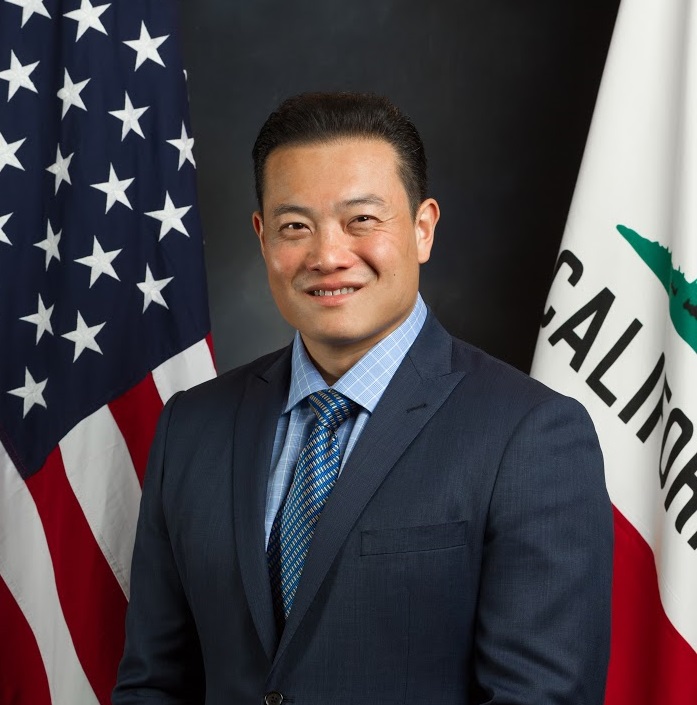
Asm. Phillip Chen
Sponsored bills
(1) The existing Safe Neighborhoods and Schools Act, enacted as an initiative statute by Proposition 47, as approved by the electors at the November 4, 2014, statewide general election, makes the theft of property that does not exceed $950 in value petty theft, and makes that crime punishable as a misdemeanor, with certain exceptions. The initiative statute defines shoplifting as entering a commercial establishment with the intent to commit larceny while that establishment is open during regular hours, where the value of the property that is taken or intended to be taken does not exceed $950. The initiative statute requires that shoplifting be punished as a misdemeanor. Proposition 47 authorizes amendment of its provisions by a 23 vote of the Members of each house of the Legislature so long as the amendments are consistent with and further the intent of the act. This bill would amend Proposition 47 by authorizing acts of shoplifting that occur on 2 or more separate occasions within a 12-month period, and the aggregated value of the merchandise taken exceeds $950, to be punished either by imprisonment in a county jail for not more than one year or by 16 months or 2 or 3 years in a county jail. By increasing the penalty for a crime, this bill would impose a state-mandated local program. (2) Existing law defines the crime of burglary to include entering a railroad car or cargo container with the intent to commit grand larceny or petit larceny or any felony within. Exiting law divides burglary into first and 2nd degrees, with first degree burglary defined as burglary of an inhabited dwelling house, a vessel that is inhabited and designed for habitation, a floating home, a trailer coach, or the inhabited portion or any other building. Existing law defines 2nd degree burglary as all other types of burglary. First degree burglary is punishable by imprisonment in the state prison for 2, 4, or 6 years and 2nd degree burglary being punishable in a county jail for not more than one year or by 16 months or 2 or 3 years in a county jail. This bill would make burglary with regard to a railroad car or a cargo container punishable by imprisonment in a county jail for 2, 4, or 6 years. By increasing the penalty for a crime, this bill would impose a state-mandated local program. (3) The California Constitution requires the state to reimburse local agencies and school districts for certain costs mandated by the state. Statutory provisions establish procedures for making that reimbursement. This bill would provide that no reimbursement is required by this act for a specified reason.
This measure would recognize March 2022 as Sudden Unexplained Death in Childhood Awareness Month.
This measure would proclaim the month of March 2022 as Traumatic Brain Injury Awareness Month.
This measure would resolve that the Legislature declares March 12, 2022, as National Girl Scout Day.
The Personal Income Tax Law and Corporation Tax Law allow various credits against the taxes imposed by those laws. This bill, for taxable years beginning on or after January 1, 2021, and before January 1, 2023, would allow a credit against the taxes imposed by those laws to employers, as specified, for the expenses of complying with specified COVID-19 supplemental paid sick leave requirements. Existing law requires any bill authorizing a new tax expenditure to contain, among other things, specific goals, purposes, and objectives that the tax expenditure will achieve, detailed performance indicators, and data collection requirements. This bill would include additional information required for any bill authorizing a new tax expenditure. This bill would also make findings and declarations related to a gift of public funds.
Existing law provides for the licensure and regulation of adult alcoholism or drug abuse recovery or treatment facilities by the State Department of Health Care Services and authorizes the department to enforce those provisions. Existing law also requires the department to require that an individual providing counseling services within a program be certified by a certifying organization approved by the department. Existing law authorizes the department to charge a fee to all programs for licensure or certification by the department, and establishes the Residential and Outpatient Program Licensing Fund to hold these fees. This bill would create the Allied Behavioral Health Board within the Department of Consumer Affairs, and would transfer the responsibility to oversee those certifying organizations from the State Department of Health Care Services to the board. The bill would require the board to establish regulations and standards for the licensure of substance use disorder counselors, as specified. The bill would require an applicant for a substance use disorder counselor license to have documented to a certifying organization that they have obtained a master's degree in alcohol and drug counseling or a related counseling master's degree, as specified, and to pass specified examinations, and would require the board to review the criminal history of the applicant, as specified. The bill would prohibit a person from using the title of "Licensed Alcohol Drug Counselor" unless the person has applied for and obtained a license from the board, and would make a violation of that provision punishable by an administrative penalty not to exceed $1,000. The bill would require the board to establish fees for licensure, as specified, and would revert all unencumbered funds appropriated from fees in the Residential and Outpatient Program Licensing Fund to the State Department of Health Care Services for the purpose of certification oversight of substance use disorder counselors to that fund. The bill would make its provisions operative upon the appropriation by the Legislature of funds allocated to the state from a specified settlement agreement, consistent with the requirements of the settlement agreement, and sufficient to implement this chapter.