

Existing law defines the crime of human trafficking and imposes a penalty of at least 5, 8, or 12 years in state prison and a fine of not more than $500,000. This bill would prohibit plea bargaining in a case in which the indictment or information charges the crime of human trafficking and it is alleged that the victim is a minor, unless there is insufficient evidence to prove the people's case, or testimony of a material witness cannot be obtained, or a reduction or dismissal would not result in a substantial change in sentence. By increasing the penalty for a crime, this bill would impose a state-mandated local program. The California Constitution requires the state to reimburse local agencies and school districts for certain costs mandated by the state. Statutory provisions establish procedures for making that reimbursement. This bill would provide that no reimbursement is required by this act for a specified reason.
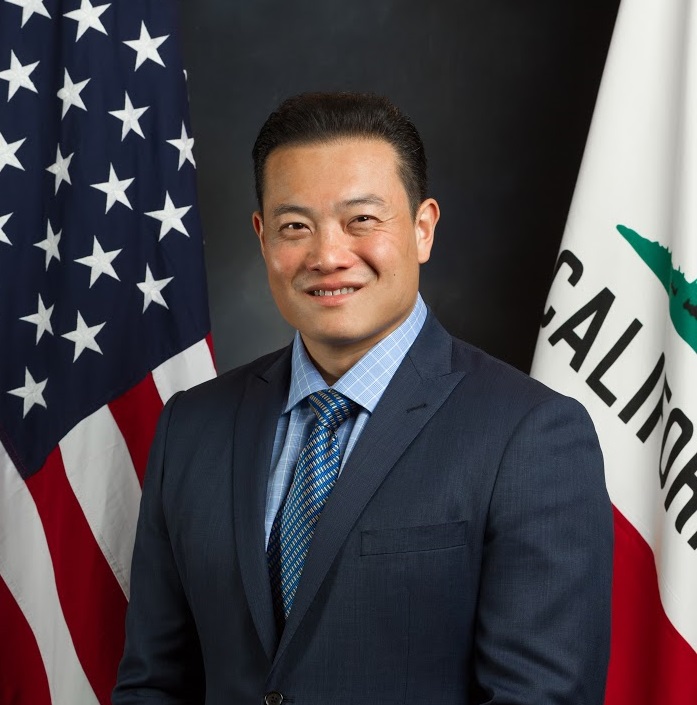
Asm. Phillip Chen
Sponsored bills
Existing law authorizes the State Department of Health Care Services to, subject to an appropriation, establish a Behavioral Health Continuum Infrastructure Program. Existing law authorizes the department, pursuant to this program, to award competitive grants to qualified entities to construct, acquire, and rehabilitate real estate assets or to invest in needed mobile crisis infrastructure to expand the community continuum of behavioral health treatment resources to build or expand the capacity of various treatment and rehabilitation options for persons with behavioral health disorders, as specified. This bill would authorize the department, in awarding the above-described grants, to give preference to qualified entities that are intending to place their projects in specified facilities or properties. The bill would continuously appropriate, without regard to fiscal year, $1,000,000,000 to the department for purposes of implementing the Behavioral Health Continuum Infrastructure Program.
The Personal Income Tax Law, in modified conformity with federal income tax laws, allows various deductions from gross income in computing adjusted gross income under that law, but does not conform with the federal deduction in computing adjusted gross income allowed for certain expenses of elementary and secondary school teachers. This bill, for each taxable year beginning on or after January 1, 2022, and before January 1, 2027, would, in modified conformity with federal personal income tax laws, allow a deduction in computing adjusted gross income for certain expenses of public elementary and secondary school teachers. Existing law requires any bill authorizing a new tax expenditure to contain, among other things, specific goals, purposes, and objectives that the tax expenditure will achieve, detailed performance indicators, and data collection requirements. This bill would include additional information required for any bill authorizing a new tax expenditure. This bill would take effect immediately as a tax levy.
Existing law, the California Uniform Controlled Substances Act, classifies controlled substances into 5 schedules and places the greatest restrictions and penalties on the use of those substances placed in Schedule I. The act classifies the drug fentanyl in Schedule II. Existing law prohibits a person from possessing for sale or purchasing for purposes of sale, specified controlled substances, including fentanyl, and provides for imprisonment in a county jail for 2, 3, or 4 years for a violation of this provision. Existing law also requires a local health officer to assume that the fentanyl manufacturing process has led to some degree of chemical contamination and take action, as prescribed, if a fentanyl laboratory activity has taken place at a property. This bill would establish the California Fentanyl Abuse Task Force to undertake various duties relating to fentanyl abuse including, among others, collecting and organizing data on the nature and extent of fentanyl abuse in California and evaluating approaches to increase public awareness of fentanyl abuse. The bill would require the task force to be chaired by the Attorney General, or their designee, and would specify the membership of the task force. The bill would require the first meeting of the task force to take place no later than March 1, 2023, and would require the task force to meet at least once every 2 months. The bill would require the task force to report its findings and recommendations to the Attorney General, the Governor, and the Legislature by July 1, 2024. The bill would repeal these provisions on January 1, 2025.
Existing law establishes the Employment Development Department and vests the department with various duties. Existing law establishes the Director of Employment Development as the executive officer of the department. Existing law provides for the payment of unemployment compensation benefits to eligible persons who are unemployed through no fault of their own through a federal-state unemployment insurance program administered by the department. Existing law requires the department to make various types of information available on its internet website, including information about overpayments and information for victims of identity theft who receive incorrect tax forms. This bill would require the director, beginning on July 1, 2023, to make certain information about timeframes for processing unemployment compensation benefit applications available on the department's internet website, including the current average timeframe for issuing a first payment when the department does not request additional or clarifying information, and for making a final determination of eligibility for benefits, as specified. The bill would also require the director to update the required information every 2 weeks and to display on the department's internet website graphical representations of certain data. The bill would further require the director to provide the web address where this information may be found to claimants, as specified.
This measure would designate a specified portion of Interstate Highway Route 405 in the County of Los Angeles as the Officer Tommy Scott Memorial Highway. The measure would request that the Department of Transportation determine the cost of appropriate signs showing this special designation and, upon receiving donations from nonstate sources covering that cost, erect those signs.
This measure would declare March 13, 2022, to April 15, 2022, as Deaf History Month.