Existing law, until January 1, 2026, requires the Department of the California Highway Patrol to coordinate with the Department of Justice to convene a regional property crimes task force to identify geographic areas experiencing increased levels of property crimes and assist local law enforcement with resources, such as personnel and equipment. This bill would specify theft of vehicle parts and accessories as a property crime for consideration by the regional property crimes task force.
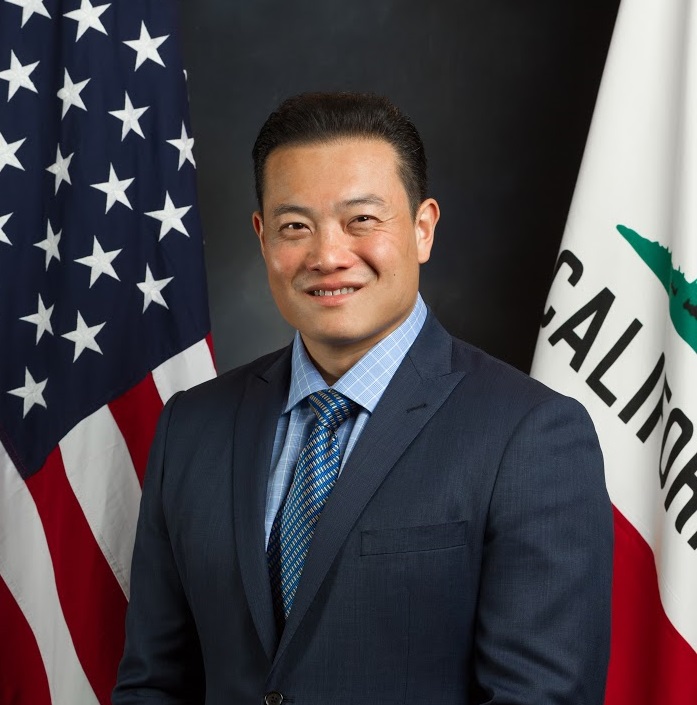
Asm. Phillip Chen
Sponsored bills
Existing law authorizes use of the Emergency Alert System to inform the public of local, state, and national emergencies. Existing law requires a law enforcement agency to activate the Emergency Alert System within the appropriate area if that agency determines that a child 17 years of age or younger, or an individual with a proven mental or physical disability, has been abducted and is in imminent danger of serious bodily injury or death, and there is information available that, if disseminated to the general public, could assist in the safe recovery of that person. Existing law also authorizes the issuance and coordination of a Blue Alert following an attack upon a law enforcement officer or a Silver Alert relating to a person who is 65 years of age or older who is reported missing. This bill would authorize a law enforcement agency to request the Department of the California Highway Patrol to activate a Yellow Alert if a person has been killed due to a hit-and-run incident and the law enforcement agency has specified information concerning the suspect or the suspect's vehicle. The bill would authorize the Department of the California Highway Patrol to activate a Yellow Alert within the requested geographic area upon request of the law enforcement agency if it concurs with the law enforcement agency that specified requirements are met. This bill would also require the Department of the California Highway Patrol to track the number of Yellow Alert requests it receives from law enforcement agencies. The bill would require the Department of the California Highway Patrol to submit a final report to the Legislature of the efficacy, the advantages, and the disadvantages of the Yellow Alert System by January 1, 2026. On January 1, 2026, the provisions of this bill would be repealed.
This measure would proclaim June 19, 2022, as Veterans of the Republic of Vietnam Armed Forces Day.
This measure would recognize June 21, 2022, as the 2022 International Day of Yoga in California.
This measure would proclaim Sunday, June 12, 2022, as Loving Day.
Existing law authorizes the governing board of a community college to authorize the students of a college to organize a student body association and requires a student who is elected to serve as an officer in the student government to be enrolled in the community college at the time of election and throughout their term with a minimum of 5 semester units or its equivalent. Existing law establishes the Adult Education Program under the administration of the Chancellor of the California Community Colleges and the Superintendent of Public Instruction. The program requires the chancellor and the Superintendent, with the advice of the executive director of the State Board of Education, to divide the state into adult education regions and approve one adult education consortium in each adult education region, as specified. Existing law authorizes any community college district, school district, or county office of education, or any joint powers authority consisting of community college districts, school districts, county offices of education, or a combination of these, located within the boundaries of the adult education region, to join the consortium as a member. This bill would additionally allow a student to be elected to serve as an officer in the student government if they are enrolled in an adult education program offered by a community college district, or are a disabled student, as defined.

This measure would call upon the Biden Administration to cancel all federal student debt.
The Lempert-Keene-Seastrand Oil Spill Prevention and Response Act generally requires the administrator for oil spill response, acting at the direction of the Governor, to implement activities relating to oil spill response, including drills and preparedness, and oil spill containment and cleanup. The act requires, without regard to intent or negligence, any party responsible for the discharge or threatened discharge of oil in waters of the state to report the discharge immediately to the Office of Emergency Services. The act makes it a crime to fail to notify the office in violation of that requirement. This bill would define "threatened discharge of oil in waters of the state" to mean a discharge by an offshore facility, as defined, including an offshore pipeline, located where an oil spill may impact state waters. The bill would require an offshore facility to be presumed to be located where an oil spill may impact state waters if certain circumstances apply, including that any portion of an offshore pipeline that services the offshore facility transports oil to, from, or through state waters. By expanding the scope of a crime, the bill would impose a state-mandated local program. The California Constitution requires the state to reimburse local agencies and school districts for certain costs mandated by the state. Statutory provisions establish procedures for making that reimbursement. This bill would provide that no reimbursement is required by this act for a specified reason.