

Existing law, the Speech-Language Pathologists and Audiologists and Hearing Aid Dispensers Licensure Act, until January 1, 2023, establishes the Speech-Language Pathology Audiology and Hearing Aid Dispensers Board within the Department of Consumer Affairs for the licensure and regulation of speech-language pathologists, speech-language pathology aides, speech language pathology assistants, audiologists, dispensing audiologists, and hearing aid dispensers. Existing law provides for the appointment of members of the board by specified appointing authorities, and, until January 1, 2023, authorizes the board to appoint an executive officer. Existing law authorizes an appointing authority to remove from office at any time any member of a board appointed by the appointing authority for continued neglect of duties, incompetence, or unprofessional or dishonorable conduct. Existing law makes a violation of the act a misdemeanor. This bill would extend the operation of the board and the authorization to appoint an executive officer until January 1, 2027, and would authorize an appointing authority to remove from office at any time any member of the board appointed by that appointing authority. The bill would specify that, in addition to the enforcement and administration of the act, the board is vested with other regulatory duties of the act. The bill would require an applicant, registrant, or licensee under the act who has an email address to provide it to the board no later than July 1, 2023. By expanding the scope of a crime, the bill would impose a state-mandated local program. Existing law establishes the Hearing Aid Dispensing Committee, comprised of 5 members, within the jurisdiction of the board. This bill would abolish the committee. Existing law defines "audiology aide" to mean any person meeting the minimum requirements established by the board. Existing law prohibits an audiology aide from performing any function that constitutes the practice of audiology unless they are under the supervision of an audiologist. This bill would delete that prohibition and would instead define "audiology aide" to mean any person meeting the minimum requirements established by the board who works directly under the supervision of an audiologist. Existing law requires speech-language pathologists and audiologists supervising speech-language pathology or audiology aides to register with the board the name of each person working under their supervision. This bill would make speech-language pathology and audiology aide registrations expire every 2 years and would require the board to establish a renewal fee in an amount not to exceed $30. The bill would require the speech-language pathologist or audiologist supervising the speech-language pathology or audiology aide to, at the time of renewal, update the board on the duties the aide performs and the training program and assessment methods the supervisor is using. Existing law requires an applicant for licensure as an audiologist to submit evidence of satisfactory completion of supervised clinical practice under the direction of an educational institution approved by the board and satisfactory completion of supervised professional experience following completion of the didactic and clinical rotation requirements of an audiology doctoral program. This bill would require the clinical practice to be under the direction of an audiology doctoral program at an educational institution approved by the board, and would delete the requirement that supervised professional experience follow completion of the didactic and clinical rotation requirements of the audiology doctoral program. Existing law requires the board to deem a person who holds a Certificate of Clinical Competence in Speech-Language Pathology issued by the American Speech-Language-Hearing Association's Council for Clinical Certification to have met specified educational and experience requirements for licensure as a speech-language pathologist or audiologist. This bill would make that requirement applicable only to licensure as a speech-language-pathologist and effective only until January 1, 2027, and would instead require the board, until January 1, 2027, to deem a person who holds either a valid Certification of Clinical Competence in Audiology issued by the American Speech-Language-Hearing Association's Council for Clinical Certification or a valid American Board of Audiology certificate issued by the American Academy of Audiology to have met specified educational and experience requirements for licensure as an audiologist. Existing law lists various reasons for which the board is authorized to suspend, revoke, or impose terms and conditions upon the license of any licensee, including incompetence, gross negligence, or repeated negligent acts. This bill would add specified reasons for which the board is authorized to suspend, revoke, or impose terms and conditions upon a license, including for a disciplinary action taken by any public agency in any state or territory for any act substantially related to the practice of speech-language pathology, audiology, or hearing aid dispensing. The bill would authorize a person whose license has been revoked, suspended, or who has been placed on probation to petition the board for reinstatement or modification of penalty after a specified minimum period of time has elapsed from the effective date of the decision ordering that disciplinary action in accordance with specified procedural and other requirements. Existing law provides that a plea or verdict of guilty or a conviction following a plea of nolo contendere made to a charge substantially related to the qualifications, functions, and duties of a speech-language pathologist or audiologist is deemed to be a conviction for specified provisions of the act. This bill would also make that provision applicable to hearing aid dispensers. The bill would also make various other conforming and technical changes to the act, including updating cross-references and deleting an obsolete provision. This bill would incorporate additional changes to Section 2530.2 of the Business and Professions Code proposed by SB 1453 to be operative only if this bill and SB 1453 are enacted and this bill is enacted last. The California Constitution requires the state to reimburse local agencies and school districts for certain costs mandated by the state. Statutory provisions establish procedures for making that reimbursement. This bill would provide that no reimbursement is required by this act for a specified reason. Existing constitutional provisions require that a statute that limits the right of access to the meetings of public bodies or the writings of public officials and agencies be adopted with findings demonstrating the interest protected by the limitation and the need for protecting that interest. This bill would make legislative findings to that effect.
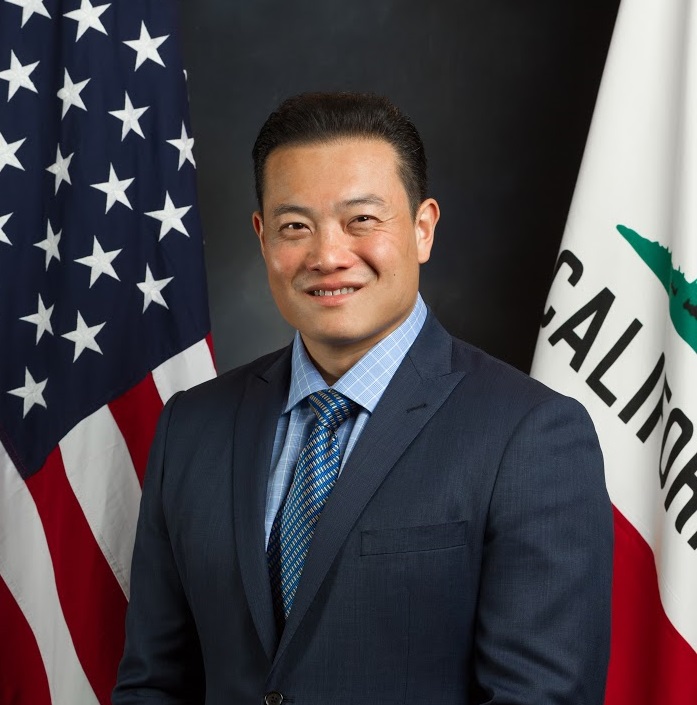
Asm. Phillip Chen
Sponsored bills
Existing law establishes the University of California, under the administration of the Regents of the University of California, and the California State University, under the administration of the Trustees of the California State University, as 2 of the segments of public postsecondary education in the state. A provision of the Donahoe Higher Education Act expresses the intent of the Legislature that specified categories of applicants be prioritized in a specified order for the purpose of enrollment planning and admission priority practice at the undergraduate resident student level for the California State University and the University of California, including applicants who have been previously enrolled at the campus to which they are applying, as specified. The act applies to the University of California only to the extent that the regents, by appropriate resolution, make it applicable. This bill would require the California State University, and request the University of California, to require each campus in their respective systems to grant students the right to reenroll in their baccalaureate degree program after withdrawing or stopping out, if the student was in good academic standing with the university.
(1) Existing law, the Assisted Outpatient Treatment Demonstration Project Act of 2002, known as Laura's Law, requires each county to offer specified mental health programs, unless a county or group of counties opts out by a resolution passed by the governing body, as specified. Existing law, the Lanterman-Petris-Short Act, provides for short-term and longer-term involuntary treatment and conservatorships for people who are determined to be gravely disabled. This bill, contingent upon the State Department of Health Care Services developing an allocation to provide financial assistance to counties, would enact the Community Assistance, Recovery, and Empowerment (CARE) Act, which would authorize specified adult persons to petition a civil court to create a voluntary CARE agreement or a court-ordered CARE plan and implement services, to be provided by county behavioral health agencies, to provide behavioral health care, including stabilization medication, housing, and other enumerated services to adults who are currently experiencing a severe mental illness and have a diagnosis identified in the disorder class schizophrenia and other psychotic disorders, and who meet other specified criteria. The bill would require the Counties of Glenn, Orange, Riverside, San Diego, Stanislaus, and Tuolumne and the City and County of San Francisco to implement the program commencing October 1, 2023, and the remaining counties to commence no later than December 1, 2024. The bill would require the Judicial Council to develop a mandatory form for use in filing a CARE process petition and would specify the process by which the petition is filed and reviewed, including requiring the petition to be signed under penalty of perjury, and to contain specified information, including the facts that support the petitioner's assertion that the respondent meets the CARE criteria. The bill would also specify the schedule of review hearings required if the respondent is ordered to comply with an up to one-year CARE plan by the court. The bill would make the hearings in a CARE Act proceeding confidential and not open to the public, thereby limiting public access to a meeting of a public body. The bill would authorize the CARE plan to be extended once, for up to one year, and would prescribe the requirements for the graduation plan. By expanding the crime of perjury and imposing additional duties on the county behavioral health agencies, this bill would impose a state-mandated local program. This bill would require the court to appoint counsel for the respondent, unless the respondent has retained their own counsel. The bill would require the Legal Services Trust Fund Commission at the State Bar to provide funding to qualified legal services projects to provide legal counsel in CARE Act proceedings, as specified. The bill would authorize the respondent to have a supporter, as defined. The bill would require the State Department of Health Care Services, in consultation with specified stakeholders, to provide optional training and technical resources for volunteer supporters on the CARE process, community services and supports, supported decisionmaking, and other topics, as prescribed. This bill would require the California Health and Human Services Agency, or a designated department within that agency, to engage an independent, research-based entity to advise on the development of data-driven process and outcome measures for the CARE Act and to convene a workgroup to provide coordination and support among relevant state and local partners and other stakeholders throughout the phases of county implementation of the CARE Act. The bill also would require the State Department of Health Care Services to provide training and technical assistance to county behavioral health agencies to implement the act and to provide training to counsel, as specified. The bill would require the Judicial Council, in consultation with the department and others, to provide training to judges regarding the CARE process, as specified. This bill would authorize the court, at any time during the CARE process, if it finds the county or other local government entity not complying with court orders, to report that finding to the presiding judge of the superior court or their designee. If the presiding judge or their designee finds, by clear and convincing evidence, that the local government has substantially failed to comply with the CARE process, the presiding judge may impose a fine of up to $1,000 per day and, if the court finds persistent noncompliance, to appoint a special master to secure court-ordered care for the respondent at the county's cost. The bill would establish the CARE Act Accountability Fund in the State Treasury to receive the fines collected under the Act, which would, upon appropriation, be allocated and distributed by the department to the local government entity that paid the fines to serve individuals who have schizophrenia spectrum or other psychotic disorders who are experiencing or are at risk of homelessness, criminal justice involvement, hospitalization, or conservatorship. This bill would require the department, in consultation with the Judicial Council, to develop an annual reporting schedule for the submission of CARE Act data from the trial courts and would require the Judicial Council to aggregate the data and submit it to the department. The bill would require the department, in consultation with various other entities, to develop an annual CARE Act report and would require county behavioral health agencies and other local governmental entities to provide the department with specified information for that report. The bill would require an independent, research-based entity retained by the department to develop an independent evaluation of the effectiveness of the CARE Act and would require the department to produce a preliminary and final report based on that evaluation. By increasing the duties of a local agency, this bill would impose a state-mandated local program. This bill would exempt a county or an employee or agent of a county from civil or criminal liability for any action by a respondent in the CARE process, except when an act or omission constitutes gross negligence, recklessness, or willful misconduct. Existing law, the Mental Health Services Act (MHSA) , an initiative measure enacted by the voters as Proposition 63 at the November 2, 2004, statewide general election, establishes the Mental Health Services Fund (MHSF) , a continuously appropriated fund, to fund various county mental health programs, including children's mental health care, adult and older adult mental health care, prevention and early intervention programs, and innovative programs. This bill would clarify that MHSA funds may be used to provide services to individuals under a CARE agreement or a CARE plan. (2) Existing law, the Knox-Keene Health Care Service Plan Act of 1975, provides for the licensure and regulation of health care service plans by the Department of Managed Health Care. Existing law also provides for the regulation of health insurers by the Department of Insurance. Existing law requires health care service plans and insurers to provide coverage for medically necessary treatment of mental health and substance use disorders. Violation of the Knox-Keene Act by a health care service plan is a crime. This bill would require health care service plans and insurers to cover the cost of developing an evaluation for CARE process services and the provision of all health care services for an enrollee or insured when required or recommended for the person pursuant to a CARE plan, as specified, without cost sharing, except for prescription drugs, and regardless of whether the services are provided by an in-network or out-of-network provider. Because a violation of this requirement by a health care service plan would be a crime, this bill would impose a state-mandated local program. (3) Existing law prohibits a person from being tried or adjudged to punishment while that person is mentally incompetent. Existing law establishes a process by which a defendant's mental competency is evaluated and by which the defendant receives treatment, with the goal of returning the defendant to competency. Existing law suspends a criminal action pending restoration to competency. This bill, for a misdemeanor defendant who has been determined to be incompetent to stand trial, would authorize the court to refer the defendant to the CARE process. (4) Existing constitutional provisions require that a statute that limits the right of access to the meetings of public bodies or the writings of public officials and agencies be adopted with findings demonstrating the interest protected by the limitation and the need for protecting that interest. This bill would make legislative findings to that effect. (5) This bill would state that its provisions are severable. (6) This bill would incorporate additional changes to Section 1370.01 of the Penal Code proposed by SB 1223 to be operative only if this bill and SB 1223 are enacted and this bill is enacted last. (7) The California Constitution requires the state to reimburse local agencies and school districts for certain costs mandated by the state. Statutory provisions establish procedures for making that reimbursement. This bill would provide that with regard to certain mandates no reimbursement is required by this act for a specified reason. With regard to any other mandates, this bill would provide that, if the Commission on State Mandates determines that the bill contains costs so mandated by the state, reimbursement for those costs shall be made pursuant to the statutory provisions noted above.
This measure would proclaim the month of September 2022 as Prostate Cancer Awareness Month.
This measure would designate a specified portion of State Highway Route 44, near Oak Run in the County of Shasta, as the Stan Statham Memorial Highway. This measure would request the Department of Transportation to determine the cost of appropriate signs showing this special designation and, upon receiving donations from nonstate sources covering that cost, to erect those signs.
This measure would designate the East End Complex-Block 171 in Sacramento as the Mario Obledo Building, and would request the Department of General Services to determine the cost of erecting appropriate plaques and markers showing the designation and, upon receiving donations from nonstate sources, to cover that cost to erect signage.
This measure would urge the United States Congress to amend the United States Social Security Administration's index of earnings to ensure that a decline in aggregate wages due to COVID-19 does not result in decreased benefits.
Existing law requires a sheriff or jailer upon whom a paper in a judicial proceeding, that is directed to a prisoner in their custody, is served, to deliver the paper to the prisoner, with a note of the time of its service. Existing law makes the sheriff or jailer liable to the prisoner for all damages occasioned for neglecting to perform that duty. This bill would also require a warden upon whom a paper is served to deliver the paper to an incarcerated person in their custody according to these provisions.
This measure would urge the United States Secretary of Education to establish and submit to the United States Congress for approval a monthly student loan payment plan for federal student loans, based on the personal savings rate as published by the federal Bureau of Economic Analysis.
This measure would designate the portion of State Route 5 from El Horno Street, at postmile 10.001, to Crown Valley Parkway, at postmile 13.776, in the County of Orange as the Senior Master Sergeant John James Paoletti Memorial Highway. The measure would request that the Department of Transportation determine the cost of appropriate signs showing this special designation and, upon receiving donations from nonstate sources covering that cost, erect those signs.