Existing law establishes a system of public elementary and secondary schools in this state and authorizes school districts and other local educational agencies to provide instruction to pupils in kindergarten and grades 1 to 12, inclusive. Existing law requires attendance in all schools and classes to be recorded and kept according to specified regulations. This bill would make a nonsubstantive change to the latter provision.
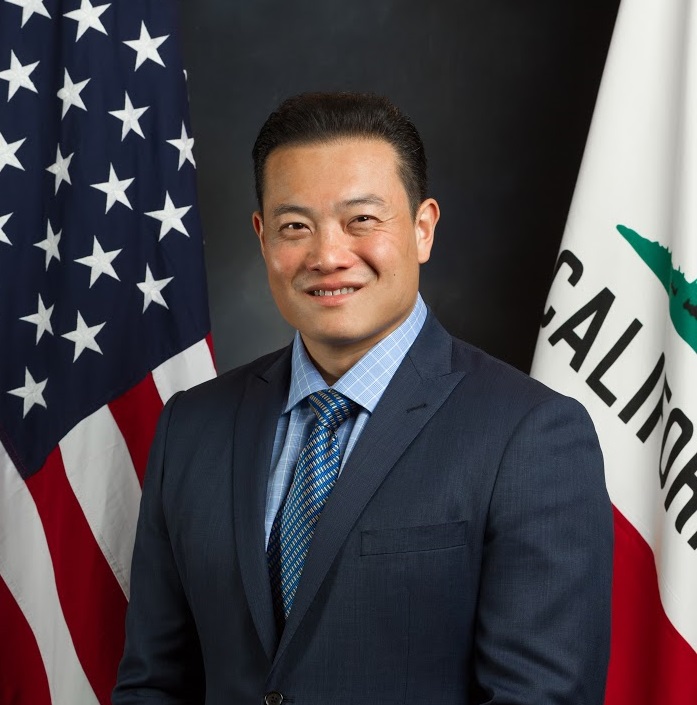
Asm. Phillip Chen
Sponsored bills
Existing law, the California Life and Health Insurance Guarantee Association Act, establishes the California Life and Health Insurance Guarantee Association to protect specified persons against failure in the performance of contractual obligations because of the impairment or insolvency of a member insurer that issued a life or health insurance policy or specified annuity contract. This bill would make a technical, nonsubstantive change to that provision.
Existing law authorizes a local government to grant franchises and other privileges to certain public utilities, and requires that those franchises or privileges be granted consistent with specified conditions. This bill would make nonsubstantive changes to that requirement.
Existing law provides for the certification and regulation of radiologic technologists by the State Department of Public Health. Existing law authorizes the department to adopt regulations to implement those provisions, as specified. Under existing law, notwithstanding any other law, a radiologic technologist certified under the Radiologic Technology Act is authorized to perform venipuncture in an upper extremity to administer contrast materials, manually or by utilizing a mechanical injector, under the direct supervision of a licensed physician, and if other specified conditions are met. Existing law defines "direct supervision" as the direction of an authorized procedure by a licensed physician and surgeon who shall be physically present within the facility and available within the facility where the procedures are performed, as specified. A violation of these provisions is a misdemeanor. This bill would authorize a radiologic technologist with the above qualifications to perform venipuncture according to the prescribed conditions when under the general supervision of a physician and surgeon. The bill would define "general supervision" to mean under the direction of a licensed physician and surgeon who is either physically present within the facility and available within the facility where the procedures are performed, or is available by telephone. By changing the definition of a crime, the bill would impose a state-mandated local program. The California Constitution requires the state to reimburse local agencies and school districts for certain costs mandated by the state. Statutory provisions establish procedures for making that reimbursement. This bill would provide that no reimbursement is required by this act for a specified reason.

The California Integrated Waste Management Act of 1989, which is administered by the Department of Resources Recycling and Recovery, establishes an integrated waste management program that requires each county and city and county to prepare and submit to the department a countywide integrated waste management plan. Existing law requires the State Air Resources Board to complete a comprehensive strategy to reduce emissions of short-lived climate pollutants in the state and to approve and begin implementing the strategy to achieve a reduction in the statewide emissions of methane by 40% below 2013 levels by 2030, among other goals. Existing law requires the methane emissions goals to reduce the landfill disposal of organics by meeting specified targets that include a 50% reduction in the level of the statewide disposal of organic waste from the 2014 level by 2020 and a 75% reduction in the level of the statewide disposal of organic waste from the 2014 level by 2025. Existing law authorizes the department, in consultation with the state board, to adopt regulations that achieve the specified targets for reducing organic waste in landfills. Existing law authorizes local jurisdictions to charge and collect fees to recover the local jurisdiction's costs incurred in complying with those regulations. Existing law also requires, no later than July 1, 2020, the department, in consultation with the state board, to analyze the progress that the waste sector, state government, and local governments have made in achieving the specified targets for reducing organic waste in landfills. Existing law authorizes the department, depending on the outcome of that analysis, to amend the regulations to include incentives or additional requirements, as specified. This bill would require the department to analyze the progress that the waste sector, state government, and local governments have made in achieving the organic waste reduction goals for 2020 and 2025 every 5 years. Because existing law authorizes the department to amend the regulations depending on the outcome of the analysis, as described above, the bill would add to the duties of local governments related to organic waste in landfills, thereby imposing a state-mandated local program. The California Constitution requires the state to reimburse local agencies and school districts for certain costs mandated by the state. Statutory provisions establish procedures for making that reimbursement. This bill would provide that no reimbursement is required by this act for a specified reason.

Existing law declares that the protection of the public interest in the development of the water resources of the state is of vital concern to the people of the state and that the state shall determine in what way the water of the state, both surface and underground, should be developed for the greatest public benefit. Existing law establishes within the Natural Resources Agency the State Water Resources Control Board and the California regional water quality control boards. Existing law requires the work of the state board to be divided into at least 2 divisions, known as the Division of Water Rights and the Division of Water Quality. This bill would establish a statewide goal to increase above- and below-ground water storage capacity by a total of 3,700,000 acre-feet by the year 2030 and a total of 4,000,000 acre-feet by the year 2040. The bill would require the Department of Water Resources, in consultation with the state board, to take reasonable actions to promote or assist efforts to achieve the statewide goal, as provided. The bill would require the department, beginning July 1, 2027, and on or before July 1 every 2 years thereafter until January 1, 2043, in consultation with the state board, to prepare and submit a report to the Legislature on the progress made to achieve the statewide goal.
Existing law, the Motor Vehicle Fuel Tax Law, imposes a tax upon each gallon of motor vehicle fuel removed from a refinery or terminal rack in this state, entered into this state, or sold in this state, at a specified rate per gallon. Existing unfair competition laws establish a statutory cause of action for unfair competition, including any unlawful, unfair, or fraudulent business act or practice and unfair, deceptive, untrue, or misleading advertising and acts prohibited by false advertisement laws. This bill would suspend the imposition of the tax on motor vehicle fuels for one year. The bill would require that all savings realized based on the suspension of the motor vehicle fuels tax by a person other than an end consumer, as defined, be passed on to the end consumer, and would make the violation of this requirement an unfair business practice, in violation of unfair competition laws, as provided. The bill would require a seller of motor vehicle fuels to provide a receipt to a purchaser that indicates the amount of tax that would have otherwise applied to the transaction. This bill would also direct the Controller to transfer a specified amount from the General Fund to the Motor Vehicle Fuel Account in the Transportation Tax Fund. By transferring General Fund moneys to a continuously appropriated account, this bill would make an appropriation. This bill would declare that it is to take effect immediately as an urgency statute.
Existing law, the Control, Regulate and Tax Adult Use of Marijuana Act (AUMA) , an initiative measure, authorizes a person who obtains a state license under AUMA to engage in commercial adult-use cannabis activity pursuant to that license and applicable local ordinances. AUMA authorizes legislative amendment of its provisions with a 23 vote of both houses, without submission to the voters, to further its purposes and intent, except as provided. Existing law, the Medicinal and Adult-Use Cannabis Regulation and Safety Act (MAUCRSA) , among other things, consolidates the licensure and regulation of commercial medicinal and adult-use cannabis activities, and requires the Department of Cannabis Control to administer its provisions. MAUCRSA grants to the department the sole authority to create, issue, deny, renew, discipline, condition, suspend, or revoke licenses for commercial cannabis activity. This bill would also grant to the department the sole authority to transfer, assign, or reassign those licenses. The bill would declare that its provisions further the purpose and intent of AUMA.
Existing law establishes the Natural Resources Agency, composed of departments, boards, conservancies, and commissions responsible for the restoration, protection, and management of the state's natural and cultural resources. Existing law establishes in the agency the Department of Water Resources, which manages and undertakes planning with regard to water resources in the state. This bill would require the agency, and each department, board, conservancy, and commission within the agency, to take all reasonable steps to approve the necessary permits for specified projects that meet certain employment conditions within 180 days from receiving a complete permit application. The bill would require the department, board, conservancy, or commission responsible for issuing a permit to post updates on its internet website for each permit application explaining how the permit approval process is progressing and the estimated time until the permit is approved.
Existing law declares that it is the policy of the state that no adoptable animal should be euthanized if it can be adopted into a suitable home. Existing law also declares that it is the policy of the state that no treatable animal should be euthanized.. This bill, Bowie's Law, would require all animal shelters, as defined, to provide public notice on their internet website at least 72 hours before euthanizing any dog, cat, or rabbit, except as provided. The bill would require that notice to indicate that the animal is subject to euthanasia and to include information about the animal and its availability for adoption. The bill would authorize an animal shelter to provide this public notice for less than 72 hours if the animal shelter makes certain determinations. The bill would, for each instance where the animal shelter provides public notice for less than 72 hours, require the animal shelter to document the reason and to keep it on file and available for public inspection, as provided. By imposing new requirements on a public animal control agency or shelter, the bill would constitute a state-mandated local program. The bill would also require the Department of Food and Agriculture to conduct a study on the overcrowding of California's animal shelters, the ways in which the state might address animal shelter overcrowding, and the feasibility of a statewide database of dogs and cats that provides public notice and information at the statewide level, as specified. The bill would require the department to, on or before January 1, 2026, submit a report on its study findings to the Legislature, as provided. The bill would repeal these study and reporting requirements on January 1, 2027. The California Constitution requires the state to reimburse local agencies and school districts for certain costs mandated by the state. Statutory provisions establish procedures for making that reimbursement. This bill would provide that, if the Commission on State Mandates determines that the bill contains costs mandated by the state, reimbursement for those costs shall be made pursuant to the statutory provisions noted above.