

Existing law directs the Commission on Peace Officer Standards and Training to establish training and guidelines for law enforcement officers, as defined, in the handling of domestic violence complaints, such as how to respond to domestic violence incidents, the legal duties imposed on law enforcement officers to make arrests and offer assistance, and techniques to promote the safety of the victim, as specified. Existing law requires law enforcement agencies to develop and implement written policies for officer responses to domestic violence incidents, including furnishing written notice to victims at the scene in the form of a Victims of Domestic Violence card that contains, among other information, telephone numbers for local hotlines, shelters, and counseling centers. This bill would add the issuance of Victims of Domestic Violence cards as a topic in the course of instruction for the training of law enforcement officers. This bill would additionally require the Victims of Domestic Violence card to be a different color than other cards issued by officers, to include a disclaimer, to be available in languages other than English, and to include various information such as the definition of domestic violence and the statute of limitations for domestic violence. This bill would make these changes operative on January 1, 2025. Because this bill would expand an existing local program, it would impose a state-mandated local program. Existing law establishes the Office of Emergency Services and makes it responsible for providing assistance such as financial, technical, and educational support, as specified, on the topic of domestic violence to local entities including domestic violence support centers and law enforcement. This bill, commencing January 1, 2025, would require the office to develop a model Victims of Domestic Violence card that can be modified by cities and counties. The bill would also require the office to publish on an internet website maintained by the office specified information and resources to assist victims of domestic violence, including, among other things, a summary of state mandatory arrest policies for domestic violence crimes. The California Constitution requires the state to reimburse local agencies and school districts for certain costs mandated by the state. Statutory provisions establish procedures for making that reimbursement. This bill would provide that, if the Commission on State Mandates determines that the bill contains costs mandated by the state, reimbursement for those costs shall be made pursuant to the statutory provisions noted above.
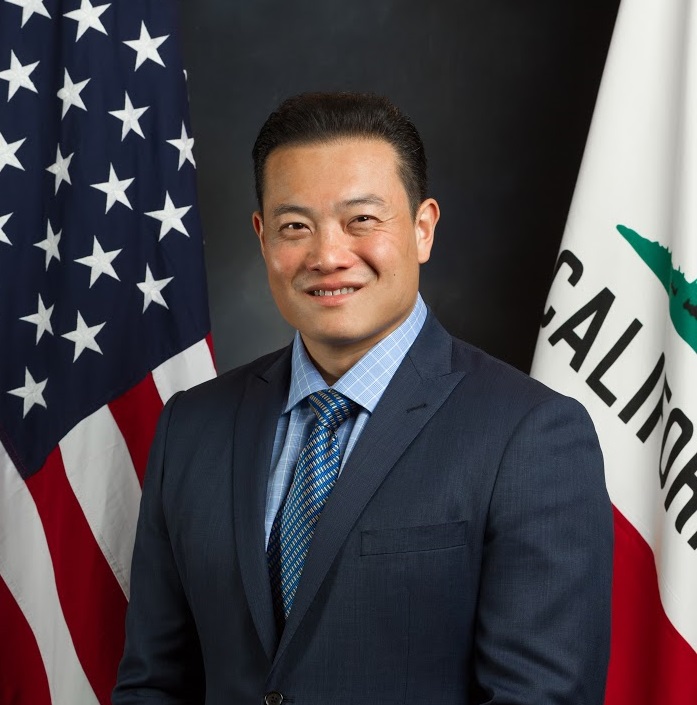
Asm. Phillip Chen
Sponsored bills
Existing law authorizes the Secretary of the Department of Corrections and Rehabilitation to prescribe and amend rules and regulations for the administration of prisons. Existing law authorizes the department to develop polices and regulations on visitation. Existing law allows an inmate sentenced to life without the possibility of parole, or to life and the inmate does not have a parole date established, to have family visits. This bill would make a technical, nonsubstantive change to that provision.
Existing law requires that a defendant be brought to trial within 60 days of arraignment on an indictment or information in a felony case, or within 30 or 45 days of arraignment or entry of plea in a misdemeanor case, as specified. Under existing law, the case must be dismissed if the defendant did not waive that time limit or consent to an extension of time, as specified, and the case is not brought to trial within the time limit. This bill would specify certain scenarios that would qualify as good cause to extend these deadlines, including, among other things, if a prosecutor or defense counsel is ill and the anticipated recovery period is shorter than the time it would take for a replacement to prepare for trial, as specified.
The Personal Income Tax Law allows various credits against the taxes imposed by that law. That law, in modified conformity to federal income tax law, authorizes a credit for household and dependent care expenses necessary for gainful employment, as provided. This bill would allow a credit against those taxes for each taxable year beginning on or after January 1, 2025, and before January 1, 2030, in an amount equal to childcare costs, as defined, paid or incurred by the qualified taxpayer in this state. The bill would limit the total credit for each taxable year, as specified. Existing law requires any bill authorizing a new tax expenditure, as defined, to include tax credits, to contain, among other things, specific goals, purposes, and objectives that the tax credit will achieve, detailed performance indicators, and data collection requirements. This bill would include findings and reporting requirements in compliance with this requirement. This bill would take effect immediately as a tax levy.
The California Environmental Quality Act (CEQA) requires a lead agency, as defined, to prepare, or cause to be prepared, and certify the completion of an environmental impact report (EIR) on a project that the lead agency proposes to carry out or approve that may have a significant effect on the environment or to adopt a negative declaration if it finds that the project will not have that effect. CEQA also requires a lead agency to prepare a mitigated negative declaration for a project that may have a significant effect on the environment if revisions in the project would avoid or mitigate that effect and there is no substantial evidence that the project, as revised, would have a significant effect on the environment. CEQA establishes a procedure by which a person may seek judicial review of the decision of the lead agency made pursuant to CEQA. The Jobs and Economic Improvement Through Environmental Leadership Act of 2021 authorizes the Governor, until January 1, 2024, to certify environmental leadership development projects that meet specified requirements for certain streamlining benefits related to CEQA. The act, among other things, requires a lead agency to prepare the record of proceedings for an environmental leadership development project, as provided, and to include a specified notice in the draft EIR and final EIR. The act is repealed by its own term on January 1, 2026. This bill would extend the application of the act to water storage projects, water conveyance projects, and groundwater recharge projects that provide public benefits and drought preparedness. The bill would authorize the Governor, until January 1, 2025, to certify water storage projects, water conveyance projects, and groundwater recharge projects as environmental leadership development projects. The bill would make other conforming changes. Because a lead agency would be required to prepare the record of proceedings for water storage projects, water conveyance projects, and groundwater recharge projects pursuant to the act, this bill would impose a state-mandated local program. The California Constitution requires the state to reimburse local agencies and school districts for certain costs mandated by the state. Statutory provisions establish procedures for making that reimbursement. This bill would provide that no reimbursement is required by this act for a specified reason.
Existing law prohibits a person from transacting any class of insurance business in this state without first being admitted for that class. Under existing law, admission is secured by procuring a certificate of authority from the Insurance Commissioner. Existing law requires the commissioner, before granting a certificate of authority or amended certificate of authority to any applicant, to consider the qualifications of the applicant, as specified, and to issue a certificate of authority upon consideration of all relevant qualifications, unless the commissioner makes a finding that the applicant is materially deficient in respect to one or more of the specified qualifications. This bill would, on or before September 1, 2024, require the department to provide a report to the Legislature on the number of applicants approved and denied in the preceding 10 years, the reasons for denying the certificates of authority, and recommendations on how to accommodate innovation and allow for more competition in California's insurance market.
Existing law prescribes the powers and duties that are common to cities and counties, including the powers and duties of legislative bodies. Under existing law, if a statute requires a local agency to take legislative action by resolution, and the local agency's charter requires it to take legislative action by ordinance, action by ordinance is compliance with the statute for all purposes. This bill would make a nonsubstantive change to those provisions.
The California Oil Refinery Cost Disclosure Act requires operators of refineries in the state that produce gasoline meeting California specifications, within 30 days of the end of each calendar month, to submit a report to the State Energy Resources Conservation and Development Commission containing certain information regarding its refining activities related to the production of gasoline that month. Existing law requires the commission to post the reported data, in aggregate, on its internet website within 45 calendar days of the end of each calendar month. This bill would require the commission to post and regularly update a dashboard on its internet website that includes the difference in average gasoline prices in California compared to national average gasoline prices, the identification of California-specific taxes, fees, regulations, and policies and their individual contribution to gasoline prices in the state, and any substantiated evidence of price gouging or other anticompetitive behavior within the petroleum industry and its contribution to the price differential.
Existing law prescribes the powers and duties that are common to cities and counties, including the powers and duties of legislative bodies. Under existing law, whenever a statute requires a local agency to take legislative action by resolution, and the local agency's charter requires it to take legislative action by ordinance, action by ordinance is compliance with the statute for all purposes. This bill would make a nonsubstantive change to those provisions.
Existing law with respect to the collection of property taxes provides that any county department, officer, or employee may refrain from collecting any tax, assessment, penalty or cost, license fees, or money owing to the county where the amount to be collected is $20 or less. This bill would make nonsubstantive changes to that provision.