

Existing law requires, if an insurance company makes a total loss settlement on a total loss salvage vehicle or a nonrepairable vehicle, the insurance company, an occupational licensee of the Department of Motor Vehicles (DMV) authorized by the insurance company, or a salvage pool authorized by the insurance company to, within 10 days from the settlement of the loss or after receipt of title, forward the properly endorsed certificate of ownership or other evidence of ownership acceptable to the DMV, the license plates, and a fee, to the DMV, except as specified, and requires the DMV, upon receipt of those required items, to issue a salvage certificate or a nonrepairable vehicle certificate for the vehicle. A violation of the Vehicle Code is an infraction. This bill would, if an insurance company requests a salvage pool or an occupational licensee to take possession of a vehicle that is the subject of a total loss claim, and, subsequently, the insurance company does not take ownership of the vehicle, authorize the insurance company to direct the salvage pool or occupational licensee to release the vehicle to the registered and legal owner or lienholder of the vehicle after notice from the insurance company authorizing the release. The bill would require the salvage pool or occupational licensee to send 2 notices to the registered and legal owner and any lienholder of the vehicle informing them that they have 30 days from the date of mailing of the first notice and 14 days from the date of mailing of the 2nd notice, and that they have the right to contact the salvage pool or occupational licensee of the department regarding their intent to pick up the vehicle in order to receive an additional 30 days from the date of contact, to pick up the vehicle from the salvage pool or occupational licensee before the vehicle is deemed abandoned. If the registered and legal owner or any lienholder of the vehicle does not pick up the vehicle in those timelines, the bill would require the vehicle to be deemed abandoned and would require the vehicle's certificate of title to be deemed to be assigned to the salvage pool or occupational licensee of the department. The bill would authorize the salvage pool or occupational licensee to request on a form signed under penalty of perjury that the DMV issue a salvage certificate or nonrepairable vehicle certificate for the vehicle, as specified, and would require the DMV to issue the certificate. By creating a new infraction and expanding the scope of the crime of perjury, this bill would impose a state-mandated local program. Existing law requires, whenever a salvage pool acquires a total loss salvage vehicle, a nonrepairable vehicle, or a recovered stolen vehicle and the vehicle license plates have not been removed pursuant to specified statutes, the salvage pool, prior to disposing of that vehicle, to remove and submit the license plates to the department. This bill would also require a salvage pool to remove and submit a vehicle's license plates to the department for a vehicle the salvage pool acquires through the provisions above and the license plates have not been removed. The California Constitution requires the state to reimburse local agencies and school districts for certain costs mandated by the state. Statutory provisions establish procedures for making that reimbursement. This bill would provide that no reimbursement is required by this act for a specified reason.
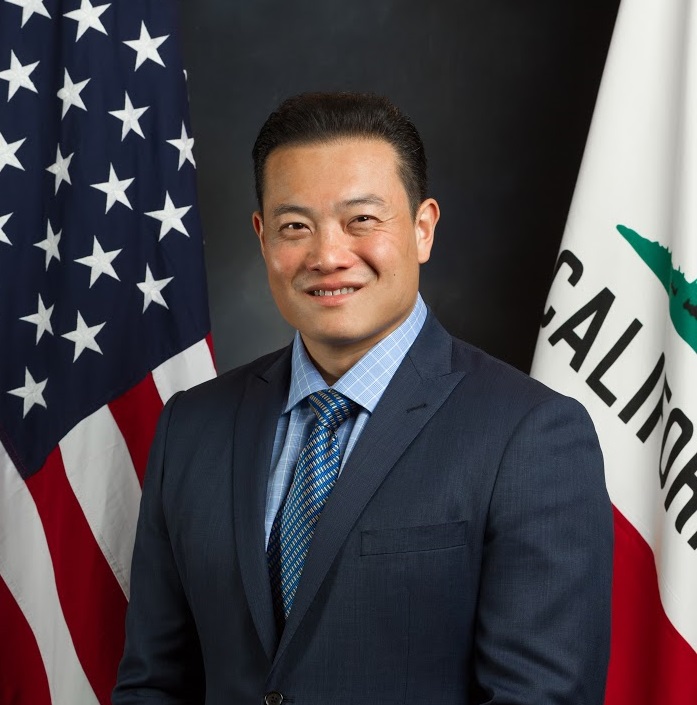
Asm. Phillip Chen
Sponsored bills
Existing law, the Professional Engineers Act and the Professional Land Surveyors' Act, provide for the licensure and regulation of engineers and land surveyors by the Board for Professional Engineers, Land Surveyors, and Geologists. Existing law, the Architects Practice Act, provides for the licensure and regulation of architects by the California Architects Board. Existing law, the Uniform Partnership Act of 1994, authorizes the formation of registered limited liability partnerships and foreign limited liability partnerships, as specified. Existing law authorizes persons licensed to engage in the practice of engineering, land surveying, or architecture to form registered limited liability partnerships and foreign limited liability partnerships if specified conditions are met. Existing law requires a registered limited liability partnership or foreign limited liability partnership providing architectural, engineering, or land surveying services to comply with requirements, as specified, for claims based upon acts, errors, or omissions arising out of those services. Existing law repeals these provisions on January 1, 2026. This bill would extend the operation of the above-described provisions to January 1, 2034, and make conforming changes. This bill would incorporate additional changes to Sections 6738 and 8729 of the Business and Professions Code proposed by AB 3253 to be operative only if this bill and AB 3253 are enacted and this bill is enacted last.
Existing law makes it a misdemeanor to willfully commit a trespass by engaging in specified acts, including driving a vehicle upon real property belonging to, or lawfully occupied by, another and known not to be open to the general public, without the consent of the owner, the owner's agent, or the person in lawful possession, except as specified, including making a lawful service of process, as prescribed. This bill would provide that the above-specified trespass provision does not apply to a repossession agency licensed by the Department of Consumer Affairs and its employees when they are on private property searching for collateral or repossessing collateral, and, upon completing that search or repossession, leave the private property within a reasonable amount of time.
Existing law authorizes a beneficiary to enforce the liability on a bond against both the principal and sureties by civil action. Under existing law, a judgment of liability on a bond, except as specified, is in favor of the beneficiary and against the principal and sureties, and obligates each of them jointly and severally. Existing law provides that except as specified, the aggregate liability of a surety to all persons for all breaches of the condition of a bond is limited to the amount of the bond, and that the liability of the principal is not limited to the amount of the bond. This bill would define "aggregate liability," for purposes of the provisions above, to include all liability for damages, costs, and attorney's fees, including any attorney's fees that may be assessed as costs, if recoverable. The bill would define "surety" for these purposes as a corporate insurer or interinsurance exchange to which the Insurance Commissioner has issued a certificate of authority to transact surety insurance in the state.
(1) Existing state and federal law, including the federal Voting Rights Act of 1965, require the Secretary of State and county elections officials to provide language assistance to voters in order to access voting information, register to vote, and cast their votes at the polling place. Existing law requires a county elections official to provide a facsimile copy of the ballot with the ballot measures and ballot instructions printed in Spanish and other languages if the Secretary of State has determined that doing so is appropriate, as specified. This bill would, by December 15, 2025, and by December 15 of every subsequent year following a presidential election, require the Secretary of State to determine the number of residents of voting age in each county and precinct who are members of a single language minority group and who lack sufficient skills in English to vote without assistance, as specified. The bill would require that, by that same date, the Secretary of State make publicly available on the Secretary of State's internet website a list of languages used by single language minority groups, as specified. Beginning January 1, 2028, this bill would further require the Secretary of State and county elections officials to provide specified materials in the language of the applicable language minority group as well as in the English language. (2) Existing law requires the Secretary of State to make specified findings and determinations regarding the provision of ballot materials in languages other than English. Until January 1, 2028, this bill would direct the Secretary to make those findings and determinations by December 15 of each year following a presidential election, and it would further limit the expansion of categories of covered languages for the purpose of providing facsimile ballots. As of January 1, 2028, this bill would impose new requirements relating to translated ballots, including requiring the training of specified precinct board members. The bill would make conforming changes. By increasing the duties of county elections officials, the bill would impose a state-mandated local program. (3) Existing law requires the elections official to send a voter information guide that contains the written statement of each candidate. Existing law requires the elections official to provide a Spanish translation of the written statement to each candidate who wishes to have one and to select a person to provide the translation who is, among other things, a certified and registered interpreter on the judicial council master list or a current voting member in good standing of the American Translators Association. This bill would add a language speaker with relevant experience in providing certified translations of legal documents who has been referred by a nonprofit agency to the list of eligible individuals that may provide the translation. (4) This bill would incorporate additional changes to Section 3019 of the Elections Code proposed by AB 3184 to be operative only if this bill and AB 3184 are enacted and this bill is enacted last. The bill would incorporate changes to Section 4005 of the Elections Code proposed by SB 1450 to be operative only if this bill and SB 1450 are enacted and this bill is enacted last. (5) The California Constitution requires the state to reimburse local agencies and school districts for certain costs mandated by the state. Statutory provisions establish procedures for making that reimbursement. This bill would provide that, if the Commission on State Mandates determines that the bill contains costs mandated by the state, reimbursement for those costs shall be made pursuant to the statutory provisions noted above.
(1) Existing law, the California Public Employees' Pension Reform Act of 2013 (PEPRA) , generally requires a public retirement system, as defined, to modify its plan or plans to comply with the act. PEPRA, among other things, establishes new defined benefit formulas and caps on pensionable compensation. The County Employees Retirement Law of 1937 (CERL) authorizes counties to establish retirement systems pursuant to its provisions in order to provide pension benefits to their employees. CERL generally vests management of each retirement system in a board of retirement. CERL authorizes a board of retirement to correct errors in the calculation of a retired member's monthly allowances or other benefits under CERL in certain circumstances, including if the member caused their final compensation to be improperly increased or otherwise overstated at the time of retirement, and the system applied that overstated amount as the basis for calculating the member's monthly retirement allowance or benefits under CERL, subject to certain limitations. The Public Employees' Retirement Law (PERL) also authorizes its board of administration to adjust retirement payments due to errors or omissions, including for cases in which the retirement systems that the benefits of a member or annuitant are, or would be, based on disallowed compensation that conflicts with PEPRA and other specified laws and is thus impermissible. This bill would require a retirement system established under CERL, upon determining that the compensation reported for a member is disallowed compensation, to require the employer, as defined, to discontinue reporting the disallowed compensation. The bill would require, for an active member, the retirement system to credit all employer contributions made on the disallowed compensation against future contributions to the benefit of the employer that reported the disallowed compensation, and return any member contribution paid by, or on behalf of, that member, to the member directly or indirectly through the employer that reported the disallowed compensation, except in certain circumstances in which a system has already initiated a process, as defined, to recalculate compensation. The bill would require the system, for a retired member, survivor, or beneficiary whose final compensation was predicated upon the disallowed compensation, to credit the employer contributions made on the disallowed compensation against future contributions, to the benefit of the employer that reported the disallowed compensation, to return any member contributions paid by, or on behalf of, that member, to the member directly, and to permanently adjust the benefit of the affected retired member, survivor, or beneficiary to reflect the exclusion of the disallowed compensation. The bill would establish other conditions required to be satisfied with respect to a retired member, survivor, or beneficiary when final compensation was predicated upon disallowed compensation, including, among others, requiring a specified payment to be made by the employer that reported contributions on the disallowed compensation to the retired member, survivor, or beneficiary, as appropriate. The bill would authorize a retirement system that has initiated a process prior to January 1, 2024, to permanently adjust the benefit of the affected retired member, survivor, or beneficiary to reflect the exclusion of the disallowed compensation to use that system in lieu of specified provisions that the bill would enact. The bill would also require certain information regarding the relevant retired member, survivor, or beneficiary needed for purposes of these provisions to be kept confidential by the recipient. This bill would authorize an employer to submit to a retirement system for review a compensation item proposed to be included in an agreement, as specified, on and after January 1, 2025, that is intended to form the basis of a pension benefit calculation and would require the system to provide guidance on the matter. The bill would prescribe a process in this regard. The bill would specify that it does not affect or otherwise alter a party's right to appeal any determination regarding disallowed compensation made by the system after July 30, 2020. (2) Existing constitutional provisions require that a statute that limits the right of access to the meetings of public bodies or the writings of public officials and agencies be adopted with findings demonstrating the interest protected by the limitation and the need for protecting that interest. This bill would make legislative findings to that effect.
Existing law establishes the Office of Vital Records within the State Department of Public Health. Existing law prescribes the duties of the State Registrar of Vital Statistics (State Registrar) and local registrars of births and deaths with respect to the registration of certificates of live birth, fetal death, or death, and marriage licenses. Existing law prescribes the information to be listed on a certificate of live birth. Existing law requires the State Registrar, upon request and payment of a fee, as specified, to provide an applicant a decorative heirloom certificate of any birth registered to that official, containing only identification information and the seal of the State of California and a facsimile of the State Registrar's signature. This bill would require the State Registrar to, upon request and payment of a fee, provide an applicant a decorative Asian Zodiac heirloom certificate, as specified. The bill would require the decorative Asian Zodiac heirloom certificate to be of a distinctive design as determined by the department to include Asian Zodiac artwork by local artists, the seal of the State of California, and a facsimile of the State Registrar's signature. The bill would require the certificate to contain only identification information, as determined by the State Registrar. The bill would require the department to set the fee for the decorative Asian Zodiac heirloom certificate to capture the reasonable costs of developing, preparing, and providing the decorative Asian Zodiac heirloom certificate. The bill would require the moneys collected by the State Registrar to be deposited with the Treasurer for credit to the Health Statistics Special Fund. The bill would specify that, upon appropriation, the moneys in the fund may be used by the department for the administrative costs of developing, preparing, and providing the decorative Asian Zodiac heirloom certificate, including payment of local artists.
Existing law provides for the licensure and regulation by the State Department of Public Health of health facilities, as defined. Existing law requires a health facility to allow a patient's domestic partner, the children of the patient's domestic partner, and the domestic partner of the patient's parent or child to visit unless no visitors are allowed, the facility reasonably determines that the presence of a particular visitor would endanger the health or safety of a patient, member of the health facility staff, or other visitor to the health facility, or would significantly disrupt the operations of a facility, or the patient has indicated to the health facility staff that the patient does not want this person to visit. A violation of this provision is a misdemeanor. This bill, Dianne's Law, would require a health facility to allow specified persons to visit, including the patient's children and grandparents. The bill would require the health facility to develop alternate visitation protocols, if circumstances require the health facility to restrict visitor access to the facility due to health or safety concerns, that allow visitation to the greatest extent possible while maintaining patient, visitor, and staff health and safety. Notwithstanding the requirement mentioned above, the bill would prohibit a health facility from prohibiting in-person visitation in end-of-life situations unless the patient has indicated to the health facility staff that the patient does not want this person to visit, as specified, and would authorize a health facility to require visitors to adhere to personal protective equipment and testing protocols not greater than those required of facility staff for the duration of their visit. The bill would also require the facility to provide personal protective equipment and testing resources to each visitor for a patient in an end-of-life situation, to the extent that those resources have been made readily available to the facility by state or local entities for that purpose. By expanding an existing crime, the bill would impose a state-mandated local program. The California Constitution requires the state to reimburse local agencies and school districts for certain costs mandated by the state. Statutory provisions establish procedures for making that reimbursement. This bill would provide that no reimbursement is required by this act for a specified reason.
Existing law requires the State Board of Education to adopt at least 5 basic instructional materials in specified subject areas, including, among others, social science, for use in kindergarten and grades 1 to 8, inclusive, as specified. Existing law establishes the Instructional Quality Commission, as specified, and requires the commission to, among other things, develop criteria for evaluating instructional materials. This bill would require the commission, when the state board adopts new instructional materials for history-social science on or after January 1, 2025, to consider providing for inclusion, in its evaluation criteria, content on the case of Mendez v. Westminster School District of Orange County. This bill would incorporate additional changes to Section 51226.3 of the Education Code proposed by AB 1821 to be operative only if this bill and AB 1821 are enacted and this bill is enacted last.
Existing law authorizes a local agency that has the authority under law to invest funds, at its discretion, to invest a portion of its surplus funds in deposits at a commercial bank, savings bank, savings and loan association, or credit union that uses a private sector entity that assists in the placement of deposits, subject to certain conditions. Existing law, until January 1, 2026, prohibits deposits placed pursuant to that provision from exceeding 50% of the agency's funds that may be so invested and, on and after January 1, 2026, reduces that deposit limit to 30% of the agency's funds that may be so invested. This bill would extend the date of the reduction to the 30% deposit limit to January 1, 2031. Existing law establishes the California Debt and Investment Advisory Commission for, among other purposes, undertaking or commissioning studies on methods to reduce the costs and improve credit ratings of state and local issues and collecting, maintaining, and providing information on local agency investments of public funds for local agency investment. This bill would require the commission, on or before January 1, 2030, to submit a prescribed report to the appropriate policy committees of the Legislature on the deposit of surplus funds pursuant to existing law by local agencies.