

The existing federal Indian Gaming Regulatory Act of 1988 provides for the negotiation and execution of tribal-state gaming compacts for the purpose of authorizing certain types of gaming on Indian lands within a state. The California Constitution prohibits the Legislature from authorizing casinos of the type operating in Nevada and New Jersey and authorizes the Governor to negotiate and conclude tribal-state gaming compacts, subject to ratification by the Legislature. Existing law expressly ratifies a number of tribal-state gaming compacts between the State of California and specified Indian tribes. Existing law, the Gambling Control Act, provides for the regulation, oversight, and licensure of gambling establishments by the California Gambling Control Commission. Existing law prohibits a list of specified gambling games or any banking or percentage game played with cards, dice, or any device, for money, checks, credit, or any representative of value, and provides that any person who offers for play or participates in these games is guilty of a misdemeanor and is punishable as specified. Existing law authorizes gambling establishments to operate controlled games utilizing a player-dealer position, as defined, and to contract with a third party for the provision of proposition player services subject to specified conditions and regulatory requirements. Existing law generally specifies the persons or entities that may bring a civil action as prescribed for relief. Existing law authorizes a court to grant a preliminary injunction or temporary restraining order at any time prior to judgment, if the verified complaint or affidavits provide sufficient grounds to do so and the opposing party has been given notice. This bill would authorize a California Indian tribe, under certain conditions, to bring an action solely against licensed California card clubs and third-party proposition player services providers to seek a declaration as to whether a controlled game operated by a licensed California card club and banked by a third-party proposition player services provider constitutes a banking card game that violates state law, including tribal gaming rights under the constitutional provisions described above, and to request injunctive relief. The bill would require that any review of such a challenge be conducted de novo. The bill would prohibit a claim for money damages, penalties, or attorney's fees and would require that actions be filed no later than April 1, 2025, as specified. The bill would clarify that it does not intend to authorize an action, or otherwise impose any liability, against the state and would prohibit a court from issuing a preliminary injunction or temporary restraining order under certain circumstances. This bill would provide that its provisions are severable.
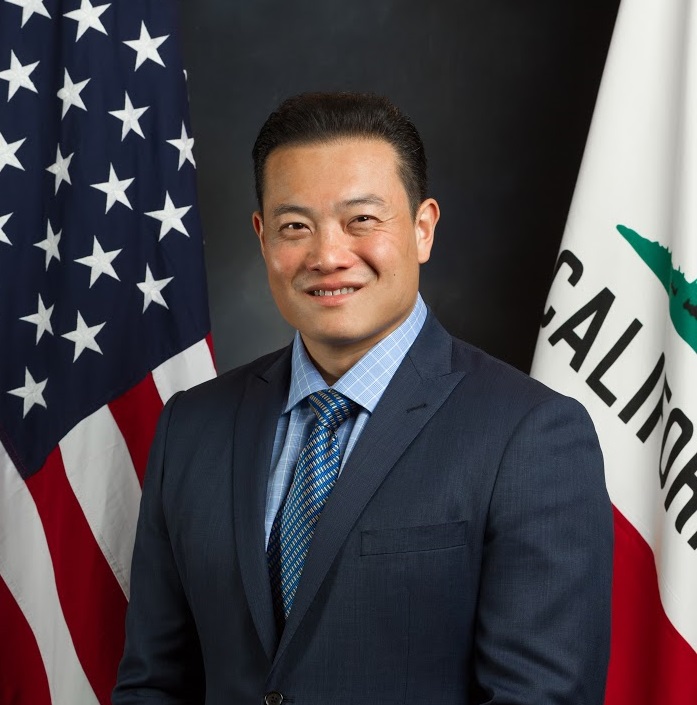
Asm. Phillip Chen
Sponsored bills
(1) Existing law, the Planning and Zoning Law, among other things, requires the legislative body of each county and city to adopt a comprehensive, long-term general plan for the physical development of the county or city and of any land outside its boundaries that relates to its planning. Existing law authorizes the legislative body, if it deems it to be in the public interest, to amend all or part of an adopted general plan, as provided. Existing law also authorizes the legislative body of any county or city, pursuant to specified procedures, to adopt ordinances that, among other things, regulate the use of buildings, structures, and land as between industry, business, residences, open space, and other purposes. This bill would prohibit a local agency, as defined, from treating a thrift retail store, as defined, differently from a nonthrift retail store engaged in the sale of new items that are similar to items sold by a thrift retail store for purposes of zoning, development standards, or permitting, except as specified. The bill would allow a local agency to require that thrift retail stores meet certain aesthetic or design standards, as prescribed. The bill would prohibit a local agency from prohibiting a thrift retail store from receiving used and donated items for sale in the store or other thrift retail stores, or reuse or recycling, or both reuse and recycling, through other means. By imposing additional duties on local officials, the bill would impose a state-mandated local program. The bill would specify that nothing in its provisions shall be construed to, among other things, prohibit the adoption or enforcement of reasonable local rules or ordinances on retail establishments engaged in the sale of new items that are similar to items sold by a thrift retail store. (2) The bill would include findings that changes proposed by this bill address a matter of statewide concern rather than a municipal affair and, therefore, apply to all cities, including charter cities. (3) The California Constitution requires the state to reimburse local agencies and school districts for certain costs mandated by the state. Statutory provisions establish procedures for making that reimbursement. This bill would provide that no reimbursement is required by this act for a specified reason.
Existing law requires the State Department of Public Health to license, inspect, and regulate clinical laboratories and specified clinical laboratory personnel. Existing law requires a clinical laboratory, as defined, performing clinical laboratory tests or examinations classified as of moderate or of high complexity under the federal Clinical Laboratory Improvement Amendments (CLIA) to obtain a clinical laboratory license, as specified. Existing law requires a separate license or registration to be obtained for each laboratory location, except for, among other things, laboratories that are not at a fixed location, as specified. This bill would authorize, upon determination by the department that the authorization conforms to federal law, practice by a pathologist who is performing pathology services at a primary laboratory site licensed by the state to review digital materials, as defined, at a remote location under a primary site's CLIA certificate. The bill would require the department, on or before June 30, 2025, to consult with the federal Centers for Medicare and Medicaid Services and would require the department to make a determination on or before January 1, 2026, for those purposes. This bill would require the department, if it determines that the authorization conforms to federal law, to communicate its determination to the Legislature and the Legislative Counsel Bureau. The bill would classify a location where digital materials are accessed by pathologists through virtual private networks, or other secure method, to be an extension of a primary site's CLIA certificate and would prohibit that remote location from requiring a separate license or registration, consistent with the interpretation of CLIA regulations by the federal Centers for Medicare and Medicaid Services guidelines, as specified.
Under existing law, a person who solicits, or who agrees to engage in, or who engages in, any act of prostitution with the intent to receive compensation, money, or anything of value from another person is guilty of disorderly conduct, a misdemeanor. Under existing law, if the person solicited was a minor, and the person who solicited the minor knew or reasonably should have known that the person solicited was a minor, the offense is punishable by imprisonment in the county jail for a mandatory minimum of 2 days and not to exceed one year, by a fine not to exceed $10,000, or by both such fine and imprisonment. This bill would make this offense applicable only to a defendant who is 18 years of age or older at the time of the offense. The bill would, if the person solicited was under 16 years of age, or if the person solicited was under 18 years of age at the time of the offense and the person solicited was a victim of human trafficking, make the offense punishable as a wobbler by imprisonment in the county jail for not more than 1 year and a fine not to exceed $10,000 or by imprisonment in the county jail for 16 months or 2 or 3 years. For a 2nd or subsequent offense under those conditions, the bill would require that the offense be punishable as a felony by imprisonment in the county jail for 16 months or 2 or 3 years. By changing the elements and increasing the punishment of a crime, this bill would impose a state-mandated local program. Existing law requires persons convicted of certain specified crimes to annually register as a sex offender, as specified, for a term of 10, 20, or 30 years. This bill would require a person who is 18 years of age or older, on or after January 1, 2025, is convicted of, and who has a prior conviction for, soliciting a minor, as specified, to annually register as a sex offender for a term of 10 years if, at the time of the offense, the person was more than 10 years older than the solicited minor. This bill would incorporate additional changes to Section 647 of the Penal Code proposed by SB 926, AB 1874, and AB 1962, to be operative only if this bill and some or all of those other bills are enacted and this bill is enacted last. The California Constitution requires the state to reimburse local agencies and school districts for certain costs mandated by the state. Statutory provisions establish procedures for making that reimbursement. This bill would provide that no reimbursement is required by this act for a specified reason.
Existing law, the Political Reform Act of 1974, deems all campaign contributions to be held in trust for expenses associated with seeking or holding office, and generally authorizes expenditures associated therewith if they are reasonably related to a political, legislative, or governmental purpose. Existing law prohibits the use of campaign funds to pay or reimburse fines, penalties, judgments, or settlements, except as specified. Existing law provides that the expenditure of campaign funds for attorney's fees and other costs in connection with administrative, civil, or criminal litigation are not related to a political, legislative, or governmental purpose unless the litigation is directly related to activities of a committee that are consistent with its primary objectives or arises directly out of a candidate's or elected officer's activities, duties, or status as a candidate or elected officer, as specified. This bill would prohibit campaign funds from being used to reimburse expenditures for attorney's fees and other costs in connection with criminal litigation if the litigation results in a conviction of the candidate or elected officer for a felony involving certain types of offenses, as specified. The bill would prohibit the use of campaign funds to pay or reimburse a candidate or elected officer for a fine, penalty, judgment, or settlement relating to a conviction for a felony involving such specified offenses. The bill would require the candidate or elected officer, if convicted, to reimburse the campaign for all funds used in connection with other legal costs and expenses related to claims of criminal acts. This bill would incorporate additional changes to Section 89513 of the Government Code proposed by SB 1170 to be operative only if this bill and SB 1170 are enacted and this bill is enacted last. A violation of the Political Reform Act of 1974 is punishable as a misdemeanor. By expanding the scope of an existing crime, this bill would impose a state-mandated local program. The California Constitution requires the state to reimburse local agencies and school districts for certain costs mandated by the state. Statutory provisions establish procedures for making that reimbursement. This bill would provide that no reimbursement is required by this act for a specified reason. The Political Reform Act of 1974, an initiative measure, provides that the Legislature may amend the act to further the act's purposes upon a 23 vote of each house of the Legislature and compliance with specified procedural requirements. This bill would declare that it furthers the purposes of the act.
Existing law, the Community Assistance, Recovery, and Empowerment (CARE) Act, authorizes specified adult persons to petition a civil court to create a voluntary CARE agreement or a court-ordered CARE plan and implement services, to be provided by county behavioral health agencies, to provide behavioral health care, including stabilization medication, housing, and other enumerated services, to adults who are currently experiencing a severe mental illness and have a diagnosis identified in the disorder class schizophrenia and other psychotic disorders, and who meet other specified criteria. Existing law requires the Department of Health Care Access and Information to perform various duties with respect to implementing health professions scholarship and loan programs. This bill would, upon appropriation, establish the Community Assistance, Recovery, and Empowerment (CARE) Scholarship Program. The bill would require the department to administer the annual scholarship for purposes of increasing the number of culturally competent marriage and family therapists, clinical social workers, professional clinical counselors, and psychologists, as specified. The bill would require scholarship recipients to agree to work for county behavioral health agencies in meeting their needs and obligations to implement the CARE Act for a minimum of 3 years upon degree completion. The bill would require the department to post information related to the scholarship on its internet website.
Existing law establishes the California Interagency Council on Homelessness to identify mainstream resources, benefits, and services that can be accessed to prevent and end homelessness in California by creating partnerships between federal, state, local, and nonprofit entities. Existing law requires a state agency or department that administers one or more state homelessness programs, upon request of the council, to participate in council activities, as specified, and to provide to the council any relevant information regarding those state homelessness programs. This bill would require, commencing September 1, 2025, a state agency or department that administers one or more state homelessness programs to report annually to the council cost and outcome data for each program the agency or department administers, and would require the council, in coordination with each agency or department required to report to the council, as specified, to develop data collection and reporting procedures for this purpose. The bill would require the council to compile the data reported by agencies and departments and, commencing April 1, 2026, annually make that data available to the public.
Existing law vests the Department of Transportation with full possession and control of all state highways. Existing law describes the authorized routes in the state highway system, including that for Route 405 from Route 5 near El Toro to Route 5 near San Fernando. This bill would specify that Route 405 from Bolsa Chica Road to Bolsa Avenue in the County of Orange shall be known and designated as the Little Saigon Freeway, and would require the department to determine the cost of appropriate signs showing that special designation and, upon receiving donations from nonstate sources sufficient to cover the cost, to erect those signs, as specified.
Existing law requires that a weapon acquired by a specified governmental entity under specified circumstances, including as part of a "gun-buyback" program, be destroyed. This bill would require a law enforcement agency that contracts with a third party for the destruction of firearms or weapons to ensure that the contract for those services prohibits the sale of any parts of, or attachments to, the firearm or other weapon, as specified. The bill would also exempt from the destruction requirement, any firearm obtained through a "gun-buyback" program that is donated to a historical society, museum, or institutional collection, as specified. By requiring a higher level of service for local agencies, this bill would impose a state-mandated local program. This bill would incorporate additional changes to Section 18005 of the Penal Code proposed by SB 1019 and AB 2739 to be operative only if this bill and either one or both of those bills are enacted and this bill is enacted last. The California Constitution requires the state to reimburse local agencies and school districts for certain costs mandated by the state. Statutory provisions establish procedures for making that reimbursement. This bill would provide that, if the Commission on State Mandates determines that the bill contains costs mandated by the state, reimbursement for those costs shall be made pursuant to the statutory provisions noted above.
Existing law authorizes the governing body of a school district, a county office of education, or a charter school to adopt a policy to limit or prohibit the use by its pupils of smartphones while the pupils are at a schoolsite or while the pupils are under the supervision and control of an employee or employees of that school district, county office of education, or charter school. Existing law, however, specifies circumstances in which a pupil may not be prohibited from possessing or using a smartphone. This bill would instead require the governing body of a school district, a county office of education, or a charter school to, by July 1, 2026, develop and adopt, and to update every 5 years, a policy to limit or prohibit the use by its pupils of smartphones while the pupils are at a schoolsite or while the pupils are under the supervision and control of an employee or employees of that school district, county office of education, or charter school, as provided. By imposing additional duties on local educational agencies, the bill would constitute a state-mandated local program. The California Constitution requires the state to reimburse local agencies and school districts for certain costs mandated by the state. Statutory provisions establish procedures for making that reimbursement. This bill would provide that, if the Commission on State Mandates determines that the bill contains costs mandated by the state, reimbursement for those costs shall be made pursuant to the statutory provisions noted above.