

Existing law, the Radiologic Technology Act, provides for the certification and regulation of radiologic technologists by the State Department of Public Health and makes a violation of the act or regulation of the department adopted pursuant to the act a misdemeanor. Existing law authorizes a radiologic technologist to perform venipuncture in an upper extremity, as specified, under the direct supervision of a licensed physician and surgeon. Existing law defines direct supervision for purposes of that provision to mean the direction of procedures by a licensed physician and surgeon who is physically present and available within the facility when the procedures are performed to provide immediate medical intervention prevent or mitigate injury to the patient in the event of adverse reaction. This bill would revise that definition to require the licensed physician and surgeon to either be physically present within the facility and immediately available to intervene or available immediately via audio and video communication with access to the patient's medical imaging records and have the ability to intervene by directing other onsite personnel. The bill would require the facility to have safety protocols and, unless the facility has a licensed physician and surgeon who is physically present, as specified, to have personnel onsite who have the appropriate license to respond to adverse events at the physician's direction. By changing the scope of direct supervision for purposes of these provisions, the violation of which is a crime, the bill would impose a state-mandated local program. The California Constitution requires the state to reimburse local agencies and school districts for certain costs mandated by the state. Statutory provisions establish procedures for making that reimbursement. This bill would provide that no reimbursement is required by this act for a specified reason.
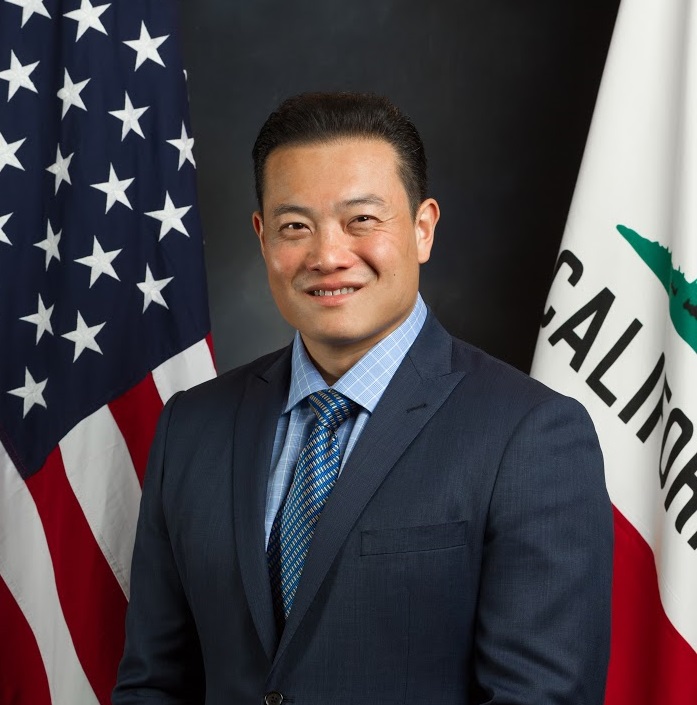
Asm. Phillip Chen
Sponsored bills
(1) Existing law authorizes specified drowning or injury prevention organizations (DIP organization) to provide informational materials, in electronic or hardcopy form, to a public school regarding specified topics relating to drowning prevention. Existing law requires a DIP organization that chooses to provide informational materials to provide, upon request by a public school, the informational materials in the 3 most commonly spoken languages associated with the population attending the school. This bill would instead require a DIP organization that chooses to provide informational materials to provide, upon request by a public school, the informational materials in English and would encourage the DIP organization to provide informational materials in the other most commonly spoken languages associated with the population attending the school. The bill would require a DIP organization that chooses to provide informational materials to a public school to provide those materials at no cost to the public school, allow the school to offer copies of the materials to pupils and parents, and provide written evidence to a school administrator that demonstrates that the informational materials provided by the DIP organization align with the drowning, drowning prevention, water safety, rescue, and swim skills lesson information found on the drowning prevention web page of the federal Centers for Disease Control and Prevention, as provided. The bill also would require the State Department of Education, in consultation with the State Department of Developmental Services and the State Department of Public Health, to gather and make available on its internet website school-based water safety and drowning prevention education resources and curriculum, as provided. The bill would authorize public schools to provide to their pupils those water safety informational materials identified by the department and provided by a DIP organization, as provided. (2) Existing law requires the State Department of Public Health to adopt and enforce regulations relating to public swimming pools, as defined. This bill would expressly authorize the State Department of Public Health to review and evaluate existing statutes and regulations under its jurisdiction recommended by the California Unintentional Injury Prevention Strategic Plan Project to ensure clarity, consistency, and alignment with current public health practices, as provided, and would authorize the department to recommend to the Legislature updates or nonsubstantive technical corrections to support effective implementation and regulatory compliance.
The California Consumer Financial Protection Law requires the Commissioner of Financial Protection and Innovation to prepare and publish on the Department of Financial Protection and Innovation's internet website an annual report detailing actions taken during the prior year under the law and requires the report to include information on actions taken with respect to, among other things, the activities of the Financial Technology Innovation Office. This bill would additionally require the report to include information on actions taken with respect to the Office of the Ombuds.
The California Environmental Quality Act (CEQA) requires a lead agency, as defined, to prepare, or cause to be prepared, and certify the completion of an environmental impact report on a project that it proposes to carry out or approve that may have a significant effect on the environment or to adopt a negative declaration if it finds that the project will not have that effect. CEQA also requires a lead agency to prepare a mitigated negative declaration for a project that may have a significant effect on the environment if revisions in the project would avoid or mitigate that effect and there is no substantial evidence that the project, as revised, would have a significant effect on the environment. CEQA exempts from its requirements various projects, including, but not limited to, housing projects that meet certain requirements and activities and approvals related to certain prison facilities. This bill would exempt from the requirements of CEQA any activity or approval necessary for the completion of the Gypsum Canyon Veterans Cemetery in the County of Orange if specified conditions are met. To the extent that a local agency would be required to determine whether an activity or approval qualifies for this exemption, the bill would impose a state-mandated local program. The bill would repeal this provision on January 1, 2030. This bill would make legislative findings and declarations as to the necessity of a special statute for the Gypsum Canyon Veterans Cemetery in the County of Orange. The California Constitution requires the state to reimburse local agencies and school districts for certain costs mandated by the state. Statutory provisions establish procedures for making that reimbursement. This bill would provide that no reimbursement is required by this act for a specified reason. This bill would declare that it is to take effect immediately as an urgency statute.
Existing law declares the public policy of the state regarding labor organization, including, among other things, that it is necessary for a worker to have full freedom of association, self-organization, and designation of representatives of their own choosing, to negotiate the terms and conditions of their employment, and to be free from the interference, restraint, or coercion of employers of labor, or their agents, in the designation of such representatives or in self-organization or in other concerted activities for the purpose of collective bargaining or other mutual aid or protection. Existing law establishes the Public Employment Relations Board (PERB) in state government as a means of resolving disputes and enforcing the statutory duties and rights of specified public employers and employees under various acts regulating collective bargaining. Under existing law, PERB has the power and duty to investigate an unfair practice charge and to determine whether the charge is justified and the appropriate remedy for the unfair practice. Existing law, the federal National Labor Relations Act (NLRA) , establishes a comprehensive statutory scheme regulating unfair labor practices on the part of employers and labor organizations in industries affecting interstate commerce, and vests in the National Labor Relations Board (NLRB) the power to conduct elections to determine employee representatives and to prevent unfair labor practices affecting commerce. Existing law, the California Public Records Act, requires that public records, as defined, be available to the public for inspection and made promptly available to any person. This bill would expand PERB's jurisdiction by authorizing a worker, to petition PERB to protect and enforce prescribed rights under specified circumstances, including if the worker is employed in a position subject to the NLRA but the NLRB has expressly or impliedly ceded jurisdiction. The bill would authorize PERB to, among other things, decide unfair labor practice cases pursuant to a specified timeline and order all appropriate relief for a violation, including civil penalties, as prescribed. In order to pursue relief from PERB, the bill would require a covered worker or their representative to file an unfair practice charge or petition that includes specified information, including, where applicable, the original charge or petition filed with the NLRB. The bill would require PERB to hold the supporting documentation and evidence confidential and maintain it as part of its investigatory file and would exempt this documentation and evidence from the California Public Records Act. If PERB determines, among other things, it has insufficient resources to process certain cases or doing so would prevent it from meeting specified statutory deadlines, the bill would require PERB to process and prioritize charges, as specified. The bill would also establish the Public Employment Relations Board Enforcement Fund (fund) in the State Treasury, would require the above-described civil penalties to be deposited into the fund, and would make moneys in the fund available upon appropriation by the Legislature to PERB for the purpose of administering the above-specified provisions. The bill would authorize PERB to rely on its own decisions and precedent under the NLRA and would authorize review of its decisions by a state appellate court, as specified. Existing law, the Alatorre-Zenovich-Dunlap-Berman Agricultural Labor Relations Act of 1975, grants agricultural employees the right to form and join labor organizations and engage in collective bargaining, as specified, and prohibits agricultural employers and labor organizations from engaging in unfair labor practices. Those provisions establish the Agricultural Labor Relations Board (ALRB) and empower the ALRB to prevent any person from engaging in those practices. Existing law establishes various definitions for these purposes. Existing law requires the ALRB to follow applicable precedents of the NLRA. This bill would specify that the ALRB has exclusive jurisdiction in all phases of the administration of the act, and to determine whether any person or entity meets one or more of those definitions. The bill would instead authorize the board to follow applicable precedents of the NLRA, but would not obligate the board to follow precedents where the ALRB deems it inappropriate to do so. This bill would make related findings and declarations and would make its provisions severable. Existing constitutional provisions require that a statute that limits the right of access to the meetings of public bodies or the writings of public officials and agencies be adopted with findings demonstrating the interest protected by the limitation and the need for protecting that interest. This bill would make legislative findings to that effect.
This measure would designate November 1, 2025, as Fernando Valenzuela Day, to highlight the positive impact his legacy created in the Latino and Hispanic community.
This measure would recognize the importance of California Native American Day, celebrated this year on September 26, 2025, and the annual California Indian Cultural Awareness Conference, to the enhancement of awareness of California Indian culture.
This measure would proclaim September 4, 2025, as Taekwondo Day in California and encourage all residents to recognize and celebrate the positive impact of Taekwondo on individuals, families, and communities throughout the state.
This measure would declare the month of March to be March4Water Month in California and would encourage all Californians to participate in activities and programs during March4Water Month to promote awareness, education, and actions that prioritize water as a vital resource for the state's future.
Maddy summaryACR 95 designates June 21, 2025, as the International Day of Yoga in California. This ceremonial resolution formally recognizes the day for public awareness but has no legal effect or policy changes. It directly affects California residents by encouraging community observances of the international event. The measure is purely symbolic, with no funding, regulations, or new obligations for state agencies or individuals.