Existing law specifies that one who indemnifies another against an act to be done by the latter, is liable jointly with the person indemnified, and separately, to every person injured by the act. This bill would make a nonsubstantive change to that provision.
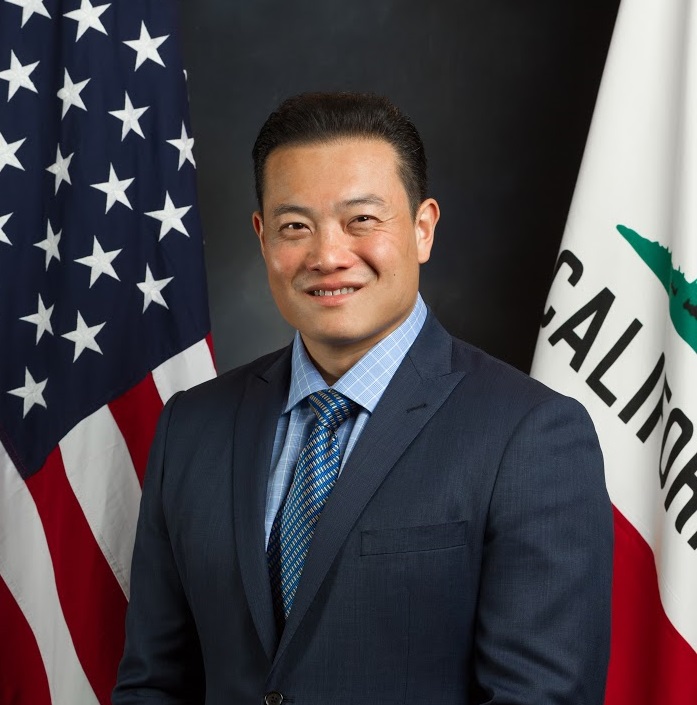
Asm. Phillip Chen
Sponsored bills
The California Global Warming Solutions Act of 2006 establishes the State Air Resources Board as the state agency responsible for monitoring and regulating sources emitting greenhouse gases. The act requires the state board to adopt rules and regulations to achieve the maximum technologically feasible and cost-effective greenhouse gas emissions reductions to ensure that the statewide greenhouse gas emissions are reduced to at least 40% below the statewide greenhouse gas emissions limit, as defined, no later than December 31, 2030. Pursuant to the act, the state board has adopted the Low-Carbon Fuel Standard regulations. This bill would void specified amendments to the Low-Carbon Fuel Standard regulations adopted by the state board on November 8, 2024.
Existing law, the Private Security Services Act, provides for the licensure and regulation of private patrol operators by the Bureau of Security and Investigative Services, and makes violations of its provisions a crime. Existing law prohibits a licensed private patrol operator from allowing an employee to perform the functions of a security guard without confirming that the person holds a current and valid security guard registration. Existing law requires an applicant for a security guard registration to complete a course in the exercise of the power to arrest and the appropriate use of force as a condition for the issuance of the registration, as provided. This bill would make a nonsubstantive change to that provision.
Existing law, the Local Agency Public Construction Act, sets forth the requirements for the payment of construction projects by local agencies. Existing law, the State Contract Act, imposes specified requirements on state agencies regarding payment of construction contracts, including requiring, within 10 days of making a construction contract payment, a state agency that maintains an internet website to post on its internet website the project for which the payment was made, the name of the construction contractor or company paid, the date the payment was made or the date the state agency transmitted instructions to the Controller or other payer to make the payment, the payment application number or other identifying information, and the amount of the payment. Existing law exempts from these provisions, among other things, construction contracts valued below $25,000. This bill would require a local agency that maintains an internet website to post on its internet website the information described above. The bill would exempt from these provisions construction contracts valued below $25,000. The bill would prohibit a local agency that fails to comply with these provisions from withholding any retention proceeds from any remaining payment, as specified. By adding to the duties of local agencies, the bill would impose a state-mandated local program. The California Constitution requires the state to reimburse local agencies and school districts for certain costs mandated by the state. Statutory provisions establish procedures for making that reimbursement. This bill would provide that, if the Commission on State Mandates determines that the bill contains costs mandated by the state, reimbursement for those costs shall be made pursuant to the statutory provisions noted above.
Existing law, the Motor Vehicle Fuel Tax Law, imposes a tax upon each gallon of motor vehicle fuel removed from a refinery or terminal rack in this state, entered into this state, or sold in this state, at a specified rate per gallon. Existing unfair competition laws establish a statutory cause of action for unfair competition, including any unlawful, unfair, or fraudulent business act or practice and unfair, deceptive, untrue, or misleading advertising and acts prohibited by false advertisement laws. This bill would suspend the imposition of the tax on motor vehicle fuels for one year. The bill would require that all savings realized based on the suspension of the motor vehicle fuels tax by a person other than an end consumer, as defined, be passed on to the end consumer, and would make the violation of this requirement an unfair business practice, in violation of unfair competition laws, as provided. The bill would require a seller of motor vehicle fuels to provide a receipt to a purchaser that indicates the amount of tax that would have otherwise applied to the transaction. This bill would also direct the Controller to transfer a specified amount from the General Fund to the Motor Vehicle Fuel Account in the Transportation Tax Fund. By transferring General Fund moneys to a continuously appropriated account, this bill would make an appropriation. This bill would declare that it is to take effect immediately as an urgency statute.
The California Credit Union Law provides for the licensure and regulation of credit unions by the Commissioner of Financial Protection and Innovation. The law requires a credit union to be directed by a board of directors, as provided. The law requires the officers of every credit union to include a chairman or president, one or more vice chairmen or vice presidents, a secretary and a treasurer or chief financial officer, as well as other officers as may be necessary, as provided. The law requires a credit union to have a credit committee, except as specified. The law requires a credit union to have a supervisory committee, except as specified. The law requires the supervisory committee to notify members of a credit union within seven days after the suspension of any or all members of the credit committee, any member of the board of directors, or any other officer, as provided. This bill would instead require the notice described above to be given within seven business days after the suspension of any or all members of the credit committee, any member of the board of directors, or any other officer.
Existing law allows a search warrant to be issued upon probable cause, supported by affidavit, naming or describing the person to be searched or searched for, and particularly describing the property, thing, or things and the place to be searched. Existing law describes search warrants and enumerates the grounds upon which a search warrant may be issued, including, without limitation, for property that was stolen or embezzled, or for property or things that were used to commit a felony. Existing law authorizes a defendant to move for the return of property or to suppress evidence obtained as a result of a search and seizure if the search or seizure was without a warrant and was unreasonable or, the search and seizure was with a warrant and certain criteria apply. Existing law provides for a hearing on the defendant's motion where the court receives evidence and determines whether the evidence is inadmissible at any trial or other hearing, except as specified, or returns the property. This bill would allow a search warrant for stolen or embezzled currency, as specified, to include an order for such currency to be returned to a lawful owner identified in the warrant pursuant to specified procedures including a hearing, if requested, to determine that the currency was stolen or embezzled, before it is returned to its owner. The bill would require an independent hearing, where the agency seizing the currency would have the burden of proving, by a preponderance of the evidence, that the currency was stolen or embezzled. The bill would require the agency seizing the property, no less than 10 days before returning the currency to the lawful owner, to notify the prosecuting authority in the jurisdiction where the embezzlement or theft may reasonably be prosecuted.
Existing law defines the crime of burglary, which consists of entering specified buildings, places, or vehicles with the intent to commit grand or petty theft or a felony. Existing law defines burglary of the first degree as any burglary of an inhabited building and makes burglary of the first degree punishable by imprisonment in the state prison for 2, 4, or 6 years. Existing law defines all other burglary as burglary of the 2nd degree and makes it punishable by imprisonment in the county jail for one year or as a felony. Existing law defines any 2nd degree burglary during and within an affected county in a state of emergency or local emergency, as specified, as looting, punishable by either imprisonment in a county jail for one year or as a felony. This bill would make that crime punishable instead as a felony. By increasing the punishment of a crime, this bill would impose a state-mandated local program. The California Constitution requires the state to reimburse local agencies and school districts for certain costs mandated by the state. Statutory provisions establish procedures for making that reimbursement. This bill would provide that no reimbursement is required by this act for a specified reason.
Existing law, the California Emergency Services Act, authorizes the Governor to proclaim a state of emergency, as defined, under specified circumstances. Existing law makes it a misdemeanor to impersonate a peace officer or an officer or member of a fire department or the Office of the State Fire Marshal. This bill would make impersonating a peace officer or an officer or member of a fire department or the Office of the State Fire Marshal during a state of emergency or local emergency punishable as either a misdemeanor or a felony, as specified. By increasing the punishment of a crime, this bill would impose a state-mandated local program. The California Constitution requires the state to reimburse local agencies and school districts for certain costs mandated by the state. Statutory provisions establish procedures for making that reimbursement. This bill would provide that no reimbursement is required by this act for a specified reason.
Existing sales and use tax laws impose taxes on retailers measured by the gross receipts from the sale of tangible personal property sold at retail in this state, or on the storage, use, or other consumption in this state of tangible personal property purchased from a retailer for storage, use, or other consumption in this state. The Sales and Use Tax Law provides various exemptions from those taxes, including a partial exemption from those taxes, on and after July 1, 2014, and before July 1, 2030, for the gross receipts from the sale of, and the storage, use, or other consumption of, among other things, qualified tangible personal property purchased by a qualified person for purchases not exceeding $200,000,000, for use primarily in manufacturing, processing, refining, fabricating, or recycling of tangible personal property, as specified. Existing law requires the California Department of Tax and Fee Administration to provide a report to the Joint Legislative Budget Committee and the Department of Finance of, among other things, the total dollar amount of exemptions, as specified. Existing law repeals these provisions on January 1, 2031. This bill would, instead, extend the above-described partial exemption from those taxes until January 1, 2031, and would remove the above-described reporting requirement pertaining to the California Department of Tax and Fee Administration. The bill would make various conforming changes and repeal these provisions on January 1, 2036. Existing law requires any bill authorizing a new tax expenditure to contain, among other things, specific goals, purposes, and objectives that the tax expenditure will achieve, detailed performance indicators, and data collection requirements. This bill would require the California Department of Tax and Fee Administration, if requested by the Legislature, to submit a report to the Legislature on the exemption and would provide findings and declarations relating to the goals of the exemption. The Bradley-Burns Uniform Local Sales and Use Tax Law authorizes counties and cities to impose local sales and use taxes in conformity with the Sales and Use Tax Law, and existing laws authorize districts, as specified, to impose transactions and use taxes in accordance with the Transactions and Use Tax Law, which generally conforms to the Sales and Use Tax Law. Amendments to the Sales and Use Tax Law are automatically incorporated into the local tax laws. Existing law requires the state to reimburse counties and cities for revenue losses caused by the enactment of sales and use tax exemptions. This bill would provide that, notwithstanding Section 2230 of the Revenue and Taxation Code, no appropriation is made and the state shall not reimburse any local agencies for sales and use tax revenues lost by them pursuant to this bill. This bill would take effect immediately as a tax levy.