

Existing law establishes the California Assessment of Student Performance and Progress (CAASPP) as the statewide system of pupil assessments under which certain assessments are required or authorized to be administered in public schools, as specified, including a consortium summative assessment in English language arts and mathematics for grades 3 to 8, inclusive, and grade 11 that measures content standards adopted by the State Board of Education. This bill would require, pursuant to specified provisions of the federal Elementary and Secondary Education Act, the Superintendent of Public Instruction to approve a nationally recognized high school assessment that a local educational agency, as defined, may, at its own discretion, administer, if the alternative assessment is approved by the local educational agency's governing board or body in a public meeting, commencing with the 2021–22 school year, and each school year thereafter, in lieu of the consortium summative assessment in English language arts and mathematics for grade 11. The bill would require a nationally recognized high school assessment approved by the Superintendent to meet specified requirements, would authorize the Superintendent to require the publisher of that assessment to provide documentation that the assessment meets or exceeds these requirements, and would require the Superintendent, if he or she determines that the assessment does not meet these requirements, to inform the assessment's publisher in writing of specific deficiencies and changes needed to meet these requirements. The bill would authorize a governing board of a local educational agency that is part of a consortium of local educational agencies to enter into a cooperative contract with a publisher for purposes of providing an assessment, as provided. To the extent permitted by the United States Department of Education, the bill would deem certain nationally recognized high school assessments to meet these requirements, and would require the Superintendent to approve these assessments for selection by a local educational agency. The bill would require the state board to amend the state plan required pursuant to federal law to account for the authorization for local educational agencies to use an alternate assessment pursuant to the bill's provisions, if required by federal law. The bill would require a local educational agency that administers a nationally recognized high school assessment to comply with specified requirements, would require the Superintendent to apportion to the local educational agency the lesser of the actual cost of administering the alternative assessment, as specified, and the amount that would have been apportioned to the local educational agency if it had administered the consortium summative assessment in English language arts and mathematics for grade 11. The bill would state that a local educational agency may administer only one nationally recognized high school assessment in lieu of the consortium summative assessment in English language arts and mathematics for grade 11. The bill would make these provisions inoperative 5 years after the first school year in which a local educational agency is able to exercise the authority to administer the alternative assessment, as specified, and would repeal these provisions as of the following January 1. The bill would require the Superintendent to inform the Legislative Counsel within 30 days of when this 5 year condition has been satisfied and post that determination on its internet website. The bill would require the State Department of Education to ensure that local educational agencies comply with specified requirements concerning the alternative assessment that apply in connection with the summative assessments under the CAASPP, including that grade 11 pupils, or parents or legal guardians of those pupils, may request results from the alternative assessment. Existing law requires the Superintendent to prepare and submit, and subsequently post on the internet website of the department, an annual report to the state board containing an analysis of the results and test scores of the summative assessments administered under the CAASPP. This bill would require the Superintendent to include the results and test scores of the alternative assessment in that annual report.
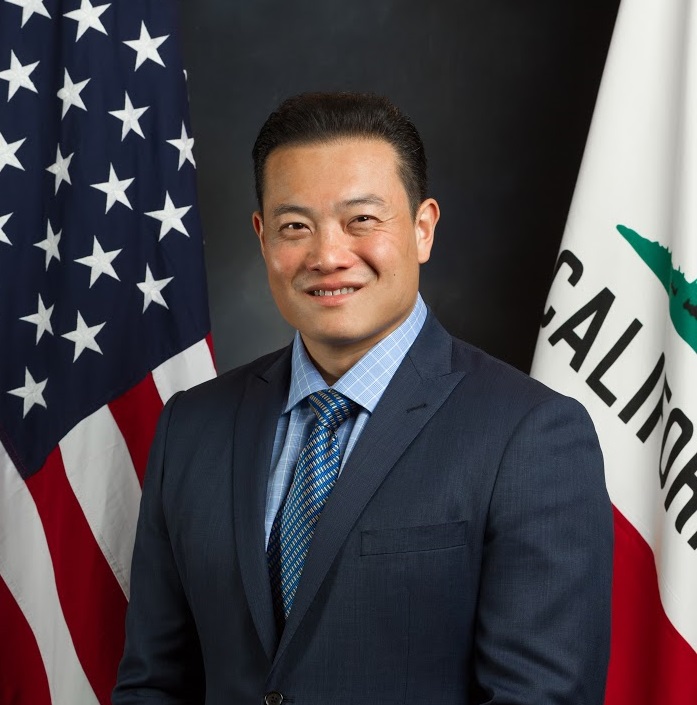
Asm. Phillip Chen
Sponsored bills
This measure would recognize September 2020 as Sickle Cell Disease Awareness Month and encourage the Legislature to appropriate funds for research, treatment, and monitoring of sickle cell disease, and for related education and outreach.
This measure would designate October 23, 2020, as Chinese American Day in California to highlight the important historical contributions of Chinese Americans to California and to the United States of America.
This measure would urge specified state departments and the Attorney General to use their authority to ensure that health care service plans and health insurers subject to their authority comply with the federal Paul Wellstone and Pete Domenici Mental Health Parity and Addiction Equity Act of 2008.
Existing law establishes the Department of Motor Vehicles in the Transportation Agency and sets forth the powers and duties of the department, including, but not limited to, vehicle registration and the issuance and renewal of driver's licenses. Existing law defines a "person," for the purposes of these and related provisions, as a natural person, firm, copartnership, association, limited liability company, or corporation. Under existing law, a violation of, or failure to comply with, any provision of the Vehicle Code is unlawful and constitutes an infraction, unless otherwise provided. This bill would make it unlawful for any person to sell, or offer for sale, an appointment with the department, as specified. Because a violation of this provision would be an infraction, the bill would create a state-mandated local program. The California Constitution requires the state to reimburse local agencies and school districts for certain costs mandated by the state. Statutory provisions establish procedures for making that reimbursement. This bill would provide that no reimbursement is required by this act for a specified reason.
The California Constitution grants the retirement board of a public employee retirement system plenary authority and fiduciary responsibility for investment of moneys and administration of the retirement fund and system. The California Constitution qualifies this grant of powers by reserving to the Legislature the authority to prohibit investments if it is in the public interest and the prohibition satisfies standards of fiduciary care and loyalty required of a retirement board. Existing law prohibits the boards of administration of the Public Employees' Retirement System and the State Teachers' Retirement System from making investments in certain countries and in thermal coal companies, as specified, subject to the boards' plenary authority and fiduciary responsibility for investment of moneys and administration of the systems. This bill, upon the passage of a federal law that imposes sanctions on the government of Turkey for failure to officially acknowledge its responsibility for the Armenian Genocide, would prohibit the boards of administration of the Public Employees' Retirement System and the State Teachers' Retirement System from making additional or new investments, or renewing existing investments, of public employee retirement funds in an investment vehicle in the government of Turkey that is issued by the government of Turkey or that is owned by the government of Turkey. The bill would require the boards to liquidate existing investments in the government of Turkey within 18 months of the passage of the above-described federal law. The bill would require these boards to make specified reports to the Legislature and the Governor regarding these actions within one year of the passage of a federal law imposing those sanctions on the government of Turkey and on or before January 1, 2024. The bill would specify that its provisions do not require a board to take any action that the board determines in good faith is inconsistent with its constitutional fiduciary responsibilities to the retirement system. The bill would indemnify from the General Fund and hold harmless the present, former, and future board members, officers, and employees of, and investment managers under contract with, the boards, in connection with actions relating to these investments. The bill would repeal the above-described prohibited investment and reporting provisions on January 1, 2025, or if a determination is made by the board, the Department of State, the Congress of the United States, or another appropriate federal agency that the government of Turkey has officially acknowledged its responsibility for the Armenian Genocide, whichever occurs first.
Existing law governs the operation of animal shelters by, among other things, setting a minimum holding period for stray dogs, cats, and other specified animals, and requiring animal shelters to ensure that those animals, if adopted, are spayed or neutered. This bill would require an animal shelter, defined to include a public animal control agency or shelter, society for the prevention of cruelty to animals shelter, humane society shelter, or rescue group, that knows, to the best of the knowledge of the shelter or rescue group, that a dog, at the age of 4 months or older, bit a person and broke that person's skin, thus requiring a state-mandated bite quarantine, before selling, giving away, or otherwise releasing the dog, to disclose in writing to the person to whom the dog is released the dog's bite history and the circumstances related to the bite. The bill would require the animal shelter or rescue group to obtain a signed acknowledgment from the person to whom the dog is sold, given away, or transferred that the person has been provided this information about the dog. The bill would make a violation of this law punishable by a civil fine not to exceed $500, imposed by the city or county in which the animal shelter or rescue group is located, and would require the proceeds of that fine to be paid to either the local public animal control agency or shelter or the city or county, depending on whether the violation was committed by a private or public entity. By imposing new duties on local public officials, the bill would create a state-mandated local program. The California Constitution requires the state to reimburse local agencies and school districts for certain costs mandated by the state. Statutory provisions establish procedures for making that reimbursement. This bill would provide that, if the Commission on State Mandates determines that the bill contains costs mandated by the state, reimbursement for those costs shall be made pursuant to the statutory provisions noted above.
This measure would proclaim September 29, 2019, as Gold Star Mothers' and Families' Day in California.
This measure would designate October 23, 2019, as Chinese American Day in California to highlight the important historical contributions of Chinese Americans to California and to the United States of America.
This measure would declare September 23, 2019, as First Responder Day.