

Passed Jan 25, 2024
1 co-sponsor
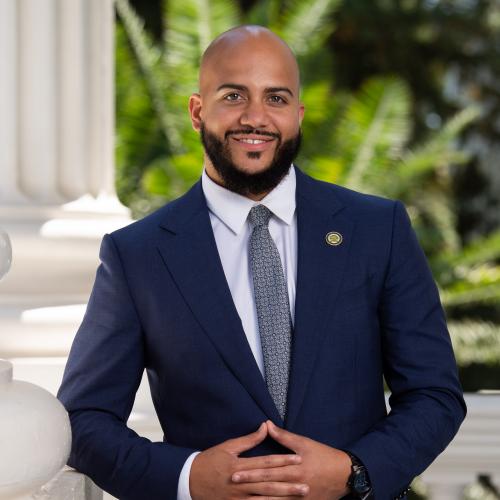
Asm. Isaac Bryan
Total votes
17,249
all sessions
Attendance
93%
744 missed
Near the chamber average
With party
99%
of cast votes
Near the chamber average
Bipartisan score
0%
crosses aisle rarely
Near the chamber average
Sponsored
1,230
bills & resolutions
Near the chamber average
Committees
12
assignments
1,230 bills and resolutions
Sponsored bills
Total
1,230
Primary
117
Co-sponsor
1,113
This page
1,230
matching current filters
Passed Jan 16, 2024
1 co-sponsor
Short-term lodging: advertising: rates.
Existing law makes it unlawful for any owner or operator of a motel, motor court, or like establishment to post or maintain outdoor advertising signs relating to room rates that has any untrue, misleading, false, or fraudulent representations, and specified other requirements on outdoor signs for those establishments. Existing law also prohibits an owner or operator of a hotel or motel from increasing the hotel or motel's rates upon the proclamation of a state of emergency by the President of the United States or the Governor or upon the declaration of a local emergency, as specified. This bill would prohibit a place of short-term lodging, as defined, from advertising or offering a room rate that does not include all fees or charges required to stay at the short-term lodging except taxes and fees imposed by a government on the stay, as specified. The bill would also require a place of short-term lodging to include in the total price to be paid, before the consumer reserves a stay, all taxes and fees imposed by a government on the stay. The bill would make a violation of those provisions subject to a specified civil penalty not to exceed $10,000 and would authorize an action to enforce those provisions to be brought by a city attorney, district attorney, county counsel, or the Attorney General. The bill would make the bill's provisions operative on July 1, 2024.
Signed into law Oct 13, 2023
1 co-sponsor
Fentanyl Misuse and Overdose Prevention Task Force.
Existing law, the California Uniform Controlled Substances Act, classifies controlled substances into 5 schedules and places the greatest restrictions and penalties on the use of those substances placed in Schedule I. The act classifies the drug fentanyl in Schedule II. Existing law prohibits a person from possessing for sale or purchasing for purposes of sale, specified controlled substances, including fentanyl, and provides for imprisonment in a county jail for 2, 3, or 4 years for a violation of this provision. This bill would, subject to an appropriation, establish the Fentanyl Misuse and Overdose Prevention Task Force to undertake various duties relating to fentanyl misuse, including, among others, collecting and organizing data on the nature and extent of fentanyl misuse in California and evaluating approaches to increase public awareness of fentanyl misuse. The bill would require the task force to be cochaired by the Attorney General and the State Public Health Officer, or their designees, and would specify the membership of the task force. The bill would require the first meeting of the task force to take place no later than June 1, 2024, and would require the task force to meet at least once every 2 months. The bill would require the task force to submit an interim report to the Governor and the Legislature by July 1, 2025, and would require the task force to report its findings and recommendations to the Governor and the Legislature by December 1, 2025. The bill would repeal these provisions on January 1, 2026. This bill would declare that it is to take effect immediately as an urgency statute.
Signed into law Oct 13, 2023
1 co-sponsor
Individuals with disabilities: The Dignity for All Act.
Existing law includes the terms "mentally retarded persons," "mentally retarded children," "retardation," and "handicap." This bill, The Dignity for All Act, would make nonsubstantive changes to those provisions to eliminate this obsolete terminology. The bill would repeal obsolete provisions of law.
Signed into law Oct 13, 2023
1 co-sponsor
Tenancy: security deposits.
Existing law regulates the terms and conditions of residential tenancies, and prohibits a landlord from demanding or receiving security for a rental agreement for residential property, however denominated, in an amount or value in excess of an amount equal to 2 months' rent, in the case of unfurnished residential property, and an amount equal to 3 months' rent, in the case of furnished residential property, in addition to any rent for the first month paid on or before initial occupancy. This bill would, beginning July 1, 2024, instead prohibit a landlord from demanding or receiving security for a rental agreement for residential property in an amount or value in excess of an amount equal to one month's rent, regardless of whether the residential property is unfurnished or furnished, in addition to any rent for the first month paid on or before initial occupancy. The bill, unless the prospective tenant is a service member, as defined, would prohibit a landlord from demanding or receiving security for a rental agreement for residential property in an amount or value in excess of 2 months' rent, in addition to any rent for the first month, if the landlord (1) is a natural person or a limited liability corporation in which all members are natural persons and (2) owns no more than 2 residential rental properties that collectively include no more than 4 dwelling units offered for rent.
Signed into law Oct 11, 2023
1 co-sponsor
The Political Reform Act of 1974: Fair Political Practices Commission: political reform education program.
The Political Reform Act of 1974 provides for the comprehensive regulation of campaign financing, including requiring the reporting of campaign contributions and expenditures and imposing other reporting and recordkeeping requirements on campaign committees. Under existing law, the Fair Political Practices Commission has primary responsibility for the impartial, effective administration and implementation of the Political Reform Act of 1974. Existing law makes a knowing or willful violation of the Political Reform Act of 1974 a misdemeanor and subjects offenders to criminal penalties. Under existing law, a person who files an original statement or report after a deadline imposed by the Political Reform Act of 1974 is liable in the amount of $10 per day after the deadline until the statement or report is filed, as specified. Existing law authorizes a filing officer to not impose this liability if the officer determines that the late filing was not willful and that enforcement of the liability will not further the purposes of the act, except as specified. Existing regulation directs the commission to develop a diversion program to allow for the education of a person who commits a minor violation of the act, as specified. This bill would authorize the commission to establish and administer a political reform education program as an alternative to an administrative proceeding, as specified. The bill would establish eligibility requirements for the political reform education program, including that the person has little or no experience with the act and that the violation resulted in minimal or no public harm. If a person meets the requirements to participate in the political reform education program and completes the program, this bill would exempt the person from administrative, civil, or criminal penalties for the applicable violation of the Political Reform Act of 1974, as specified. The bill would authorize the commission to impose additional eligibility requirements for participation in the program. The bill would authorize the commission to charge a fee to program participants in an amount not to exceed the reasonable cost to administer the political reform education program. The bill would require the fee be paid to the General Fund. The bill would express the intent of the Legislature to appropriate funds annually to the commission to administer the political reform education program. The bill would prohibit a filing officer from imposing the $10 per day liability if the person who filed the late report or statement was unable to timely file due to serious illness or hospitalization or if the person completes the political reform education program, as specified. The Political Reform Act of 1974, an initiative measure, provides that the Legislature may amend the act to further the act's purposes upon a 23 vote of each house of the Legislature and compliance with specified procedural requirements. This bill would declare that it furthers the purposes of the act. This bill would declare that it is to take effect immediately as an urgency statute.
Signed into law Oct 10, 2023
1 co-sponsor
Juveniles: transfer to court of criminal jurisdiction.
Existing law, as amended by the Public Safety and Rehabilitation Act of 2016, enacted by Proposition 57 at the November 8, 2016, statewide general election, authorizes the district attorney to make a motion to transfer a minor from juvenile court to a court of criminal jurisdiction in a case in which a minor is alleged to have committed a felony when the minor was 16 years of age or older, or in a case in which a specified serious offense is alleged to have been committed by a minor when the minor was 14 or 15 years of age, but the minor was not apprehended prior to the end of juvenile court jurisdiction. The act may be amended by a majority vote of the members of each house of the Legislature if the amendments are consistent with and further the intent of the act. Existing law requires the court to find by clear and convincing evidence that the minor is not amenable to rehabilitation when under the jurisdiction of the juvenile court, after consideration of specified criteria, in order to find that the minor should be transferred to a court of criminal jurisdiction, and requires the order reciting the court's basis for its decision to transfer jurisdiction to include the reasons supporting the court's finding that the minor is not amenable to rehabilitation while under the jurisdiction of the juvenile court. Existing law allows the court, in evaluating these criteria, to give weight to any relevant factor. This bill would make consideration of any relevant factor mandatory and would specify additional factors that the juvenile court is required to consider when evaluating the minor's criminal sophistication when determining whether to transfer a matter to a court of criminal jurisdiction. The bill would require the court to consider evidence offered that indicates that the person against whom the minor is accused of committing an offense trafficked, sexually abused, or sexually battered the minor when considering the circumstances and gravity of the offense alleged in the petition to have been committed by the minor. The bill would require the juvenile court to retain the minor in its custody if the court receives evidence that the person against whom the child is accused of committing the offense trafficked, sexually abused, or sexually battered the minor before the commission of the offense, unless the court finds by clear and convincing evidence that the person had not trafficked, sexually abused, or sexually battered the minor. Existing law authorizes a person whose case was transferred from juvenile court to a court of criminal jurisdiction to file a motion to return the case to juvenile court for disposition under specified circumstances, including, among others, when the person is convicted at trial only of an offense that was not the basis for transfer from juvenile court to the criminal court, as specified. The bill would require a court of criminal jurisdiction to return a case to juvenile court for disposition pursuant to these provisions if the court receives evidence that the person against whom the minor is accused of committing an offense trafficked, sexually abused, or sexually battered the minor prior to, or during commission of the alleged offense, unless the court finds, by clear and convincing evidence, that the person had not trafficked, sexually abused, or sexually battered the minor. By increasing the number of minors that may be retained under the jurisdiction of the juvenile court, thereby increasing the number of minors who are entitled to county-funded rehabilitative services, this bill would impose a state-mandated local program. The California Constitution requires the state to reimburse local agencies and school districts for certain costs mandated by the state. Statutory provisions establish procedures for making that reimbursement. This bill would provide that no reimbursement is required by this act for a specified reason.
Signed into law Oct 10, 2023
1 co-sponsor
Public postsecondary education: course materials.
Existing law requires each campus of the California Community Colleges and the California State University, and requests each campus of the University of California, to clearly highlight the courses that exclusively use digital course materials, as specified, and clearly communicate to students that the course materials for these courses are free of charge and therefore not required to be purchased. This bill would, commencing July 1, 2024, require each campus of the California Community Colleges and the California State University, and request each campus of the University of California, to prominently display the estimated costs for each course of all required course materials and fees directly related to those materials, for no less than an annually increasing percentage, up to 75% by January 1, 2028, of the total number of courses on the online campus course schedule for which a faculty member or course instructor has been assigned. The bill would define, for purposes of this requirement, "course materials" to include digital or physical textbooks, devices such as calculators and remote attendance platforms, and software subscriptions. By imposing new duties on community college districts, the bill would impose a state-mandated local program. The California Constitution requires the state to reimburse local agencies and school districts for certain costs mandated by the state. Statutory provisions establish procedures for making that reimbursement. This bill would provide that, if the Commission on State Mandates determines that the bill contains costs mandated by the state, reimbursement for those costs shall be made pursuant to the statutory provisions noted above.
Signed into law Oct 10, 2023
1 co-sponsor
Crime: witnesses and informants.
Existing state law requires, upon request by specified persons, that a certifying official from a certifying entity, as defined, certify "victim helpfulness" or "victim cooperation" on specified federal supplemental forms relating to immigration when the person was a victim of a qualifying criminal activity or human trafficking, and has, is, or is likely to be helpful or cooperative regarding the investigation or prosecution of that qualifying criminal activity, as specified. This bill would specify that a person submitting those forms does not have to be present in the United States at the time of filing, and would require the certifying entity to forward the form to the victim or other specified individuals without requiring the victim to provide government-issued identification. The bill would require a certifying entity that does not certify the form regarding "victim helpfulness" to provide a written explanation for the denial of the certification. The bill would require a certifying entity to certify that form for direct victims, indirect victims, and bystander or witness victims, as specified. The bill would prohibit a certifying entity from refusing to complete either of those forms for specified reasons, including, among others, the informant's criminal history information or immigration history. The bill would require the certifying entities to process those forms within 7 days if the victim asserts a qualifying family member of the victim will lose eligibility for specified immigration statuses within 60 days. By imposing additional duties on local law enforcement, this bill would impose a state-mandated local program. Existing federal law provides a petition form to request temporary immigration benefits for a person who is a witness or informant, as specified. This bill would authorize a certifying official from a certifying entity, as defined, to certify that a person is a witness or informant on that federal petition form when the person is an informant with reliable information about an important aspect of a crime or pending commission of a crime, the person is willing to share that information with law enforcement officials or become a witness in court, and the person's presence in the United States is important and leads to the successful investigation or prosecution of that crime. The California Constitution requires the state to reimburse local agencies and school districts for certain costs mandated by the state. Statutory provisions establish procedures for making that reimbursement. This bill would provide that, if the Commission on State Mandates determines that the bill contains costs mandated by the state, reimbursement for those costs shall be made pursuant to the statutory provisions noted above.
Signed into law Oct 10, 2023
1 co-sponsor
Ask Maddy
·
AI policy assistant
Ask Maddy about Isaac Bryan
Scope: california
Hi! I can help you understand Isaac Bryan's legislative record. What would you like to know?
Try one of these
i
Maddy answers using official bill text and legislative records. Always verify before sharing.
Sources cited inline