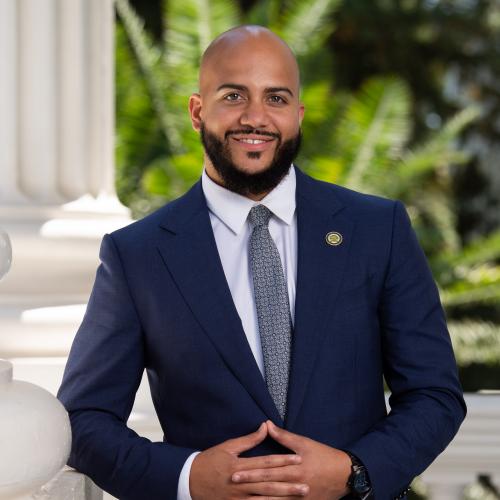
Photo of Isaac Bryan
D California Assembly · District 55 On the 2026 ballot

Asm. Isaac Bryan

Compare
Total votes
17,249
all sessions
Attendance
93%
744 missed
Near the chamber average
With party
99%
of cast votes
Near the chamber average
Bipartisan score
0%
crosses aisle rarely
Near the chamber average
Sponsored
1,230
bills & resolutions
Near the chamber average
Committees
12
assignments
1,230 bills and resolutions

Sponsored bills

Total
1,230
Primary
117
Co-sponsor
1,113
This page
1,230
matching current filters
Co-sponsor AB 855
Failed · California Assembly · Co-sponsor
Criminal procedure: fines, fees, and restitution.

The California Constitution entitles the victim of a crime to restitution. Existing law requires the court in each criminal case to order a convicted defendant to pay restitution, as specified. Existing law requires the order of restitution to include interest at the annual rate of 10%. Under existing law, certain delinquent payments, including payments for fines, fees, and restitution, may be referred to the Franchise Tax Board for collection. Existing law imposes interest on these delinquent payments. This bill would change the annual interest rate on restitution orders and the annual interest rate charged by the Franchise Tax Board on certain delinquent payments, including fines, fees, and restitution, to no more than 1%.

Failed Feb 1, 2024 1 co-sponsor
Primary AB 61
died · California Assembly · Lead sponsor
Criminal procedure: arraignment.

Existing law requires a person, once arrested, to be taken before a magistrate without delay and, in any event, within 48 hours after arrest, not including weekends and holidays, as specified. This bill would remove the weekends and holidays exemption, thereby requiring a person to be taken before the court within 48 hours of their arrest, or to be released, except that if the 48-hour period expires at a time that the court is in session, the arraignment can occur anytime that day. Existing law requires a person arrested without a warrant to be taken before the nearest magistrate in the county in which the offense is triable without delay. Existing law also authorizes a peace officer to release the arrested person from custody instead of taking them before a magistrate under certain specified circumstances, including if the person was arrested for intoxication only. This bill would require the person to be taken before the magistrate within 48 hours of their arrest. This bill would require that the court make an initial determination of probable cause, as specified, no more than 48 hours after the warrantless arrest. The bill would also require that if the court makes an initial finding of no probable cause, the court order the person to be released immediately. Existing law similarly requires a juvenile that has been arrested to be released with 48 hours, excluding judicial holidays, unless a petition has been filed to make the minor a ward of the court or charges have been filed charging the minor as an adult. This bill would remove the judicial holidays exemption and the petition exemption and would instead prohibit any juvenile from being held more than 48 hours if they did not receive an initial judicial determination of probable cause. By imposing a higher level of service on prosecutors, public defenders, police, jails, and courthouses, this bill would impose a state-mandated local program. The California Constitution requires the state to reimburse local agencies and school districts for certain costs mandated by the state. Statutory provisions establish procedures for making that reimbursement. This bill would provide that, if the Commission on State Mandates determines that the bill contains costs mandated by the state, reimbursement for those costs shall be made pursuant to the statutory provisions noted above.

died Feb 1, 2024 0 co-sponsors
Primary AB 745
Failed · California Assembly · Lead sponsor
Reentry Housing and Workforce Development Program.

Existing law establishes the Department of Housing and Community Development in the Business, Consumer Services, and Housing Agency and makes the department responsible for administering various housing programs throughout the state, including, among others, the Multifamily Housing Program, the Housing for a Healthy California Program, and the California Emergency Solutions Grants Program. Upon appropriation by the Legislature for this express purpose, this bill would require the department to create the Reentry Housing and Workforce Development Program, and would require the department to take specified actions to provide grants to applicants, as defined, for innovative or evidence-based housing, housing-based services, family reunification services, women services, and employment interventions to allow people with recent histories of incarceration to exit homelessness and remain stably housed. The bill would require the department to establish a process, in collaboration with the Department of Corrections and Rehabilitation and with counties in which recipients are operating, for referral of participants, in accordance with certain guidelines and procedures. The bill would require the department to score applicants to the program competitively according to specified criteria. The bill would require recipients of funds from the program to use those funds for, among other things, long-term rental assistance in permanent housing, incentives to landlords, and innovative or evidence-based services to assist participants in accessing permanent supportive housing. The bill would require the department to distribute funds allocated by executing contracts with awarded entities for a term of 5 years, subject to automatic renewal. The bill would require a recipient of the program to submit an annual report to the department. The bill would require the department to hire an independent evaluator to assess outcomes from the program and would require the department to submit the analysis of that assessment to specified committees of the Legislature.

Failed Feb 1, 2024 0 co-sponsors
Co-sponsor AB 963
Failed · California Assembly · Co-sponsor
The End the Foster Care-to-Homelessness Pipeline Act.

Existing law, Bergeson-Peace Infrastructure and Economic Development Bank Act, establishes the California Infrastructure and Economic Development Bank (I-Bank) in the Governor's Office of Business and Economic Development, that is governed by a board of directors. The act, among other things, authorizes the I-Bank to make loans, issue bonds, and provide financial assistance for various types of projects that qualify as economic development or public development facilities. This bill, the End the Foster Care-to-Homelessness Pipeline Act, would establish the End the Foster Care-to-Homelessness Pipeline Program within the I-Bank to guarantee qualified loans made by financial institutions to qualified nonprofit and for-profit businesses for the construction, acquisition, and renovation of housing for current and former foster youth between 18 and 25 years of age and who qualify for specified programs. The bill would authorize the bank, in determining whether to guarantee a qualified loan, to give preference to counties with high housing inelasticity and high rates of foster youth, as specified. The bill would authorize the bank to reimburse up to 80% of the guaranteed portion of principal and interest that result from a qualified loan that is in default, not to exceed $250,000,000, and would require the Controller to transfer moneys from the General Fund to the California Infrastructure and Economic Development Bank Fund, at the direction of the bank, for that purpose. By requiring the Controller to transfer moneys into a continuously appropriated fund, the bill would make an appropriation.

Failed Feb 1, 2024 1 co-sponsor
Co-sponsor AB 1497
Failed · California Assembly · Co-sponsor
Criminal procedure.

(1) Existing law, in a criminal trial, allows evidence of mental disease, mental defect, or mental disorder solely for the issue of whether or not the accused actually formed a required specific intent, premeditated, deliberated, or harbored malice aforethought, when a specific intent crime is charged. This bill would instead allow that evidence for the issue of whether or not the accused actually formed the required mental state for the crime that is charged, including whether or not the accused committed a willful act, premeditated, deliberated, harbored malice aforethought, acted knowingly, acted maliciously, or acted with conscious disregard for human life. (2) Existing law allows a person who was arrested or convicted of a nonviolent offense while they were a victim of human trafficking, intimate partner violence, or sexual violence, to petition the court, under penalty of perjury, for vacatur relief. To receive that relief, existing law requires that the person establish, by clear and convincing evidence, that the arrest or conviction was the direct result of being a victim of human trafficking, intimate partner violence, or sexual violence, which demonstrates that the person lacked the requisite intent to commit the offense. Existing law requires the court, under those circumstances, to find that the person lacked the requisite intent to commit the offense and to vacate the conviction as invalid due to legal defect at the time of the arrest or conviction. This bill would allow that relief for a person arrested or convicted of any offense. By expanding the scope of the crime of perjury, this bill would impose a state-mandated local program. (3) Existing law creates an affirmative defense against a charge of a crime that the person was coerced to commit the offense as a direct result of being a victim of human trafficking, intimate partner violence, or sexual violence at the time of the offense and when the person had reasonable fear of harm. Existing law prohibits this defense from being used with respect to a violent felony, as defined. This bill would allow that defense to be used with respect to a violent felony. (4) If a court issues an order for a person who was arrested or convicted of an offense while they were a victim of intimate partner violence or sexual violence, existing law requires the court to order the law enforcement agency having jurisdiction over the offense, the Department of Justice, and any law enforcement agency that arrested the petitioner or participated in the arrest of the petitioner to seal their records of the arrest and the court order to seal and destroy the records within 3 years from the date of the arrest, or within one year after the court order is granted, whichever occurs later, and thereafter to destroy their records of the arrest and the court order to seal and destroy those records. This bill would require the court to also order any law enforcement agency that has taken action or maintains records because of the offense, including, but not limited to, departments of probation, rehabilitation, corrections, and parole, to seal and destroy their records. The bill would require the agencies mentioned above to seal their records of arrest and court order to seal and destroy the records within one year from the date of arrest, or within 90 days after the court order is granted, whichever occurs later. The bill would require the agencies to destroy these records within one year of the date of the court order. The bill would also require the Department of Justice to notify the petitioner and the petitioner's counsel that the department has complied with the order to seal the arrest records by the applicable deadline. (5) Existing law requires the court, when a judgment of imprisonment is imposed and specifies 3 possible terms, to impose the middle term unless there are circumstances in aggravation or mitigation of the crime. Existing law requires the court to order imposition of a lower term if the person has experienced psychological, physical, or childhood trauma, is or was a youth, as defined, at the time of the commission of the offense, or was a victim of intimate partner violence or human trafficking, unless the aggravating circumstances so far outweigh the mitigating circumstances that the imposition of the lower term would be contrary to the interests of justice. This bill would require the court, when deciding whether the aggravating circumstances outweigh the mitigating circumstances, to only consider those aggravating circumstances that have been stipulated to by the defendant, or have been found true beyond a reasonable doubt at trial by the jury or by the judge in a court trial. The bill would require the court, except in specified circumstances, to, upon the request of the defendant, bifurcate the trial on the circumstances in aggravation from the trial of charges and enhancements. (6) Existing law requires a person convicted of 2 or more felonies to be sentenced to an aggregate term of imprisonment for all convictions at a sum of the principal term, the subordinate term, and any additional term imposed for applicable enhancements, prior convictions, and prior prison terms. Under existing law, a principal term consists of the greatest term of imprisonment imposed by the court for any of the crimes, including any term imposed for applicable enhancements. Under existing law, the subordinate term for each consecutive offense is 1/3 of the middle term of imprisonment prescribed for each other felony conviction for which a consecutive term of imprisonment is imposed, including 1/3 of the term imposed for any specific enhancements applicable to those subordinate offenses. This bill would, unless contrary to the interests of justice, prohibit a court from imposing consecutive terms for 2 or more felonies if the person has experienced psychological, physical, or childhood trauma, is or was a youth at the time of the commission of the offense, or was a victim of intimate partner violence or human trafficking prior to the instant offense, or at the time of the commission of the offense. (7) Existing law imposes various sentence enhancements, consisting of additional and consecutive terms of imprisonment. This bill would prohibit a court, unless contrary to the interests of justice, from imposing a term of imprisonment for any sentence enhancement if the person has experienced psychological, physical, or childhood trauma, is or was a youth at the time of the commission of the offense, or was a victim of intimate partner violence or human trafficking prior to the instant offense, or at the time of the commission of the offense. (8) The California Constitution requires the state to reimburse local agencies and school districts for certain costs mandated by the state. Statutory provisions establish procedures for making that reimbursement. This bill would provide that no reimbursement is required by this act for a specified reason.


Failed Feb 1, 2024 1 co-sponsor
Co-sponsor SB 838
In committee · California Senate · Co-sponsor
Victim compensation: use of force by a law enforcement officer.

Existing law provides for the compensation of victims and derivative victims of specified types of crimes by the California Victim Compensation Board from the Restitution Fund, a continuously appropriated fund, for specified losses suffered as a result of those crimes. Existing law defines various terms for purposes of these provisions, including "crime," which includes any public offense wherever it may take place that would constitute a misdemeanor or felony. This bill would revise the definition of "crime" to include, solely for the purposes of eligibility for compensation under this chapter, an incident occurring on or after January 1, 2024, in which an individual sustains serious bodily injury, as defined, or death as a result of a law enforcement officer's use of force, regardless of whether the law enforcement officer is arrested for, charged with, or convicted of committing a crime. The bill would define "law enforcement officer" for these purposes. By expanding the types of incidents for which compensation can be paid from a continuously appropriated fund, the bill would make an appropriation. Existing law requires that a person be ineligible for compensation under specified conditions, including, among other things, if the board determines that denial of the claim for compensation is appropriate because of the nature of the victim's involvement in the events leading to the crime or the involvement of the person whose injury or death gives rise to the application. Existing law requires the board to deny an application if it finds that the victim failed to cooperate reasonably with a law enforcement agency in the apprehension and conviction of the person committing the crime. This bill, in the case of a claim based on a victim's serious bodily injury or death that resulted from a law enforcement officer's use of force, as described above, would prohibit the board from denying an application based on certain circumstances, including the victim's or other applicant's involvement in the crime, except as specified, the victim's failure to cooperate, or the contents of a police report, or the lack thereof. The bill, in the case of a claim based on a victim's serious bodily injury or death as a result of a crime, would require the board to adopt guidelines that allow the board to rely on evidence other than a police report, as specified. Existing law requires that the board be subrogated to the rights of the recipient to the extent of any compensation granted by the board. This bill would specify that the above-described subrogation of the board applies to compensation by the board for any claim, including a claim based on serious bodily injury or death that resulted from a law enforcement officer's use of force.

In committee Feb 1, 2024 1 co-sponsor
Primary AB 1036
Failed · California Assembly · Lead sponsor
Health care coverage: emergency medical transport.

Existing law, the Knox-Keene Health Care Service Plan Act of 1975, provides for the licensure and regulation of health care service plans by the Department of Managed Health Care and makes a willful violation of the act a crime. Existing law provides for the regulation of health insurers by the Department of Insurance. Existing law generally requires a health care service plan contract or large group health insurance policy to provide an enrollee or insured with basic health care services, which include emergency health care services. Existing law prohibits a health care service plan that provides basic health care services from requiring prior authorization or refusing to pay for an ambulance or ambulance transport services if the request was made for an emergency medical condition and the services were required or if an enrollee reasonably believed the medical condition was an emergency that required ambulance transport services. Existing law requires a policy of disability insurance issued, amended, delivered, or renewed in this state on or after January 1, 1999, that provides hospital, medical, or surgical coverage with coverage for emergency health care services to include coverage for emergency medical transportation services without regard to whether or not the emergency provider contracts with the insurer or to prior authorization. Existing law establishes the Medi-Cal program, which is administered by the State Department of Health Care Services and under which qualified low-income individuals receive health care services. The Medi-Cal program is, in part, governed and funded by federal Medicaid program provisions. Existing law establishes a schedule of benefits under the Medi-Cal program, including various emergency medical services. This bill would require a physician, upon an individual's arrival to an emergency department of a hospital, to certify in the treatment record whether an emergency medical condition existed, or was reasonably believed to have existed, and required emergency medical transportation services, as specified. This bill would, if a physician has certified that emergency medical transportation services according to these provisions, require a health care service plan, disability insurance policy, and Medi-Cal managed care plan, to provide coverage for emergency medical transport, consistent with an individual's plan or policy. The bill would specify that the indication by a physician pursuant to these provisions is limited to an assessment of the medical necessity of the emergency medical transport services, and does not apply or otherwise impact provisions regarding coverage for care provided following completion of the emergency medical transport. The bill would specify for Medi-Cal benefits, these provisions do not apply to various specified provisions relating to nonemergency transport services or any other law or regulation related to reimbursement or authorization requirements for services provided for emergency services and care. The California Constitution requires the state to reimburse local agencies and school districts for certain costs mandated by the state. Statutory provisions establish procedures for making that reimbursement. This bill would provide that no reimbursement is required by this act for a specified reason.
Failed Feb 1, 2024 0 co-sponsors
Primary AB 819
Vetoed · California Assembly · Lead sponsor
Crimes: public transportation: fare evasion.

Existing law makes it a crime, punishable as an infraction and subsequently as a misdemeanor, for an adult to evade payment of a fare of a public transportation system, the misuse of a transfer, pass, ticket, or token with the intent to evade the payment of a fare, or the unauthorized use of a discount ticket, as specified. Under existing law, a 3rd or subsequent violation of fare evasion or other listed associated violations is a misdemeanor and punishable by a fine of up to $400 or by imprisonment in a county jail for a period of not more than 90 days, or both. This bill would no longer categorize as a misdemeanor a 3rd or subsequent violation, by an adult, of evading the payment of a fare of a public transportation system, the misuse of a transfer, pass, ticket, or token with the intent to evade the payment of a fare, or the unauthorized use of a discount ticket, and would make a 3rd or subsequent violation punishable only by a fine of up to $400.

Vetoed Feb 1, 2024 0 co-sponsors
Primary AB 1224
Failed · California Assembly · Lead sponsor
Workforce development: green jobs survey.

Existing law establishes the Labor and Workforce Development Agency in state government under the supervision of an executive officer known as the Secretary of Labor and Workforce Development. Existing law charges the agency with various duties relating to coordinating workforce programs and overseeing specified departments, boards, and panels, including the Employment Development Department and the California Workforce Development Board. Existing law establishes the California Workforce Development Board, formerly named the California Workforce Investment Board, as the body responsible for assisting the Governor in the development, oversight, and continuous improvement of California's workforce investment system and the alignment of the education and workforce investment systems to the needs of the 21st century economy and workforce. Existing law requires the board to establish a committee known as the Green Collar Jobs Council to, among other things, consult with other state agencies, higher education representatives, local workforce investment boards, industry representatives, and specified others in the development of a strategic initiative relating to the training and development of a skilled workforce to meet the needs of California's emerging green economy. This bill would require the Labor Market Information Division of the Employment Development Department to conduct, upon appropriation by the Legislature, a green jobs survey, as specified, to gather information about statewide green job industry strengths. The bill would require the division to create a standard operating definition of "green job" based on the results of the survey for the purpose of employment in California, as described. The bill would require the California Workforce Development Board to incorporate the survey's findings into education outreach, as specified, and would require the Workforce Services Branch of the Employment Development Department to incorporate the survey's findings into appropriate communications or educational materials relating to job opportunities for persons seeking employment.

Failed Feb 1, 2024 0 co-sponsors
Primary AB 1683
died · California Assembly · Lead sponsor
Child welfare agencies: enforcement.

Existing law requires the State Department of Social Services to promulgate regulations for county child welfare departments, including, but not limited to, any case of separation or desertion of a parent from a child that results in foster care assistance payments, payments for a minor child placed in the same home as a minor or nonminor dependent parent, and California Work Opportunity and Responsibility to Kids (CalWORKs) payments to a caretaker relative of a child who comes within the jurisdiction of the juvenile court. This bill would make technical, nonsubstantive changes to these provisions.

died Feb 1, 2024 0 co-sponsors
Showing 641 to 650 of 1,230 bills
Previous 1 … 64 65 66 … 123 Next