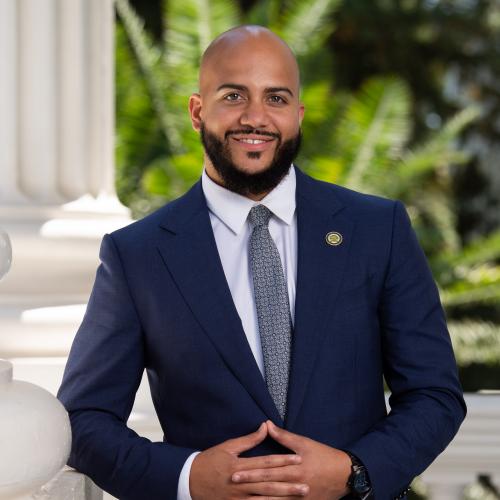
Photo of Isaac Bryan
D California Assembly · District 55 On the 2026 ballot

Asm. Isaac Bryan

Compare
Total votes
17,249
all sessions
Attendance
93%
744 missed
Near the chamber average
With party
99%
of cast votes
Near the chamber average
Bipartisan score
0%
crosses aisle rarely
Near the chamber average
Sponsored
1,230
bills & resolutions
Near the chamber average
Committees
12
assignments
1,230 bills and resolutions

Sponsored bills

Total
1,230
Primary
117
Co-sponsor
1,113
This page
1,230
matching current filters
Co-sponsor SCR 156
Signed into law · California Senate · Co-sponsor
Relative to National Stroke Awareness Month.

Maddy summaryThis bill designates the month of May 2026 as National Stroke Awareness Month. The primary effect is to officially recognize this time period for public education and awareness campaigns regarding stroke prevention and treatment. It does not alter laws, allocate funding, or impose new requirements on individuals or organizations. The measure serves as a symbolic gesture to highlight the importance of stroke awareness during the specified month.

Signed into law Jun 5, 2026 1 co-sponsor
Co-sponsor AJR 18
Passed · California Assembly · Co-sponsor
Recognition of the historical wrongdoing committed against California Native Americans.

This measure would recognize the historical wrongdoing committed against California Native Americans and urge the federal government to work alongside tribal leaders to address historic injustices, uphold treaty obligations, and ensure equitable access to resources, healthcare, education, and environmental stewardship.

Passed Jun 4, 2026 1 co-sponsor
Primary AB 1768
Signed into law · California Assembly · Lead sponsor
Transactions and use taxes: Counties of Contra Costa and Los Angeles.

Existing law authorizes various local governmental entities, subject to certain limitations and approval requirements, to levy a transactions and use tax for general or specific purposes, in accordance with the procedures and requirements set forth in the Transactions and Use Tax Law, including a requirement that the combined rate of all taxes that may be imposed in accordance with that law in any county not exceed 2%. This bill would authorize, until December 31, 2031, the County of Los Angeles, by an ordinance adopted by the county, to levy a tax pursuant to the Transactions and Use Tax Law at a rate not to exceed 0.5% for general and special purposes, subject to voter approval, as specified. The bill would also authorize, until December 31, 2031, the County of Contra Costa, by an ordinance adopted by the county, to levy a tax pursuant to the Transactions and Use Tax Law at a rate not to exceed 0.625% for general or specific purposes, subject to voter approval, as specified. The bill would authorize those taxes to exceed the 2% limit described above. This bill would make legislative findings and declarations as to the necessity of a special statute for the Counties of Contra Costa and Los Angeles. This bill would declare that it is to take effect immediately as an urgency statute.

Signed into law Jun 1, 2026 0 co-sponsors
Co-sponsor SCR 164
Signed into law · California Senate · Co-sponsor
Relative to Black Health Equity Advocacy Week.

This measure would recognize May 4, 2026, to May 8, 2026, inclusive, and every first full week of May thereafter, as Black Health Equity Advocacy Week and commend the California Black Health Network and other organizations throughout the state for their efforts to improve the health, well-being, and life expectancy of Black Californians.

Signed into law May 29, 2026 1 co-sponsor
Co-sponsor AB 2729
In committee · California Assembly · Co-sponsor
Medi-Cal: Employer Responsibility for Medi-Cal Trust Fund.

Existing law establishes the Medi-Cal program, which is administered by the State Department of Health Care Services and under which qualified low-income individuals receive health care services. The Medi-Cal program is in part governed by, and funded pursuant to, federal Medicaid program provisions. Existing federal law, Public Law 119-21, enacted on July 4, 2025, sets forth various changes to different health care programs, including certain requirements for Medicaid eligibility with regard to work or community engagement reporting, redeterminations, and cost sharing, among other factors, for certain Medicaid populations pursuant to a specified implementation timeline. Existing law, the federal Patient Protection and Affordable Care Act, imposes a certain assessment on an applicable large employer, as defined, that offers full-time employees and their dependents the opportunity to enroll in minimum essential coverage, and for whom one or more full-time employees have been certified as having enrolled in a qualified health plan for which a premium tax credit or cost-sharing reduction is allowed or paid. This bill would create the Employer Responsibility for Medi-Cal Trust Fund to consist of new taxes and deposits, including employer penalties specified in the Budget Act of 2026. The bill would continuously appropriate moneys in the fund to the department to fund the costs of administering the Medi-Cal program in a manner necessary to prevent loss of or to restore health care coverage, benefits, or access to care following the passage of Public Law 119-21 and subsequent state budget actions. The bill would state that these provisions would become operative only if the Medicaid provisions of Public Law 119-21 are not repealed prior to January 1, 2027. By creating a continuously appropriated fund, the bill would make an appropriation. This bill would declare that it is to take effect immediately as an urgency statute.

In committee May 19, 2026 1 co-sponsor
Co-sponsor ACR 141
Signed into law · California Assembly · Co-sponsor
Relative to Vesak Day.

This measure would recognize the significance of Vesak Day to people of Buddhist faith and extend sincere best wishes to the state's Buddhist community in celebrating Vesak Day.

Signed into law May 18, 2026 1 co-sponsor
Co-sponsor HR 111
Passed · California Assembly · Co-sponsor
Relative to International Day Against Homophobia, Biphobia, Interphobia, and Transphobia.

Maddy summaryThis House Resolution recognizes May 17, 2026, as the International Day Against Homophobia, Biphobia, Interphobia, and Transphobia within the California Legislature. The measure formally acknowledges the ongoing discrimination faced by LGBTQ+ individuals globally and reaffirms the state's commitment to equality and civil rights. By adopting this resolution, the Assembly encourages all Californians to support inclusive practices and stand against hate toward the LGBTQ+ community.

Passed May 18, 2026 1 co-sponsor
Primary AB 2114
In committee · California Assembly · Lead sponsor
Public postsecondary education: nonresident tuition fee exemption: educational asylum program.

Existing law establishes the California Community Colleges, under the administration of the Board of Governors of the California Community Colleges, the California State University, under the administration of the Trustees of the California State University, and the University of California, under the administration of the Regents of the University of California, as the 3 segments of public postsecondary education in the state. Existing law establishes uniform residency requirements for purposes of ascertaining the amount of tuition and fees to be paid by students of public postsecondary educational institutions. Existing law requires a student classified as a nonresident to pay nonresident tuition, in addition to other fees required by the institution, except as provided. These provisions apply to the University of California only to the extent that the regents, by appropriate resolution, make them applicable. This bill would authorize a participating public postsecondary educational institution to administer an educational asylum program, in collaboration with the Regents of the University of California, the Trustees of the California State University, and the Board of Governors of the California Community Colleges. The bill would require a participating institution to grant educational asylum status to a transfer student who meets specified requirements, including residing in a restricted state, as defined. The bill, commencing with the 2027–28 school year, would exempt a transfer student who is granted educational asylum status from paying nonresident tuition at a participating institution and would require the transfer student to only pay resident tuition and fees.

In committee May 14, 2026 0 co-sponsors
Co-sponsor AB 1861
In committee · California Assembly · Co-sponsor
Special education: public complaint database.

Existing law requires that every individual with exceptional needs, as defined, who is eligible, be provided with educational instruction, services, or both, at no cost to their parent or guardian or, as appropriate, to them. Under existing law, a free appropriate public education is required to be made available to individuals with exceptional needs in accordance with specified federal regulations adopted pursuant to the federal Individuals with Disabilities Education Act. Existing law requires the State Department of Education to investigate a complaint alleging a violation of the act and to issue a written decision within 60 days of the complaint being filed, as provided. This bill would require the department, on or before January 1, 2030, to create, or contract to create, and maintain a publicly available online aggregate database of all complaints that the department receives on and after July 1, 2027, that allege a violation of the federal law described above. The bill would require the database to include specified data for each complaint, including, among other things, the total number of complaints the department investigated disaggregated by school district, county office of education, or charter school. After the database has been created, the bill would require the department to ensure that the data required to be included in the database is updated and published on or before December 31 of each year.

In committee May 14, 2026 1 co-sponsor
Co-sponsor AB 1790
In committee · California Assembly · Co-sponsor
Corporations Tax Law: water's-edge election: global intangible low-taxed income.

The Corporation Tax Law imposes on every corporation doing business in the state, as defined, a tax according to or measured by net income and, in the case of a corporation with income derived from or attributable to sources both within and without this state, apportions the income between this state and other states and foreign countries in accordance with a single sales formula based on the sales within and without this state, except that in the case of an apportioning trade or business that derives more than 50% of its gross business receipts from conducting one or more qualified business activities, as defined, business income is apportioned in accordance with a specified 3-factor formula. Existing federal law, for purposes of determining a taxpayer's gross income for federal income tax purposes, requires that a person who is a United States shareholder of any controlled foreign corporation, as defined, to include in their gross income the net CFC tested income, as provided. The Corporation Tax Law, for taxable years beginning on or after January 1, 2003, for purposes of determining income derived from or attributable to sources within this state, allows corporations to make a statutory election as to whether their income is determined on a "water's-edge" basis or on a worldwide unitary basis. Under existing law, the election to report income on a water's-edge basis remains in effect until terminated, and provides conditions for the termination of the election. This bill, for taxable years beginning on or after January 1, 2026, would require a taxpayer that files on a water's-edge basis to account for net CFC tested income within the water's-edge group, as provided. The bill would require a taxpayer that files on a water's-edge basis to include all income and apportionment factors of any corporation, other than a bank, whose sales factor, instead of the average of 3 factors, in the United States is at least 20%. The bill would also terminate all water's-edge elections for the first taxable year beginning on or after January 1, 2028, and would not allow a taxpayer to make a water's-edge election, or file on a water's-edge basis, for taxable years beginning on or after January 1, 2028. The bill would authorize any taxpayer that has made a water's-edge election to terminate that election without the consent of the Franchise Tax Board for taxable years beginning on or after January 1, 2026, and before January 1, 2028. This bill would include a change in state statute that would result in a taxpayer paying a higher tax within the meaning of Section 3 of Article XIIIA of the California Constitution, and thus would require for passage the approval of 23 of the membership of each house of the Legislature. This bill would take effect immediately as a tax levy.


In committee May 14, 2026 1 co-sponsor
Showing 151 to 160 of 1,230 bills
Previous 1 15 16 17 123 Next