

(1) The Outdoor Advertising Act, a violation of which is a crime, provides for the regulation by the Department of Transportation of advertising displays, as defined, within view of public highways. Existing law exempts from certain provisions of the act advertising displays located in specific geographic areas in the City of Los Angeles if those displays meet prescribed conditions and requirements, including the condition that the advertising display is authorized by, or in accordance with, an ordinance adopted by the City of Los Angeles that regulates advertising displays by identifying the specific displays or establishing regulations that include, at a minimum, specified restrictions, as provided. This bill would authorize the ordinance adopted by the City of Los Angeles to authorize a framework of allowable signage that preserves flexibility in the ultimate placement, sizing, and scope of advertising displays, and define a range or maximum signage capacity, as specified. The bill would also authorize the City of Los Angeles to adopt implementing ordinances that sequence or phase the authorization of advertising displays over time. (2) This bill would declare that it is to take effect immediately as an urgency statute.
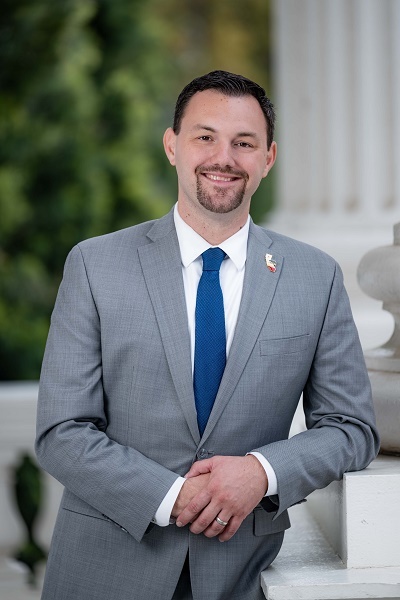
Asm. Nick Schultz
Sponsored bills
(1) Existing law prescribes the duties of the State Registrar of Vital Statistics (State Registrar) and local registrars of births and deaths with respect to the registration of certificates of live birth, fetal death, or death, and marriage licenses. Existing law requires the State Registrar to prescribe and furnish all record forms for use in carrying out the provisions governing vital records and prohibits the use of any record form or format other than those prescribed by the State Registrar. Existing law requires every live birth, fetal death, death, and marriage that occurs in the state to be registered with the local registrar. Existing law requires certificates of live birth, fetal death, or death, and a marriage license to include specified information, such as the full name of the child on a certificate of live birth and the full names of the parties to be married on a marriage license. Existing law also requires the county clerk to issue a confidential marriage license, as specified, on a form prescribed by the State Registrar. This bill would require, commencing no earlier than 2 years after an appropriation of funds by the Legislature, the State Registrar to require the use of a diacritical mark on an English letter within a name field to be properly recorded, when applicable, on a certificate of live birth, fetal death, death, marriage license and certificate, or confidential marriage license and certificate, and would require the use of a diacritical mark to be deemed an acceptable entry by the State Registrar. The bill would provide that the absence or presence of a diacritical mark on a certificate of live birth, fetal death, or death, or a marriage license and certificate or confidential marriage license and certificate does not render the document invalid nor affect any constructive notice imparted by proper recordation of the document. The bill would authorize the State Registrar to develop a list of acceptable diacritical marks for use on a certificate of live birth, fetal death, or death, or a marriage license and certificate or confidential marriage license and certificate through all-county letters or similar instructions from the State Registrar without taking further regulatory actions. The bill would authorize the State Registrar to remove any diacritical marks on the birth, fetal death, death, and marriage license and certificate data before furnishing the vital statistics to a federal, state, or local government agency. The bill would authorize, beginning July 1, 2026, if a name is not accurately recorded because of the absence of a diacritical mark on an English letter in any certificate of live birth, fetal death, death, or marriage already registered, the person asserting the omission, or the person's conservator, or if a minor, the person's parent or guardian, to make an affidavit under oath, as specified, stating the changes necessary to make the record correct. The bill would require the affidavit to be supported by the affidavit of one other person having knowledge of the facts and be filed with the State Registrar. The bill would require the State Registrar to, review the request and, if the request is accompanied with the payment of a specified fee, to issue an amendment to any certificate of live birth, fetal death, death, or marriage with the accurate name identified in the request. The bill would also authorize, if a name field of either of the parties married or their parents is not accurately recorded because of the absence of a diacritical mark on an English letter on any confidential license and certificate of marriage already registered, the party asserting the omission to make an affidavit, under oath, stating the changes necessary to make the record correct and file it with the county clerk. The bill would authorize the county clerk to charge a fee, not to exceed the amount of the fee for any other amended confidential marriage license and certificate issued by the county clerk and not to exceed the reasonable cost to provide the amended marriage license and certificate. The bill would require the county clerk to review the amendment for acceptance for filing, and if accepted, file the amendment and note the fact of the amendment, with its date, on the otherwise unaltered original confidential license and certificate of marriage. By requiring the affidavit to be under oath, the bill would expand the crime of perjury, thereby imposing a state-mandated local program. By increasing duties on county clerks, the bill would impose a state-mandated local program. (2) Existing law requires the collection of specified fees for certified copies of a fetal death record, death record, a birth certificate, marriage record, or marriage dissolution record. Existing law requires all applicants for certified copies of the above-described records to pay an additional fee of $3 to be collected by the State Registrar, the local registrar, county recorder, or county clerk, as appropriate. This bill would increase the additional fee charged for certified copies of the above-described records to $5. (3) The California Constitution requires the state to reimburse local agencies and school districts for certain costs mandated by the state. Statutory provisions establish procedures for making that reimbursement. This bill would provide that with regard to certain mandates no reimbursement is required by this act for a specified reason. With regard to any other mandates, this bill would provide that, if the Commission on State Mandates determines that the bill contains costs so mandated by the state, reimbursement for those costs shall be made pursuant to the statutory provisions noted above.
Existing law provides that a crime punishable with death, by imprisonment in the state prison, or by imprisonment in a county jail for more than one year is a felony and all other offenses, except those that are classified as infractions, are misdemeanors. Existing law further provides that a crime that is punishable, in the discretion of the court, as a felony or as a misdemeanor is a misdemeanor under certain circumstances, including when, at or before the preliminary examination or prior to a certain order being filed, the magistrate determines that the offense is a misdemeanor. This bill would instead make a crime a misdemeanor under that condition any time the court, prior to trial, determines that the offense is a misdemeanor. The bill would also require, following a denial of a motion under this provision, a subsequent motion to be made only upon a showing of changed circumstances.
Existing law authorizes the Public Utilities Commission to fix the rates and charges for public utilities, including electrical corporations and gas corporations, and requires those rates and charges to be just and reasonable. Under existing law, a regulated public utility is prohibited from using ratepayer funds for advocacy-related activities that are political or do not otherwise benefit ratepayers. This bill would prohibit, except as provided, each electrical corporation or gas corporation from recording to accounts that contain expenses that the electrical corporation or gas corporation recovers from ratepayers, or otherwise recovering from ratepayers, various expenses, including those associated with political influence activities or promotional advertising, as specified. The bill would require each electrical corporation or gas corporation to clearly and conspicuously disclose in all of its public messages whether the costs of the public messages are paid for by the corporation's shareholders or ratepayers. The bill would require each electrical corporation or gas corporation, on or before May 31, 2026, and annually thereafter, to report, as part of a specified statement to the commission, certain related information. The bill would require the commission to make the reports publicly available, as provided. This bill would require the commission to assess a civil penalty, based on the severity of the violation, against an electrical corporation or gas corporation that violates the prohibition described above, or that neglects to comply with any part or provision of any order, decision, decree, rule, direction, demand, or requirement of the commission related to implementing that prohibition, as provided. Under existing law, a violation of the Public Utilities Act or any order, decision, rule, direction, demand, or requirement of the commission is a crime. Because the above provisions would be part of the act and a violation of a commission action implementing this bill's requirements would be a crime, the bill would impose a state-mandated local program. The California Constitution requires the state to reimburse local agencies and school districts for certain costs mandated by the state. Statutory provisions establish procedures for making that reimbursement. This bill would provide that no reimbursement is required by this act for a specified reason.
Existing law makes it a crime for a person to manufacture or cause to be manufactured specified firearms. Existing law prohibits a person, other than a state-licensed firearms manufacturer, from using a computer numerical control (CNC) milling machine or three-dimensional printer to manufacture a firearm. This bill would prohibit a person from knowingly or willfully causing another person to engage in the unlawful manufacture of firearms or knowingly or willfully aiding, abetting, prompting, or facilitating the unlawful manufacture of firearms, including the manufacture of assault weapons or .50 BMG rifles or the manufacture of any firearm using a three-dimensional printer or CNC milling machine, as specified. The bill would make a violation of these provisions a misdemeanor. By creating a new crime, this bill would create a state-mandated local program. Existing law authorizes a civil action against a person who knowingly distributes or causes to be distributed any digital firearm manufacturing code to any person, except as specified. For these purposes, existing law defines "digital firearm manufacturing code" to mean any digital instructions in the form of computer-aided design files or other code or instructions that may be used to program a CNC milling machine, a three-dimensional printer, or a similar machine to manufacture or produce a firearm, including a completed frame or receiver or a firearm precursor part. Existing law authorizes the Attorney General, county counsel, or city attorney to bring an action against this person and seek a civil penalty, as specified, for each violation, as well as injunctive relief. This bill would include computer-aided manufacturing files as a digital instruction and include the manufacture or production of a machinegun and specified firearm components, including large-capacity magazines, as part of the definition of digital firearm manufacturing code. The bill would also authorize a person who has suffered harm in California as a result of a violation of these provisions to seek compensatory damages and injunctive relief. The bill would create a rebuttable presumption that a person violated the provision of unlawfully distributing or causing to be distributed any digital firearm manufacturing code if the person owns or participates in the management of an internet website that makes digital firearm manufacturing code available for purchase, download, or other distribution to individuals, and the internet website, under the totality of the circumstances, encourages individuals to upload, disseminate, or use digital firearm manufacturing code to manufacture firearms, as specified. Existing law establishes a firearm industry standard of conduct, which requires a firearm industry member, as defined, to establish, implement, and enforce reasonable controls, as defined, and to take reasonable precautions to ensure that the member does not sell, distribute, or provide a firearm-related product, as defined, to a downstream distributor or retailer of firearm-related products who fails to establish, implement, and enforce reasonable controls. For these purposes, existing law defines firearm accessory and firearm manufacturing machine. This bill would require, prior to completing the sale or delivery in California or to a California resident of a firearm barrel that is unattached to a firearm, firearm accessory, or a firearm manufacturing machine, a firearm industry member to comply with specified requirements, including providing a prospective purchaser with clear and conspicuous notice that specified conduct is generally a crime in California, including manufacturing firearms to be sold or transferred to an individual without a license to manufacture firearms. Existing law, subject to exceptions, provides that any person who has been convicted of certain misdemeanors may not, within 10 years of the conviction, own, purchase, receive, possess, or have under their custody or control any firearm and makes a violation of that prohibition a crime. This bill would also prohibit any person convicted of specified misdemeanor violations, including manufacturing an undetectable firearm or knowingly or willfully causing another person to engage in the unlawful manufacture of firearms, on or after January 1, 2026, from owning, purchasing, or receiving any firearm within 10 years of the conviction, and makes a violation of that prohibition a public offense punishable by imprisonment in a county jail, a fine, or by both the fine and imprisonment. Because this bill would expand the application of a crime to a larger class of potential offenders, this bill would impose a state-mandated local program. This bill would make these provisions severable. This bill would incorporate additional changes to Section 3273.50 of the Civil Code proposed by AB 1127 to be operative only if this bill and AB 1127 are enacted and this bill is enacted last. The California Constitution requires the state to reimburse local agencies and school districts for certain costs mandated by the state. Statutory provisions establish procedures for making that reimbursement. This bill would provide that no reimbursement is required by this act for a specified reason.
Existing law makes it unlawful to take a bird, mammal, fish, reptile, or amphibian, except as authorized by law. This bill would make it unlawful for a person in California to import, cause to be imported, export, cause to be exported, transport, sell, offer for sale, possess with the intent to sell, receive, acquire, or purchase any fish, wildlife, or plant that was taken, possessed, transported, or sold in violation of any law or statute of any state or any law, treaty, or statute of the United States with regard to fish, wildlife, or plants in effect on January 19, 2025. The bill would, upon conviction or other entry of judgment, require any seized evidence be forfeited, as specified. The bill would make these provisions inoperative on December 31, 2031, and would repeal them on January 1, 2032. Under existing law, a violation of the Fish and Game Code is a crime. Because the above provision would be part of the Fish and Game Code, a violation of which would be a crime, this bill would impose a state-mandated local program. The California Endangered Species Act (CESA) requires the Fish and Game Commission to establish a list of endangered species and a list of threatened species pursuant to a prescribed listing process, and generally prohibits the taking of those species. Existing law requires the commission to publish a notice in the California Regulatory Notice Register upon receipt of a petition to add or remove a species from either the list of endangered species or the list of threatened species by the Department of Fish and Wildlife. This bill would require the department to determine if there is a decrease in protections by the federal government for an endangered or threatened species, as defined, and, if so, would require the department to publish written findings in the California Regulatory Notice Register that would add the species to the commission's list of provisional candidate species, as specified. The bill would require the department to report the provisional candidacy determination at the next public meeting of the commission. The bill would prohibit criminal or civil liability for an entity operating under federal authorization for take, as specified, as long as the entities are in full compliance with their federal biological opinion. The bill would make these provisions inoperative on December 31, 2031, and would repeal them on January 1, 2032. Existing constitutional provisions require that a statute that limits the right of access to the meetings of public bodies or the writings of public officials and agencies be adopted with findings demonstrating the interest protected by the limitation and the need for protecting that interest. This bill would make legislative findings to that effect. The California Constitution requires the state to reimburse local agencies and school districts for certain costs mandated by the state. Statutory provisions establish procedures for making that reimbursement. This bill would provide that no reimbursement is required by this act for a specified reason.
Existing law generally provides for the regulation of law enforcement agencies, including, among other things, requiring each local law enforcement agency to conspicuously post on their internet websites all current standards, policies, practices, operating procedures, and education and training materials that would otherwise be available to the public under specified circumstances. This bill would require each law enforcement agency to maintain a policy to require an official report prepared by a law enforcement officer or any member of a law enforcement agency that is generated using artificial intelligence either fully or partially to include specified information, including a disclosure statement and the signature of the law enforcement officer or member of a law enforcement agency who prepared the official report, as specified. If an officer or any member of an agency uses artificial intelligence to create an official report, the bill would require the first draft created to be retained for as long as the official report is retained. The bill would, except for the official report, prohibit a draft of any report created with the use of artificial intelligence from constituting an officer's statement. The bill would require an agency utilizing artificial intelligence to generate a first draft or official report to maintain an audit trail that identifies, at a minimum, certain things, including the person who used artificial intelligence to create a report. The bill would prohibit a contracted vendor from sharing, selling, or otherwise using information provided by a law enforcement agency to be processed by artificial intelligence, except as provided. The bill would define terms for purposes of these provisions. By requiring local law enforcement agencies to adopt a new policy, this bill would impose a state-mandated local program. The California Constitution requires the state to reimburse local agencies and school districts for certain costs mandated by the state. Statutory provisions establish procedures for making that reimbursement. This bill would provide that, if the Commission on State Mandates determines that the bill contains costs mandated by the state, reimbursement for those costs shall be made pursuant to the statutory provisions noted above.
Existing law provides that recorded covenants, conditions, restrictions, or private limits on the use of land contained in instruments affecting the transfer or sale of any interest in real property that, among other things, restrict the number, size, or location of the residences that may be built on the property, are not enforceable against the owner of an affordable housing development, as defined, if an approved restrictive covenant affordable housing modification document has been recorded in the public record, as provided. As part of this process, existing law requires the owner to submit to the county recorder a copy of the original restrictive covenant and any documents the owner believes necessary to establish that the property qualifies as an affordable housing development and requires the county counsel to determine, among other things, if the property qualifies as an affordable housing development and if a modification document may be recorded. Existing law provides that these provisions do not authorize any development that is not otherwise consistent with local general plans, zoning ordinances, and any applicable specific plan. This bill would extend those provisions to a housing development that is owned or controlled by an entity or individual that has submitted a development project application to redevelop an existing commercial property, and the development project includes residential uses permitted by state housing laws or local land use and zoning regulations and would make various conforming changes. The bill would additionally make these provisions applicable to covenants, conditions, restrictions, or private limits contained in a reciprocal easement agreement, as provided, and include instruments affecting the transfer or sale of any interest in real property that prohibits the number, size, or location of residences that may be built on the property or restricts or prohibits the residential uses of the property. The bill would further provide that these provisions do not authorize any development that is not otherwise consistent with state housing laws. By imposing additional duties on county officials, the bill would impose a state-mandated local program. The California Constitution requires the state to reimburse local agencies and school districts for certain costs mandated by the state. Statutory provisions establish procedures for making that reimbursement. This bill would provide that no reimbursement is required by this act for a specified reason.
The California FAIR Plan Association is a joint reinsurance association in which all insurers licensed to write basic property insurance participate in administering a program for the equitable apportionment of basic property insurance for persons who are unable to obtain that coverage through normal channels. Existing law requires the association's plan of operation and any amendment to the plan to be approved by the Insurance Commissioner. Existing law establishes the California Infrastructure and Economic Development Bank and authorizes it to issue bonds to provide funds for the payment of costs of a project for a participating party or upon request by a state entity. This bill would authorize the association, if granted prior approval from the commissioner, to request the California Infrastructure and Economic Development Bank to issue bonds, and would authorize the bank to issue those bonds to finance the costs of claims, to increase liquidity and claims-paying capacity of the association, and to refund bonds previously issued for that purpose. The bill would specify that the association is a participating party and that financing all or any portion of the costs of claims or to increase liquidity and the claims-paying capacity of the association is a project for bond purposes. The bill would authorize the bank to loan the proceeds of issued bonds to the association, and would authorize the association to enter into a loan agreement with the bank and to enter into a line of credit agreement or other agreement This bill would require the association, if the above-described bonds, loan agreements, or lines of credit received the prior approval of the commissioner, and if the association is unable to timely and fully meet its repayment obligation, to assess members in the amounts and at the times necessary to timely pay in full all obligations of the association with respect to those bonds, loan agreements, lines of credit, and other agreements, as specified. The bill would authorize the association to secure those bonds, loan agreements, lines of credit, and other agreements by a statutory lien, as specified. Existing law establishes the California Infrastructure and Economic Development Bank Fund, a continuously appropriated fund, for the purpose of implementing the objectives of the bank. To the extent that the bill would result in additional revenues being deposited into the California Infrastructure and Economic Development Bank Fund, the bill would make an appropriation. This bill would declare that it is to take effect immediately as an urgency statute.
Existing law requires the court, in a case involving a conviction of a serious or violent felony resulting in a sentence of 15 years or more, to order that the defendant be provided reasonable access to discovery materials upon the prosecution of a postconviction writ of habeas corpus or a motion to vacate judgment and a showing that good faith efforts to obtain discovery materials from trial counsel were made and were unsuccessful. Existing law defines "discovery materials" as materials in the possession of the prosecution and law enforcement authorities that the defendant would have been entitled to at the time of trial. Existing law requires trial counsel to retain copies of files for criminal convictions of serious or violent felonies resulting in a sentence greater than 15 years for the duration of the client's imprisonment. Existing law authorizes trial counsel to retain those copies digitally, if every item is preserved. This bill would authorize reasonable access, except as specified, to discovery materials for felonies resulting in a sentence of incarceration in the Department of Corrections and Rehabilitation. The bill would broaden the definition of "discovery materials" to include, among other things, materials from any prosecutor who tried or worked on the case that tend to negate guilt, or mitigate the sentence or offense. The bill would clarify the definition of "the prosecution" to include the prosecuting agency and counsel for the respondent to a habeas corpus petition. The bill would require the prosecutor, in order to shield jury selection notes from disclosure, to make a foundational proffer describing how information in their file would bear on their case strategy. The bill would require the court, upon a showing of good cause by the prosecutor, to conduct an in camera review and order necessary redactions. The bill would clarify that good cause to shield jury selection notes from disclosure is shown when the prosecution did not exercise any peremptory challenges during jury selection. The bill would additionally require trial counsel, for all criminal convictions on or after July 1, 2026, that result in a sentence of incarceration in the Department of Corrections and Rehabilitation to retain digital color copies of every item in the file. By increasing the duties of public defenders, this bill would create a state-mandated local program. The California Constitution requires the state to reimburse local agencies and school districts for certain costs mandated by the state. Statutory provisions establish procedures for making that reimbursement. This bill would provide that, if the Commission on State Mandates determines that the bill contains costs mandated by the state, reimbursement for those costs shall be made pursuant to the statutory provisions noted above.