

The Surface Mining and Reclamation Act of 1975 prohibits a person, with exceptions, from conducting surface mining operations unless, among other things, a permit is obtained from, a specified reclamation plan is submitted to and approved by, and financial assurances for reclamation have been approved by, the lead agency for the operation of the surface mining operation. The act requires, within 90 days of a surface mining operation becoming idle the operator to submit an interim management plan to the lead agency for review. Under existing law, the review and approval of an interim management plan is not a project for the purposes of the California Environmental Quality Act (CEQA) . The act authorizes the interim management plan to remain in effect for a period not to exceed 5 years, which may be renewed for an additional period not to exceed 5 years, and which may be renewed for one additional 5-year renewal period at the expiration of the first 5-year renewal period, if the lead agency finds that the surface mining operator has complied fully with the interim management plan, as provided. This bill would, until January 1, 2033, authorize a surface mining operation that is authorized to extract construction aggregate materials, as defined, but currently idle, to apply for and request the Division of Mine Reclamation to review and comment on an application for "Idle Reserve Mine Status" to determine whether specified conditions are met. If the division concludes that all of the specified conditions are met and comments on the application for "Idle Reserve Mine Status," and if the lead agency approves "Idle Reserve Mine Status," the bill would authorize the lead agency to extend the maximum renewal period that an interim management plan may remain in effect by up to 10 years, as provided. The bill would authorize the State Mining and Geology Board to adopt regulations to implement these provisions. The bill would require the division to, on or before December 31, 2028, compile and post on its internet website specified information. The bill would provide that the approval of "Idle Reserve Mine Status" is not a project for purposes of CEQA. The act requires the lead agency to cause surface mining operations to be inspected in intervals of no more than 12 months, solely to determine whether a surface mining operation is in compliance with the act. This bill would expressly include in the above-described inspection requirement surface mining operations that are active, idle, in "Idle Reserve Mine Status," newly permitted, or in the process of being reclaimed. The bill would revise and recast the definition of "idle" and would define, for purposes of the act, "active," "in the process of being reclaimed," and "reserves." Existing law requires the owner or operator of a mining operation within the state to, among other things, annually report specified information to the Supervisor of Mine Reclamation, including the mining operation's status as active, idle, reclaimed, or in the process of being reclaimed. Existing law requires the State Mining and Geology Board to impose, by regulation, an annual reporting fee on, and method for collecting that fee from, each active or idle mining operation. This bill would add "Idle Reserve Mine Status" as a reportable status of a mining operation described above. The bill would require the board to instead impose the above-described annual reporting fee on each mining operation that is newly permitted, active, idle, in "Idle Reserve Mine Status," or in the process of being reclaimed. Existing constitutional provisions require that a statute that limits the right of access to the meetings of public bodies or the writings of public officials and agencies be adopted with findings demonstrating the interest protected by the limitation and the need for protecting that interest. This bill would make legislative findings to that effect.
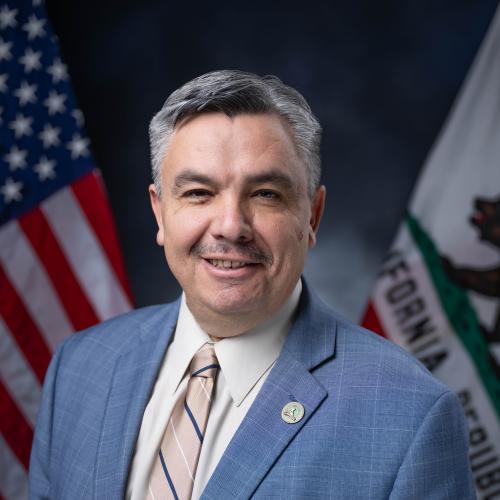
Rep. Juan Carrillo
Sponsored bills
Maddy summaryCalifornia Assembly Resolution 140 designates August 2026 as Children's Get Offline and Get Outdoors Month to promote awareness of the benefits of screen-free play for child development. The resolution cites research linking excessive social media use and reduced free play time to increased rates of anxiety, depression, and other behavioral issues among teenagers. It encourages families and communities to support unstructured outdoor activities and highlights ongoing federal efforts to protect children's mental health through technology guardrails.
Existing law requires the Department of Corrections and Rehabilitation to maintain a canteen at its active facilities, and until January 1, 2028, prohibits the sale prices of the articles offered for sale in a canteen from exceeding a 35% markup above the price of the articles paid to the vendors. Existing law, commencing on January 1, 2028, requires the sale amounts of the articles to be offered for sale to be fixed by the secretary at amounts that will render each canteen self-supporting. This bill would prohibit the sale price of an article offered for sale in a commissary, as defined, at a private detention facility, defined as a detention facility that is operated by a private, nongovernmental, for-profit entity, and operating pursuant to a contract or agreement with a governmental entity, from exceeding a 35% markup above the amount paid to a vendor for that article.
This measure would urge President Donald J. Trump to avoid raising the cost of living for American consumers by rescinding the tariffs that he has imposed since taking office in January 2025 and refunding the American people for the costs passed on to them by his tariffs. The measure would also urge the United States Congress to enact a joint resolution to rescind President Trump's tariffs and to oppose all future unilateral and arbitrary tariff increases imposed by President Trump.
Maddy summaryCalifornia Assembly Resolution 137 formally recognizes the Diwali festival scheduled for November 8, 2026, and encourages state residents to participate in the celebration. The resolution highlights the cultural significance of the holiday for Indian Americans and South Asian communities, noting its themes of unity, joy, and the triumph of light over darkness. It also acknowledges that California previously designated Diwali as an official state holiday in 2025. This measure serves as a commemorative statement rather than a law with new regulatory or financial provisions.
This measure would declare the Legislature's opposition to any federal executive action that restricts, burdens, or interferes with California's vote by mail system and would call upon the United States Congress to reject any federal legislation that would restrict or eliminate vote by mail options and to protect the constitutional authority of states to administer their own elections.
This measure would recognize August 26, 2026, as Women's Equality Day and its historic importance to women's rights, including the battle to attain those rights in the past, present, and future.
Maddy summaryThis bill designates 2026 as the International Year of the Woman Farmer to acknowledge the vital contributions of women in agriculture. It functions as a formal proclamation rather than a law that changes regulations or allocates funding. The measure directly affects the state by officially recognizing the importance of female agricultural workers during that year.
This measure would affirm the fundamental importance of indigent defense to due process, equal justice, and democratic governance, recognize public defenders as essential protectors of constitutional rights and the rule of law, and encourage the development of statewide approaches to indigent defense.
Maddy summaryThis bill designates June 2026 as Electronic Dance Music Month to recognize the genre's cultural significance. It directly affects communities and organizations involved in the electronic dance music scene by encouraging public awareness and celebration during that period. The measure requires no new funding or legal changes, serving instead as a symbolic declaration to highlight the month's theme.