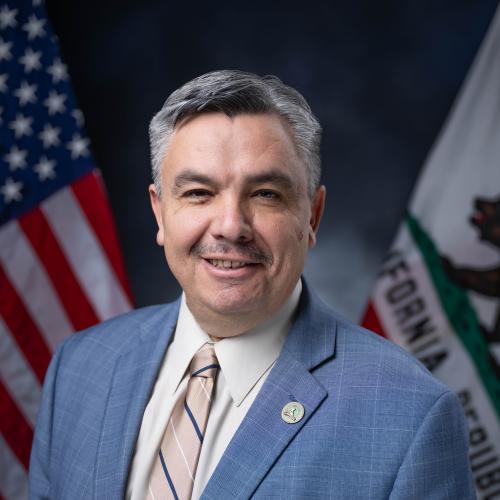
Photo of Juan Carrillo
D California Assembly · District 39 On the 2026 ballot

Asm. Juan Carrillo

Compare
Total votes
10,001
all sessions
Attendance
96%
345 missed
Near the chamber average
With party
99%
of cast votes
Near the chamber average
Bipartisan score
0%
crosses aisle rarely
Near the chamber average
Sponsored
862
bills & resolutions
Near the chamber average
Committees
13
assignments
862 bills and resolutions

Sponsored bills

Total
862
Primary
84
Co-sponsor
778
This page
862
matching current filters
Co-sponsor AB 1972
Signed into law · California Assembly · Co-sponsor
Regional property crimes task force.

Existing law authorizes the Governor to appoint and commission individuals designated by a railroad company to serve as police officers. Existing law, until January 1, 2026, requires the Department of the California Highway Patrol to coordinate with the Department of Justice to convene a regional property crimes task force to identify geographic areas experiencing increased levels of property crimes and assist local law enforcement with resources, such as personnel and equipment. This bill would require the task force to assist railroad police and would specify cargo theft as a property crime for consideration by the regional property crimes task force. This bill would declare that it is to take effect immediately as an urgency statute.

Signed into law Aug 16, 2024 1 co-sponsor
Co-sponsor AB 46
Passed · California Assembly · Co-sponsor
Personal income taxes: exclusion: Military Services Retirement and Surviving Spouse Benefit Payment Act.

The Personal Income Tax Law imposes a tax on individual taxpayers measured by the taxpayer's taxable income for the taxable year, but excludes certain items of income from the computation of tax, including an exclusion for combat-related special compensation. This bill, for taxable years beginning on or after January 1, 2024, and before January 1, 2034, would exclude from gross income retirement pay received by a taxpayer from the federal government for service performed in the uniformed services, as defined, during the taxable year. The bill, for taxable years beginning on or after January 1, 2024, and before January 1, 2034, would also exclude from gross income annuity payments received by a qualified taxpayer, as defined, pursuant to a United States Department of Defense Survivor Benefit Plan during the taxable year. The bill would make related findings and declarations. Existing law requires any bill authorizing a new tax expenditure to contain, among other things, specific goals, purposes, and objectives that the tax expenditure will achieve, detailed performance indicators, and data collection requirements. This bill also would include additional information required for any bill authorizing a new tax expenditure. The bill would require the Franchise Tax Board and the Department of Veterans Affairs to provide any data requested by the Legislative Analyst to write the report, as provided, and would make taxpayer information received by the Legislative Analyst subject to limitation on the collection and use of that information. By expanding the scope of a crime, this bill would impose a state-mandated local program. The California Constitution requires the state to reimburse local agencies and school districts for certain costs mandated by the state. Statutory provisions establish procedures for making that reimbursement. This bill would provide that no reimbursement is required by this act for a specified reason. This bill would take effect immediately as a tax levy.

Passed Aug 15, 2024 1 co-sponsor
Co-sponsor AB 4
Passed · California Assembly · Co-sponsor
Covered California: expansion.

Existing federal law, the Patient Protection and Affordable Care Act (PPACA) , requires each state to establish an American Health Benefit Exchange to facilitate the purchase of qualified health benefit plans by qualified individuals and qualified small employers. Existing state law creates the California Health Benefit Exchange, also known as Covered California, to facilitate the enrollment of qualified individuals and qualified small employers in qualified health plans as required under PPACA. Existing law requires the Exchange to apply for a federal waiver to allow persons otherwise not able to obtain coverage through the Exchange because of their immigration status to obtain coverage from the Exchange. This bill would delete that requirement and would instead require the Exchange, no sooner than January 1, 2026, and upon appropriation by the Legislature for this purpose, to administer a program to allow persons otherwise not able to obtain coverage by reason of immigration status to enroll in health insurance coverage in a manner as substantially similar to other Californians as feasible, consistent with federal guidance and given existing federal law and rules. The bill would require the Exchange to undertake outreach, marketing, and other efforts to ensure enrollment, which would begin on October 1, 2027. The bill would also require the Exchange to adopt an annual program design for each coverage year to implement the program, provide appropriate opportunities for stakeholders, including the Legislature, and the public to consult on the design of the program, and report to the Department of Finance and the Legislature on progress toward implementation, as specified. The bill would establish the Covered California for All Fund in the General Fund, to be administered by the Exchange, into which user fees, appropriations, and other funds would be deposited to be used upon appropriation to pay for the administration of the program.

Passed Aug 15, 2024 1 co-sponsor
Co-sponsor SB 245
Passed · California Senate · Co-sponsor
California Food Assistance Program: eligibility and benefits.

Existing federal law provides for the Supplemental Nutrition Assistance Program (SNAP) , known in California as CalFresh, under which supplemental nutrition assistance benefits allocated to the state by the federal government are distributed to eligible individuals by each county. Existing law requires the State Department of Social Services to establish a food assistance program, known as the California Food Assistance Program (CFAP) , to provide assistance to a noncitizen of the United States if the person's immigration status meets the eligibility criteria of SNAP in effect on August 21, 1996, but the person is not eligible for SNAP benefits solely due to their immigration status, as specified. Existing law also makes eligible for the program an applicant who is otherwise eligible for the program, but who entered the United States on or after August 22, 1996, if the applicant is sponsored and the applicant meets one of a list of criteria, including that the applicant, after entry into the United States, is a victim of the sponsor or the spouse of the sponsor if the spouse is living with the sponsor. Existing law, to become operative on the date that the department notifies the Legislature that the Statewide Automated Welfare System (SAWS) has been updated to perform the necessary automation, and subject to an appropriation in the annual Budget Act, makes an individual 55 years of age or older eligible for the program if the individual's immigration status is the sole basis for their ineligibility for CalFresh benefits. This bill would delete the above-described contingency and, commencing on October 1, 2027, remove that age limitation and make any individual eligible for the program if the individual's immigration status is the sole basis for their ineligibility for CalFresh benefits. By extending eligibility for CFAP, which is administered by the counties, this bill would impose a state-mandated local program. The California Constitution requires the state to reimburse local agencies and school districts for certain costs mandated by the state. Statutory provisions establish procedures for making that reimbursement. This bill would provide that, if the Commission on State Mandates determines that the bill contains costs mandated by the state, reimbursement for those costs shall be made pursuant to the statutory provisions noted above.

Passed Aug 15, 2024 1 co-sponsor
Co-sponsor AB 311
Passed · California Assembly · Co-sponsor
California Food Assistance Program: eligibility and benefits.

Existing federal law provides for the Supplemental Nutrition Assistance Program (SNAP) , known in California as CalFresh, under which supplemental nutrition assistance benefits allocated to the state by the federal government are distributed to eligible individuals by each county. Existing law requires the State Department of Social Services to establish a food assistance program, known as the California Food Assistance Program (CFAP) , to provide assistance to a noncitizen of the United States if the person's immigration status meets the eligibility criteria of SNAP in effect on August 21, 1996, but the person is not eligible for SNAP benefits solely due to their immigration status, as specified. Existing law also makes eligible for the program an applicant who is otherwise eligible for the program, but who entered the United States on or after August 22, 1996, if the applicant is sponsored and the applicant meets one of a list of criteria, including that the applicant, after entry into the United States, is a victim of the sponsor or the spouse of the sponsor if the spouse is living with the sponsor. Existing law, to become operative on the date that the department notifies the Legislature that the Statewide Automated Welfare System (SAWS) has been updated to perform the necessary automation, and subject to an appropriation in the annual Budget Act, makes an individual 55 years of age or older eligible for the program if the individual's immigration status is the sole basis for their ineligibility for CalFresh benefits. This bill would remove that age limitation and make any individual eligible for the program if the individual's immigration status is the sole basis for their ineligibility for CalFresh benefits. By extending eligibility for CFAP, which is administered by the counties, this bill would impose a state-mandated local program. The California Constitution requires the state to reimburse local agencies and school districts for certain costs mandated by the state. Statutory provisions establish procedures for making that reimbursement. This bill would provide that, if the Commission on State Mandates determines that the bill contains costs mandated by the state, reimbursement for those costs shall be made pursuant to the statutory provisions noted above.

Passed Aug 15, 2024 1 co-sponsor
Primary AB 2071
Passed · California Assembly · Lead sponsor
Pupil instruction: English Learner Roadmap: grant program: parent toolkit.

Existing law establishes the State Board of Education, and requires the state board to adopt rules and regulations, not inconsistent with the laws of the state, to govern the public elementary and secondary schools of the state. Existing law requires the state board to determine all questions of policy within its powers. Pursuant to these powers, the state board has adopted a policy known as the California English Learner Roadmap State Board of Education Policy: Educational Programs and Services for English Learners, also known as the EL Roadmap Policy, for the stated purpose of assisting the State Department of Education in providing guidance to local educational agencies with respect to educating English learners attending California public schools. Existing law establishes the State Department of Education, under the administration of the Superintendent of Public Instruction, and assigns the department numerous duties relating to the governance and funding of local educational agencies. This bill would require the state board to, on or before March 15, 2026, develop and adopt a "California English Learner Roadmap: Parent Toolkit" that will be made available to families served by school districts, county offices of education, and charter schools that are implementing the EL Roadmap Policy. The bill would require the state board to convene a workgroup to assist in the development of the parent toolkit, as provided. The bill would require the department to develop forms that may be used by parents of English learner pupils to request services from the pupil's teacher or administrator as it relates to the parent toolkit. The bill would establish the English Learner Roadmap Implementation Grant Pilot Program with the goal of locally planning and implementing the EL Roadmap Policy. The bill would require the department, on or before September 1, 2025, to award no more than 8 one-time grants of up to $1,500,000 per grant and no more than 4 one-time grants of up to $750,000 per grant to school districts, county offices of education, or charter schools, as provided. The bill would require the department to, among other things, determine application procedures and selection criteria for grant awards, review applications, identify and determine how data will be collected and shared with the public, and meet quarterly with leaders from the grant recipients for specified purposes. The bill would require grant recipients to submit to the department specified data as it relates to the grant received. The bill would require the department to submit to the appropriate policy and fiscal committees of the Legislature a progress report on or before January 31, 2027, and, on or before December 1, 2028, a final report, with specified information about, among other things, the successes and challenges of the grant program, as provided. This bill would make implementation of its provisions contingent upon an appropriation by the Legislature, as provided.


Passed Aug 15, 2024 0 co-sponsors
Co-sponsor AB 3238
Passed · California Assembly · Co-sponsor
California Environmental Quality Act: electrical infrastructure projects.

The California Environmental Quality Act (CEQA) requires a lead agency, as defined, to prepare, or cause to be prepared, and certify the completion of an environmental impact report on a project that it proposes to carry out or approve that may have a significant effect on the environment or to adopt a negative declaration if it finds that the project will not have that effect. The CEQA also requires a lead agency to prepare a mitigated negative declaration for a project that may have a significant effect on the environment if revisions in the project would avoid or mitigate that effect and there is no substantial evidence that the project, as revised, would have a significant effect on the environment. The CEQA exempts certain projects from its requirements, including actions necessary to prevent or mitigate an emergency. Existing law prohibits an electrical corporation from beginning the construction of a line, plant, or system, or extensions of those facilities without first having to obtain from the Public Utilities Commission a certificate that the present or future convenience and necessity require or will require the construction. Existing law specifies that the certificate is not required for the extension, expansion, upgrade, or other modification of existing electrical transmission facilities. This bill would, for electrical infrastructure projects, as defined, designate the commission as the lead agency for purposes of the CEQA, would require the commission to prescribe procedures for the preparation of the appropriate environmental review document for those projects, and would specify the manner in which the environmental review for those projects is to be conducted. The bill would repeal these provisions on January 1, 2035.

Passed Aug 15, 2024 1 co-sponsor
Primary AB 2485
Passed · California Assembly · Lead sponsor
Regional housing need: determination.

The Planning and Zoning Law requires each county and city to adopt a comprehensive, long-term general plan for the physical development of the county or city, which includes, among other mandatory elements, a housing element. That law requires, for the 4th and subsequent revisions of the housing element, the Department of Housing and Community Development (department) , in consultation with each council of governments, where applicable, to determine the existing and projected need for housing for each region, at least 2 years prior to the scheduled revision of the housing element, as specified. That law requires the department's determination to be based upon population projections produced by the Department of Finance and regional population forecasts developed by the council of governments and used for the preparation of the regional transportation plan, as specified. That law also requires the department to meet and consult with the council of governments regarding the assumptions and methodologies to be used to determine a region's housing need and requires the council of governments to provide data assumptions from the council of governments' projections, as specified. That law authorizes the department to accept or reject the information provided by the council of governments and, requires the department, after consultation with the council of governments, to make determinations on the data assumptions and the methodology the department will use to determine the region's housing need, as specified. That law requires the department to provide its determinations to the council of governments, as specified. This bill would for the 8th and subsequent revisions of the housing element require the department to convene and engage stakeholders to consider improvements to the process of determining the existing and projected housing need for each region before determining any region's existing projected housing need. The bill would require the department, prior to finalization of the regional determination, as specified, to publish on the department's internet website a summary of the information the department considered and determinations made by the department to improve the process of determining the existing and projected housing need for each region. The bill would additionally require the department to publish on its internet website the data sources, analyses, and methodology, including assumptions and factors used in and applied to the Department of Finance's population projections and engagement process with the council of governments prior to finalization of the regional determination. The bill would additionally require the department to publish its determinations on the data assumptions and methodology it will use to determine a region's housing need on the department's internet website.

Passed Aug 15, 2024 0 co-sponsors
Co-sponsor HR 110
Passed · California Assembly · Co-sponsor
Relative to infrastructure.

Maddy summaryThis California Assembly resolution encourages the U.S. Congress to pass legislation creating a National Infrastructure Bank to fund critical repairs and upgrades for roads, bridges, dams, and other public works. The bill cites reports from the American Society of Civil Engineers highlighting billions of dollars in investment gaps and poor conditions affecting California's transportation and water systems. It advocates for a financing model that uses existing federal debt rather than new taxes, aiming to stimulate the economy, create jobs, and prioritize projects in disadvantaged communities. The resolution formally requests that federal leaders adopt this approach to address the state's urgent infrastructure needs.

Passed Aug 15, 2024 1 co-sponsor
Co-sponsor HR 116
Passed · California Assembly · Co-sponsor
Relative to the assassination attempt on former President Donald J. Trump.

Maddy summaryThis California House Resolution condemns the July 13, 2024, assassination attempt on former President Donald J. Trump and calls for an end to political violence. The measure highlights the event where Trump was wounded while speaking at a rally in Butler, Pennsylvania, and notes that one attendee died and others were injured while trying to protect him. It urges the state to foster a political environment based on respectful discourse and nonviolence. The resolution is a formal statement of the Assembly's stance and does not create new laws or change existing policies.

Passed Aug 15, 2024 1 co-sponsor
Showing 451 to 460 of 862 bills
Previous 1 … 45 46 47 … 87 Next