

(1) Existing law authorizes the legislative body of a city or a county to designate a proposed enhanced infrastructure financing district to finance public capital facilities or other specified projects, including acquisition, construction, or repair of commercial structures by the small business occupant of such structures, if such acquisition, construction, or repair is for purposes of fostering economic recovery from the COVID-19 pandemic, as specified, with a governing body referred to as the public financing authority, by adopting a resolution of intention to establish the proposed district. This bill would revise these provisions to instead authorize the designation of a proposed enhanced infrastructure financing district to finance capital facilities or other specified projects for the acquisition, construction, or repair of commercial structures by the small business occupant of such structures, as described above, if such acquisition, construction, or repair is for purposes of fostering economic recovery of a community, as specified. Existing law requires the public financing authority of an enhanced infrastructure financing district to hold a meeting and 3 public hearings on a proposed infrastructure financing plan, as provided. Existing law requires the public financing authority to review the enhanced infrastructure financing plan at least annually and to make any amendments, as specified. Existing law authorizes amendments to an approved infrastructure financing plan, as described, subject to approval by a majority vote of the governing board at a public hearing held following the provision of a 30 day mailed notice, as described. Existing law requires amendments that propose the increase of the limit of the total number of dollars in local taxes allocation to the plan to be adopted in accordance with all notices and hearing requirements for the affected landowners and residents within the proposed additional territory applicable to an initial proposed enhanced infrastructure financing plan. This bill would instead authorize the amendments, as specified, or the addition of a participating taxing entity and its representatives as members of a public financing authority after the date of district formation, to be approved by a majority vote of the public financing authority at a public hearing held following the provision of a 30-day mailed notice, as described above. The bill would instead require amendments that propose the increase of the limit of the total number of dollars in local taxes allocation to the plan, except where the increase is the result of an affected taxing entity agreeing to participate in the existing district and the plan is amended, as specified, to be adopted in accordance with all notices and hearing requirements, as described above. Existing law requires a public financing authority to adopt an annual report on or before June 30 of each year after holding a public hearing. This bill would instead require a public financing authority to adopt an annual report within 7 months of the close of each fiscal year after holding a public hearing. If, after the date of district formation, an affected taxing entity adopts a resolution approving the plan and to participate in the division of taxes used to finance an enhanced infrastructure financing district, existing law requires the division of taxes to be based upon the last equalized assessment roll that is used for the district, as specified. This bill would additionally authorize an affected taxing entity to, at any time after the date of district formation, approve the plan and participate in the division of taxes used to finance the activities of a district, by adopting a resolution of the governing body. (2) Existing law authorizes the creation of community revitalization and investment authorities, as specified, to carry out a community revitalization plan within a community revitalization and investment area. Existing law requires not less than 70% of the land calculated by census tracts, census block groups, as defined, or any combination of both within the area to be characterized by specified conditions, including the annual median household income that is less than, at the option of the authority, 80% of the statewide, countrywide, or citywide annual median income and three of four conditions, including deteriorated commercial or residential structures. This bill would instead require not less than 60% of the land calculated by census tracts, census block groups, as defined, or any combination of both within the area to be characterized by either of the two specified conditions, including the annual median household income that is less than, at the option of the authority, 80% of the statewide, countrywide, or citywide annual median income or three of four conditions, including deteriorated commercial or residential structures. The bill would make related technical, nonsubstantive changes. Existing law requires a community revitalization authority to consider adoption of a community revitalization plan at 3 public hearings, as specified. Existing law requires a community revitalization authority to post a notice of each meeting or public hearing, as specified, in an easily identifiable and accessible location on the authority's internet website and to mail a written notice of the meeting or public hearing to each owner of land and each resident at least 10 days prior to the meeting or public hearing. Existing law also requires notice of each public hearing to be published in a newspaper of general circulation, as specified. This bill would instead require a community revitalization authority to consider adoption of a community revitalization plan at 2 public hearings, as specified, and would make conforming changes. As an alternative to mailing separate mailed notices prior to the meeting or public hearing, the bill would authorize the authority to mail a notice to each landowner, resident, and affected taxing entity at least 40 days before the meeting, as specified. The bill would require the designated contact person, as described, to assemble and maintain an email contact list of all landowners, residents, and other interested parties who have expressed interest in receiving information and materials. Except for the newspaper notices, as described above, the bill would require a notice required by the above-described provisions to be provided in English and in all other languages spoken jointly by 20% or more of the population in the jurisdiction of the county of the proposed authority that speaks English less than "very well" and jointly speaks a language other than English, as specified.
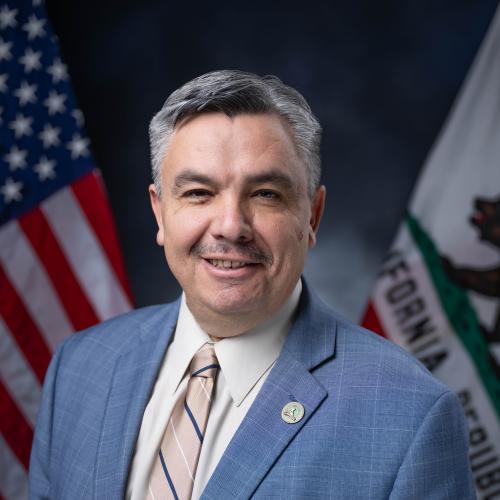
Asm. Juan Carrillo
Sponsored bills
Existing law, the Emergency Medical Services System and the Prehospital Emergency Medical Care Personnel Act (act) , establishes the Emergency Medical Services Authority, which is responsible for the coordination of various state activities concerning emergency medical services (EMS) . The act authorizes a county to develop an EMS program by designating a local EMS agency. Existing law also requires the Commission on Emergency Medical Services to review and approve regulations, standards, and guidelines to be developed by the authority. Existing law generally makes a violation of the act a misdemeanor. This bill would require, by January 1, 2027, a public safety agency that provides "911" call processing services for emergency medical response to provide prearrival medical instructions to "911" callers requiring medical assistance, including, among other things, airway and choking medical instructions for infants, children, and adults and administration of naloxone for narcotics overdoses. The bill would require prearrival medical instructions to be approved by the local EMS agency medical director and implemented consistent with the medical protocols and procedures adopted by the public safety agency. By expanding the scope of a crime, and to the extent that the bill would create new duties for a public safety agency, the bill would impose a state-mandated local program. The California Constitution requires the state to reimburse local agencies and school districts for certain costs mandated by the state. Statutory provisions establish procedures for making that reimbursement. This bill would provide that with regard to certain mandates no reimbursement is required by this act for a specified reason. With regard to any other mandates, this bill would provide that, if the Commission on State Mandates determines that the bill contains costs so mandated by the state, reimbursement for those costs shall be made pursuant to the statutory provisions noted above.
Existing law requires the State Air Resources Board to adopt and implement motor vehicle fuel specifications for the control of air contaminants and sources of air pollution. Existing law prohibits the state board from adopting any regulation that establishes a specification for motor vehicle fuel unless that regulation, and a multimedia evaluation conducted by affected agencies and coordinated by the state board, are reviewed by the California Environmental Policy Council. This bill would, notwithstanding that prohibition, authorize blends of gasoline containing 10.5% to 15% ethanol by volume to be sold in the state for use as a transportation fuel until (1) the California Environmental Policy Council completes its review of those blends and (2) the state board either adopts a regulation establishing a specification for those blends or posts an assessment on its internet website demonstrating that it is not possible for a regulation establishing a specification for those blends to meet specified requirements. This bill would declare that it is to take effect immediately as an urgency statute.
Existing law establishes the Tribal Nation Grant Fund, administered by the California Gambling Control Commission, for the receipt and deposit of moneys received by the state from Indian tribes pursuant to the terms of tribal-state gaming compacts. Under existing law, moneys in the Tribal Nation Grant Fund are available, upon appropriation by the Legislature, for the discretionary distribution of funds to nongaming and limited-gaming tribes, as specified. Existing law establishes the Tribal Nation Grant Fund Program and authorizes Tribal Nation Grant Fund Panel to award grants from available moneys within the fund and make other distributions from the fund to eligible tribes, as specified. Existing law requires an eligible tribe requesting a grant to submit an application on a form approved by the panel and provided by the commission. Existing law authorizes the panel to distribute of the available moneys in the fund to all eligible tribes that submitted a completed grant application, as specified. Existing law authorizes the panel, in its discretion and based upon the purpose or project set forth in the application, to require an eligible tribe to encumber or expend any or all of a grant within a specified period of time, as described. Existing law requires each eligible tribe and each individual applying on behalf of each eligible tribe to agree to return to the fund any amount of a grant not encumbered or expended, as specified. This bill would additionally establish the fund for the receipt and deposit of moneys received by the state from Indian tribes pursuant to the terms of class III gaming secretarial procedures. The bill would revise the grant distribution provisions described above to authorize the panel to award grants as specific distribution grants to fund a specifically described purpose or project, or as equal shares grants for distribution to eligible tribes in equal amounts, as specified. The bill would require the panel to develop application forms for the specific distribution grants and the equal shares grants, as described, and would require the equal shares grants application form to include, among other things, a certification from the eligible tribe that the funds will be used for specified purposes. The bill would require the panel to distribute as equal shares grants $600,000 per eligible tribe, or at least 85% of the available moneys in the fund, whichever is greater, as specified. The bill would authorize the panel to distribute as specific distribution grants the remaining available moneys in the fund, as specified. The bill would no longer authorize the panel to require an eligible tribe to encumber or expend any or all of a grant within a specified period of time and would make a related conforming change. The bill would no longer require each eligible tribe and each individual applying on behalf of each eligible tribe to return to the fund any amount of a grant not encumbered or expended, as specified. The bill would make a related statement of legislative intent.
This measure would designate November 1, 2025, as Fernando Valenzuela Day, to highlight the positive impact his legacy created in the Latino and Hispanic community.
This measure would recognize the importance of California Native American Day, celebrated this year on September 26, 2025, and the annual California Indian Cultural Awareness Conference, to the enhancement of awareness of California Indian culture.
(1) The Confidentiality of Medical Information Act (CMIA) prohibits a provider of health care, a health care service plan, a contractor, or a corporation and its subsidiaries and affiliates from intentionally sharing, selling, using for marketing, or otherwise using any medical information, as defined, for any purpose not necessary to provide health care services to a patient, except as provided. The CMIA prohibits a provider of health care, health care service plan, or contractor from disclosing medical information regarding a patient of the provider of health care or an enrollee or subscriber of a health care service plan without first obtaining authorization from the patient, except if the disclosure is compelled by, among other things, a search warrant lawfully issued to a governmental law enforcement agency or a court order. Existing law makes a violation of these provisions that results in economic loss or personal injury to a patient punishable as a misdemeanor. This bill would revise the definition of "medical information" to include immigration status, including current and prior immigration status, and place of birth, if that information is known or collected, as specified, and would define "immigration enforcement" to mean any and all efforts to investigate, enforce, or assist in the investigation or enforcement of any federal civil immigration law, and also includes any and all efforts to investigate, enforce, or assist in the investigation or enforcement of any federal criminal immigration law that penalizes a person's presence in, entry or reentry to, or employment in, the United States. The bill would specify that a provider of health care, health care service plan, or contractor shall disclose medical information regarding a patient of the provider of health care or an enrollee or subscriber or a health care service plan pursuant to a valid search warrant issued by a judicial officer, including a magistrate, to a governmental law enforcement agency, or pursuant to a state or federal court order issued by a court of this state or a federal court. The bill would also prohibit, except to the extent expressly authorized by a patient, enrollee, or subscriber, or as otherwise permitted or required, a provider of health care, health care service plan, contractor, or corporation and its subsidiaries and affiliates from disclosing medical information for immigration enforcement. Because the bill would expand the scope of a crime, it would impose a state-mandated local program. (2) Under existing law, the State Department of Public Health is responsible for the licensing and regulation of various facilities and settings that provide health care services, as specified. Existing law makes a willful violation of these provisions a crime. This bill would require health care provider entities, as defined, to establish or amend procedures for monitoring, documenting, and receiving visitors to health care provider entities to the extent possible. The bill would require health care provider entity personnel to immediately notify health care provider entity management, administration, or legal counsel of any request for access to a health care provider entity site or patient for immigration enforcement, and to provide any requests for review of health care provider entity documents, as prescribed. The bill would prohibit, unless required by state or federal law, a health care provider entity and its personnel from allowing any person access to nonpublic areas of the provider's facilities for immigration enforcement purposes, except as specified. The bill would require health care provider entities to inform staff and relevant volunteers on how to respond to requests relating to immigration enforcement that grants access to health care provider entity sites or to patients. The bill would require that health care provider entities comply with these provisions within 45 days from their effective date. By expanding the scope of a crime and increasing duties on local health officials, the bill would impose a state-mandated local program. The California Constitution requires the state to reimburse local agencies and school districts for certain costs mandated by the state. Statutory provisions establish procedures for making that reimbursement. This bill would provide that with regard to certain mandates no reimbursement is required by this act for a specified reason. With regard to any other mandates, this bill would provide that, if the Commission on State Mandates determines that the bill contains costs so mandated by the state, reimbursement for those costs shall be made pursuant to the statutory provisions noted above. This bill would provide that no reimbursement is required by this act for a specified reason. This bill would declare that it is to take effect immediately as an urgency statute.
(1) Existing law prohibits, except as required by state or federal law or as required to administer a state or federally supported educational program, school officials and employees of a school district, county office of education, or charter school from collecting information or documents regarding citizenship or immigration status of pupils or their family members. Existing law requires the superintendent of a school district, the superintendent of a county office of education, and the principal of a charter school, as applicable, to report to the respective governing board or body of the local educational agency in a timely manner any requests for information or access to a schoolsite by an officer or employee of a law enforcement agency for the purpose of enforcing the immigration laws in a manner that ensures the confidentiality and privacy of any potentially identifying information. This bill would prohibit school officials and employees of a local educational agency from allowing an officer or employee of an agency conducting immigration enforcement to enter a nonpublic area of a schoolsite, as defined, for any purpose without being presented with a valid judicial warrant, judicial subpoena, or a court order. The bill would require school officials and employees of a local educational agency, to the extent practicable, to request valid identification of any officer or employee of an agency conducting immigration enforcement seeking to enter a nonpublic area of a schoolsite. The bill would also prohibit a local educational agency and its personnel from disclosing or providing, in writing, verbally, or in any other manner, the education records of or any information about a pupil or a pupil's family and household without the pupil's parents' or guardians' written consent, a school employee, or a teacher to an officer or employee of an agency conducting immigration enforcement without a valid judicial warrant or judicial subpoena, or court order directing the local educational agency or its personnel to do so. By imposing additional duties on local educational agencies, the bill would impose a state-mandated local program. (2) Existing law requires the Attorney General, by April 1, 2018, in consultation with the appropriate stakeholders, to publish model policies limiting assistance with immigration enforcement at public schools, to the fullest extent possible consistent with federal and state law, and ensuring that public schools remain safe and accessible to all California residents, regardless of immigration status, as provided. Existing law requires local educational agencies, by July 1, 2018, to adopt those model policies developed by the Attorney General or equivalent policies. This bill would require the Attorney General, by December 1, 2025, to update those model policies to ensure that the policies align with the above-described prohibitions on school officials and employees of local educational agencies allowing an officer or employee of an agency conducting immigration enforcement to enter a nonpublic area of a schoolsite without a valid judicial warrant or judicial subpoena, or a court order and from disclosing or providing certain information to those officers or employees, as provided. The bill also would require a local educational agency to update its model policy by March 1, 2026, and to make the policy available to the State Department of Education upon request. By imposing additional duties on local educational agencies, the bill would impose a state-mandated local program. (3) This bill would make these provisions severable. (4) The California Constitution requires the state to reimburse local agencies and school districts for certain costs mandated by the state. Statutory provisions establish procedures for making that reimbursement. This bill would provide that, if the Commission on State Mandates determines that the bill contains costs mandated by the state, reimbursement for those costs shall be made pursuant to the statutory provisions noted above. (5) This bill would declare that it is to take effect immediately as an urgency statute.
Existing law makes it a misdemeanor to wear a mask, false whiskers, or any personal disguise, as specified, with the purpose of evading or escaping discovery, recognition, or identification while committing a public offense, or for concealment, flight, evasion, or escape from arrest or conviction for any public offense. This bill would make it a crime for a law enforcement officer to wear a facial covering in the performance of their duties, except as specified. The bill would define law enforcement officer as anyone designated by California law as a peace officer who is employed by a city, county, or other local agency, and any officer or agent of a federal law enforcement agency or law enforcement agency of another state, or any person acting on behalf of a federal law enforcement agency or agency of another state. The bill would make a violation of these provisions punishable as an infraction or a misdemeanor, as specified. By creating a new crime, this bill would impose a state-mandated local program. The bill would require any law enforcement agency operating in California to, by July 1, 2026, maintain and publicly post a written policy limiting the use of facial coverings, as specified. The bill would exempt personnel of any agency from the crime of wearing a facial covering if an agency maintains a policy pursuant to this section no later than July 1, 2026. The bill would deem a policy consistent with these provisions for the purposes of that exception unless a member of the public, an oversight body, or a local governing authority challenges it. The bill would also impose a specified civil penalty against certain officers for tortious conduct, including, but not limited to, false imprisonment or false arrest of an individual while wearing a facial covering. The bill would, if the agency does not address deficiencies within 90 days, authorize the complaining party to proceed to a court of competent jurisdiction for a judicial determination of the exemption, as specified. The bill would define a law enforcement agency for these purposes as any entity of a city, county, or other local agency, that employs anyone designated by California law as a peace officer, any federal law enforcement agency, or any law enforcement agency of another state. By imposing additional duties on local law enforcement agencies, this bill would create a state-mandated local program. This bill would declare its provisions to be severable. This bill would make related findings and declarations. The California Constitution requires the state to reimburse local agencies and school districts for certain costs mandated by the state. Statutory provisions establish procedures for making that reimbursement. This bill would provide that with regard to certain mandates no reimbursement is required by this act for a specified reason. With regard to any other mandates, this bill would provide that, if the Commission on State Mandates determines that the bill contains costs so mandated by the state, reimbursement for those costs shall be made pursuant to the statutory provisions noted above.
This measure would proclaim the month of October 2025 as California Firefighter Appreciation Month and October 4, 2025, as California Firefighters Memorial Day.