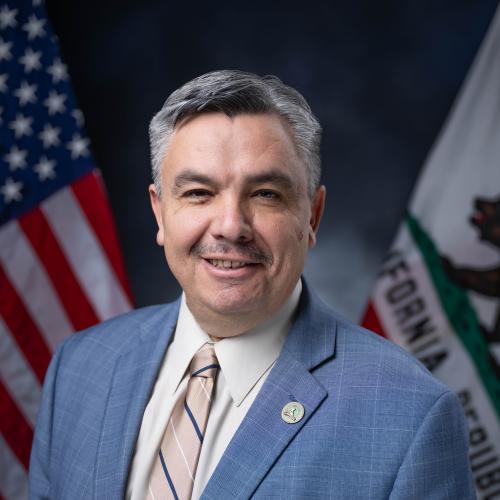
Photo of Juan Carrillo
D California Assembly · District 39 On the 2026 ballot

Asm. Juan Carrillo

Compare
Total votes
10,001
all sessions
Attendance
96%
345 missed
Near the chamber average
With party
99%
of cast votes
Near the chamber average
Bipartisan score
0%
crosses aisle rarely
Near the chamber average
Sponsored
862
bills & resolutions
Near the chamber average
Committees
13
assignments
862 bills and resolutions

Sponsored bills

Total
862
Primary
84
Co-sponsor
778
This page
862
matching current filters
Co-sponsor HR 95
Passed · California Assembly · Co-sponsor
Relative to National Public Works Week.

Maddy summaryThis bill designates the week of May 17 to May 24, 2026, as National Public Works Week throughout California to honor the contributions of public works professionals. It directly affects engineers, managers, and employees in government and the private sector who maintain essential infrastructure like transportation systems, water supplies, and public buildings. The resolution requests that the Governor issue a proclamation encouraging the public to observe the week with educational programs and activities that highlight the importance of these workers.

Passed May 14, 2026 1 co-sponsor
Primary AB 1885
In committee · California Assembly · Lead sponsor
Public contracts: retention proceeds.

Existing law, with respect to a contract relating to the construction of any public work of improvement, prohibits the retention proceeds withheld from any payment by a public entity from the original contractor, by the original contractor from any subcontractor, and by a subcontractor from any subcontractor from exceeding 5% of the payment, except as specified. This bill, with respect to those contracts, would further limit specified state agencies, including the Department of Water Resources, the Department of Parks and Recreation, and the Department of Corrections and Rehabilitation, from withholding retention proceeds from a progress payment to a contractor in excess of 3.5% of the payment. The bill would require those state agencies to promptly notify the appropriate policy committees of the Legislature if the state agency's best interests are compromised because of the 3.5% retention limitation imposed by the bill. Existing law, except as specified, prohibits the percentage of the retention proceeds withheld in a contract between the original contractor and a subcontractor, and in a contract between a subcontractor and any subcontractor thereunder, from exceeding the percentage specified in the contract between the public entity and the original contractor. This bill would provide that nothing in the bill alters, amends, or impairs the rights, duties, and obligations of an original contractor, its subcontractors, and all subcontractors thereunder relating to the construction of any public work of improvement pursuant to the above-described provision. This bill would repeal its provisions on January 1, 2032.

In committee May 14, 2026 0 co-sponsors
Co-sponsor SB 1179
In committee · California Senate · Co-sponsor
Doctors from El Salvador Program.

Existing law, the Medical Practice Act, establishes the Medical Board of California to license and regulate the practice of medicine. Existing law establishes within the act the Licensed Physicians from Mexico Program, which authorizes the board to issue a limited number of nonrenewable 3-year physician's and surgeon's licenses to physicians from Mexico who are licensed, certified, or recertified and in good standing in their medical specialty in Mexico and who meet specified other requirements. This bill would establish the Doctors from El Salvador Program for the purpose of permitting licensed physicians from El Salvador to practice medicine in California for up to 3 years. The bill would require the program to be developed in consultation with representatives from a community health clinic in California that has an established partnership and framework with specified universities in El Salvador and would require the program to, among other things, recruit and vet candidates and assist candidates for the program in El Salvador to meet all program requirements. The bill would require the board to issue a nonrenewable 3-year physician and surgeon's license to a person who is licensed, certified, or recertified, and in good standing in the applicable medical specialty in El Salvador and who meets other requirements of the program. This bill would require a licensee in the program to practice only in the nonprofit community health center that offered the licensee employment and the corresponding hospital. The bill would require a federally qualified health center employing a licensee in the program to take certain actions, including creating and maintaining medical quality assurance protocols for those licensees. The bill would also require the federally qualified health centers to work with a California medical school or residency program to conduct 10 secondary reviews of randomly selected patient encounters with each of those licensees every 6 months, as specified. The bill would also require the faculty from the medical school or residency program and federally qualified health center chief medical officers to jointly develop 2 quality assurance seminars to be attended by the licensees. This bill would require an evaluation of the program to be conducted 12 months after the program has commenced by one of specified universities in El Salvador and an unspecified medical school in southern California, except that if the evaluation does not begin within 18 months of commencement of the program, the bill would require the Director of Consumer Affairs to select an independent consultant to conduct the evaluation. The bill would require progress reports to be provided to the Legislature on achievable time intervals beginning in the 2nd year of implementation of the program. The bill would require the board to coordinate with the community health center, as specified, to ensure that the number of program participants that are issued a license does not exceed a certain number of licensees, based on the year in which the applicant applies. The bill would establish various fees to be deposited in the Contingent Fund of the Medical Board of California or the CURES Fund, as specified. This bill would make legislative findings and declarations as to the necessity of a special statute.

In committee May 14, 2026 1 co-sponsor
Co-sponsor AB 1557
In committee · California Assembly · Co-sponsor
Vehicles: electric bicycles.

Existing law defines an electric bicycle as a bicycle equipped with fully operable pedals and an electric motor that does not exceed 750 watts of power. Existing law classifies electric bicycles into 3 classes with different restrictions. Existing law defines a "class 1 electric bicycle" as a bicycle equipped with a motor that provides assistance only when the rider is pedaling, that is not capable of exclusively propelling the bicycle, and that ceases to provide assistance when the bicycle reaches the speed of 20 miles per hour. Existing defines a "class 2 electric bicycle" as a bicycle equipped with a motor that may be used exclusively to propel the bicycle and that is not capable of providing assistance when the bicycle reaches the speed of 20 miles per hour. Existing law defines a "class 3 electric bicycle" as a bicycle equipped with a speedometer and a motor that, in pertinent part, provides assistance only when the rider is pedaling and that ceases to provide assistance when the bicycle reaches the speed of 28 miles per hour. A violation of the Vehicle Code is a crime. This bill would instead define a class 1 electric bicycle as a bicycle equipped with a motor that provides assistance only when the rider is pedaling, that is not capable of exclusively propelling the bicycle, and that ceases to provide assistance when the bicycle reaches the speed of 16 miles per hour. The bill would define a class 2 electric bicycle as a bicycle equipped with a motor that may be used exclusively to propel the bicycle, and that is not capable of providing assistance when the bicycle reaches the speed of 16 miles per hour. The bill would provide that, notwithstanding these definitions, an electric bicycle manufactured prior to January 1, 2027, that was equipped with a motor that is not capable of exceeding 750 watts of continuous power and otherwise met the legal requirements for the relevant class at the time of manufacture shall retain its classification. This bill would authorize a cargo electric bicycle to be equipped with an electric motor with a maximum continuously rated power of 750 watts. The bill would define a cargo electric bicycle as an electric bicycle that is built with a reinforced frame and integrated rack or platform designed to transport goods or additional persons. This bill would prohibit a manufacturer from equipping, and a retailer from offering for sale or advertising, any device labeled as an electric bicycle with a motor that is capable of exceeding 750 watts of peak power. The bill would also prohibit a manufacturer from equipping, and a retailer from offering for sale or advertising, any device labeled as a class 1 or class 2 electric bicycle with a motor that is capable of exceeding 250 watts of continuous power or that is capable of providing assistance to reach speeds greater than 16 miles per hour. The bill would make a violation of these provisions punishable by a civil penalty not to exceed $15,000 for a first violation and not to exceed $50,000 for each subsequent violation, upon an action brought by the Attorney General, a city attorney, a county counsel, or a district attorney. The bill would specify that a violation of this provision is not a criminal offense. Existing law prohibits a person under 16 years of age from operating a class 3 electric bicycle, and authorizes a peace officer to remove the electric bicycle being operated by the person. Existing law requires an agency to release a seized electric bicycle to the owner, violator, or their agent after a minimum of 48 hours if certain conditions are met, including that the costs of removal, seizure, and storage have been paid. Existing law authorizes an agency to require, as a condition of release of an electric bicycle removed under this provision, proof that the violator has completed an electric bicycle safety and training program or a related local bicycle safety course, as described. This bill would prohibit a person under 16 years of age from operating an electric bicycle with a motor that is capable of exceeding 250 watts of continuous power, and would authorize a peace officer to remove the electric bicycle that is being operated by the person. The bill would authorize an agency to require proof that the violator has completed an electric bicycle safety and training program or a related local bicycle safety course, as described, as a condition of release of the electric bicycle. Because a violation of this prohibition would be a crime, the bill would impose a state-mandated local program. The California Constitution requires the state to reimburse local agencies and school districts for certain costs mandated by the state. Statutory provisions establish procedures for making that reimbursement. This bill would provide that no reimbursement is required by this act for a specified reason.


In committee May 14, 2026 1 co-sponsor
Co-sponsor ACR 176
Passed · California Assembly · Co-sponsor
Relative to Second Chance Month.

Maddy summaryThis bill designates April 2026 as Second Chance Month in California to raise awareness about opportunities for individuals reentering society after incarceration. The measure is a ceremonial proclamation that does not alter laws, allocate funding, or change government operations. Its primary purpose is to encourage public recognition of the challenges faced by formerly incarcerated people and to highlight available support resources during that specific month.

Passed May 13, 2026 1 co-sponsor
Co-sponsor ACR 171
Signed into law · California Assembly · Co-sponsor
Relative to California Home Visiting Week.

This measure would proclaim the week of April 20, 2026, to April 24, 2026, inclusive, as California Home Visiting Week, and would encourage all Californians to recognize and celebrate the contributions of home visiting programs and professionals and the families they serve.

Signed into law May 12, 2026 1 co-sponsor
Co-sponsor ACR 170
Signed into law · California Assembly · Co-sponsor
Relative to Mosquito Awareness Week.

Maddy summaryThis bill designates the week of April 19 to April 25, 2026, as Mosquito Awareness Week. The measure is a commemorative resolution that officially recognizes this specific time period to highlight mosquito-related issues. It does not create new laws, impose regulations, or allocate funding, but rather serves to raise public awareness through official designation.

Signed into law May 12, 2026 1 co-sponsor
Co-sponsor ACR 160
Signed into law · California Assembly · Co-sponsor
Relative to Parkinson's Awareness Month.

Maddy summaryThis bill designates April 2026 as Parkinson's Disease Awareness Month in California. It requires state officials to issue a formal proclamation highlighting the importance of raising public awareness about the condition. The measure does not change laws or allocate funding but serves to recognize the month dedicated to this health issue.

Signed into law May 12, 2026 1 co-sponsor
Co-sponsor ACR 130
Signed into law · California Assembly · Co-sponsor
Relative to Sylvia Mendez Day.

Maddy summaryThis bill designates April 14 of every year as Sylvia Mendez Day to honor the civil rights activist who challenged school segregation in California. The measure is a commemorative resolution that does not change laws, allocate funding, or alter government operations. By establishing this annual observance, the state recognizes Mendez's historical contributions to education and civil rights.

Signed into law May 12, 2026 1 co-sponsor
Co-sponsor ACR 161
Signed into law · California Assembly · Co-sponsor
Relative to Special Districts Week.

Maddy summaryThis bill designates the week of April 5, 2026, through April 11, 2026, as Special Districts Week. It directly affects special districts, which are local government entities that provide specific services like water supply or fire protection to communities. The primary mechanism is an official proclamation that encourages public awareness and recognition of the work these districts perform. This measure does not alter any laws or budgets but serves as a commemorative resolution to highlight the importance of special districts.

Signed into law May 12, 2026 1 co-sponsor
Showing 151 to 160 of 862 bills
Previous 1 … 15 16 17 … 87 Next