

The Public Employees' Retirement Law (PERL) establishes the Public Employees' Retirement System (PERS) to provide a defined benefit to members of the system based on final compensation, credited service, and age at retirement, subject to certain variations. Existing law creates the Public Employees' Retirement Fund, which is continuously appropriated for purposes of PERS, including depositing employer and employee contributions. Under the California Constitution, assets of a public pension or retirement system are trust funds. The California Public Employees' Pension Reform Act of 2013 (PEPRA) establishes a variety of requirements and restrictions on public employers offering defined benefit pension plans. In this regard, PEPRA restricts the amount of compensation that may be applied for purposes of calculating a defined pension benefit for a new member, as defined, by restricting it to specified percentages of the contribution and benefit base under a specified federal law with respect to old age, survivors, and disability insurance benefits. Existing law, the Teachers' Retirement Law, establishes the State Teachers' Retirement System (STRS) and creates the Defined Benefit Program of the State Teachers' Retirement Plan, which provides a defined benefit to members of the program, based on final compensation, creditable service, and age at retirement, subject to certain variations. This bill, for service performed on and after January 1, 2027, would prohibit the pensionable compensation for calendar year 2027 used to calculate the defined benefit paid to a new member of a retirement system subject to PEPRA who retires from the system from exceeding specified percentages of the contribution and benefit base under the specified federal law with respect to old age, survivors, and disability insurance benefits. The bill would make related, conforming changes to these provisions on pensionable compensation. The bill also would require a new member of STRS to be subject to specified limits of the Teachers' Retirement Law. PEPRA requires each retirement system that offers a defined benefit plan for safety members of the system to use one of 3 formulas for safety members, 2% at age 57, 2.5% at age 57, or 2.7% at age 57. This bill would establish new retirement formulas, for employees first hired on or after January 1, 2027, as 2.5% at age 55, 2.7% at age 55, or 3% at age 55, subject to certain exceptions. For new members hired on or after January 1, 2013, who are safety members, the bill would require employers to adjust the formulas for service performed on or after January 1, 2027, to offer the formula that has the same fraction at age 55 as the fraction at age 57 in the formula the employer offered pursuant to existing law. The bill would authorize a public employer and a recognized employee organization to negotiate a prospective increase to the retirement benefit formulas for safety members and new safety members, consistent with the formulas permitted under PEPRA, including the new formulas described above. This bill would authorize an employer and its employees to agree in a memorandum of understanding to be subject to a higher safety plan or a lower safety plan, subject to certain requirements, including that the memorandum of understanding is collectively bargained in accordance with applicable laws. By increasing the contribution to continuously appropriated funds, and by increasing expenditures from those funds, this bill would make an appropriation.
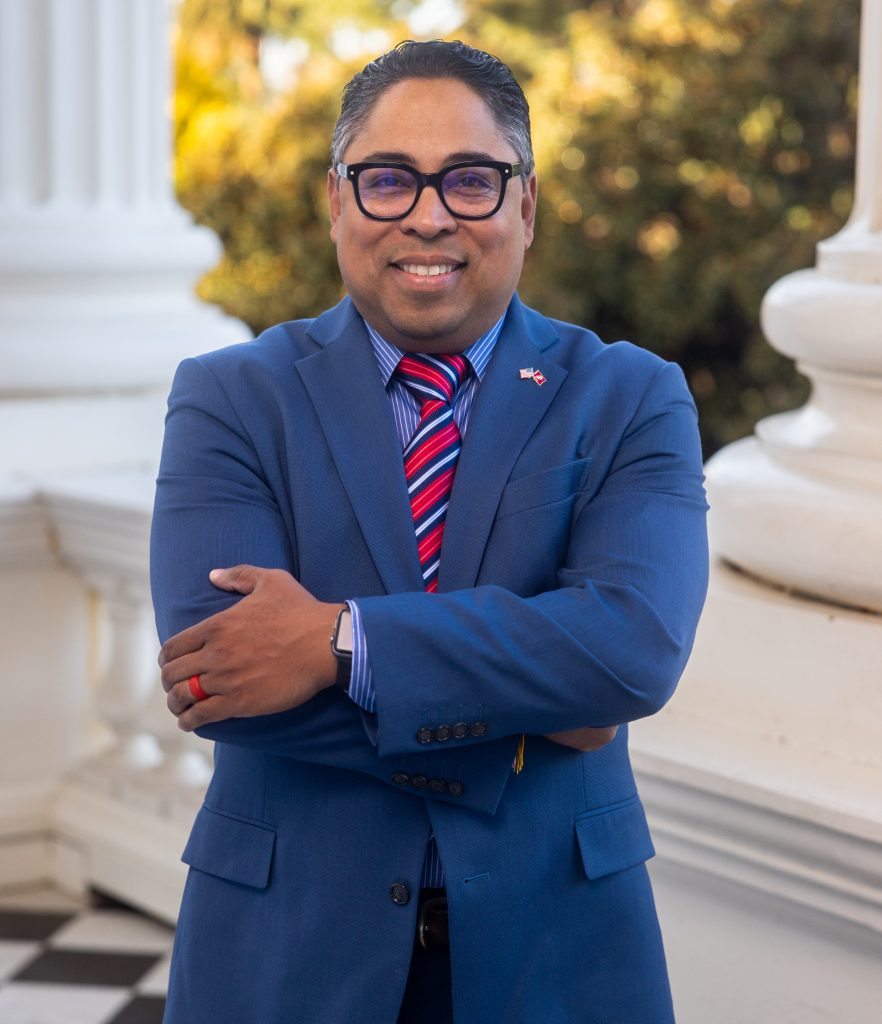
Rep. Jeff Gonzalez
Sponsored bills
Existing law creates within the Department of Corrections and Rehabilitation, under the Undersecretary for Operations, the Division of Adult Institutions, among others, and requires each division to be headed by a director, who is appointed by the Governor, as specified. Existing law also requires the Governor to appoint 4 subordinate officers to the division, as specified. Existing law requires each subordinate officer appointed to oversee an identified category of adult institutions, one of which oversees female offender facilities. This bill would instead require the Governor to appoint 3 subordinate officers, as specified, who would oversee an identified category of male adult institutions, and one subordinate officer, as specified, who would oversee female adult institutions. The bill would create within the department, and under the Undersecretary for Operations, the Division of Female Programs and Services. The bill would require the director of this division to be responsible solely for female adult institutions and community facilities housing female offenders. The bill would require the director to report to the undersecretary and to have a minimum of 5 years of experience serving a female correctional population in a custody setting. The bill would also require this new division to manage and provide oversight of adult female programs, including prisons, conservation camps, and parole and community programs and to develop gender-responsive, trauma-informed, culturally sensitive approaches to program and policy development. Existing law requires the department to create a Female Offender Reform Master Plan and present it to the Legislature by a specified date. Existing law requires the department to, among other things, create policies and operational practices that are designed to ensure a safe and productive institutional environment for female offenders. This bill would require the department to provide a report to the Legislature on the implementation of the plan, and update statistics contained in the plan, by March 1, 2027, and every 3 years thereafter. The bill would require the department to maintain the plan, including subsequent updates and reports, in consultation with the commission and others, as specified. The bill would also require the department to post the plan, any reports, and any updates to the plan to the department's internet website. This bill would require the department to establish the Gender Responsive Strategies Commission (GRSC) to develop active partnerships and to support successful implementation of gender responsive practices and rehabilitation programs for incarcerated individuals. The bill would require the GRSC to be composed of 19 representatives, as specified, and would require the department, by June 1, 2027, and annually thereafter, to provide a written report to the Legislature on appointments to the GRSC and the department's response and progress toward implementing the GRSC's recommendations. Existing law also requires the department to contract with nationally recognized gender-responsive experts in prison operational practices, staffing, classification, substance abuse, trauma treatment services, mental health services, transitional services, and community corrections to, among other things, conduct a staffing analysis of all current job classifications assigned to each prison that houses only females, as specified, and develop programs and training for department staff in correctional facilities. This bill would require the department, through this contract, no later than March 1, 2027, and every 3 years thereafter, to prepare and submit to the Legislature an updated staffing analysis and would require a comprehensive review of the office's policies and practices and other aspects of women-centered corrections developed to enhance safety and rehabilitative efforts, as specified. The bill would also require the training program to include training at the academy and, for those working in a female prison, 40 hours of initial training with a curriculum specifically focused on working with the population within female institutions and an 8-hour annual training thereafter. Existing law requires the secretary of the department to expand the existing prison ombudsperson program to ensure the comprehensive deployment of ombudspersons throughout the state prison system with specific focus on the maximum security institutions. This bill would instead require the Undersecretary for Operations to perform this duty and would require the undersecretary to appoint an ombudsperson solely assigned to adult female institutions.
Existing law, the California Emergency Services Act, creates, within the office of the Governor, the Office of Emergency Services (Cal OES) under the supervision of the Director of Emergency Services. Under existing law, Cal OES is responsible for the state's emergency and disaster response services for natural, technological, or man-made disasters and emergencies, including responsibility for activities necessary to prevent, respond to, recover from, and mitigate the effects of emergencies and disasters to people and property, as provided. Existing law vests the Public Utilities Commission (PUC) with regulatory authority over public utilities, including telephone corporations. Existing law requires local public agencies to establish a "9-1-1" emergency telephone number, as specified. Existing law also authorizes a local public agency to establish a nonemergency "3-1-1" telephone system. Under existing federal law, the Federal Communications Commission (FCC) has designated "2-1-1" to be the national abbreviated dialing code to provide access to nonemergency community information and referral services. Pursuant to authority delegated by the FCC to state regulatory bodies and its existing statutory authority, the PUC has established procedures for implementing 2-1-1 dialing in California. This bill would create in the State Treasury the 2-1-1 Fund and, upon appropriation by the Legislature, would require Cal OES to allocate moneys appropriated from the fund to the California 211 Providers Network to be used for, among other things, enhancing critical 2-1-1 system capacity and service quality through core operating support, providing equitable access to 2-1-1 dialing and services, publishing a statewide 2-1-1 community needs data dashboard for use by state agencies, and providing annual reports to Cal OES, as specified. The bill would authorize Cal OES, upon appropriation by the Legislature, to recover its reasonable administrative costs to administer the 2-1-1 Fund, as specified.
Existing law generally designates the State Air Resources Board as the state agency with the primary responsibility for the control of vehicular air pollution, and air pollution control districts and air quality management districts with the primary responsibility for the control of air pollution from all sources other than vehicular sources. Existing law requires the state board to inventory sources of air pollution within the air basins of the state, determine the kinds and quantity of air pollutants, and monitor air pollutants in cooperation with districts and other agencies. This bill would require the state board to expand its incident air monitoring program, subject to an appropriation by the Legislature for those purposes, to provide support for a regional network of air quality incident response centers, including at least one air quality incident response and evaluation center located at the South Coast Air Quality Management District, in order to facilitate emergency air monitoring response at the local and regional level. The bill would require each air quality incident response center to be operated by the state board or an air district and would require the state board and each district that operates an air quality incident response center to coordinate to provide emergency air monitoring response for disasters or other crises impacting air quality and public health in the state. The bill would provide that funding made available by the Legislature for purposes of these provisions may be used for various purposes, including program funding to plan, create, equip, and maintain air quality incident response centers. To the extent that the bill would expand the duties of an air district, the bill would impose a state-mandated local program. The California Constitution requires the state to reimburse local agencies and school districts for certain costs mandated by the state. Statutory provisions establish procedures for making that reimbursement. This bill would provide that, if the Commission on State Mandates determines that the bill contains costs mandated by the state, reimbursement for those costs shall be made pursuant to the statutory provisions noted above.
Existing law generally provides for the regulation of law enforcement agencies and requires specified law enforcement agencies to maintain policies on, among other things, use of force, hate crimes, and gun violence restraining orders. Existing law requires the Commission on Peace Officer Standards and Training to establish and keep updated a field training officer course relating to competencies of the field training program and police training program that addresses how to interact with persons with certain conditions. This bill would make it unlawful for a law enforcement officer to deny, delay, obstruct, or fail to facilitate access to medical evaluation or treatment for an individual under law enforcement control, but who is not in the custody of, or detained by, the Department of Corrections and Rehabilitation, if it is safe and reasonable to provide access to treatment and a medical professional has been requested or is present and is willing to render care to the individual. If access to medical evaluation or treatment is denied or delayed when a medical professional is present and is willing to assist, the bill would require law enforcement to document the basis of the denial within 72 hours of the incident, as specified. The bill would authorize administrative discipline, including suspension or termination, against a law enforcement officer who violates those provisions. By creating a new crime and by increasing the duties on local law enforcement relating to reporting, the bill would impose a state-mandated local program. The California Constitution requires the state to reimburse local agencies and school districts for certain costs mandated by the state. Statutory provisions establish procedures for making that reimbursement. This bill would provide that with regard to certain mandates no reimbursement is required by this act for a specified reason. With regard to any other mandates, this bill would provide that, if the Commission on State Mandates determines that the bill contains costs so mandated by the state, reimbursement for those costs shall be made pursuant to the statutory provisions noted above.
Existing law establishes the California Career Technical Education Incentive Grant Program, administered by the State Department of Education, with the purpose of encouraging, maintaining, and strengthening the delivery of high-quality career technical education programs. Existing law provides, for the 2021–22 fiscal year and each fiscal year thereafter, that $300,000,000 shall be available to the department, upon appropriation by the Legislature, for the program. Existing law requires an applicant to demonstrate a proportional dollar-for-dollar match and sets that amount for the 2021–22 fiscal year, and each fiscal year thereafter, at $2 for every $1 received from the program. Existing law prohibits an applicant from being awarded an amount higher than the amount that the allocation formula determines them to be eligible to receive under the program. Existing law requires the Superintendent of Public Instruction, in administering the program, to perform specified duties, including, among other duties, to (1) determine, in collaboration with the executive director of the State Board of Education, and make public on a preliminary basis at least 30 days before a regularly scheduled meeting of the state board, the allocation formula, (2) distribute funding on a multiyear schedule, (3) require grant recipients to submit program reports, (4) manage the grant process, and (5) promote the success of K–12 career technical education programs, as provided. This bill would require the department, instead of the Superintendent, to perform the above-described duties. The bill would, for purposes of allocations commencing no later than the 2027–28 fiscal year and pursuant to the above-described requirements, also require the department to determine, in consultation with the executive director of the state board, a revised allocation formula that ensures that all funds appropriated for the program in any given fiscal year are fully allocated to program applicants in that fiscal year, as provided.
The Planning and Zoning Law requires each county and city to adopt a comprehensive, long-term general plan for the physical development of the county or city, and of any land outside its boundaries that bears relation to its planning. Existing law authorizes the legislative body of a county or city to adopt ordinances that, among other things, regulate the use of buildings, structures, and land as between industry, business, residences, open space, and other purposes, as provided. For these purposes, existing law authorizes the legislative body to divide a county or city into zones, but requires that regulations adopted be uniform for each class or kind of building or use of land throughout each zone. The California Environmental Quality Act (CEQA) requires a lead agency, as defined, to prepare an environmental impact report on a project that it proposes to carry out or approve that may have a significant effect on the environment or to adopt a negative declaration if it finds that the project will not have that effect. This bill, the Public Lands Protection Act, would, upon transfer to any private or nonfederal entity of a parcel of land located within the state that is owned by the United States government on or after January 1, 2025, and that has been designated in an adopted general plan or zoning ordinance as open space, public land, resource conservation, or an equivalent conservation-oriented designation, immediately subject that parcel to the zoning designation and associated state and local restrictions. The bill would also, upon transfer of a parcel of land located within the state that is owned by the United States government on or after January 1, 2025, and that has not been designated in an adopted general plan or zoning ordinance at the time of transfer to any private or nonfederal entity, automatically subject that parcel to the most restrictive conservation-oriented zoning designation currently applied in the jurisdiction, by operation of law. The bill would prohibit a parcel of land governed by these provisions from being rezoned, subdivided, or granted any development entitlement that is inconsistent with a conservation-oriented zoning designation, unless certain requirements are satisfied, including that a full environmental impact report is completed in accordance with CEQA. Notwithstanding these provisions, the bill would require electric infrastructure and clean energy facilities necessary to achieve California's climate and decarbonization goals to be deemed permitted uses in a conservation-oriented zoning designation if certain conditions are met. The bill would also exempt certain other parcels from these provisions. This bill would include findings that changes proposed by this bill address a matter of statewide concern rather than a municipal affair and, therefore, apply to all cities, including charter cities. This bill would make these provisions severable. This bill would declare that it is to take effect immediately as an urgency statute.
Existing law imposes taxes upon income and real property, and taxes upon certain transactions and excise taxes. The Fee Collection Procedures Law provides procedures for the collection of certain fees and surcharges and is administered by the California Department of Tax and Fee Administration (CDTFA) . Under existing law, a violation of the Fee Collection Procedures Law is a crime. This bill would, beginning July 1, 2028, establish the Private Detention Facility Tax Law, which would impose an annual tax on each private detention facility operator, as defined, equal to 25% of the operator's gross income, as defined, for the prior fiscal year, as defined. The bill would establish the Due Process for All Fund in the State Treasury, except as provided, and would require all revenues collected, less refunds and reimbursement to the CDTFA, be deposited into the fund. In the event that Assembly Bill 2465 is enacted, the bill would instead require all revenues be deposited into the Due Process for All Fund as established by that bill. The bill would direct moneys in the fund, upon appropriation by the Legislature, be used for immigration-related services. The bill would require the CDTFA to administer and collect the tax pursuant to the Fee Collection Procedures Law. By expanding the application of the crimes associated with the Fee Collection Procedures Law, the bill would impose a state-mandated local program. This bill would include a change in state statute that would result in a taxpayer paying a higher tax within the meaning of Section 3 of Article XIIIA of the California Constitution, and thus would require for passage the approval of 23 of the membership of each house of the Legislature. The California Constitution requires the state to reimburse local agencies and school districts for certain costs mandated by the state. Statutory provisions establish procedures for making that reimbursement. This bill would provide that no reimbursement is required by this act for a specified reason. This bill would take effect immediately as a tax levy.
Existing law, the Knox-Keene Health Care Service Plan Act of 1975, provides for the licensure and regulation of health care service plans by the Department of Managed Health Care and makes a willful violation of the act a crime. Existing law also provides for the regulation of health insurers by the Department of Insurance. Existing law requires an individual or small group health care service plan contract or health insurance policy to include, at a minimum, coverage for essential health benefits, as specified. Commencing January 1, 2027, if the United States Department of Health and Human Services approves a new essential health benefits benchmark plan for the state, existing law requires essential health benefits to include an annual hearing exam and one hearing aid per ear every three years. This bill, the Let California Kids Hear Act, would require a large group health care service plan contract or health insurance policy issued, amended, or renewed on or after January 1, 2028, to include coverage for hearing aids, as defined, and related services for enrollees and insureds under 21 years of age, if medically necessary. The bill would authorize a large group health care service plan contract or health insurance policy to limit the dollar coverage for each individual hearing aid device to $3,000, as specified. Because a willful violation of these requirements by a health care service plan would be a crime, the bill would impose a state-mandated local program. The California Constitution requires the state to reimburse local agencies and school districts for certain costs mandated by the state. Statutory provisions establish procedures for making that reimbursement. This bill would provide that no reimbursement is required by this act for a specified reason.
Existing law authorizes an off-highway motor vehicle that has been issued a plate or device to be operated or driven upon a highway under certain circumstances. Existing law authorizes various public entities, and the Director of Parks and Recreation, to designate a highway, or portion thereof, for the combined use of regular vehicular traffic and off-highway motor vehicles if certain requirements are met, including a prohibition on a designation of greater than 3 miles. Existing law, until January 1, 2028, authorizes the City of Needles to operate a pilot project that exempts specified combined-use highways in the City of Needles from this prohibition to link together existing trails and trailheads on federal Bureau of Land Management or United States Forest Service lands and to link off-highway motor vehicle recreational-use areas with necessary service and lodging facilities in order to provide a unified linkage of trail systems for off-highway motor vehicles, as prescribed. Existing law requires the City of Needles to prepare and submit to the Legislature reports evaluating the effectiveness and environmental impacts of the pilot project, as specified. This bill would extend the operation of the above-described pilot program to January 1, 2033, and would make other technical changes. This bill would make legislative findings and declarations as to the necessity of a special statute for the City of Needles.