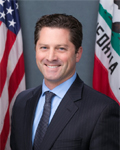
Photo of Jordan Cunningham
R California Assembly · District 35

Asm. Jordan Cunningham

Compare
Total votes
13,035
all sessions
Attendance
91%
921 missed
Lower than 86% of chamber peers
With party
95%
of cast votes
Among the lowest in the chamber
Bipartisan score
3%
crosses aisle rarely
Higher than 98% of chamber peers
Sponsored
995
bills & resolutions
Near the chamber average
Committees
0
assignments
995 bills and resolutions

Sponsored bills

Total
995
Primary
116
Co-sponsor
879
This page
995
matching current filters
Co-sponsor ACR 182
Passed · California Assembly · Co-sponsor
California Down Syndrome Awareness Week and Day.

This measure would proclaim March 15, 2020, to March 22, 2020, as California Down Syndrome Awareness Week and March 21, 2020, as California Down Syndrome Day, and would encourage all Californians to support and participate in related activities.

Passed May 26, 2020 1 co-sponsor
Co-sponsor SB 1071
In committee · California Senate · Co-sponsor
Personal income taxes: exclusion: uniformed services: retirement pay.

The Personal Income Tax Law imposes a tax on individual taxpayers measured by the taxpayer's taxable income for the taxable year, but excludes certain items of income from the computation of tax, including an exclusion for combat-related special compensation. This bill, for taxable years beginning on or after January 1, 2021, and before January 1, 2031, would exclude from gross income specified amounts of retirement pay received by a taxpayer from the federal government for service performed in the uniformed services, as defined, during the taxable year. Existing law requires any bill authorizing a new tax expenditure to contain, among other things, specific goals, purposes, and objectives that the tax expenditure with achieve, detailed performance indicators, and data collection requirements. The bill also would include additional information required for any bill authorizing a new income tax credit. This bill would take effect immediately as a tax levy.

In committee May 12, 2020 1 co-sponsor
Primary AB 3360
In committee · California Assembly · Lead sponsor
Sales and use taxes: exemption: lease of solar electric generation systems: Greenhouse Gas Reduction Fund: transfer.

Existing sales and use tax laws impose taxes on retailers measured by the gross receipts from the sale of tangible personal property sold at retail in this state, or on the storage, use, or other consumption in this state of tangible personal property purchased from a retailer for storage, use, or other consumption in this state. The Sales and Use Tax Law defines a "sale" and "purchase" to include the lease of tangible personal property for consideration, except for tangible personal property leased in substantially the same form as acquired by the lessor, as to which the lessor has paid sales tax reimbursement or has paid use tax measured by the purchase price of the property. Under existing law, in the case of a lease that is a "sale" or "purchase," the granting of possession by the lessor to the lessee is a continuing sale in this state by the lessor, and the possession of the property by a lessee is a continuing purchase for use in this state by the lessee, as respects any period of time the leased property is situated in this state. Existing law generally requires, if tax has not been paid based on the purchase price, use tax to apply to that lease that is a "sale" or "purchase," measured by the rentals payable. The Sales and Use Tax Law also provides various exemptions from those taxes, including a partial exemption from those taxes, on and after January 1, 2018, and before July 1, 2030, from the sale of, and the storage, use, or other consumption of, qualified tangible personal property purchased for use by a qualified person, as defined, to be used primarily in the generation or production, as defined, or storage and distribution, as defined, of electric power. Existing law provides that the partial exemption also applies to leases of qualified tangible personal property classified as "continuing sales" and "continuing purchases," thereby exempting from tax a lease that is a "sale" or "purchase," measured by the rentals payable, provided the lessee is a qualified person and the tangible personal property is used in specified activity, including in the generation or production, or storage and distribution, of electric power. This bill, on and after January 1, 2021, and before July 1, 2030, would provide that this partial exemption also applies to the rentals payable pursuant to the leases of tangible personal property provided the lessee is a resident leasing a solar electric generation system that meets or exceeds the compliance requirements of equipment used for purposes of complying with specified state buildings standards and the tangible personal property is used in specified activities. The Bradley-Burns Uniform Local Sales and Use Tax Law authorizes counties and cities to impose local sales and use taxes in conformity with the Sales and Use Tax Law, and existing laws authorize districts, as specified, to impose transactions and use taxes in accordance with the Transactions and Use Tax Law, which generally conforms to the Sales and Use Tax Law. Exemptions from state sales and use taxes are automatically incorporated into the local tax laws. This bill would specify that this exemption does not apply to local sales and use taxes or transactions and use taxes. Existing law requires all moneys, except for fines and penalties, collected by the State Air Resources Board from the auction or sale of allowances for greenhouse gas emissions as part of a market-based compliance mechanism established pursuant to the California Global Warming Solutions Act of 2006 to be deposited in the Greenhouse Gas Reduction Fund and to be available upon appropriation by the Legislature. Existing law requires, no later than each May 1 following calendar years 2018 to 2030, inclusive, the California Department of Tax and Fee Administration to provide to the Joint Legislative Budget Committee and to the Department of Finance a report of the revenue value of the total dollar amount of specified sales and use tax exemptions, including the above-described exemption, taken for the immediately preceding calendar year. Existing law requires an amount equal to the revenue value of the total dollar amount, as reported by the department, with the concurrence of the Department of Finance, to be transferred from the Greenhouse Gas Reduction Fund to the General Fund no later than each June 30 next following the calendar year, as specified. This bill would include the revenue value of the total dollar amount of exemptions provided by this bill taken for the immediately preceding calendar year in the report by the department and in the amount to be transferred from the Greenhouse Gas Reduction Fund to the General Fund. Existing law requires any bill authorizing a new tax expenditure under the Sales and Use Taw Law to contain, among other things, specific goals, purposes, and objectives that the tax expenditure will achieve, detailed performance indicators, and data collection requirements. This bill also would include additional information required for any bill authorizing a new tax expenditure.


In committee May 6, 2020 0 co-sponsors
Primary AB 2085
In committee · California Assembly · Lead sponsor
Tied-house restrictions: donations of alcoholic beverages: returns.

The Alcoholic Beverage Control Act provides that nothing in that act prohibits specified licensees from giving or selling beer, wine, or distilled spirits, as applicable, to certain nonprofit organizations, as specified, at prices other than those contained in schedules filed with the Department of Alcoholic Beverage Control. This bill would permit a licensee authorized to give or sell alcoholic beverages under this provision to accept the return of an alcoholic beverage from the nonprofit corporation, organization, or association in connection with an event conducted under a seasonal or temporary license issued by the department if, at the termination of the period of the license, the nonprofit corporation, organization, or association has alcoholic beverages remaining.

In committee May 5, 2020 0 co-sponsors
Co-sponsor SJR 11
Passed · California Senate · Co-sponsor
Relative to the Spent Fuel Prioritization Act of 2019.

This measure would urge the United States Department of Energy to implement the prompt and safe relocation of spent nuclear fuel from specified nuclear facilities in the state to a licensed and regulated interim consolidated storage facility. The measure would also urge the department to determine and finalize a permanent location for spent nuclear fuel from California nuclear facilities.

Passed Mar 16, 2020 1 co-sponsor
Co-sponsor AB 2318
In committee · California Assembly · Co-sponsor
Human trafficking.

Existing law requires specified businesses and establishments, including hotels, motels, and bed and breakfast inns, to post a notice developed by the Department of Justice in clear view of the public and employees that contains specified information on access to help and services for victims of slavery and human trafficking. Existing law makes a violation of this requirement punishable by a civil penalty. This bill would also require short-term rentals, as defined, to post that notice.

In committee Mar 16, 2020 1 co-sponsor
Primary AB 2187
In committee · California Assembly · Lead sponsor
Pupil instruction: financial literacy.

Existing law requires each pupil completing grade 12 to satisfy certain requirements as a condition of receiving a diploma of graduation from high school. These requirements include the completion of designated coursework in grades 9 to 12, inclusive, including, among others, a one-semester course in economics. Existing law authorizes a governing board of a school district to adopt other coursework requirements. This bill would authorize a school district or charter school to incorporate a financial literacy program into an economics course offered by the local educational agency, and would authorize the curriculum for the financial literacy program to include specified topics. The bill would authorize a local educational agency that chooses to establish the financial literacy program to collaborate with a financial institution, as defined, at no cost to the local educational agency.

In committee Mar 16, 2020 0 co-sponsors
Primary AB 3212
In committee · California Assembly · Lead sponsor
The Parent's Accountability and Child Protection Act.

Existing federal law requires an operator of an internet website or online service directed to a child, as defined, or an operator of an internet website or online service that has actual knowledge that it is collecting personal information from a child, to provide notice of what information is being collected and how that information is being used, and to give the parents of the child the opportunity to refuse to permit the operator's further collection of information from the child. Existing law prohibits an operator of an internet website, online service, online application, or mobile application, as specified, from marketing or advertising specified types of products or services to a minor. Existing law, the Parent's Accountability and Child Protection Act, requires a person or business that conducts business in California and that seeks to sell specified products or services to take reasonable steps, as specified, to ensure that the purchaser is of legal age at the time of purchase or delivery, including, but not limited to, verifying the age of the purchaser. Existing law prohibits a business from selling the personal information of consumers if the business has actual knowledge that the consumer is less than 16 years of age, unless the consumer, in the case of consumers between 13 and 16 years of age, or the consumer's parent or guardian, in the case of consumers who are less than 13 years of age, has affirmatively authorized the sale of the consumer's personal information. Existing law specifies that this right may be referred to as the "right to opt-in." This bill would prohibit a person or business that conducts business in California, that operates a social media internet website or application that requires opt-in consent before selling a minor's personal information, to obtain consent to sell the minor's personal information in a manner that is separate from the social media internet website's or application's general terms and conditions.

In committee Mar 9, 2020 0 co-sponsors
Showing 451 to 460 of 995 bills
Previous 1 … 45 46 47 … 100 Next