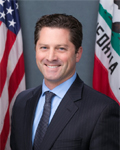
Photo of Jordan Cunningham
R California Assembly · District 35

Asm. Jordan Cunningham

Compare
Total votes
13,035
all sessions
Attendance
91%
921 missed
Lower than 86% of chamber peers
With party
95%
of cast votes
Among the lowest in the chamber
Bipartisan score
3%
crosses aisle rarely
Higher than 98% of chamber peers
Sponsored
995
bills & resolutions
Near the chamber average
Committees
0
assignments
995 bills and resolutions

Sponsored bills

Total
995
Primary
116
Co-sponsor
879
This page
995
matching current filters
Primary AB 2008
Passed · California Assembly · Lead sponsor
Contracts: parental consent.

Existing law sets forth the requirements for establishing the consent of the parties to the formation of a contract. This bill would, when consent from a parent or guardian is required by law, prohibit obtaining the consent through the minor.

Passed Jul 7, 2020 0 co-sponsors
Co-sponsor AB 1248
Passed · California Assembly · Co-sponsor
Institutional purchasers: purchase of California-grown agricultural products.

Under existing law, price, fitness, and quality being equal, any body, officer, or other person charged with the purchase, or permitted or authorized to purchase supplies for the use of the state, or of any of its institutions or offices, or for the use of any county or city, is required to always prefer supplies that are manufactured or produced in the state, and is required to next prefer supplies partially manufactured or produced in the state. Existing law requires all California state-owned or state-run institutions, except public universities and colleges and school districts, to purchase an agricultural product grown in California when the bid or price of the California-grown agricultural product does not exceed by more than 5% the lowest bid or price for an agricultural product produced outside the state and the quality of the California-grown agricultural product is comparable. Existing law also requires the institutions, when they solicit or intend to accept a bid or price for agricultural products grown outside the state, to accept the bid or price from a vendor that packs or processes these agricultural products in the state before accepting a bid or price from a vendor that packs or processes these agricultural products outside of the state when specified conditions are met, including that the bid or price of the agricultural product grown outside the state and packed or processed in the state does not exceed by more than 5% the lowest bid or price for the agricultural product packed or processed outside the state. Existing law requires a school district that solicits bids for the purchase of an agricultural product to accept a bid or price for that agricultural product when it is grown in California before accepting a bid or price for an agricultural product that is grown outside the state when the bid or price of the California-grown agricultural product does not exceed the lowest bid or price for an agricultural product produced outside the state and the quality of the California-grown agricultural product is comparable. Under existing law, these provisions only apply to a contract to purchase agricultural products for a value that is less than the value of the threshold for supplies and services for which California has obligated itself under the Agreement on Government Procurement of the World Trade Organization. This bill would instead require all California state-owned or state-run institutions, including public universities and colleges and school districts, that purchase agricultural products to only purchase an agricultural product grown in California unless the agricultural product is not available from an in-state source or is not grown in the state. The bill would eliminate the above-described preference for in-state vendors. The bill would eliminate the provision that limits the application of these preferences to contracts to purchase agricultural products for a value that is less than the value of the above-described threshold. The bill would exempt agricultural products provided to a California state-owned or state-run institution by the United States Department of Agriculture through the Foods in Schools program from these preferences. The bill would define "agricultural product" for purposes of these provisions as fruits, tree nuts, peanuts, vegetables, melons, potatoes, meat from livestock, eggs, or dairy products. The bill would require the California State Auditor to investigate violations of these provisions. By creating new duties for school districts and community college districts, this bill would impose a state-mandated local program. The California Constitution requires the state to reimburse local agencies and school districts for certain costs mandated by the state. Statutory provisions establish procedures for making that reimbursement. This bill would provide that, if the Commission on State Mandates determines that the bill contains costs mandated by the state, reimbursement for those costs shall be made pursuant to the statutory provisions noted above.

Passed Jul 2, 2020 1 co-sponsor
Primary AB 1982
Passed · California Assembly · Lead sponsor
Teacher credentialing: basic skills proficiency test: exemption.

Existing law requires the Commission on Teacher Credentialing, among other duties, to establish standards for the issuance and renewal of credentials, certificates, and permits. Existing law prohibits the commission from issuing initially a credential, permit, certificate, or renewal of an emergency credential to a person to serve in the public schools unless the person has demonstrated proficiency in basic reading, writing, and mathematics skills in the English language by passing the state basic skills proficiency test. Existing law exempts specified applicants from this basic skills proficiency test requirement, including, among others, out-of-state teachers who have passed a basic skills exam in another state, eminence credential applicants who have achieved eminence in a field of endeavor taught or service practiced in the public schools of California, and applicants who achieve scores on the writing, reading, and mathematics sections of the College Board SAT Reasoning Test, the enhanced ACT English and mathematics tests, or the California State University Early Assessment Program that are sufficient to waive the English placement test and the entry level mathematics examination administered by the California State University. This bill would, until December 31, 2023, exempt from the basic skills proficiency test requirement an applicant who earns at least a letter grade of B in qualifying coursework, as defined, determined by a credential preparation program or the commission, as specified, to sufficiently serve as an alternative indicator of proficiency in basic reading, writing, and mathematics skills in the English language. The bill would also, until December 31, 2023, exempt an applicant who a credential preparation program determines has demonstrated proficiency in the basic skills through a combination of qualifying coursework, passage of components of the state basic skills proficiency test, and scores on the writing, reading, and mathematics sections of the College Board SAT Reasoning Test, the enhanced ACT English and mathematics tests, or the California State University Early Assessment Program that are sufficient to waive the English placement test and the entry level mathematics examination administered by the California State University.


Passed Jul 1, 2020 0 co-sponsors
Primary AB 2410
Passed · California Assembly · Lead sponsor
Athletic trainers.

Existing law provides for the regulation of various professions and vocations, including those of an athlete agent. This bill would make it unlawful for any person to hold themselves out as an athletic trainer, use the title of, among others, athletic trainer, or to use specified terms to imply or suggest that the person is an athletic trainer, unless that person fulfills certain requirements, including, but not limited to, being certified by the Board of Certification, Inc., or its predecessors or successors, or by another certifying entity with comparable standards for certifying athletic trainers. The bill would make it an unfair business practice to use the title "athletic trainer," "certified athletic trainer," or other specified terms that imply or suggest that the person is an athletic trainer if the person does not meet the requirements. This bill, notwithstanding these provisions, would authorize a person who has worked as an athletic trainer in California for a period of 20 consecutive years prior to January 1, 2021, and who is not otherwise eligible to use the title "athletic trainer," to use that title. This bill would declare that it is to take effect immediately as an urgency statute.

Passed Jul 1, 2020 0 co-sponsors
Co-sponsor ACR 159
Signed into law · California Assembly · Co-sponsor
Relative to California Fitness Week.

This measure would declare the week of February 17 to February 21, 2020, inclusive, as California Fitness Week, and would encourage Californians to enrich their lives through proper nutrition and exercise.

Signed into law Jun 17, 2020 1 co-sponsor
Co-sponsor ACR 155
Signed into law · California Assembly · Co-sponsor
Relative to Black History Month.

This measure would recognize February 2020 as Black History Month, urge all citizens to join in celebrating the accomplishments of African Americans during Black History Month, encourage the people of California to recognize the many talents of African Americans and the achievements and contributions they make to their communities to create equity and equality for education, economics, and social justice, and recognize the significance in protecting citizens' right to vote and remedying racial discrimination in voting.

Signed into law Jun 17, 2020 1 co-sponsor
Co-sponsor ACA 25
Passed · California Assembly · Co-sponsor
A resolution to propose to the people of the State of California an amendment to the Constitution of the State, by adding Section 21.5 to Article IV thereof, relating to the Legislature.

The California Constitution requires the Legislature to convene in regular session on specified dates and provides that a majority of the membership constitutes a quorum, although a lesser number may recess from day to day and compel the attendance of absent members. The California Constitution requires the proceedings of each house of the Legislature to be open and public and recognizes the right of the public to attend, record, and broadcast those proceedings. The California Constitution authorizes the Legislature to provide for the convening of the Legislature to meet the needs resulting from a war-caused or enemy-caused disaster in the state. This measure would permit Members to remotely attend and vote in a legislative proceeding, or to vote by proxy in a legislative proceeding if permitted by their house, during the pendency of a state of emergency declared by the Governor or the President of the United States, under specified conditions. The measure would provide, among other conditions, that a Member may remotely attend and vote, or vote by proxy as authorized, in a proceeding only if the state of emergency prevents the Member from safely attending the proceeding in person. The measure would also provide that a Member attending remotely would be included in the determination of a quorum. The measure would provide that if 15 or more of the Members of a house cannot attend a proceeding during a state of emergency because they are deceased, disabled, or missing, a quorum may be established by a majority of those Members able to attend. The measure would specify that the Legislature may provide by statute for temporarily filling the vacant offices of Members with pro tempore members in the event that 15 or more of the Members of a house are deceased, disabled, or missing during a state of emergency. The measure would require the Legislature by concurrent resolution, or each house by separate resolutions, 23 of the membership concurring, to adopt rules to implement this provision no later than the end of the biennial legislative session in which this measure takes effect, except as specified.

Passed Jun 15, 2020 1 co-sponsor
Co-sponsor AB 2554
In committee · California Assembly · Co-sponsor
Correctional personnel: peer support.

Existing law authorizes the state, a local or regional public fire agency, or a local or regional law enforcement agency to establish a peer support and crisis referral program to provide a network of peers available to aid fellow emergency services or law enforcement personnel on emotional or professional issues. Existing law authorizes emergency services or law enforcement personnel to refuse to disclose, and to prevent another from disclosing, a confidential communication between them and a peer support team member, crisis hotline staff member, or crisis referral service, except under limited circumstances, including in a criminal proceeding. Under existing law, a person providing peer support services, as specified, and the agency that employs that person are not liable for damages, except in an action for medical malpractice, relating to an act, error, or omission in performing peer support services, unless the act, error, or omission constitutes gross negligence or intentional misconduct. This bill would authorize the Department of Corrections and Rehabilitation to establish a peer support and crisis referral program until January 1, 2024. The bill would extend the above-described confidentiality protections to correctional personnel who participate in a peer support and crisis referral program and would extend the above-described liability protections to the department and correctional employees who are peer support team members. The bill would require the department to establish a peer support advisory committee to advise, assist, support, and advocate for the program, and to establish a selection panel to screen and process applications, interviews, and member selection for the committee.

In committee Jun 3, 2020 1 co-sponsor
Showing 441 to 450 of 995 bills
Previous 1 … 44 45 46 … 100 Next